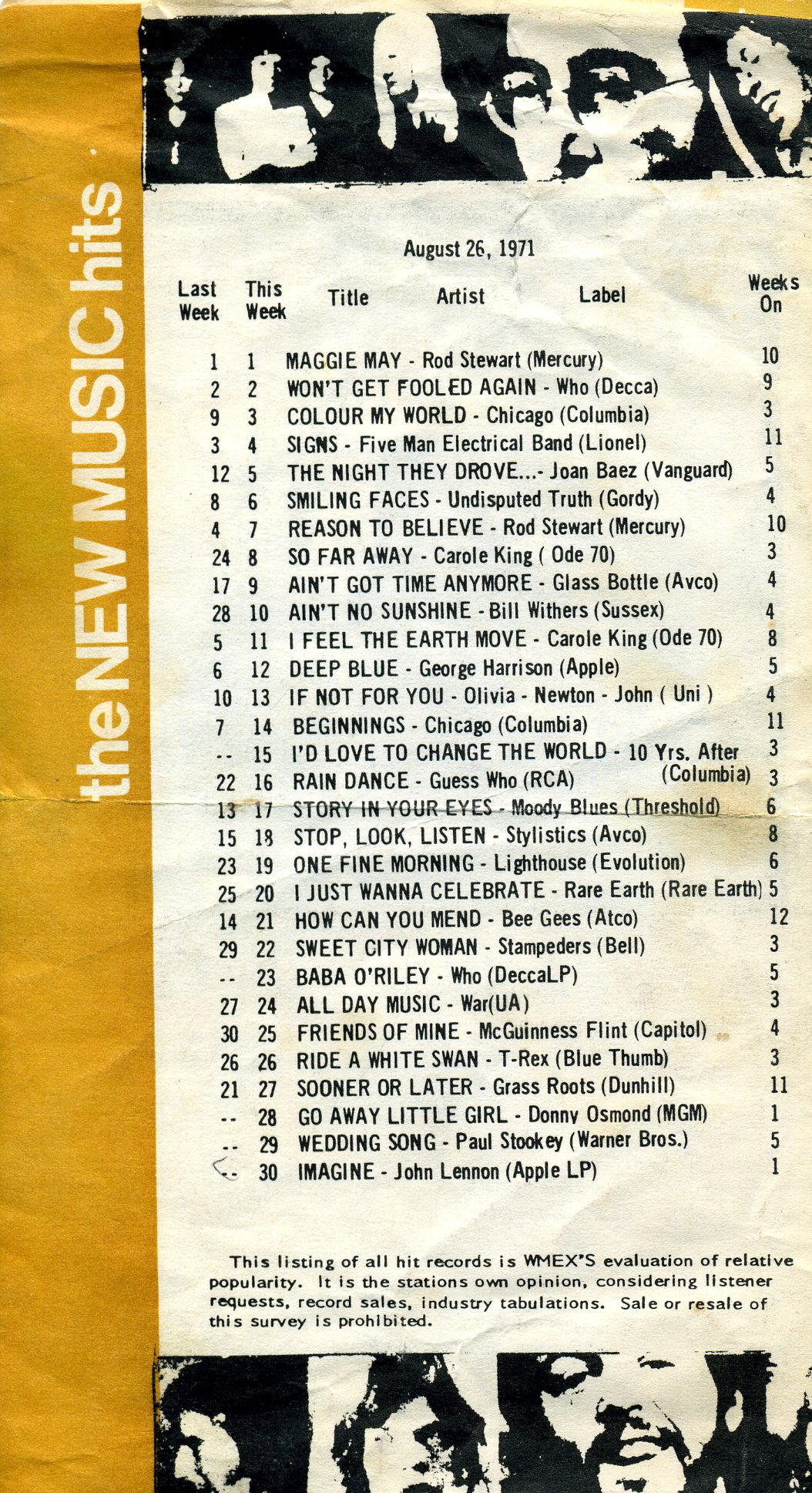
At 13 years old, you’re old enough to leave the house and mess about on your own, but not quite old enough for a real summer job once school vacation rolled around. Back in 1971, a paper route or mowing the odd lawn would be enough to keep you in cream sodas and 45s for the time being. It was the type of singles below that would infatuate us later baby boomers either on our record players or over the humid airwaves on stations like the old WMEX 1510 AM, whose playlists I once collected and managed never to lose. With the transistor radio pressed to the left ear with one hand, while the other flung copies of the old Boston Evening Globe at suburban ranch houses, here is how it went down 43 years ago today—a typically great countdown of the post-Woodstock, pre-disco age.
“Maggie May” Rod Stewart. Rod the Mod’s breakout solo hit dominated the local charts that whole summer, as did the album as a whole. Maybe us young’uns were in awe of a singer who would happen to know a seducing older woman who would actually “wreck the bed.” But by late August, the inevitable backlash set in, with some WMEX DJs grousing about its overexposure. But it was nothing like the backlash from his old rock fans when he dropped “Do You Think I’m Sexy” some seven years later. “Won’t Get Fooled Again” The Who. Another classic that hasn’t left the radio since its ’71 debut. But here you’d be listening to the lean-and-mean single version, which clocked in at 3:37, a full five minutes shorter than what was on Who’s Next. This edit, which blows by like a bullet train, pre-figures punk rock and was matched with a great B-side as well (“I Don’t Even Know Myself”). “Color My World” Chicago. With its drowsy six-note piano motif and Hallmark lyrics, this song was the inevitable slow dance choice at school cafeteria mixers. Awkward! It was also an early indicator that Chicago as a band would soon go from cool to clueless. “Signs” Five Man Electrical Band. The Sixties may have ended but that didn’t mean we had to stop getting up in the grill of The Man, as this Ottawa quintet so righteously proved. C’mon, all together, “If God were here he’d tell it to your face/Man, you’re some kind of sinner!” “The Night They Drove Old Dixie Down” Joan Baez. Like a surprise cavalry attack, Joan’s dilettante version of the Band’s masterful Civil War drama charged into the Top 5 before anyone could react in time. As Janet Maslin (then a Rolling Stone record reviewer) pointed out, the original Robbie Robertson lyrics were printed right inside her own album jacket, making inexcusable such gaffes as singing “so much cavalry” instead of “Stoneman’s cavalry” and declaring “there goes the Robert E. Lee” as if the narrator were watching a riverboat and not the legendary Confederate general in the flesh. “Smiling Faces Sometimes” Undisputed Truth. Blue-chip advice on dealing with frenemies from this R&B vocal trio from the Motor City. Hear them out; they’re “only trying to school ya.”
“Reason to Believe” Rod Stewart. Back to the Summer of Rod. His pensive take on the great Tim Hardin ballad was originally the A side but Maggie was not to “B” denied. “So Far Away” Carole King. It was also the Summer of Carole, who assured us that the age of the woman singer-songwriter had well and truly arrived with the blockbuster Tapestry album. “So Far Away” and “I Feel the Earth Move” (at #8 and #11) followed up “It’s Too Late” which had been #1 nationally for five weeks that spring. “Ain’t Got Time Anymore” Glass Bottle. One-hit wonders who harkened back to the AM pop style of the later 60s. “Ain’t No Sunshine” Bill Withers. Two “ain’t” songs in a row? What would your 7th grade English teacher think? Withers’ brooding acoustic-soul classic made the biggest leap up the chart this week. “Deep Blue” George Harrison. The flip side to the “Bangla Desh” single made it much higher in the survey, helped no doubt by WMEX’s quirky methodology.
“If Not for You” Olivia Newton-John. If not for this limp Dylan cover, the Top 30 would be a much better place. “Beginnings” Chicago. A damn sight better than “Color My World” though it was a bit odd that Columbia Records was going back to the first album for hits even though Chicago III was already in the stores. “I’d Love to Change the World” Ten Years After. The only hit single by Britain’s blues-rock titans, who had wowed the hippie hordes at Wodstock exactly two years earlier. “Rain Dance” Guess Who. Eccentric later hit by Burton Cummings and Co. and much appreciated by future hipster kids in our subdivision. “Story in Your Eyes” the Moody Blues. Gateway prog for the same group as above. “Stop, Look, Listen” Stylistics. The first of many elegant U.S. Top 40 hits for one of the premier Philly Soul groups. “One Fine Morning” Lighthouse. Kick-ass Canadian brass rock which also featured some blazing lead guitar, which you could hear in full if you caught it on an FM station, something we were catching wind of by then.
“I Just Wanna Celebrate” Rare Earth. The first successful white band to record for Motown (who named a label imprint after them) and this song, famous for its count-off and thunderous beat, had a refrain that made it popular in commercials and soundtracks ever since. “How Can You Mend a Broken Heart?” the Bee Gees. After three months on the survey, plenty of us were tired of hearing Robin Gibb’s tremulous rhetorical question, but it wasn’t going without a fight, barely getting pushed out of the top 20 this week. “Sweet City Woman” the Stampeders. Those Canadians keep right on coming. It’s Instant Summer once you hear that triple-time banjo strum, cowbell and lyrics filled with romantic anticipation—the biggest hit for the Calgary-based trio. “Baba O’Riley” the Who. If the ‘MEX staff wanted a great album track on the countdown then on it went, though I wondered how a song that was debuting at #23 could have been on the charts for five weeks. “All Day Music” War. The first post-Eric Burdon hit for the multi-ethnic Long Beach band, and one of several associated with the warmest of seasons.
“Friends of Mine” McGuiness Flint. These appealing and unassuming folk-rockers probably couldn’t get played nowadays unless they owned a radio station. For shame. “Ride a White Swan” T. Rex. If you listened to the New Music Authority on 1510AM you wouldn’t have to wait around for “Bang a Gong” to get hip to Marc Bolan and his elfin ways. Of course, the first of many HUGE hits for him in the U.K. “Sooner or Later” the Grass Roots. One of the latter-day smashes for these AM pop princes. I’m pretty sure Creedy had left the band by then. “Go Away Little Girl” Donny Osmond. You know, I always thought that this ditty should have had an answer song from the fairer sex. There would be a mid-song spoken word part where the girl would say “Why don’t you go away first, Donny, and we’ll call it even.” “Wedding Song” Paul Stookey. Wow, two clunkers in a row. I said it was a great Top 30, not a perfect one. “Imagine” John Lennon. This actually didn’t become a hit until the fall and an international anthem after that. But that didn’t stop the new Music guys, though the progressive AM business model would not hold and as we young teens grew up and it was quickly onto WBCN and other FM rock outlets, including college radio in the 80s and beyond.
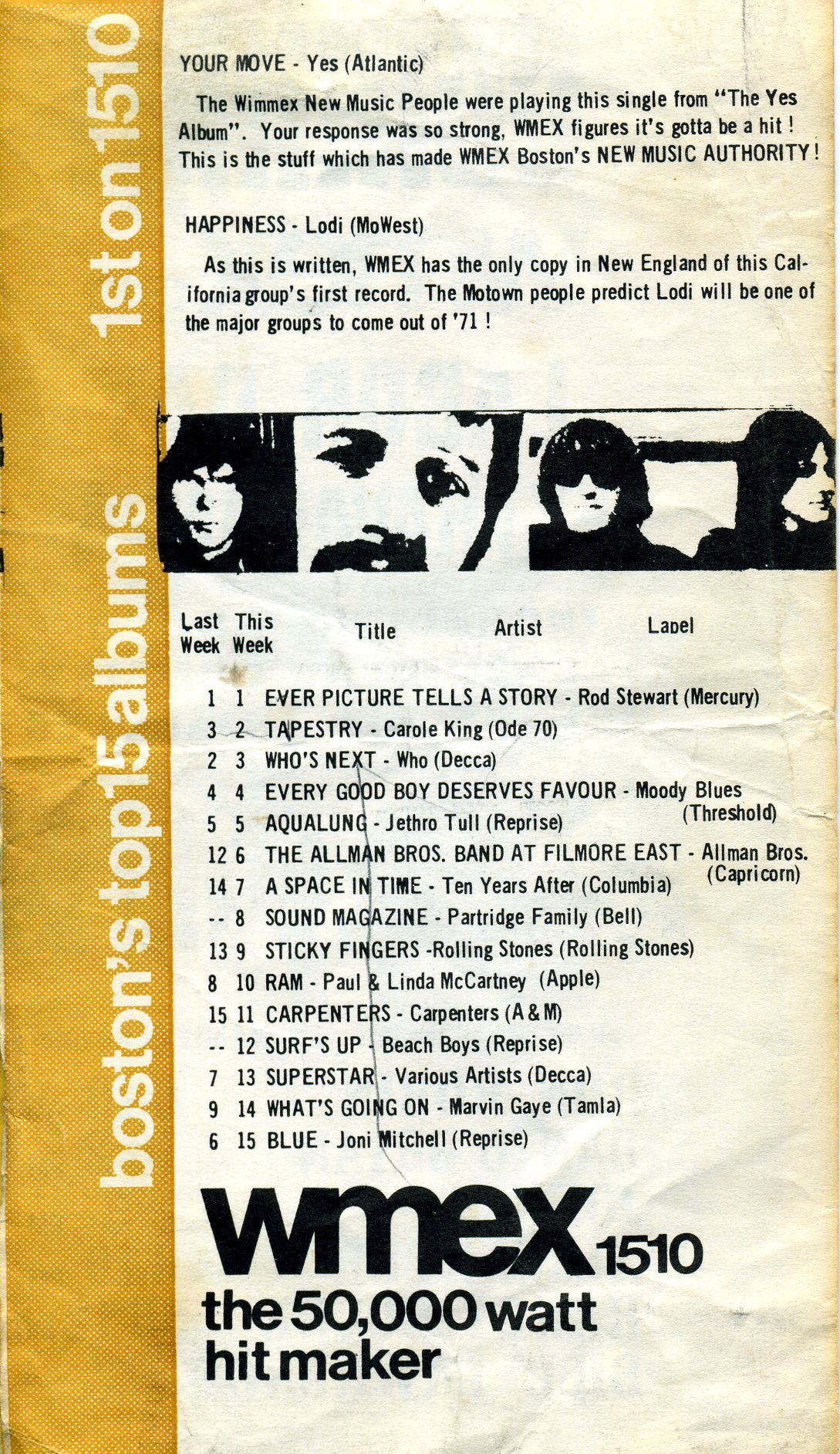
Well, I’m not sure what, if anything, happened to Lodi—though album-oriented groups like Yes were quickly migrated to the FM band. Speaking of albums, this top 15 list (with a few exceptions) is like a veritable Mt. Rushmore of classic rock LPs. But those aged 11 or under at the time get a pass if the first of these you owned was Sound Magazine.
 Reel and Rock