Month: March 2018

Documentary Spotlight: No Place for “Big Charity” in the age of none

Big Charity
Directed by Alex Glustrom–2015–63 minutes

The French Quarter may have survived the 2005 devastation brought on by Hurricane Katrina, but some of New Orleans’ poorer neighborhoods, like the Lower Ninth Ward, were not so lucky and never fully recovered. The greatest institutional loss for the city, especially for those sections of town, had to be the historic Mercy Hospital. Its last iteration was the handsome and hulking Art Deco behemoth that was located downtown just two blocks from the Superdome. The hospital’s forced closing after sustaining relatively minor damage during Katrina, and the larger social implications of the shutdown, is the story of this thoughtful and quietly indignant film.

A lot can be known about Charity Hospital simply by looking at its name. The 1940 building that now stands abandoned was preceded by several others, dating back to 1736. It was founded by a French shipbuilder who stipulated a beneficent institution for the poor in his will. It kept up that model straight into the early 21st century in the giant 1939 building raised by taxpayer money and operated by the Daughters of Charity in their distinctive cornettes. With its crazy-quilt egalitarian alliances and 2700 beds, Big Charity (as it was commonly known) was not only an invaluable local resource, but the safety net hospital for the whole state of Louisiana. The building featured inspirational phrases inscribed in the lobby (“Where the Unusual Occurs, Miracles Happen”) and idealistic New Deal friezes; even it’s layout, with two extensive projecting wings resembling arms in an embrace, seemed to suggest its ages-old benevolence.

But the ad hoc coalition of community goodwill, government largesse and the nunnery was bound to be strained over a long period of shifting economics and the gradual gentrification of health care. Big Charity was eventually subsumed by the nearby Louisiana State University Health Sciences Center. The hospital that stayed afloat through the Antebellum era, the Reconstruction and the advent of modern inner-city poverty, would get sunk by the notion that such places now need to be “destination facilities.” The catalyst for Charity’s demise was Katrina. Director Alex Glustrom excels in mapping out the discouraging chain of events at the hospital during the late August ’05 hurricane and the suspicious aftermath. Katrina was strong enough to shake the gargantuan building but aside from a severely flooded basement it seemingly escaped the worst.

But while Charity may have survived a Category 5 cyclone, it was no match for the institutional power play that came next. While caregivers scrambled to provide critical services without power, evacuation helicopters bypassed Charity, in more ways than one. By alternating the recollections of doctors, nurses and support staff with news footage and home video shot on the scene, Glustrom re-constructs a distressing portrait of the hospital’s sudden and shocking marginalization. Even more saddening, in the bigger picture, is the on-camera testimony of military officers whose men and women then came in and helped with evacuation, pumped out the basement and did a fix-up job on the facilities post-haste. But when they reported to LSU that the building was all ready to be re-booted they were flatly told there were no plans to reopen it.

Charity was shut up tight and its critical services unceremoniously moved to a tent city inside a closed shopping mall (the archival footage making it seem, depressingly, like a Third World scenario). Meanwhile, the old building was mysteriously infiltrated by a group of people who methodically “scuttled” the facilities. When the federal disaster relief payoff came it was a half-billion bucks for a new mega-health center, even though a modern rehab of Mercy Hospital would have cost a fraction of that. And so it goes.

Of course, reasonable people could disagree on whether or not a state-of-the-art new facility would be a better value in the long run. The more crucial issue is the overbearing influence of mega-institutions of the 21st century getting their way in every situation. The contrast between the quiet compassion of the Charity caregivers vs. the bloodless bottom-line certainties of the LSU administration is chilling. At the top of this too-big-too-fail pyramid is the Health Sciences Center chancellor, Dr. Larry Hollier. In a USA drifting towards a you’re-on-your-own default mindset, with a president well-known for his personal perversions and general heartlessness, this is the “nice” face of a screw-you philosophy.

Hollier politely tells us the LSU center is “moving away from indigent care.” as if that will solve the problem of indigence. The bulldozing of several blocks of the adjacent Mid-City neighborhood, to make way for the new complex, is termed an “inconvenience.” (This includes the demolition of many homes rebuilt post-Katrina). While Mercy Hospital remains a giant ghost shell of a building with many tales to tell, its walled-off impersonal replacement is now in place and there was no way it was going to carry over the old name. The word charity nowadays is seen by people as a “stigma” declares Dr. Hollier. Based on what I’ve seen in this moving documentary, I think a clear majority of New Orleans residents would disagree. If the doctor wants to find a person who believes that statement, he can start with a look in the mirror.
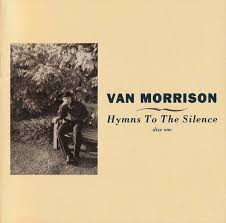

“Make Mine a Double” #4: Van Morrison’s “Hymns to the Silence” (1991)

Among those known primarily as solo performers, there are few rock artists who have enjoyed continuous careers as long and as successful/influential as has Van Morrison. A certain Mr. Dylan, whose debut album hit the racks in 1962, is the obvious standard bearer while the post- Buffalo Springfield Neil Young could also named. The Belfast-bred Morrison first came up in the mid-60s with his group Them—their single “Gloria” has since become a rock ‘n’ roll rite of passage for nearly anyone who has ever picked up an electric guitar. Fresh out of the gate as a solo act in 1967, he had a huge pop hit in “Brown-Eyed Girl” but almost as quickly recorded the virtually unclassifiable Astral Weeks, a jazzy/folky improv flight of fancy that pondered his own post-war youth and made his reputation as a great innovator and vocalist, becoming one of rock’s most acclaimed albums ever despite selling almost nothing at the time.

With a personality as ornery as the music was often sublime, Van the Man followed his muse with a singular determination, able to turn out hits on a fairly regular basis while incorporating a wealth of musical idioms and showing a temperament that made him hard to figure. To say he always “enjoyed” his success would be a stretch. Impatient with music-biz types, critics and even at times his own audience, Morrison has not been shy about editorializing in song. He was in just such a mood when he released this record in 1991.


Van spots a music-industry bloke in the front row and prepares his right jab.

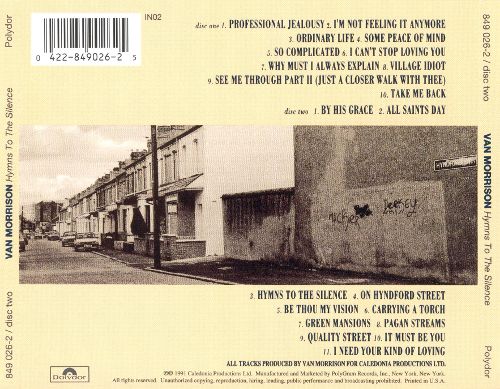
Hymns to the Silence is one of those double-disc affairs that comes along not as a career-peak embarrassment of riches (like Blonde on Blonde or Layla) but more of a case of a prolific songwriter having accumulated a backlog of material—and apparently some grudges as well. On the dullish opener called “Professional Jealousy” Morrison says of his chosen trade, “The only requirement is to know what is needed/and then delivering what’s needed on time.” Not the greatest omen at the start of a 94-minute album. The next track, “I’m Not Feeling it Anymore,” with its catchy piano hook and sprightly rhythm, is a considerable improvement but again voices the same doubts: “If this is success then something’s awful wrong/’cause I bought the dream and I had to play along.” Many of the songs that follow settle into blues-based grooves as Morrison yearns for an “Ordinary Life” or at least “Some Peace of Mind.” He does enjoy the company of his simpatico backing group, breaking out his alto sax for the lively roadhouse rumble “So Complicated” while sharing vocals with his keyboardist/bandleader (and fellow Sixties veteran) Georgie Fame. Disc one ends with the nine-minute “Take Me Back” which echoes the form of Astral Weeks with its impassioned vocal incantations and rear-mirror view of an open-souled childhood.

It’s also a great bridge over to the more expansive views to be enjoyed on the second disc where the song titles alone (“By His Grace”, “Be Thou My Vision” and the title cut) indicate there will be less grousing and more of the spiritual searching that many of his fans have come to know and love—and expect. Finding that inner core of contentment may indeed be tricky when the means of reaching it has to be run through the cold mechanisms of the music industry. “We lived where dusk had meaning/And repaired to quiet sleep,” Van sings in “Pagan Streams”, typical of the hard-won satisfactions on Hymn’s second half. Many of these are couched in a Celtic-influenced sonic palette and the Chieftains, with whom he had recently done an album, guest on several cuts. That group’s Erik Bell plays an airy synthesizer accompaniment to Morrison’s spare, ringing guitar on the album’s most accomplished track.


Named for the Belfast location where he grew up, “On Hyndford Street” (a gritty row of brick houses pictured on the back cover) is a high-water mark for the booksmart Morrison, the kind of guy who writes songs with titles like “Rave On, John Dunne.” Morrison’s narration beautifully invokes the spirit of his literary heroes like Dylan Thomas and James Joyce, with a boy’s awakening sense of the wider world fused to a grown man’s photographic memory of long-passed events and place names (“Walking from the end of the lines to the seaside/stopping at Fusco’s for ice cream in the days before rock ‘n’ roll”). That he progressed from these humble beginnings to a status as one that music’s great artists will make some shake their heads at all the sourness of the album’s earlier tracks, even with the knowledge that fame and fortune is rarely achieved at no personal cost. But tracks like “On Hyndford Street” make it all worthwhile and longtime Van fans with certain gaps in their collections will likely find Hymns to the Silence to be a pleasant discovery, while newbies are better directed to his great albums from the late Sixties and early Seventies, or at least to a good compilation.


You can go home again. On the occasion of his 70th birthday (8/31/2015), Van sings/recites “On Hyndford Street” in this beautifully-filmed concert clip from a location he made famous, Cypress Avenue in Belfast.

“Books That Rock” spotlight: Arne Bellstorf’s “Baby’s in Black”

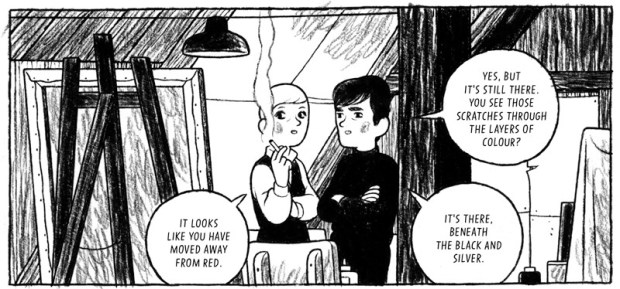
Rock and roll subjects have not exactly been excluded from the exploding popularity of indie comics over the last few decades, but they have not been a consistent point of reference either. Maybe the fact that you can’t hear a comic book is one factor. But with a band as universally popular as the Beatles, that would hardly seem to matter. As early as 1978, Marvel released a special edition “Story of the Beatles, overseen by Stan Lee. In the late 80s and early 90s, Rock N Roll Comics released a string of cartoon band bios, everyone from the Grateful Dead to AC/DC, but these have been criticized for being too skimpy and/or clichéd.

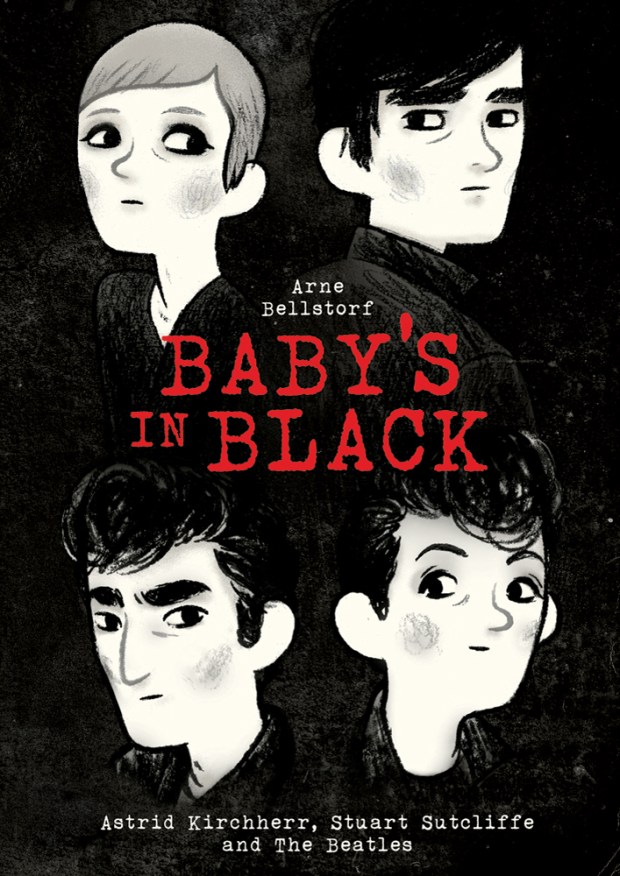
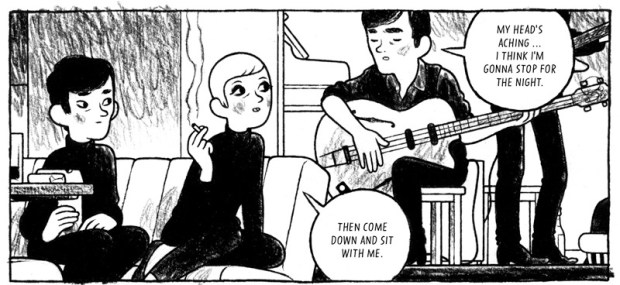
With the growing sophistication of the art-comic genre, it’s time to expect more. In 2014, German artist-writer Arne Bellstorf made a big move in the right direction with this 196-page graphic novelization of the Beatles’ early days as the house band at various Hamburg clubs. “Baby’s in Black” hones in on the romance between the group’s then-bassist Stu Sutcliffe and local photographer Astrid Kirchherr. She was part of the city’s bohemian art crowd (also included was her friend Klaus Voormann was another) that befriended the group. This was a natural angle for Bellstorf, who also hails from Hamburg.

Not only does romance sell, but this story has a tragic dénouement. As many baby-boomer rock fans already know, Sutcliffe left the band to devote more time to his primary passion (painting) while also getting engaged to Kirchherr. Then he died unexpectedly in April of 1962, likely due to a congenital brain condition that caused a fatal hemorrhage. The Beatles first hit record (“Love Me Do”) came out six months later.

So this early slice of pop history, played out in the rollicking red-light districts and quiet residential streets of Germany’s second largest city, has potentially a lot to offer on the developmental days of what would become rock and roll’s most famous band. But finding the right balance between these two main story elements is not always smooth going for Bellstorf.

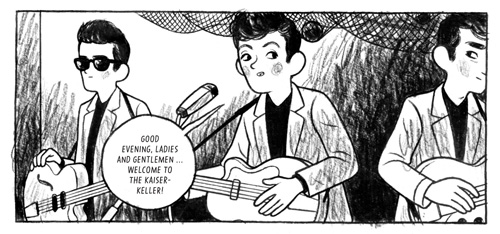
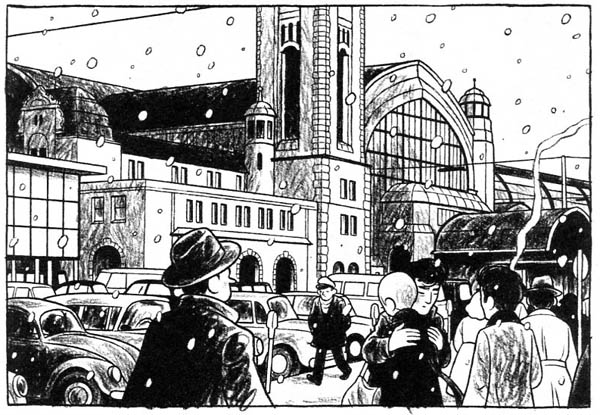
His pencil and ink style is fetching and fairly naturalistic; it is especially good in his spatial reproductions of the infamous Reeperbahn with its elaborate signage and other landmarks, like Hamburg’s central train station. But his odd way with a human visage: black marble eyes, tiny mouths and limited expression, give the book an almost naïve look that can grow unsettling. This is accentuated by his habit of filling in backgrounds and clothing with what look to be gray crayon squiggles.

So yeah, I wanted to like “Baby’s in Black” a bit more than I did, though some of it may not be due to Bellstorf. The rather flat dialogue may have been partially caused by the English translation and I guess one can only surmise so much about what these folks were actually saying back then, especially considering that some of them (Kirchherr, Voorman and Paul McCartney) are still very much alive. There remains a lot to appreciate here. The scenes where Astrid—with her trusty Rolleicord camera—arranges her famous outdoor photo shoot with the boys is a revelation on the humble origins of what became the band’s legendarily photogenic aura. Also, the narrative does (lightly) chart the progress of the Beatles as they ascend from the dingier Reeperbahn dives to more high-profile clubs and make their first record, backing up singer Tony Sheridan. Towards the end, there are several image-only pages (which include wordless speech balloons) that convey Sutcliffe’s terrible fate with much eloquence.

I do hope that rock and roll graphic novels, produced with the sensitivity that Bellstorf displays here, do become more of a thing. The pop stories of our musical heroes have been hashed over in various media formats over the years, but graphic novels, with their combination of fiction writing’s interiority and cinema’s visceral immediacy, seems like a great forum in which to re-experience pop history.

But apparently this may be a case of be careful what you wish for. Yesterday I read a news item announcing the imminent arrival (in late March) of a 464-page book called “Tales of the Smiths: A Graphic Biography.” That’s a whole lotta Morrissey! I think I have the early front-runner for the Feel-Bad Book of the Year award…

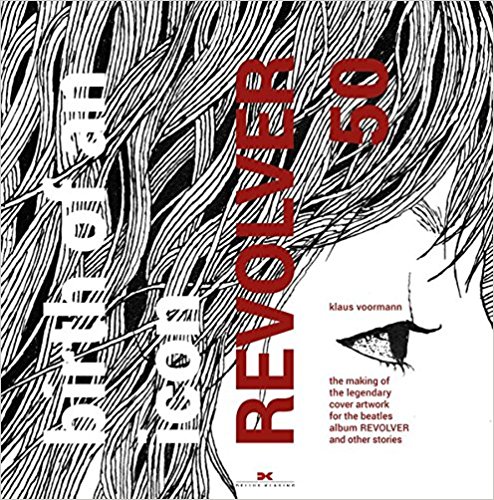
On a more positive note, you can check out Klaus Voormann’s own coffee-table sized graphic novel, “Birth of an Icon: Revolver 50,” based around the making of his totemic Beatles’ album cover in 1966.