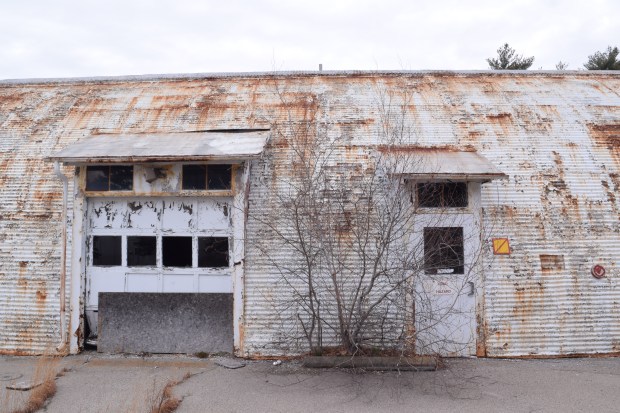
Lock him in! Lock him in! The Quonset hut at the closed South Weymouth Naval Air Station in Massachusetts. Photo by Rick Ouellette
I took the photographs in this post on January 2, 2017—after the election but before the inauguration of Donald Trump as U.S. president. The building in the picture above was one of the sites where Academy Award-winning documentarian Errol Morris interviewed former top Trump adviser Steve Bannon, the subject of his new film called “American Dharma.” It was a sort of stage set up for Bannon, who first rose to prominence (or infamy, as many of us would have it) as the executive chairman of Breitbart News, the alt-right, conspiracy-mongering website that is a favorite of the gullible current occupant of the White House.
A feature story in the arts section of the January 25th Boston Globe pointed out that the much-celebrated Morris has not found a distributor for the film, which has yet to see the light of day since it debuted at the Venice Film Festival last year. (There will be a screening at Harvard University’s Carpenter Center on Feb. 1st, just down the way from where Morris has his office). Part of the problem, might be in the blasé attitude that would let Morris indulge the highly controversial Bannon by having him blab away in the hut which resembles the one in his favorite World War II movie, “Twelve O’Clock High.” For Morris, the WW2 film title that probably best sums up his problems with his new documentary is “A Bridge Too Far.”
When I posted this photo of abandoned housing in early January of 2017, a friend wondered if it were a preview of “post-Trump America.”
That’s because “American Dharma” can be seen as the third entry in a loose trilogy of Errol Morris films about contentious men who were Presidential advisers or Cabinet secretaries: and they can also be seen as offering diminishing returns on the director’s artistic investment. (Like most people, I haven’t seen “American Dharma” and this post is about the idea of doing it in the first place). The first, 2003’s “The Fog of War,” was about Robert McNamara, Secretary of Defense in the 1960s under Presidents Kennedy and Lyndon Johnson. Ten years later, Morris came out with “The Unknown Known” about the longtime Republican operator Donald Rumsfeld, who first came to the national spotlight as chief of staff and defense secretary in the mid-1970s under President Gerald Ford and, of course, held that latter position under George W. Bush during the calamitous invasion of Iraq in the early 2000s.
“The Fog of War” was an exceptional, riveting film that deservedly won Morris an Oscar for best feature documentary, an award that many thought he should have received fifteen years earlier for “The Thin Blue Line.” Robert McNamara was born in 1916 and in an early scene he tells of his first memory, watching victorious American soldiers in a parade after the end of World War I. Morris makes the film so much more than a filmed profile of the man who had recently published a book that was a semi-mea culpa about his role in escalating the disastrous Vietnam War. It expands into an incisive examination into nearly a hundred years of an increasingly mechanized and brutal evolution of warfare (McNamara used his exceptional analytical skills to increase the efficiency of the Air Force’s firebombing of Japan near the end of WW2). At the end, McNamara is dodgy when Morris presses him as to why he didn’t voice his grave misgivings about Vietnam policy to Johnson but, aesthetically anyway, he is not let off the hook. As we hear audio of a phone interview of McNamara declining a last chance to come clean, we see the now elderly man driving around Washington in inclement weather, the hard rain of history beating down on his windshield.
“The Fog of War” was one of the first projects on which Morris use his patented “Interrotron” which (Wikipedia definition) “projects images of interviewer and interviewee on two-way mirrors in front of their respective cameras so each appears to be talking directly to the other.” And by extension, it makes it look like the interviewee is making eye contact with the viewer. But if one thinks this method will necessarily out the truth, that notion is quickly dispelled by the ceaselessly obstructionist style of Rumsfeld in “The Unknown Known.” If you can get past his weasly double-talk (naturally, the film’s title is his own phrase) and the shit-eating grin, you might get something out of this film. But if you were someone outraged at Rumsfeld’s key role in the simplistic invasion plan in Iraq (“intellectually bankrupt” in the words of one general) that left the country in tatters and was based on a flimsy premise (the evidence-free accusation of Saddam Hussein’s involvement in the 9/11 attacks), or were upset at the policy of U.S. troops standing by during the wholesale cultural destruction of the Iraq Museum looting (“stuff happens,” said Donny) or revulsed at his enabling of the heinous treatment of detainees, many of them innocent, which devolved into the torture scandal at Abu Ghraib prison (aka “enhanced interrogation techniques”), the film will leave you cold. Rumsfeld doesn’t feel exposed, he is allowed to go on and on in the current fashion of unaccountable yammering. To him and us, it’s just another day in the grinding machinery of the media-industrial complex.
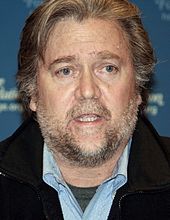
America’s favorite slovenly sociopath? Steve Bannon in 2010.
Can you blame potential distributors for thinking that “American Dharma” is more of the same, esp. in view of Bannon’s “toxic reputation” (in the words of the Boston Globe)? Breitbart is now all but the communications arm of a mindset that is not out of step with the Klu Klux Klan and neo-Nazism. I have no problem with Bannon having his say, but for God’s sake wasn’t he a top White House advisor, feeding his xenophobic notions to the already unscrupulous, spiteful and easily-manipulated Trump? That’s say enough. Any further exposure is just fodder for the ever-spinning media merry-go-round. But if you need further confirmation of what you already know, “American Dharma” will likely see the light of day in some form or the other. In the Globe article, Morris says “I think as the country becomes less angry, particularly the left, then it would be possible to look at the movie as a movie.” After Morris confirmed that Steve Bannon had seen the film and was asked what he thought, the director said “He likes it” and, according to reporter Mark Feeney, “barked out a laugh.” Forgive me if I’m not amused.
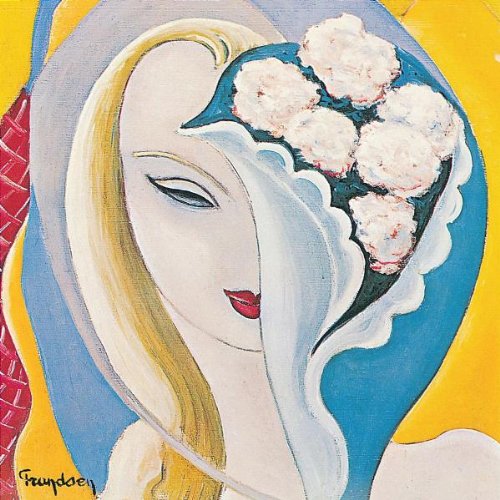
Layla and Other Assorted Love Songs is one of the most beloved and critically lauded of rock albums and it’s not hard to see why. It conflates two of the form’s most cherished devices—red-hot electric guitar solos and verses filled with vivid romantic disappointment, and achieves high-water marks in each, especially on its titanic title track. Most true-blue rock fans already know that as the Sixties drew to a close Eric Clapton was deep in the throes of a hopeless infatuation with Patti Boyd, already married to his close friend George Harrison. And that by 1970 Clapton was at a career crossroads. He had made his name as one of rock’s most exalted guitar heroes not long after moving to London from his native Surrey, first with the Yardbirds and John Mayall’s Bluesbreakers, then especially with groundbreaking power-trio Cream. But Clapton soon grew disillusioned with the lengthy (and often overblown) jamming and psychedelic left turns of the virtuosic threesome—not to mention its fractious mix of personalities.
After Cream’s famous farewell concert at the Albert Hall in November of 1968, Clapton was at a bit of a loss. Hard-wired to a belief in the overarching integrity of American blues and averse to the type of adulation that would have hippies tagging London walls with the catchphrase “Clapton is God,” he rummaged around for the right musical fit. Next up was Blind Faith and although Eric may have been musically and personally simpatico with co-leader Steve Winwood (the group also included Cream drummer Ginger Baker and bassist Ric Grech) the band collapsed under the weight of its own supergroup industry hype after only one album. By the end of 1969, Clapton was content to be a sideman with Delaney & Bonnie & Friends, playing his searing lead guitar lines from sidestage while the group’s namesake married couple held the spotlight. His first, eponymous solo LP came out soon after but before this became his chosen career path, there was one more go at working within a group format. Recruiting three members of the Delaney & Bonnie touring group and settling on a band name that obscured his role as frontman, the newly christened Derek and the Dominoes repaired to Criteria Studios in Miami during the summer of 1970. Soon after arriving their producer Tom Dowd suggested they check out a hot new group from Georgia who were playing a gig nearby, a specific request from their Cream-fan lead guitarist.
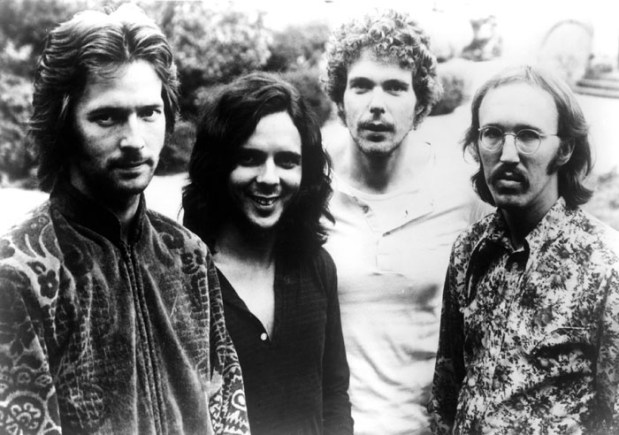
“Duane should be right along.” From l to r: Eric Clapton, Bobby Whitlock, Jim Gordon, Carl Radle
Even without the addition of a second guitarist of equal high standing, the Dominoes would have likely enjoyed a good measure of creative success. Clapton’s three full-time bandmates—keyboardist/vocalist Bobby Whitlock, bassist Carl Radle and drummer Jim Gordon—were a highly skilled supporting cast well versed in the soulful, Southern-fried rock and gritty R&B impulses of the Delaney & Bonnie/Leon Russell/Joe Cocker axis so popular at the time. But after seeing the Allman Brothers Band in concert, a mightily impressed Clapton quickly befriended (and recruited) lead guitarist Duane Allman, adding a whole new dimension to a project with a lot of upside already. Although the Allmans, like Cream, often pushed songs past the twenty-minute mark in concert, the jazzy blues improvisations of the Macon-based outfit seemed more organic and less show-offy than the famed British trio. Allman was, according to Clapton in his 2007 autobiography, “the musical brother I never had” and this was borne out by their complementary styles. The stinging tones of Clapton’s trusty Stratocaster meshed perfectly with Allman’s distinctive bottleneck slide sound and of course there would also be the sort of scintillating, fleet-fingered dual soling that would pass into guitar-geek legend.
Allman’s inspiring presence was timely. Clapton admitted in his book to going into the Layla sessions with only a couple of originals (eventual LP opener “I Looked Away” as well as a rough draft of the title cut) and a few blues standards he was keen to cover. But the material came fast and furious over that late summer and fall until it filled four sides with some of the most passionate rock music ever recorded. “I Looked Away” opens the album with a lilting country-rock groove that belies the emotionally-fraught soundscapes ahead, but it doesn’t take long to get a taste. The one-that-got-away lyric isn’t exactly groundbreaking but the vocals, with Clapton’s tenor trading verses with the deeper and somewhat gruff voice of Whitlock, are a marvel. This gambit (nearly as crucial to Layla’s success as the Clapton-Allman alliance) was said to be in emulation of Memphis R&B greats Sam & Dave, quite plausible considering the Stax Records background of fellow Memphis native Whitlock.
One can imagine the legions of guitar-loving rock fans, in the fallout of the psychedelic Sixties, having their ears prick up to this earthy and emotionally direct new music, especially after the two great tracks that follow it. The charming alliteration of “Bell Bottom Blues” came to Clapton after Patti Boyd’s request that he buy her a pair of designer flares when he got to the States. From that we get an absolutely tortured depiction of a spurned lover so in thrall to a woman that he would “crawl across the floor” and “beg you to take me back” for just one day so as not to completely perish from the scene, complete with a delicate upper-register guitar solo so heartfelt that its highlight are the notes almost too painful to play. But self-encouragement soon follows in “Keep on Growing” with Clapton and Whitlock again singing alternating lines of love lost (and offering supportive shouts of “yeah-yeah” when it’s the other’s turn) before the hopeful chorus and a liberating instrumental finish where an army of overdubbed Erics (there’s no Duane on this and two other tracks) lead the charge with the other three in full gallop close behind. In light of the originality of these three tracks, the side one closer—a conventional cover of the blues standard “Nobody Knows When You’re Down and Out”—can’t help but pale in comparison.
But in the “Assorted Love Songs” of these four sides, fresh approaches far outnumber the inveterate twelve-bar tendencies that once prompted Rolling Stone critic Jon Landau to dub Clapton the “master of the blues cliché,” a comment that deeply upset the guitarist, then still with Cream. The other three Clapton-Whitlock collaborations (“Keep on Growing” was the first) add new hues to the old blues, the vibrant vocal tag-teaming and lofty instrumental constructions don’t let up thru the determinedly soulful “Anyday,” the chugging rocker “Tell the Truth” (a much faster version produced by Phil Spector had been released as a single) and the tour de force “Why Does Love Got to be So Sad?” In this Southern-style rave-up, a near-frantic Clapton rails against romance’s age-old injustices, as well as its confusions: “Won’t you show me a place/Where I can hide my lonely face/I know you’re going to break my heart if I let you.” Most anyone with a pulse has felt at least once in their life “like a song without a name/I’ve never been the same since I met you” though it’s one of the tunes that seems most specific to Patti Boyd: “I can’t keep from singing about you.” With volume levels that could have stripped the paint off Criteria’s studio walls, Duane solos throughout the song with an intensity that is almost superhuman. When Eric joins in, the notes seems to be coming at you twenty different directions and it all ends with a decelerated, Allman’s style outro, a sweet-toned reprieve after the cathartic emotions are fully exorcised.
This YT video of “Why Does Love Got to be So Sad” features lyrics on the screen and a fine photo montage of band members as well as Patti Boyd.
What’s amazing is that all this creative outpouring took place against an admitted background of such prodigious alcohol and hard drug intake that in our own relatively temperate age it would practically constitute a national crisis. Clapton was by now well down the road to the heroin addiction that would derail his life and career pretty much until 1974. And when the original songs ran out the covers that sat beside them were mostly first-rate as well. Their amped-up version of Jimi Hendrix’s “Little Wing” may lack some of the gentler appeal of the original but the heraldic power chords, ardent vocals and Jim Gordon’s complex drum fills transform it into stirring tribute to Eric’s friend who died during the making of the album. The nine-minute take on Big Bill Bronzy’s “Key to the Highway” is more guitar-duel nirvana and the country seasoning added to Chuck Willis’ R&B stroll “It’s Too Late” made it the perfect choice to perform when the Dominoes made a well-received appearance on the Johnny Cash TV show. The best straight blues here is probably “Have You Ever Loved a Woman” with Clapton’s torrid between-the-lines soloing and its relevant love-triangle lyrics that, though written by Billy Myles, seem to cut straight through to the Eric-George-Patti situation: the obsessed but conflicted narrator backs out of a potential affair with his best friend’s old lady.
Live on the Johnny Cash Show in 1971 doing “It’s Too Late.”
Patti Boyd was first seen by the greater public when, as a young London-based model, she got to play one of a group of uniformed high-school girls flirting with the Beatles on a train ride in A Hard Day’s Night. George asked her out on the set but had to wait a few days for a yes. A toothy, girl-next-door blond beauty who was never quite exotic enough for significant modeling success, Boyd was top shelf as a rock-chick muse. Married to Harrison in 1966, her husband’s deepening devotion to Eastern mysticism may have strained the relationship but they remained married until ’74 and Boyd was the inspiration for several George-penned Beatles tunes, most notably “Something.” Although Eric was convinced the couple were on the outs by the time he and Boyd met and although feelings may have been mutual, it would a long agonizing wait for him.
“What’ll you do when you get lonely/And nobody’s waiting by your side,” began the song he wrote about Boyd that he came to Miami with in an unfinished state. Although directed at the object of his desire, Clapton could just as easily be talking to himself and the mix of self-pity and admonishment in “Layla” is made even more urgent by the relentless repetition of the song’s famous signature riff, reinforced with a reputed six tracks of guitar. Tom Dowd was a key player throughout these sessions and not just for his incandescent production. He was a fatherly facilitator for the self-doubting Clapton and helped build what began as a ballad into a rock juggernaut, especially after Allman came up with the totemic seven-note figure. The missing piece of the puzzle was found when an elegiac piano piece written and played by Jim Gordon was added as the instrumental “coda” (it takes up more than half of the seven-minute running time) renowned for its aching beauty.
In the documentary film Tom Dowd and the Language of Music, the late producer sits in front of his mixing board and deconstructs the song, isolating elements like Allman’s ghostly slide guitar sound and noting that both he and Clapton were playing notes that were “off the top of the instrument.” The quieter second section suggests that the spurned lover of the last four sides finally turns away from the woman who has “turned my whole world upside down” and heads off alone into the sunset (listen for Radle’s “walking” bass line) while Allman sounds his famous “bird tweets” in a majestic fade to black. But wait, there’s more. As if playing over the closing credits of a movie, LP closer “Thorn Tree in the Garden” makes for a fitting and intimate ending, a melancholic acoustic-guitar ballad by Bobby Whitlock that Dowd recorded by having the group sit around a single open mic.
Master producer Tom Dowd on the making of “Layla” from the highly-recommended documentary “Tom Dowd: The Language of Music”
If ever an album had a postscript—or, indeed, many of them—it’s Layla and Assorted Love Songs. First off, the album did well initially (#16 in the U.S.) but the title track only achieved its status as a ubiquitous radio classic after several fits and starts and re-releases over the next few years. The LP didn’t even get its own review in Rolling Stone, instead being twinned with the Allman Brothers’ Idlewild South in a write-up that betrays the higher critical standards of the day (“Bell Bottom Blues” is “filler”?!). Duane Allman, who was only able to squeeze in a few dates with the Dominoes on their subsequent tour, died in a motorcycle accident near his home in Macon less than a year after Layla’s release and a month shy of his 25th birthday. Carl Radle kept in contact with Clapton during the latter’s three-year layoff while battling drug addiction and was with him for the 461 Ocean Boulevard comeback album and tour in 1974—then succumbed to liver disease in 1980 after being unable to conquer his own substance abuse demons. Jim Gordon, the golden-touch session drummer whose voluminous list of credits ran the gamut from Bread to Frank Zappa, developed a severe case of (undiagnosed) schizophrenia and murdered his mother in 1983 in a delusional state that was discounted at trial due to changes in California law—as of January 2019 he is still serving a sixteen-years-to-life sentence. Thankfully, nothing tragic happened to Bobby Whitlock, unless one counts the fizzling-out of his Seventies solo career; he’s still in fine form whenever he resurfaces.
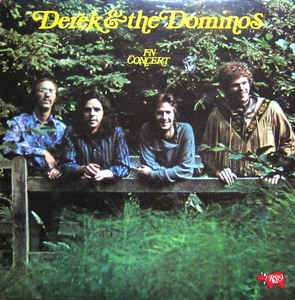
The only other official D&D release was this live album released in 1973, two years after the band broke up.
And what of Mr. Clapton? Everyone knows of his successful run as a solo artist and his elevation to one of rock’s elder statesmen. He got together with Patti Boyd soon after her divorce from Harrison and the two were wed in 1979, an era that produced perhaps the last well-known ode to her, the hit single “Wonderful Tonight.” But in her own autobiography called “Wonderful Today,” Boyd doesn’t pull her punches in recalling how quickly the union hit the rocks, the bottle quickly replacing the needle as Eric’s habit of choice. Her husband certainly has not denied just how far he fell during that period and the couple divorced in 1989, the final straw being Clapton fathering a child with another woman (Boyd was unable to conceive). Still, the ideal of the song she was most famous for inspiring stayed resilient: even his tepid “Unplugged” performance of “Layla” on MTV couldn’t kill it—indeed, it snagged Clapton one of the six Grammy awards he won in 1993. (Co-writer Jim Gordon shared the award but of course was not in attendance, neither was he mentioned in the acceptance speech). Many have commented over the years about the permenance of great art and its ability to rise above the many vagaries of its creators and creation and so too will Layla and Assorted Love Songs forever stand tall over the inauspicious circumstances that trail behind it.
You can check out an excerpt of my book “Rock Docs: A fifty-Year Cinematic Jorney” at http://booklocker.com/books/8905.html or by clicking on the book cover image above. If interested in purchasing, you can contact me directly for a special offer and free shipping! Thanks, Rick. rick.ouellette@verizon.net

 Reel and Rock