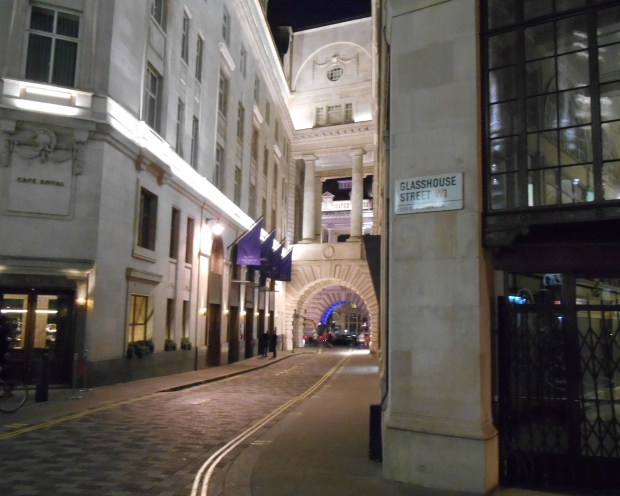
A view from behind a John Nash-designed Regent Street archway, 2016 (All photos by author unless otherwise noted)
I have come here tonight to praise the former Regent Palace Hotel, just off Piccadilly Circus in London. At 1028 rooms, it was the world’s biggest hotel on completion in 1915. I did not know this tidy little fact when I stayed there for a week in May of 1976. This would have surprised me back then. The hotel had a rounded, impressive Edwardian façade but it didn’t seem especially large. That’s maybe because many of the rooms (like mine) were small and communal bathrooms were in the hall, which was the case until the place finally closed in 2006.
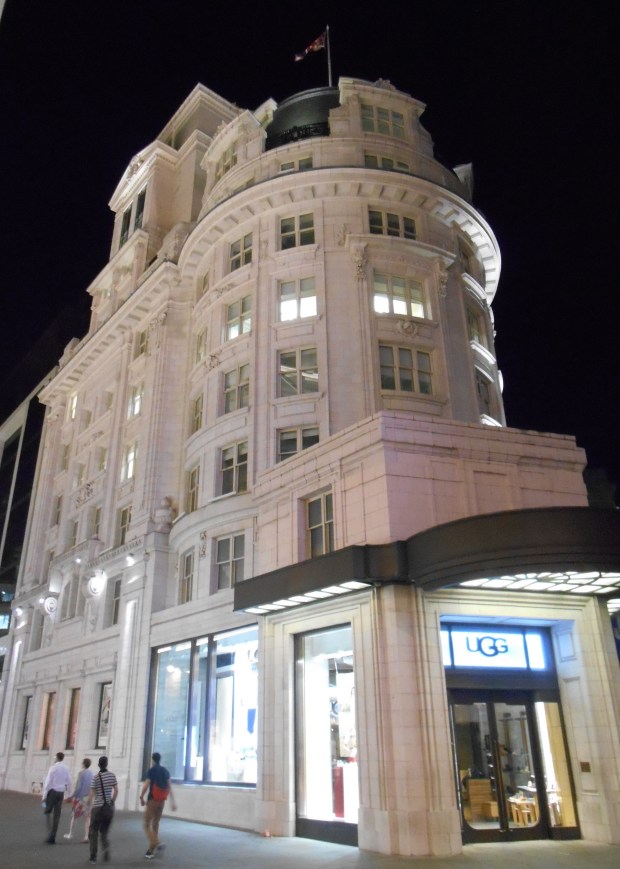
The white-washed ghost of the Regent Palace Hotel in 2016. Seemingly empty save for an Ugg store. Ugh.
So the Regent Palace was not much of a palace, but it did back up to rear of the Regent Street quadrant. That famously curved shopping street was laid out by John Nash, the master architect of Regency/Georgian England. His work also includes Buckingham Palace, the Brighton Royal Pavilion, and Marble Arch. The elegant sweep of Lower Regent Street led into Piccadilly Circus, anchoring London’s West End entertainment district, before taking a sharp turn and proceeding thru a stately institutional area to the The Mall, which of course leads to the Queen’s pad.
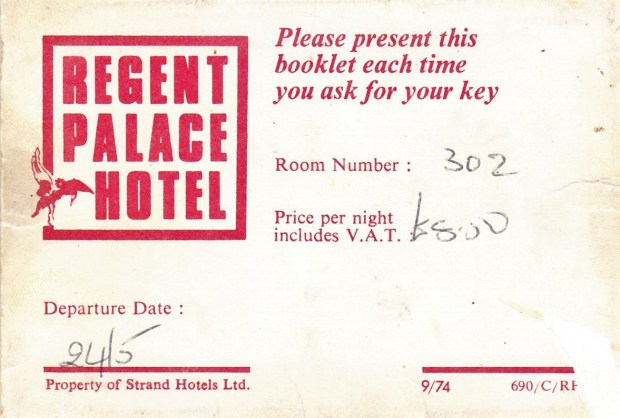
For 8 pounds a night, the Regent Palace Hotel was a place where “You enjoy all the amenities of a modern hotel, including telephone, radio and razor point.” (!!)
I’ve always had a thing about architecture and John Nash (1752-1835) is my favorite practitioner, except maybe for American Samuel McIntire, the Federalist architect/carver who’s greatest works were also done in the early 19th century. Sam’s not only a fellow countryman but lived and worked primarily in my hometown of Salem, Mass. Anyway, I cribbed the title for this post from the Simon & Garfunkel song “So Long, Frank Lloyd Wright.” After all, there just aren’t enough tribute songs to famous architects, I mean how much can you say in that format? Even S&G are pretty much reduced to saying how they and ol’ Frank would “harmonize ‘til dawn.” Sounds funny, but city-building can have its own musical richness and John Nash was a symphony-level composer. He found his fame as a patron of the Prince Regent (later King George IV) and his master plan started with a design for Regent’s Park (ringed by his terraces and great-houses) and proceeded south in a grand avenue procession down to Regent Street and the Circus. So very royal, yes, but it also gave London some of its greatest public spaces. But more on all that in a bit.
Ray Davies makes the rounds of Swinging London in this satirical Kinks Klassic from 1966.
I was 18 at the time of my first visit to the city that had so captured my boyhood imagination, mainly stirred by my steady diet of Kinks albums and Chares Dickens novels. This trip to England I had planned for some time, funded by my high-school job as a busboy and by a nice little fund put aside from my godfather that he gave me when I had turned the big 1-8. I had gone with my mom to a local travel agent (remember them?) and the guy, seeing that I was a bright young lad off on his own for the first time, suggested that the Regent Palace Hotel, a literal stone’s throw away from London’s version of Times Square, would be a good base camp. My mom was already nervous about me going but it was quickly a done deal.
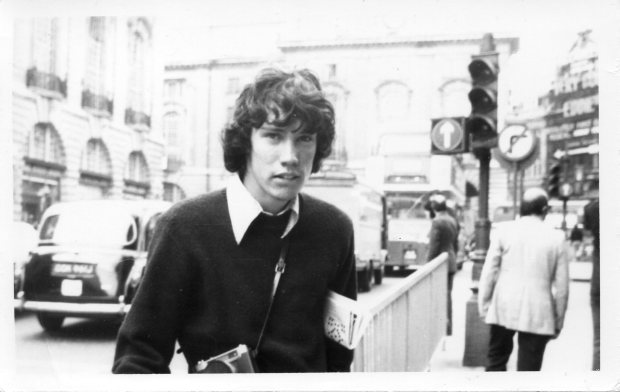
Your humble blogger at age 18, captured by a street photographer near my hotel.
Piccadilly Circus in the post-war years became world-famous for its neon-lit nightlife and its giant advertising signs for films, shows and a bewildering array of consumer goods. But ten paces away from these bright lights and rushing traffic, and thru the corner entrance of the Regent Palace it was a different story. The hotel had a certain frumpy charm, it was like a character in a Graham Greene novel, with a certain faded elegance and a hint of intrigue. (I was certainly intrigued by the occasional hooker loitering at a staircase landing). The Circus came to be one of those great gathering places, both for Londoners and tourists, but ol’ John Nash was way ahead of the curve. Lower Regent Street (completed around 1825) featured a covered arcade that kept window shoppers out of the elements and maybe give a chance for sweethearts to have a tete-a-tete, reportedly a consideration in the planning.
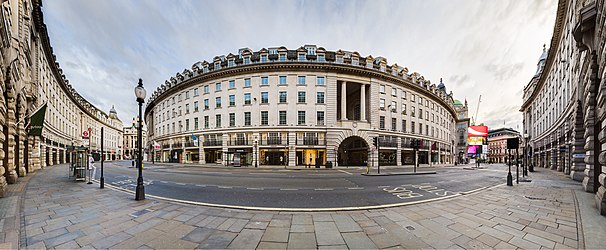
Panorama of Nash’s Regent St. quadrant. (Photo by Benh Lieu Song via Wikipedia)
Rock ‘n’ Roll Circus
Society took over from their and certainly by the 1960’s it was (like Carnaby Street) a place to see and be seen. Many of the nightclubs of Swinging London, hosting future rock mega-bands like the Who and Pink Floyd, were in adjacent areas like Leicester Square and Soho. It was well past the prime of that golden era by the time I got there in ’76. The place was considered tawdry by many, with its illicit street dealings and dignified old buildings covered in advertising hoardings and movie marquees. But it was transformational for me, the spark that started a lifetime of sporadic European travel. So I went boldly where all men had gone before and sat myself on the steps of the Shaftsbury Memorial (see below) topped by the famous statue of Eros though it is actually his brother Anteros, the god of requited love. Either way, point well taken.
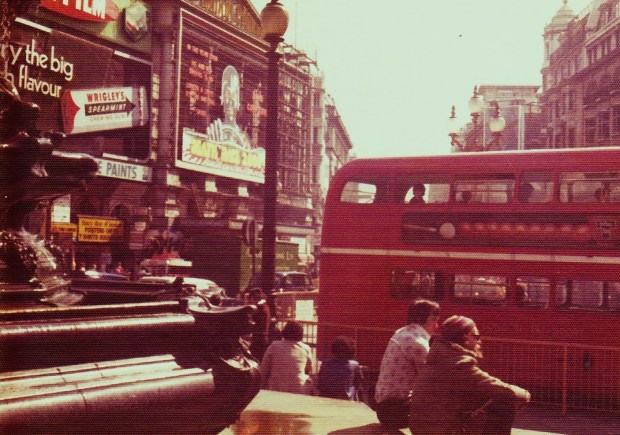
Piccadilly Circus, 1976
Across from the steps was the grand façade of the London Pavilion, where the Beatles’ Hard Day’s Night and Yellow Submarine had had their world premieres. Currently, the theater’s 3-story high sign was boosting it’s first-run showing of Death Race 2000, the pedestrians-as-points cult film; a die-cut image of David Carradine as the black-masked driver loomed over the square. Instead, I opted for a walk down Coventry Street to the now-demolished Odeon West End to see The Man Who Fell to Earth, the futuristic mind-bender starring David Bowie. The bottom of the Odeon marquee, for all of Leicester Square to see, read “Kinky Sex”—The Evening Standard. Well, your average perv may have been disappointed to buy a ticket based on that alone, but I took up my seat in the balcony (smoking allowed) not unlike the girl in Bowie’s song “Life on Mars?” who’s “hooked to the silver screen.” After having my mind suitably blown, I walked past a Piccadilly pub where an hour later, a few of the Rolling Stones stopped by a drink. I read that the next day in the (wait for it) Evening Standard.
Jumping ahead nearly 45 years, I found out something that I had long suspected, a possible brush with rock and roll history that would have been more significant than catching a glimpse of a few Black and Blue-era Stones. The pre-Sid Vicious Sex Pistols were gigging in Central London the same month in the spring of ‘76 that I was first visited my fabled London. Mainly, they had a Tuesday night residency at the nearby 100 Club. Not that I necessarily would have known what to do with a Johnny Rotten back then (I was more of a Ray Davies and Ian Anderson kind of guy), but I did miss being present at the crossroads of rock history at a time when the band were not yet tabloid fodder. But ten months later the Pistols, now with Sid in tow, the group’s manager arranged a publicity-stunting signing of a contract with A&M Records, in front of the John Nash-designed Buckingham Palace. The competing symbolism was clear, even if the band didn’t release their groundbreaking, vitriolic anthem “God Save the Queen” until several weeks later. After that, they repaired to one of the lobby bars at the Regent Palace Hotel where they were over-served by the staff, according to (I believe) Jon Savage’s definitive book “England’s Dreaming.” Just think, only a gob’s throw away from where I sat in the RPH’s breakfast room, or the Carvery restaurant, whose sliced-roasts station, dessert cart and great big Imperial pints of lager were already legends in my own mind. The group’s drunken hijinks continued over at the A&M office, where their punkified misdemeanors had them booted off the label by week’s end. Twenty years would pass by the time I saw the re-formed Sex Pistols at an outdoor venue I the summer of 1996.
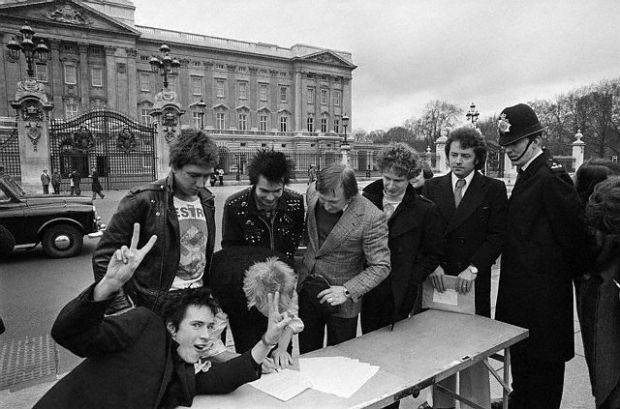
10 Mar 1977, London, England, UK — The punk rock group, The Sex Pistols, are about to be moved by a policeman as they sign a copy of their new recording contract with A & M Records outside Buckingham Palace. The next record to be released is called “God Save the Queen”. The band members (from far left to right) are John Lydon, Steve Jones, Paul Cook and Sid Vicious. — Image by © Bettmann/CORBIS
I would visit London alone again in 1994 and in 2016 with family. I was older and a bit wiser and able to take much better photographs, including those of John Nash’s greatest architectural hits (more in Part Two!). In ’94, I took a nostalgic stroll thru the Regent Palace lobby and out the side door. Also by then, the obstructing sign was down at the London Pavilion and it had been turned into a rock-themed wax museum; there were David Bowie and Mick Jagger effigies looking out imperiously from the revealed balconies. In 2016, the RPH was long-closed when I showed my son where I had stayed in another lifetime. The building, like many others in the Piccadilly/Regent Street area, had been scrubbed of their age-old London grime and white-washed to within an inch of their lives. The “people’s palace” hotel had only ghost of the memories of the lone travelers, wandering-eye businessmen and tour-group tag-a-longs that once issued forth the lobby into the whirlwind of London’s famous/infamous crossroads. But I’m still here to tell you my tale where the secret lives of buildings, people and pop culture intersect and will be back for more in Part Two.
—Rick Ouellette
 Reel and Rock