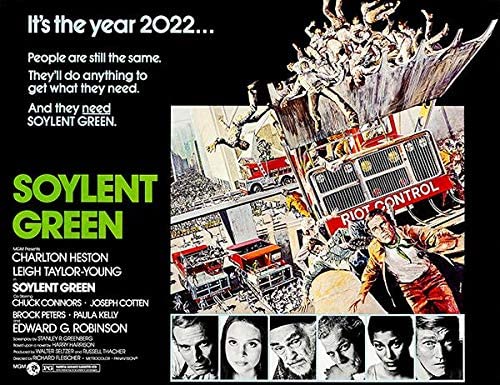
It’s Earth Day 2022, the same year that was the future setting of the iconic (and oft-parodied) 1973 science-fiction film “Soylent Green.” So it’s the perfect time to look back at the cinematic world presented therein. The whole planet is besieged by overpopulation, economic meltdown and by an ecological Armageddon. The particular setting is an overwhelmed New York City of 40 million inhabitants (half of them unemployed) most of whom have little to eat except the sickly-green wafers of the title.
Of course, it’s not much of a spoiler anymore to mention what SG is made from (it’s PEOPLE!!!). The big reveal here is just as well-known as the twist ending of the classic Twilight Zone episode “To Serve Man” (it’s a COOKBOOK!!!). It’s still a good watch, a vintage 70s potboiler starring Charlton Heston, Edward G. Robinson, Leigh Taylor-Young, and Chuck Connors, along with several notable actors in smaller roles. It was directed by Richard Fleischer, using Harry Harrison’s 1966 novel “Make Room! Make Room!” as its source material. The film’s opening montage–a visual timeline that moves from a 19th century idyll to our present day problems of pollution, runaway mass consumption, poverty and strife–sets the table pretty convincingly.
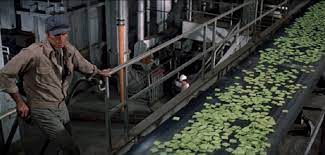
But don’t go in expecting a lot of prophetic material. “Soylent Green” is at heart a future-set police procedural with Heston as Detective Thorn who, while investigating the murder of a wealthy man, finds out he has much more than a simple homicide on his hands. Food as we still know it today is the preserve of the very wealthy, along with other luxuries like running water, soap, and linens. This is income equality on steroids.
Thorn seeks to even the score a bit when he goes to investigate at the luxury apartment of the murdered man—the Soylent Corp. executive played by Joseph Cotten before he was unceremoniously dispatched. While still questioning the man’s assigned concubine or “furniture” named Shirl (played by the doe-eyed beauty Taylor-Young) he grabs a silk pillowcase from the bedroom and, with no pretext, fills it with food, liquor and a bar of that soap. Thorn returns to the small bare-bones apartment he shares with Sol (Edward G. Robinson), the old-timer intellectual (or “book”) with whom he works on cases.
The scene where the two man luxuriate over real food and good bourbon is a humorous highlight of this often bleak film. Robinson is very good here as the wise old man who discovers the Soylent Secret from company books Thorn found in the dead man’s flat. It was EGR’s 101st and last screen role and he died twelve days after shooting wrapped, making his famous scene at the euthanasia center all the more poignant. Heston obviously loves working with him and Robinson’s influence gives Heston’s usual granite presence some needed soft edges.
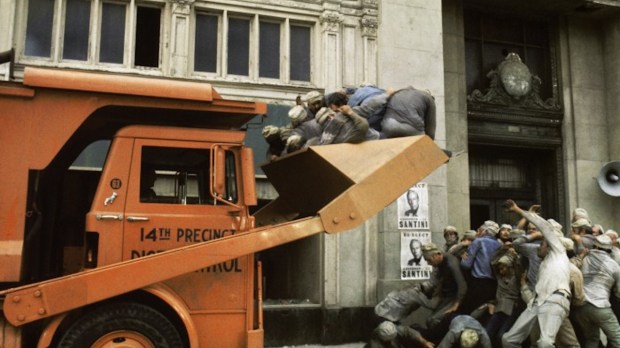
But there’s still a world-gone-berserk out there to deal with, which brings us to “Soylent Green’s” notorious food-riot centerpiece. When the SG supply runs out one day the crowd gets very unhappy very quickly, and the riot control front-end loaders are brought in post-haste. This spectacle, hyped-up due to the illustrated exaggeration in the movie’s poster, has many non-believers. Gene Siskel, in his one-and-a-half star review, warned viewers they “may never stop laughing.” (to be fair, his future TV partner Roger Ebert gave the movie 3 stars). The fact that most people caught in the shovel just don’t jump back to the ground shows that believability was sacrificed for cost considerations and thematic point-scoring.
Because let’s face it, this is not a big-budget production. Instead of a truly horrifying people scooper, they just used whatever public-works truck was available. And although there are a few good forbidding futurescapes, most of the exterior shots used the same old Manhattan/brownstone “streets” that Hollywood had been utilizing on their backlots since the Forties. So while “Soylent Green” wants to be taken seriously it often lacks both the monetary and cerebral heft to do so.
But you get some good B-movie action–the chases and shootouts and the bedroom scene with Heston and Taylor-Young–and a cast worth watching. There’s Chuck “Rifleman” Connors as the shady bodyguard, Whit “Time Tunnel” Bissell as the corrupt governor, veteran character actress Celia Lovsky as Sol’s librarian colleague and, as Thorn’s superior back at the precinct, we have Brock Peters who, a decade before, played the doomed Tom Robinson in the famous film version of “To Kill a Mockingbird.”
So, a lot to look at here if you’re considering a re-look or if you’re a young one approaching “Soylent Green” for the first time—just don’t expect a lot of Nostradamus action. Sure, the scarifying opening montage still holds weight but our world of woes is still destined to suffer the death of a thousand little cuts instead of this film’s Gotterdammerung. I guess we can be grateful that the masses aren’t being used for mass-produced food: at least not yet. However, I did recently notice that there is now an actual “meal replacement” product named Soylent (check it out on Wikipedia). So who knows, maybe 2022 is later than we think.

 Reel and Rock