Month: May 2024

Placeology #6: Denver Airport’s Conspiracy Clearinghouse

The Denver International Airport is the largest such facility in the Wester Hemisphere by land area, encompassing 52 square miles of space in the middle of a vast and nearly treeless plain, some 23 miles from the Colorado capital. It may be the sixth busiest airport in the world, but it is the first busiest when it comes to the number of urban legends and conspiracy theories that swirl around it.

It’s been said that, even before it opened in 1995, people were raising questions. Why so far away, why all that land? Things ratcheted up when the imposing and indelibly strange “Blue Mustang” went up in the middle of a plain on the approach to the airport. This 32-foot statue of an electric blue horse has red laser-light eyes and is rearing up enough to grossly display his prodigious man junk. He was finished only after its sculptor (Luis Jimenez) was killed when a large piece of it fell on him just before its completion. The work soon came to be known as “Blucifer.”

But this strange, unsettling sculpture was only the start. Soon the airport was a hotbed of conspiracy theories, based upon the general idea that it’s the new world headquarters of the Illuminati. The large network of underground tunnels was variously seen as a hideout for officials of the New World Order and/or lizard people. They are supposedly great survival bunkers for the rich and elite and, not coincidental to this line of thinking, are connected to the North American missile command. There are gargoyles in suitcases looming above the baggage claim and, to top it off, the central terminal’s roof is made up of multiple tent-like peaks and are said to symbolize the Ku Klux Klan.

To be fair, the Denver airport authority has kind of brought this on themselves. That statue (a winning design) is pretty demonic-looking—check out some close-ups online—and it can’t be decided if the roof is supposed to represent the Rockies or Native American teepees. Oh yeah, I forgot, the whole thing may be built on Indian burial ground.

Let me go on record as one who believes there is a HUGE difference between being self-aware and vigilant against forces that may do you actual harm, and falling for every batshit-crazy conspiracy that comes down the pike. Honestly, you would think that some disgruntled elite would have ratted out the Illuminati by now. Of course, the response by true believers would probably be that the fact they haven’t been exposed is proof of their existence. How grimly ironic when you learn that the known Illuminati, founded in Bavaria in 1776, was founded in part to combat the forces of superstition and obscurantism, i.e. the restriction of knowledge via misinformation, religious intolerance and the denigration of independent thought.

Some say that the popularity of conspiracy theories is due in part that it makes the less intelligent among us feel smarter and it provides a simplistic and hard-to-refute reason for problems that could be otherwise overcome by sometimes-difficult personal effort.

It’s nearly impossible to convince conspiracy theorists that they are wrong, so the best way to deal with it is with a cheeky sense of humor and that’s exactly what the administration of the Denver airport has done. When I was there during a Thanksgiving weekend, I came across several signs along a wall that is covering some renovation work at the large central terminal:

If any conspiracy aficionado were to walk by one of these lizard-people-hardhat signs and nudge a family member, declaring “See, I was right all along,” they would make a complete fool of themselves. Reverse psychology can be a wonderful thing.

In conclusion, these kind of New World Order tall tales are fun for the purpose of a graphic novel or sci-fi movie, but please don’t get to that bad place where before long you start believing that Democratic lawmakers are eating babies or at that the 1969 American lunar landing was fake but that the Nazis had a moon base as early as 1942. For more info, consult the Internet or check out the prime-time programming of the “History” Channel.

It was also slightly annoying that so many people passed by the Denver terminal’s cheeky billboards without the slightest hint of curiosity. I know it’s an airport and folks are rushing to and for but there is also downtime for many. A better engagement by the general (and reasonable) public would give them a greater understanding on the scope and the inherent danger of those whose baseless beliefs can lead them down a very dark alley, and possibly dragging civil society right down with it.
Placeology #5: Up, Up and Away into Hotel Heaven

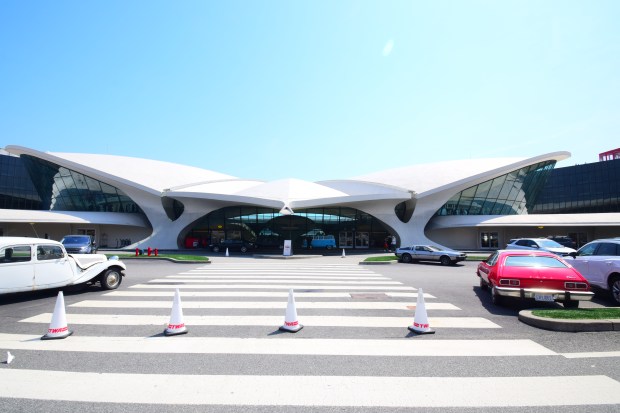
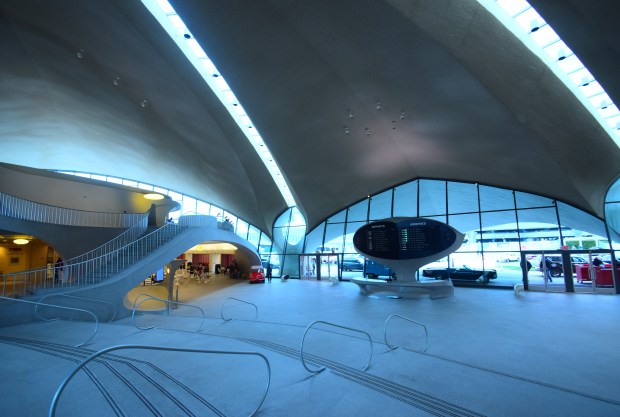
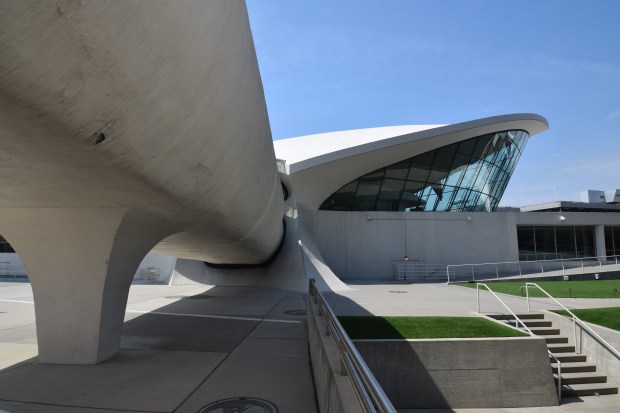
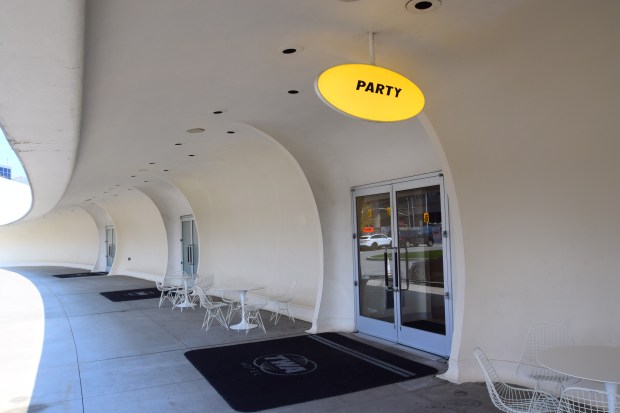
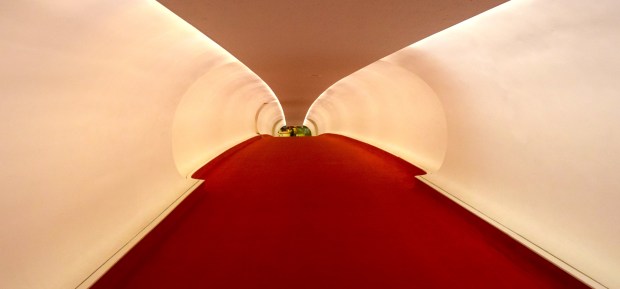
An instant induction into the “Placeology” Hall of Fame goes to the TWA Hotel at the JFK Airport in Queens, New York City. Eero Saarinen’s Jet Age/Space Age masterpiece, opened in 1962, now serves as a gigantic retro-futurist lobby for a hip but friendly destination hotel. The actual guest rooms are in two curved buildings that overlook the great sculptural form of Saarinen’s creation, made to resemble a bird taking flight. You reach the rooms by walking up the terminal’s two iconic red-carpeted tubeways, which may make you feel like you’re living inside the space station scenes in Stanley Kubrick’s “2001.”

Those ramps once led directly to the jet doors, previously passengers had to head out on the tarmac and climb the roll-up stairs in all sorts of weather. They’re indicative of the efforts of Trans World Airlines, with Howard Hughes still as principal owner, to popularize and glamourize the growing airline industry. The sunken lounges, curvaceous stairways, giant viewing windows, in fact everything down to the chic uniforms and pillbox hats worn by the stewardesses, led to a total implied package of adventure and elegance. (Compare to today!).

So you will see walls lined with photos of the Beatles, Muhammad Ali, Presidents Kennedy and Truman and movie stars ranging from Marilyn Monroe to Paul Newman. Of course, you don’t have to be a big shot to stay at today’s TWA Hotel. It’s a bit pricey but not exorbitant when compared to far less attractive places. Since airports are not standard vacation destinations, the people who are staying at the TWA are usually there because they appreciate it (an exception may be if your flight at the adjacent Jet Blue terminal was cancelled until the next day).

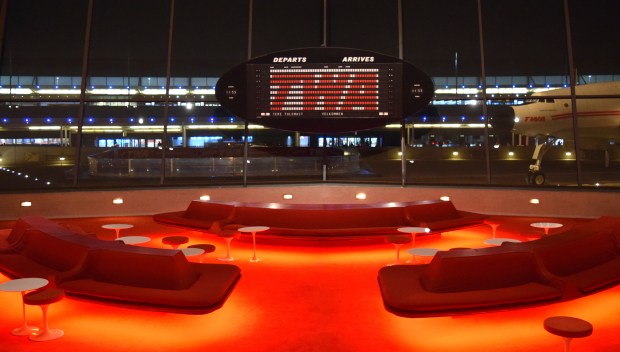
There is certainly lots to appreciate. The hotel is fun and distinctly non-snobby, as amenable to young families as it is to couples on a romantic getaway. The latter can enjoy a drink in the sunken lounger under one of the terminal’s two giant elliptical Arrivals & Departures boards, while the former can entertain themselves by checking out the Twister game room, the many vintage automobiles and the free photo booth. Aside from the soft clattering of electro-mechanical A&D boards, the main sound you’ll hear is the continuous sound of Sixties pop music over the PA, just loud enough to be a nostalgic soundtrack of your stay. Along with the sounds of the British Invasion, Motown, surf, early rock ‘n’ roll and the occasional Frank Sinatra croon, you get a couple of tunes from the girl-group pride of Queens, the Shangri-Las.

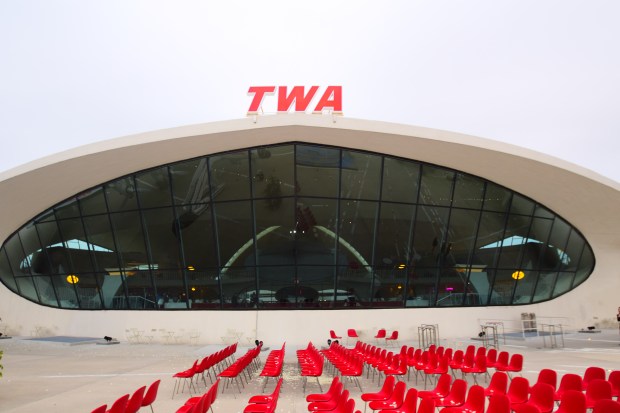
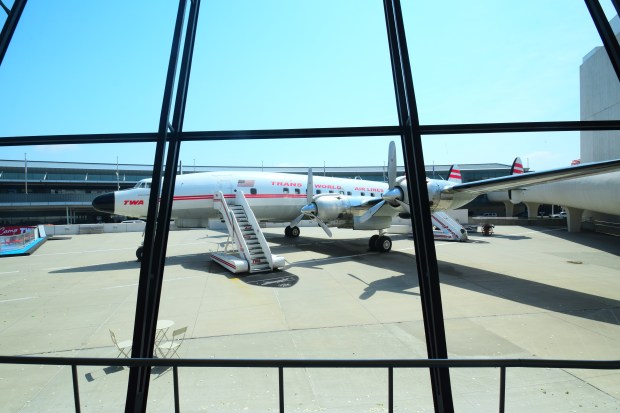
A big attraction for many is a restored propeller-driven Lockheed Constellation, an airliner that was produced between 1943-58. Its bold profile dominates the view outside the terminal’s huge oval rear window. Affectionately known as “Connie,” any guest is free to go outside and walk up the steps, where the interior is now an informal lounge (expect a crowd). But there will much less of a crowd in the terminal’s “hidden” nooks and exhibit rooms, where the hotel’s playful quality really hits a peak. There’s the “Pope Room,” a tiny vestibule where Paul VI decompressed in October of 1965 after becoming the first pontiff to set foot in the U.S. At the end of one of the tubeways you can visit (and hang out in) a recreated Sixties living room, a TWA executive office, and a simulation of Saarinen’s studio.

After settling into the fantastical realm of Eero’s creation, you may notice something which is the most gratifying feature of this whole experience: that to whatever extent possible, the developers of the TWA Hotel left this architectural gem as is. The building had been essentially vacant since the terminal was last used in 2001 until it opened as a hotel about five years back. But there was no Disneyfication in the rehab: the carpets, seat cushions, tiling and concrete sheathing are all original and a bit timeworn, even a little tatty in places.

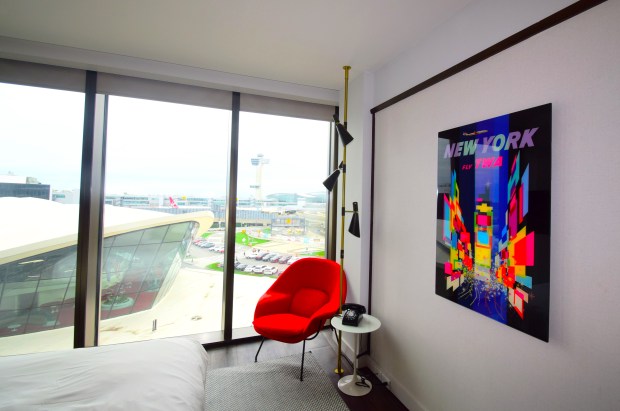
It cost a little more for a room with a “historic view,” but it is worth it.

That’s a good thing. We are invited into (for the price of a room) a real and vital piece of design history, not a replica. As you walk towards the hotel, you will enter this rarefied air with the help of outdoor speakers playing the 5th Dimension’s bouyant hit version of Jimmy Webb’s “Up—Up and Away” which was adapted into a memorable TWA television commercial. Along the way you will see translucent posters, partially blocking views of the construction of a new international terminal, that feature press testimonials of New York’s “sexiest” hotel. The one that stuck with me was from the Wall Street Journal: “They don’t build them like this anymore, and they never will again.” Truth.

Photos and text by Rick Ouellette