I'm a freelance writer and photographer and the author of the graphic novel in-progress "In a Dream of Strange Cities. My previous non-fiction works include "Rock Docs: A Fifty Year Cinematic Journey" and "Documentary 101: A Viewer's Guide to Non-Fiction Film," was released in 2013. My other activities, like psychogeography, bicycling, and a little urban exploring tie into the content of this blog, which is dedicated to the celebrating the rich history of rock music, film, literature and popular culture.
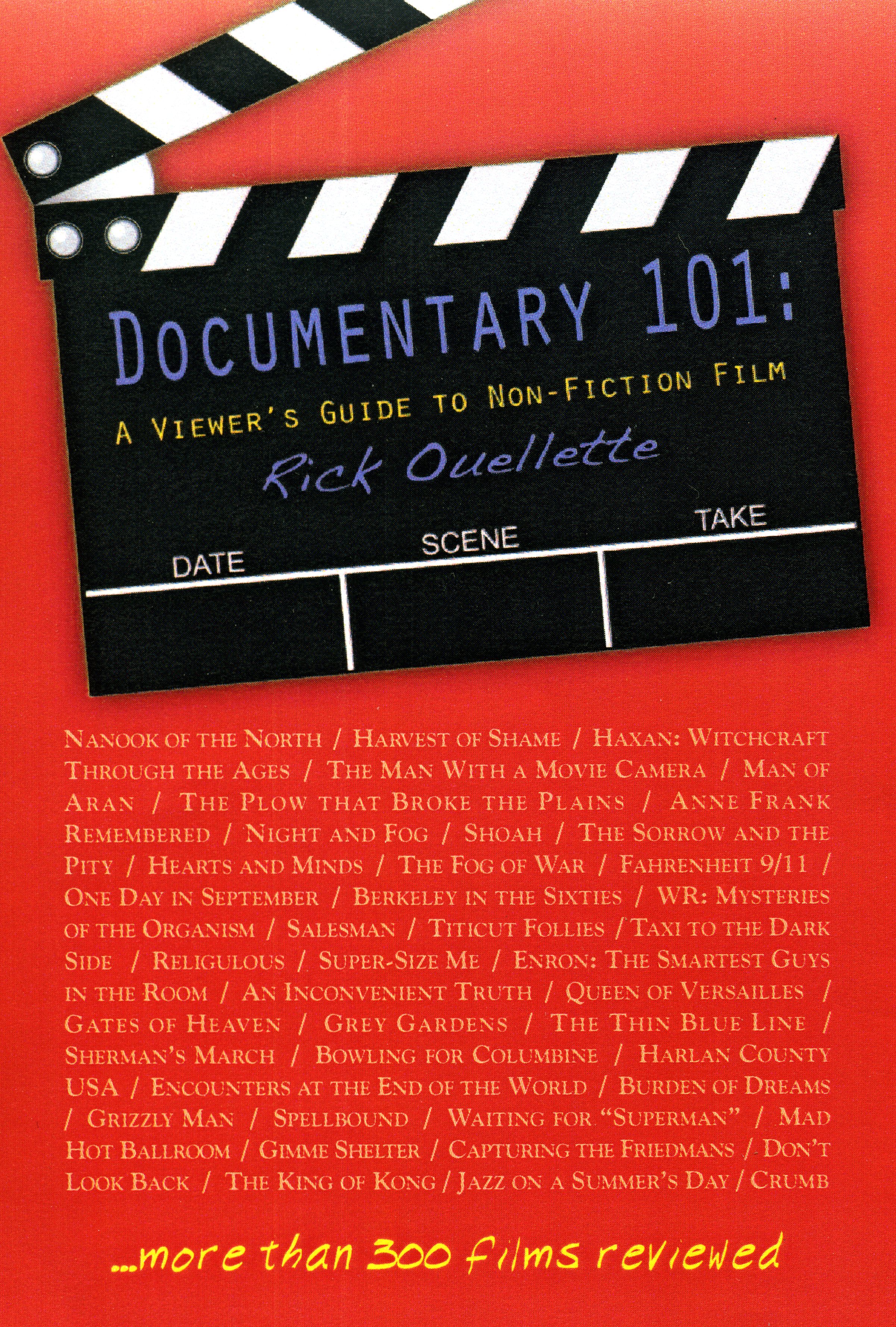
Happy to announce that my book, “Documentary 101: A Viewer’s Guide to Non-Fiction Film”, previously available only in paperback, has now been released as an e-book in all formats—in most cases selling for the low low price of only $4.99. All these sites allow you to “look inside” at the first 40 pages. See below for the links.
My publisher BookLocker.com has done a great job on the e-book conversion, allowing readers to land on any of the over 300 reviews by clicking on the title in the table of contents.
In my Categories list to the right, the “Documentary 101 Samplers” offer highlights from a more varied cross-section of the book, along with film stills only seen there.
Cheers, Rick Ouellette
(Reel and Rock readers: I am now on Facebook if you’d like to connect with me there)
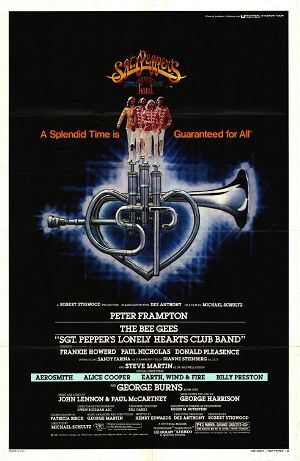
The $1 VHS Film Festival continues with 1978’s misbegotten Sgt. Pepper’s Lonely Hearts Club Band. I first got interested in the film (I had only seen bits of it on TV) after a lengthy and absorbing look-back piece by Clark Collis in a 2001 issue of Mojo magazine (discussed below). At the time it was unavailable on home video and down to its last couple of prints. So I figured if I ever came across a used tape it would be priced at either fitty cents or $30, depending if the seller knew what he had. So I when I spotted it for a buck at a used record store, I did not feel hard done by. It has since been issued on DVD and is available on Amazon for $6.66, a perfect price point for that company, if you catch my drift.
At this late date, it doesn’t seem that the status of Robert Stigwood’s white-elephant film musical of the Beatle’s most famous album will ever change much. Sgt. Pepper the movie seems forever suspended between being a forgotten fiasco and a potential cult classic, with little momentum left to nudge the needle either way. The Mojo article tracked the utter hubris of impresario Stigwood and his top-drawer clients who were recruited to star in the film and sing most of the numbers: Peter Frampton and the Bee Gees. In 1977 these were musical artists who were riding very high, the former with his blockbuster live LP Frampton Comes Alive and the latter with the Saturday Night Fever soundtrack.
All involved apparently believed that Beatles’ generational game-changer (all of ten years old at that point) was already forgotten by younger kids and that their film version would replace it in the minds of future generations. Moreover, Frampton said at the time that his role would likely lead to his becoming a movie star on the level of a Robert DeNiro. Along with this unearned arrogance, this work also comes across as a by-product of a sort of collective cocaine psychosis that gripped certain sectors of the movie and recording industries during that era. It didn’t seem like anyone was straight enough to have a coherent vision about the final product, instead they just rode the Beatles’ military-style coattails right down into a ditch.
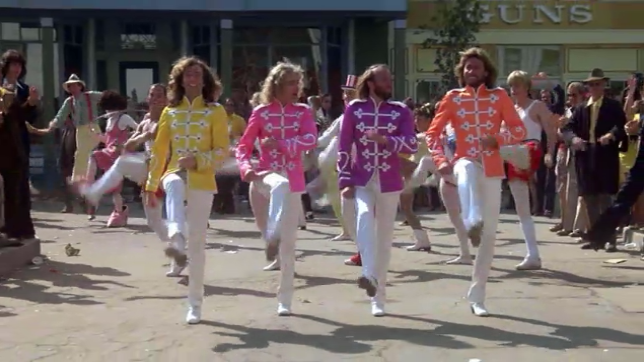
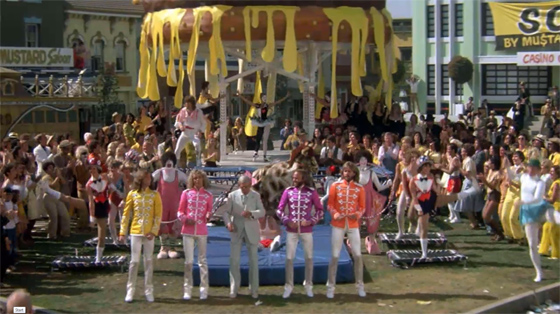
If you think these clothes are painful to look at, just try prancing around in them!
With its candy-colored costumes, overstuffed production numbers and fructose-encrusted goodies-vs.-baddies storyline, Sgt. Pepper is so icky-sweet that I felt a tummy ache coming on before the end of the first act. But once your eyes adjust to the gaudiness and your brain dials down to the film’s bottom-scraping sensibility (Mean Mr. Mustard is stealing the original Sgt. Pepper heart-shaped flugelhorn that ended World War One!) it’s not all bad. After all, you have a bumper crop of stellar Beatles tunes (mostly from Pepper and Abbey Road), many sung by a trio of brothers who, before their disco phase, were bona fide purveyors of 60s progressive pop. And the wacky visual effects are a guilty pleasure, even if they look like they were conceived by someone who was dosed with some of that bad brown acid left over from Woodstock.
Problem is, aside from the ongoing narration of Heartland mayor Mr. Kite (an amiable George Burns) it’s all music. Somewhere, a decision was made that the Brit and Aussie accents of the four stars made dialogue a no-go. That leaves them to otherwise mug and mime between singing parts and Charlie Chaplin these guys are not. Without any speaking lines, what plot there is gets cobbled together by creating scenes to fit the lyrics of disparate songs, a tricky task that the hapless director Michael Schultz is not often up to.
Tonight you did not swing successfully.
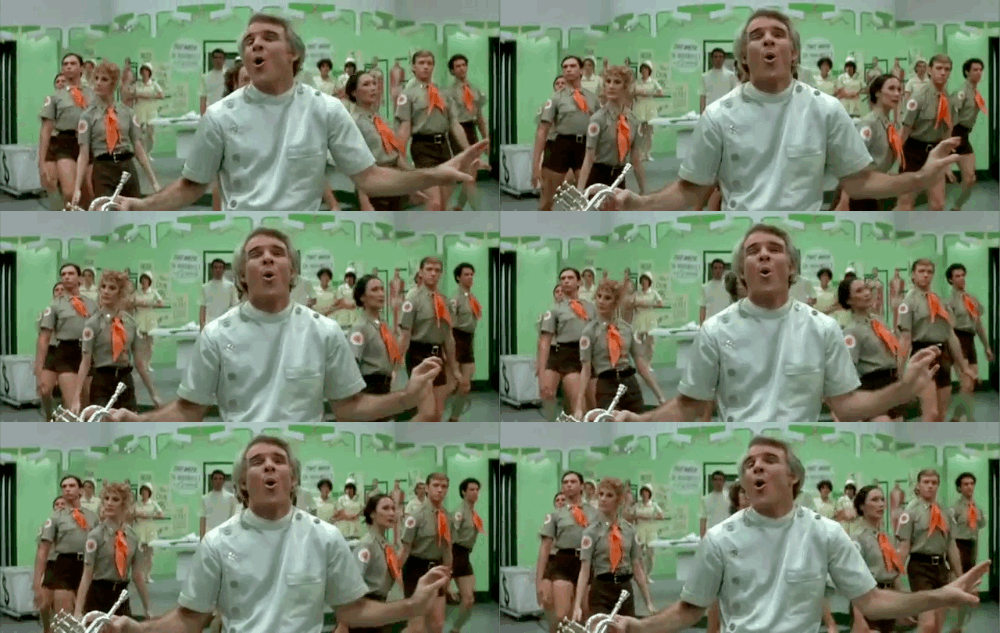
Watching Steve Martin applying his wild-crazy-guy shtick to “Maxwell’s Silver Hammer” or Alice Cooper over-enunciate “Because” from inside a God bubble are one-and-done experiences. Obscure R&B singer Diane Steinberg does fine with “Lucy in the Sky with Diamonds.” But various songs by squeaky-clean newcomer Sandy Farina as Strawberry Fields, the girlfriend of Billy Shears (Frampton) fall completely flat—she croons “Here Comes the Sun” and her namesake tune to little effect. (The utter lack of romantic chemistry between her and Peter doesn’t help matters).
As soon as they let him out of the bubble, Alice headed back to the golf course.
Nowadays, the only songs from the soundtrack you’ll hear on the radio are Aerosmith’s “Come Together” and Earth Wind and Fire’s slinky funkification of “Got to Get You into My Life.” George Martin, the film’s musical director and only real connection to the Fab Four (unless you count Billy Preston), regretted afterwards that they didn’t take more chances with the material. They had the Bee Gees play it too safe, though there are some occasional treats, like Robin Gibb’s pensive “Oh! Darling.” But after our heroes have dispensed with a succession of silly-ass villains (whose brainwashing motto “We Hate Love, We Hate Joy, We Love Money” was later purchased by a Wall St. consortium) and we get to a “Sgt. Pepper” reprise finale featuring dozens of movie and music stars brought onto the Hollywood backlot, many filmgoers must have been wondering why they didn’t just stay home and play a few Beatle records instead.
By this time, it was too late to call the whole thing off.
The movie opened to a withering volley of contemptuous reviews (Paul Nelson in Rolling Stone: “a film upon which every major decision is wrong”) but did make back it’s $18 million production budget and then some, largely thanks to foreign distribution and impulse purchases of the soundtrack album. While Robert Stigwood did end up making a profit, the film’s pariah status with the press and US/UK audiences set him back as a producer until 1996’s Evita. Sgt. Pepper also effectively ended the “acting careers” of Frampton and the Gibb brothers, while poor Sandy Farina never ate lunch in that town again. A similar cinematic exercise, Julie Taymoor’s 2007 Across the Universe, may have had a more talented director and a more plausible look, but also suffered from an awkward literalism and left behind a trail of mixed reviews and red ink. Consider this as an object lesson to “leave well enough alone,” a favorite old adage of mine that seems to have fallen out of favor in modern times. Fact is, the Beatles’ music is so vivid and timeless that it carries its own inner-eye visual legacy in the minds of both baby boomers and many others in generations that followed. Just “Let it Be” already.
Have you heard about my book “Rock Docs: A Fifty-Year Cinematic Journey”? It’s an alternative history of rock ‘n’ roll, seen through the prism of non-fiction film, with over 170 titles reviewed. You can check out a 30-page excerpt at http://booklocker.com/books/8905.html or by clicking on the book cover image above. If interested in purchasing, you can contact me directly for a special offer and free shipping! Thanks, Rick.
rick.ouellette@verizon.net
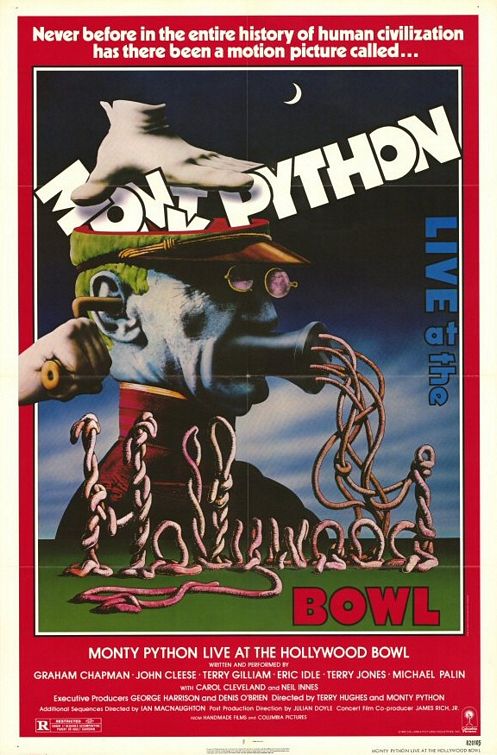
A great recent find to kick off my hypothetical $1 VHS Film Festival, as over the summer I’ll be going through the stack of videotapes that I’ve picked up for short money at various library book sales and thrift stores over the last couple of years. Although clips from the Pythons’ celebrated four-night stand at the iconic venue in 1980 have shown up in compilations, documentaries and online, the full 78-minute film (briefly released theatrically in ’82) has had a history on home video that has been sketchy at best, no pun intended.
Live at the Hollywood Bowl was a treat to watch all the way through for the first time, to get a fuller sense of the event that was the visceral highpoint of Monty Python’s popularity in the States. The troupe was met with rock-star adoration by the extremely enthusiastic southern California audience and many fans dressed the part as well—lots of them are seen sporting the handkerchief headgear of the show’s dim-witted Gumby men and one is even done up as the Pantomime Princess Margaret.
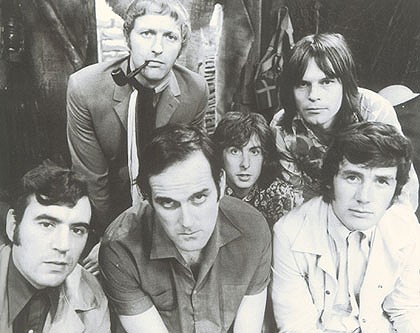
A pensive Python group shot from back in the salad days (no, not the one directed by Sam Peckinpah). From left, Terry Jones, the late Graham Chapman and his famous pipe, John Cleese, a squished-in Eric Idle, Terry Gilliam and Michael Palin.
Another plus is that they had released a few records since the TV show had ended in 1974 so there was material that was new to me or that was only vaguely familiar. Sure, you get your Silly Walks, your Argument Clinic and your Lumberjack Song. But they also perform a pair of naughty tunes from their then-current Contractual Obligation Album (“Never Be Rude to an Arab” and “Sit on My Face”) and skits where John Cleese’s pope chastises Eric Idle’s Michelangelo for a muck-up on The Last Supper (he’s painted twenty-eight disciples, three Christs and a kangaroo) and that great bit where self-made millionaires sit around with cigars and champagne trying to outdo each other on who had the toughest upbringing (“A cardboard box? You were lucky; we lived in a rolled-up newspaper inside a septic tank”).
There are also several fun segments where the group takes their act out into the audience, as when Cleese’s roving waitress tries to peddle seabird-flavored snacks during intermission.
Considering Python’s enduring popularity, maybe this concert flick will eventually get a proper release for the digital age. Does anyone out there have a copy of the short-released DVD “Live at Hollywood Bowl and Aspen”? That may be the original film plus some extra bits from the same era, because after 1980 the guys (which here also included Carol Cleveland and Neil Innes) wouldn’t get together for a proper string of live shows until (wait for it)… next month!
Their recently announced ten-night run of shows coming up in July at London’s O2 Arena will be the last time the legendary troupe will perform together (according to themselves) before they all eventually “bring down the curtain and join the Choir Invisible.” A live simulcast in over two thousand movie theaters worldwide is planned for the last of these ten shows, scheduled for July 20th. Keep a look out for details, sounds like a must-see event for us diehards.
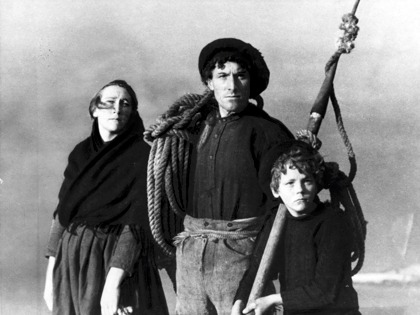
It will be 80 years ago this August that Robert Flaherty’s docu-fable Man of Aran won the prize for Best Foreign Film at the third Venice Film Festival. In a world where certain market psychologies would have you think that something a year old is passé, a documentary that’s been eight decades in the rearview mirror could be assumed to interest only academics and deep-diving film buffs. But Flaherty’s piece, which vividly evoked (somewhat anachronistically) the rugged lives of Aran Islanders, seems to resonate from around the margins of present popular culture. Daniel Radcliffe is currently starring on Broadway as “The Cripple of Inishman” a drama based around the production of the film, a 2010 feature-length retrospective on Flaherty (“A Boatload of Wild Irishmen”) references Aran in its title and a recent DVD release of this semi-silent film features a new soundtrack by the iconographic indie-rock group British Sea Power. On their regular albums, BSP’s poetical topics often revolve around the natural world and geographical/environmental themes that are simpatico with Flaherty’s work. Samplings of their lyrics are in bold face throughout.
“I headed for the coastalry/Regions of mind, to see what I’d find”
Robert Flaherty had considerable difficulty duplicating the great achievement of Nanook of the North, his 1922 Eskimo epic that is widely considered to be the mother of all narrative documentaries and also helped popularize awareness of indigenous populations. It would not be until 1934, twelve years after Nanook, that Flaherty would recapture his winning formula for success with Man of Aran. It is a film filled with stark beauty and authentic admiration for the stalwart people of these islands off the west coast of Ireland, a place where “the peculiar shelving of the coastline piles up into one of the most gigantic seas in the world”. As in Nanook, Flaherty went beyond straight documentary; he also convinced fishermen and their families to collaborate with him in conjuring up a nearly pre-industrial lost age, making for a unique film experience but one that has come in for a certain amount of criticism over the years.
“Hoopoes and herring gulls over chalky cliffs/It’s all that’s left you know, carbonate and myth”
Initially, Flaherty had mixed results gaining the islanders’ cooperation but eventually recruited enough residents to make the production possible and was assisted at times by members of England’s famed EMB Film Unit, the groundbreaking organization run by John Grierson, the man who coined the term documentary after seeing Nanook of the North. Yet the film was financed as a “real-life drama” by the Gaumont British studio. It was just as well. Flaherty, who was born in 1884, had “one foot in the age of innocence” according to photographer Walker Evans and was a filmmaker who was as enthralled with the spirit of truth as he was with the letter of it. Several recent documentaries, like Surviving Progress or Werner Herzog’s Encounters at the End of the World, have noted a particular aspect of our current ecological crisis stems from the notion that mankind sees itself as separate and superior from the very planet that it is part of. Man of Aran by contrast is a vivid re-imagination of man as sublimely co-existent with nature and even if this ideal is archaic or unrealistic, it still remains a quiet but powerful corrective.
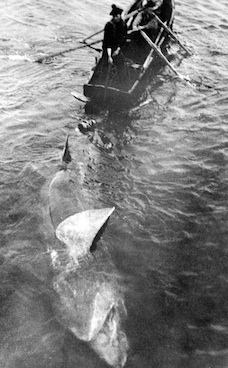
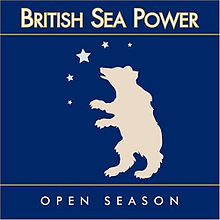
In this arcadian sequence above, boy protagonist Michael Dillane interrupts his fishing to climb partway down a craggy bluff when he spies a basking shark lolling just below the water’s surface (at the end of the clip which is 5:10 not 1:34 as listed). The song that British Sea Power chose to go along with this scene is a lovely instrumental re-working of the song “North Hanging Rock” from their 2005 album Open Season.
The local practice of hunting these whale-like creatures with harpoons died out a half-century earlier but Flaherty’s enthusiasm and persuasion won the day and soon the men, especially his closest Irish collaborator Pat Mullen, were brushing up on the subject and getting new harpoons forged. This centerpiece of the film, and one of the great prototypical scenes Flaherty would ever commit to film, shows Mullen and the “Man” of the title (Colman “Tiger” King) as they lead the crew through the daunting surf in their modest curraghs then meticulously track down and harpoon the beast—but not before it repeatedly slaps at the boat with its tail and nearly tows it out into the open sea. This led to rebukes that his film almost led to the drowning of a “boatload of wild Irishmen.”
“I don’t know what I’m made of or where from I came/Don’t even seem to remember my name or why the ghost’s alive in this cave”
Although Flaherty did not pretend that he was making anything more than a “picture” that used real islanders, Man of Aran can seem disingenuous when the purpose of the hunt is said to be to gain “shark oil for their lamps”. Electricity had been available on the Aran Islands for some time. Contemporary critics pointed out that, in the midst of the Great Depression, the poverty and absentee-landlord system that existed on the Arans at least deserved a mention. The headstrong Flaherty felt entitled to his own agenda and his tribute to his leading man (“In this desperate environment the Man of Aran, because his independence is the most precious privilege he can win from life, fights for his existence, bare though it may be”) can and probably did resonate back then as well as any more literal recognition of economic inequality.
^^^^^^^^^^^^^^^^^^^^^^^^^^^^^^^^^^^^^^^^^^^^^^^^^^
British Sea Power is based in Brighton on England’s cliff-lined southern coast and is known for their melodic indie rock and poetic lyrics that veer from personal and romantic concerns into themes that suggest astute ecological and historical awareness and that celebrate the overarching domain of nature. There are not too many bands out there inventing words like “coastalry” and writing a paean to “Larsen B” their “favourite foremost coastal Antartic shelf” that disintegrated in 2002. When the band addresses Larsen with the acknowledgment “you had 12,000 years and now it’s all over” the bittersweet observation seems turned on mankind itself, esp. with the recent escalation of dire warnings about catastrophic climate change and the Ostrich Oblivion of denial and resignation that exists alongside it.
“Daisy chains of light surround the city now/They glow but never quite illuminate/Hell and high water won’t stop us now/The future’s twisted, righteousness is coming back around/And we fall like sparks from a muzzle”
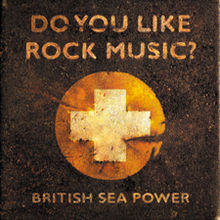
In Flaherty’s 1948 Louisiana Story, his last major film, benign oil riggers treaded lightly on the primeval Cajun bayou and indulged its inhabitants (the film was commissioned by Standard Oil though R.H. had free creative reign). Flaherty tried to see his way clear to a world where industry and nature could indefinitely co-exist. Were it only so. When British Sea Power advocated “Lights Out for Darker Skies” on their 2008 CD, Do You Like Rock Music?, it reminded me of a couple of things—the ethereal late-night radio ads from a skywatcher’s advocacy group I used to hear in the Eighties and the idea that the true meaning of the word “understanding” is nearly literal with the idea of letting oneself stand under something in order to fully comprehend it. BSP’s brand of bracing anthemic rock comes from that same imperative, devoid of the overly self-conscious type of uplift you get from bands with similar attributes. (Not to mention any names, but one has the initials A.F. and another has the initials U.2.) If you like rock music pick up one of their CDs, you won’t be sorry.
Official video for British Sea Power’s “It Ended on an Oily Stage.”
All rights to video, music and re-printed lyrics go to BSP and their publishers
Sixteen year-old Diane Lane as Corrine “Third Degree” Burns
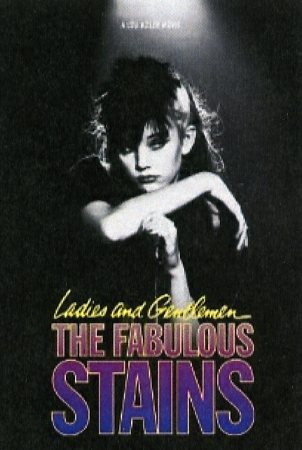
Sometimes there’s nothing quite so true as a good fiction. This saying came back to me while working on my forthcoming book on rock documentaries. Concert videos, festival films and artist biographies may preserve milestone moments and excavate the personal backstories beloved by fans. But sometimes a novelistic approach and fictional characters can allow a filmmaker to better plumb the aspirations and struggles of musicians without that overlay of hero worship that can mark a non-fiction treatment. (Some fictional bands find that cinematic notoriety may lead to success in “real” life, most notably with Spinal Tap but more fleetingly with acts like the Commitments). I recently came across a DVD of the long-obscure 1982 film “Ladies and Gentlemen, The Fabulous Stains” in the music documentary section of a library. So that’s one more “lost” rock film I can cross off my list. Be patient, “Slade in Flame”—you’re next!
Mislabeled it may have been, but “The Fabulous Stains” does hit on some timeless truths concerning the low end of the music industry food chain and youthful discontent in a troubled economic area. The director, music mogul Lou Adler, was known to dabble in film, having produced the perennial midnight movie favorite “Rocky Horror Picture Show.” Maybe he thought cult-classic lightning was going to strike twice. The story arc of the film even suggests as much: a trio of teenage girls, helped along by an ambitious female news anchor, become an overnite sensation, their confrontational brand of girl power immediately attracting hordes of copycat fans. Instead, “The Fabulous Stains” received only a brief theatrical release, afterwards being seen occasionally on basic cable or the odd VHS copy before its partial re-discovery as a seminal inspiration for the riot grrrl movement.
There’s a fair amount to like about this work, most notably an extremely young Diane Lane and her incisive performance as Corrine Burns, recently orphaned after the death of her mother. During a local news report on her and her sister Tracy (Marin Kanter), Corrine gets fired from her crap job while cameras are rolling. She and Tracy, along with their similarly disaffected cousin Jessica (a 15 year-old Laura Dern) find an escape route out of their dead-end town via the ramshackle tour bus of faded hard-rock act The Metal Corpses. The conceited frontman of this has-been group is played by the Tubes’ Fee Waybill—a bit too convincingly for his own good, it could be added. He doesn’t care much for the Looters, the upstart English punk band that’s been opening his shows (the feeling is more than mutual) and the Stains are invited on the bus as a hedge. But when disaster befalls the Corpses, the two bands left standing become tourmates and eventual rivals.
It should be noted that the Stains barely qualify as a band. They don’t have a drummer, have only rehearsed three times (“but they were long rehearsals,” one of them notes) and couldn’t be counted on to come up with a set list. What they do have is plenty of nerve and behind the steely resolve of Corrine (and Lane’s searing performance, which totally sells it) become an emblem of youthful self-determination in tough times. Her confrontational performance rant, while clad in skimpy underclothing and sporting a skunk hairdo and Ziggy Stardust make-up, is consciously promoted by the woman newscaster, making the Stains an instant phenomenon across the proverbial “tri-state area” (apparently West Virginia, Pennsylvania and another one TBD). But the real wild card here is the Looters, who come across like a great lost supergroup of the early 80s. I mean, blimey, they got half of the Sex Pistols (guitarist Steve Jones and drummer Paul Cook), the Clash’s Paul Simonon on bass and ace character actor Ray Winstone as the dynamic lead singer. In the clip below, Diane Lane’s Corrine sees her own aspirations reflected back to her in the Looters torrid performance of their signature “Join the Professionals.”
Rock film aficionados will recall Ray Winstone as Kevin in 1979’s “Quadrophenia”
In less than a week after this hometown scene the Stains have amassed legions of followers and Corrine becomes an imperious star ready to brush aside her love interest Winstone and steal his best song. But no matter, is there anybody out there who would want a movie like this to last longer than 90 minutes? Under Adler’s direction and Nancy Dowd’s generally sharp screenplay, “The Fabulous Stains” gets a lot of things right: the dullish deadweight of passed-over towns, the resentments and empty hours of musicians touring by bus, the need for outsiders to make their mark in the world. But in the minds of many potential admirers, the skunk hair and face paint probably identified the Stains with such terminally uncool MTV one-offs as Kajagoogoo. Yet fate is kind to many films seen retroactively as ahead of their time and if you live in the New York City area you have a chance to do what few others have—see “Ladies and Gentleman, The Fabulous Stains” in a theatrical screening. The BAM Rose Cinema at the Brooklyn Academy of Music is having a “Punk Rock Girls” film series until June 1st and it will be playing on May 31st. Full schedule here: http://www.bam.org/film/2014/punk-rock-girls
In Japanese director Nobuhiro Yamashita’s endearing 2005 film “Linda Linda Linda”, an all-girl band, scheduled to perform at their high school cultural festival in three days, have to start from scratch when two members drop out. Happenstance replaces ambition as they get the idea to perform three songs by Tokyo punk band Blue Hearts (including the 1987 hit “Linda Linda”) after hearing them on a mislabeled cassette and then recruit Son (Doona Bae), a half-comprehending Korean exchange student, after deciding that the next girl they see passing by will be asked to join as vocalist.
“Do you want to do a band?” The wonderful Doona Bae as Son, who suddenly finds herself a rock singer, along with (left to right) bassist Nozomi (Shiori Sekine), drummer Kyoto (Aki Maeda) and guitarist Kei (Yu Kashii)
This diffuse, amusingly minimalist movie is as much a nostalgic dream of the end of high school as it is a salute to the sisterhood of the electric guitar. “When we grow up, we won’t stop being kids,” promises the presenter of a school camcorder crew who pop up here and there to give context that the band is too busy practicing to provide, while both Son and Kyoko are also dealing with would-be boyfriends whose formal and awkward kokuhaku (confessions of love) are delivered at inopportune moments. Trying to squeeze in one last rehearsal at the pro studio of Kei’s older ex-flame, the girls finally succumb to exhaustion. Almost sleeping through their time slot, there’s a rain-soaked dash back to the school where the drenched but still adorable quartet have their victorious moment, made all the more effective by the underplayed reactions of the film’s other characters.
I couldn’t find a video clip with the subtitles, but the slow part at the start goes “Like a rat, I want to be beautiful/Because there’s a beauty that can’t be photographed” which probably sums up high school for a lot of folks.
Now that Doona Bae has crossed over into stardom on these shores (she was recently seen in “Cloud Atlas”) maybe there will be more recognition for this overlooked gem.
Far from the one-time triumph won on a high school gymnasium stage, these last two fictional bands have long histories to contend with as they embark on the inevitably fraught undertaking called the reunion tour. In “Hard Core Logo,” Bruce MacDonald’s gritty faux-documentary from 1996, a band of the same name agree to a five-city trip of western Canadian cities after getting back together for a benefit show for a fellow musician and mentor, seriously injured (or so it would seem) in a shooting. The thrash-happy HCL are led by mohawked Joe Dick (Hugh Dillon, leader of the real-life Vancouver group the Headstones) the volatile but charismatic type well known in punk rock circles. His rough-hewn integrity has often been at odds with his handsome lead guitarist Billy Tallent, who has returned north from L.A. where he is being considered for a spot in a mainstream act with a popular chick singer.
Hard Core Logo (l to r) Callum Keith Rennie (as Billy Tallent), Bernie Coulson (as Pipefitter), Hugh Dillon (as Joe Dick) and John Pyper-Ferguson (as John Oxenberger).
Off they go in their converted box van through the Canadian Rockies, hashing over the past and wondering if there’s one last shot at glory for a band with tunes like “Who the Hell Do You Think You Are” and “Rock and Roll is Fat and Ugly” and whose stage show features the front line happily spitting on each other. Ontario native McDonald (who had previously made “Roadkill” and “Highway 61”) brings a knowing north-of-the-border sensibility to the proceedings and is himself a character from behind the lens, often heard kibitzing with the band members. An honest appreciation of the Western provinces also gives the film an appealing regionalism, like when a band member comments on the receptive Calgary rock fans as compared to the snooty L.A. crowd or a “chain-smoking Quebec separatist” audience.
Although the film’s pointed realism makes you figure early on that things won’t end well, McDonald spices up the proceedings with stylistic touches like variable-speed editing and sound mix trickery (there’s even an LSD party scene) that keeps things skipping along. For a film that has been voted one of the best ever produced in Canada, “Hard Core Logo” spent a long time unavailable on home video, but is currently available online to see in full. Catch it while you can.
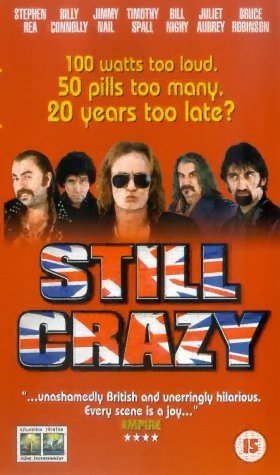
Finally, there’s “Still Crazy” from 1998, another very likable but less-noticed entry of this genre. Strange Fruit were a 70’s band from England whose in-fighting and substance abuse stymied their chances for superstardom. What are the chances?! By way of explanation, the film opens with the straw that broke the group’s back (festival gig meets ill-timed electrical storm) before fast-forwarding twenty years to the mid-Nineties where a chance meeting sets in motion plans for a reunion tour. A memorable meditation on rock’s mid-life crisis, and a cock-eyed tale of redemption, follows along with it.
Twenty years after that fateful festival, Tony Costello, the band’s keyboardist and center of gravity played by Stephen Rea, runs into the admiring son of the original promoter and learns of plans for re-booting the event. Willing to suspend his condom vending machine business to put to rights the Fruit’s unfinished business, Tony first meets up with the still-fetching Karen (Juliet Aubrey), the band’s former Girl Friday, who ditches her corporate job for a chance to be their manager. In witty sequence, they round up bassist and founding member Les (Jimmy Nail), the flamboyant but insecure lead singer Ray (Bill Nighy) and incorrigible, taxman-dodging drummer Beano (Timothy Spall). Inviting himself back in the fold is Hughie (Billy Connolly), the band’s wildman road manager and the film’s droll narrating voice.
Director Brian Gibson culled plenty of sly ensemble comedy from this crack line-up of Boomer-aged likely lads. Mainly valued as a supporting player, the great Bill Nighy is the nominal lead here as the aristocratic Ray, recovering alcoholic and middling solo act who’s trying to revive his career and hold onto his country estate. But just as big a presence in his absence is Brian, the founding guitarist who was the once the Fruit’s leading creative light but now is missing in action. True to the outsized influence of real life rockers who die young or flame out (like Pink Floyd’s Syd Barrett, who Brian resembles in flashbacks), Rays suggests to Les that the group can’t advance so long as the brooding bassist “worships the ground that Brian vomited on.”
But press on they do. Karen’s appeal to their old record company for a U.K. university tour and a catalog re-issue gets met with a counteroffer for a round of nightclub gigs in Holland and Belgium. Soon, Strange Fruit are off on their own logo-emblazoned coach, tooling down the highways and byways of the Low Countries—at first stumbling and bumbling but soon enough, with the help of their young new hotshot guitarist, getting their act together like in this prototypical hitting-their-stride sequence.
Jumping into action as Ray’s Ninja Rock Wife is actress Helena Bergstrom. Well played!
The film’s music was co-written by Chris Difford of Squeeze and Foreigner guitarist Mick Jones and the band songs are an uncanny amalgamation of 70s glam, prog and arena rock styles (Bill Nighy and Jimmy Nail do their own singing). That is crucial because, instead of filling in clichéd character slots, the film shows a rock band just as it is, with its variable tastes, mismatched ideals, awkward male camaraderie and personal imperfections, trying to reach a united peak where each member still gets individual fulfillment. It’s not easy to hold all this together, especially as the 20th anniversary festival draws closer but fate has a way of cutting both ways. Plus, Les has an ace in the hole: a long tucked away show-stopper song, an 8-minute flag waver called “The Flame Still Burns” that would be just perfect for a certain surprise guest…
Sadly, this would be director Brian Gibson’s last film as he died in 2004, aged 59. Gibson had a knack for music-related films. True, he did helm 1980’s rather regrettable “Breaking Glass” where the strident Brit singer Hazel O’Connor rises to unlikely messianic fame, although “Quadrophenia” star Phil Daniels was very good in the role of her manager. More successfully, he later made the Tina Turner biopic “What’s Love Got to Do With It” and “The Josephine Baker Story” for HBO.
I’ve just posted my fourth article on James Curnow’s great film site Curnblog, an article on art world-related documentaries centered around the recently released Penn & Teller film, “Tim’s Vermeer.” You can click on the link below if you’re interested. While you’re there you can also check out some of the many entertaining and enlightening pieces on this Australian-based site.
Up above in the header, we end National Poetry Month with another dice roll half-haiku from words picked pin-the-tail-on-the-donkey style from a poetry-magnet website. May is right around the corner and hopefully springtime is as well…
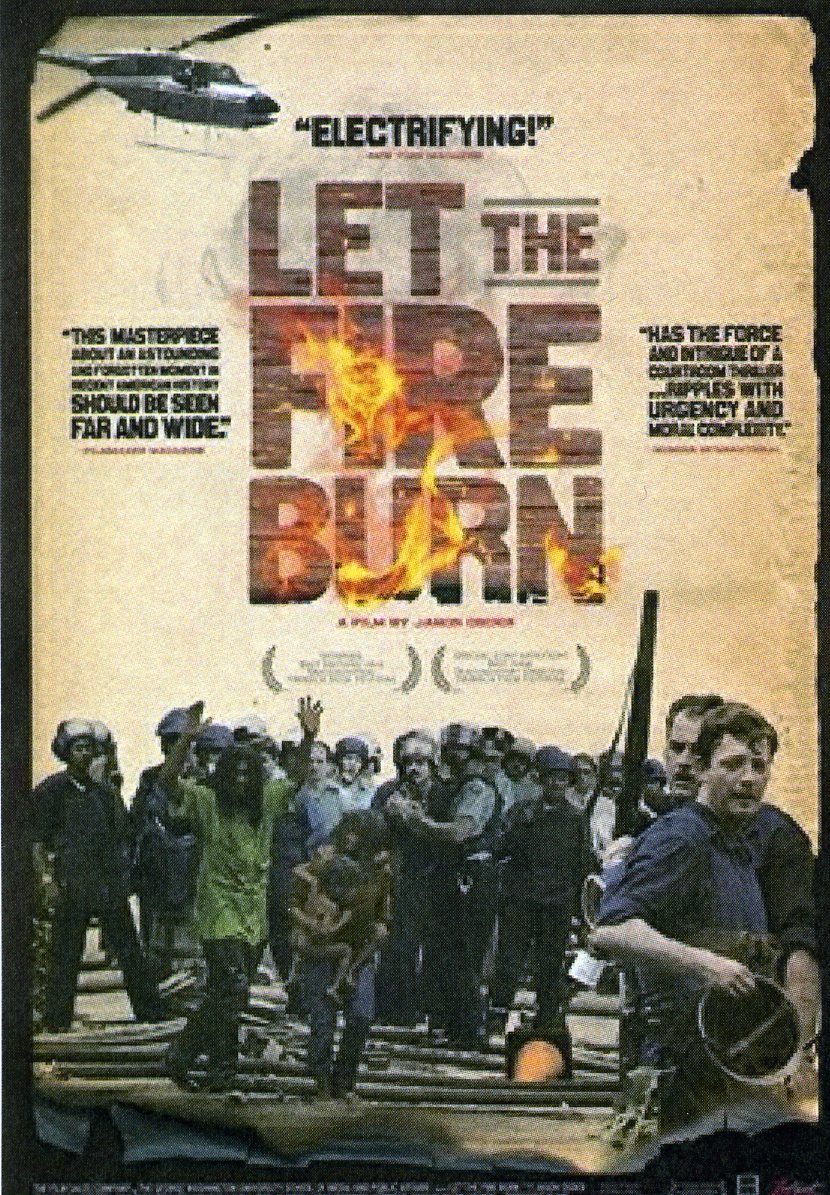
The excellent PBS documentary series “Independent Lens” continues with two more notable selections the next two Mondays at 10:00 PM. On May 5th, they’re showing “A Fragile Trust” about the New York Times plagiarism scandal centered around Jayson Blair. Definitely worth watching. Back in March (when it was warm, go figure), I saw it at the Salem Film Fest here in Massachusetts. On May 12th, I greatly anticipate seeing “Let the Fire Burn” which has received a lot of praise on the festival circuit. It examines the still hard-to-believe 1985 Philadelphia Police Dept. bombing of the compound occupied by the black liberation group MOVE, killing all but two of its members and obliterating 60 nearby houses in the process.
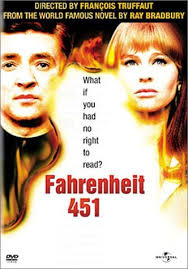
While puttering around in the library a couple of weeks ago, I looked down at the cart where they put the recently-returned DVDs and caught the soulful gaze of Julie Christie on the cover of the recently re-issued 1966 film version of “Fahrenheit 451” directed by Francois Truffaut. So of course I had to check it out. The French auteur’s first English-language movie has always had a mixed reputation at best: the acting and dialogue was deemed too starchy and the themes of Ray Bradbury’s classic speculative novel too flattened out.
But it had been so long since I last watched it (probably on a 13-inch TV) that I figured a new viewing would be like a re-discovery. And how. In this age of restored content and hi-def screens, Truffaut’s “451” looks fantastic with its autocratic iconography, bold primary colors and the retro futurism of its deftly chosen locations. Also, in view of broad societal shifts since it was made 48 years ago, the film seems more prophetic than ever.
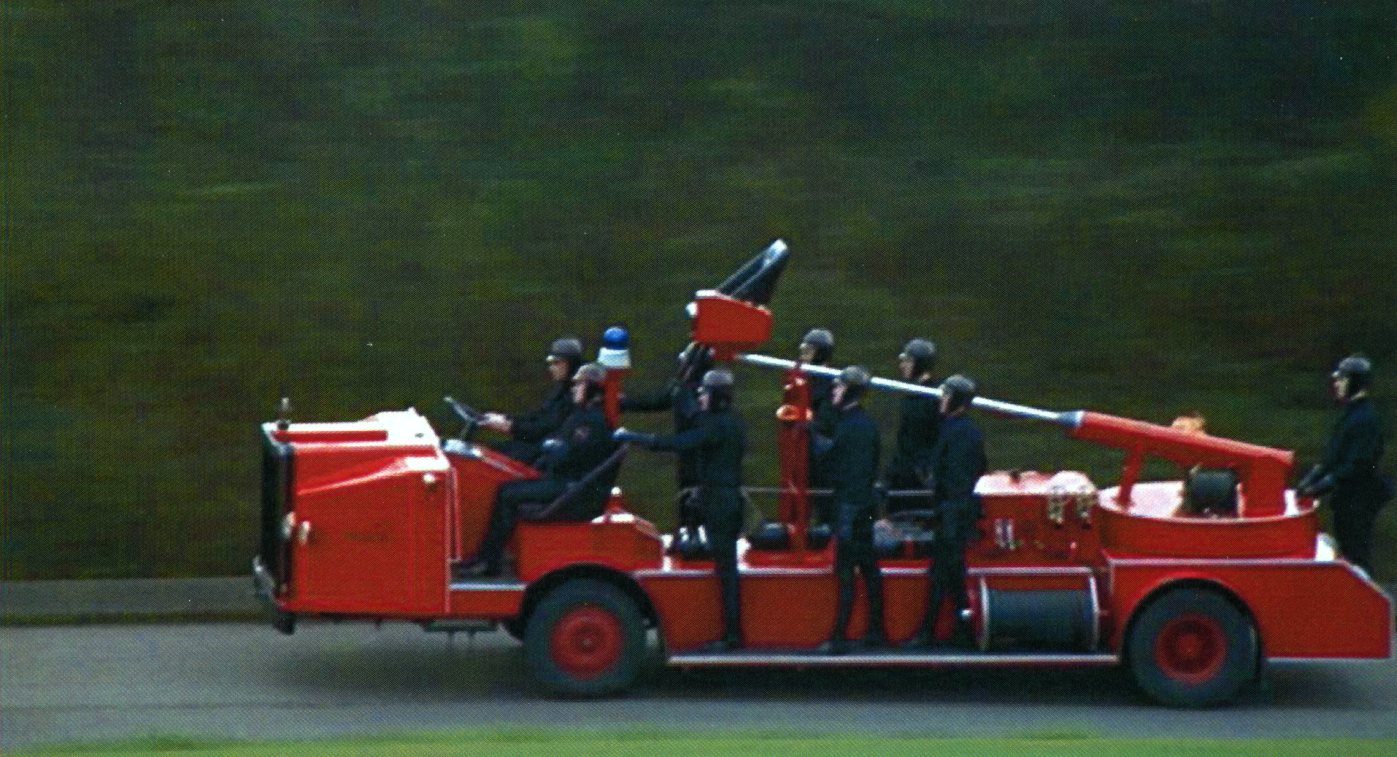
The flamethrowing fanatics of “Fahrenheit 451”
Coming soon to a Barnes & Noble near you!
Of course, the central premise of Bradbury’s cautionary tale may seem silly in retrospect. In a world where all literature is banned, the protagonist, Guy Montag (Oskar Werner), is part of a team “firemen” who rely on informants (usually neighbors) to swoop down on the homes of violators and publicly burn their hidden stashes of books. The plot centers on Montag’s crisis of conscience as he starts to read books that he has slipped into his kit bag during raids. Matters are complicated by his budding friendship with the non-conformist Clarisse. Both Clarisse (a student in the novel but a young teacher here) and Linda (Montag’s media-overloaded, pill-popping wife) are played by Christie.
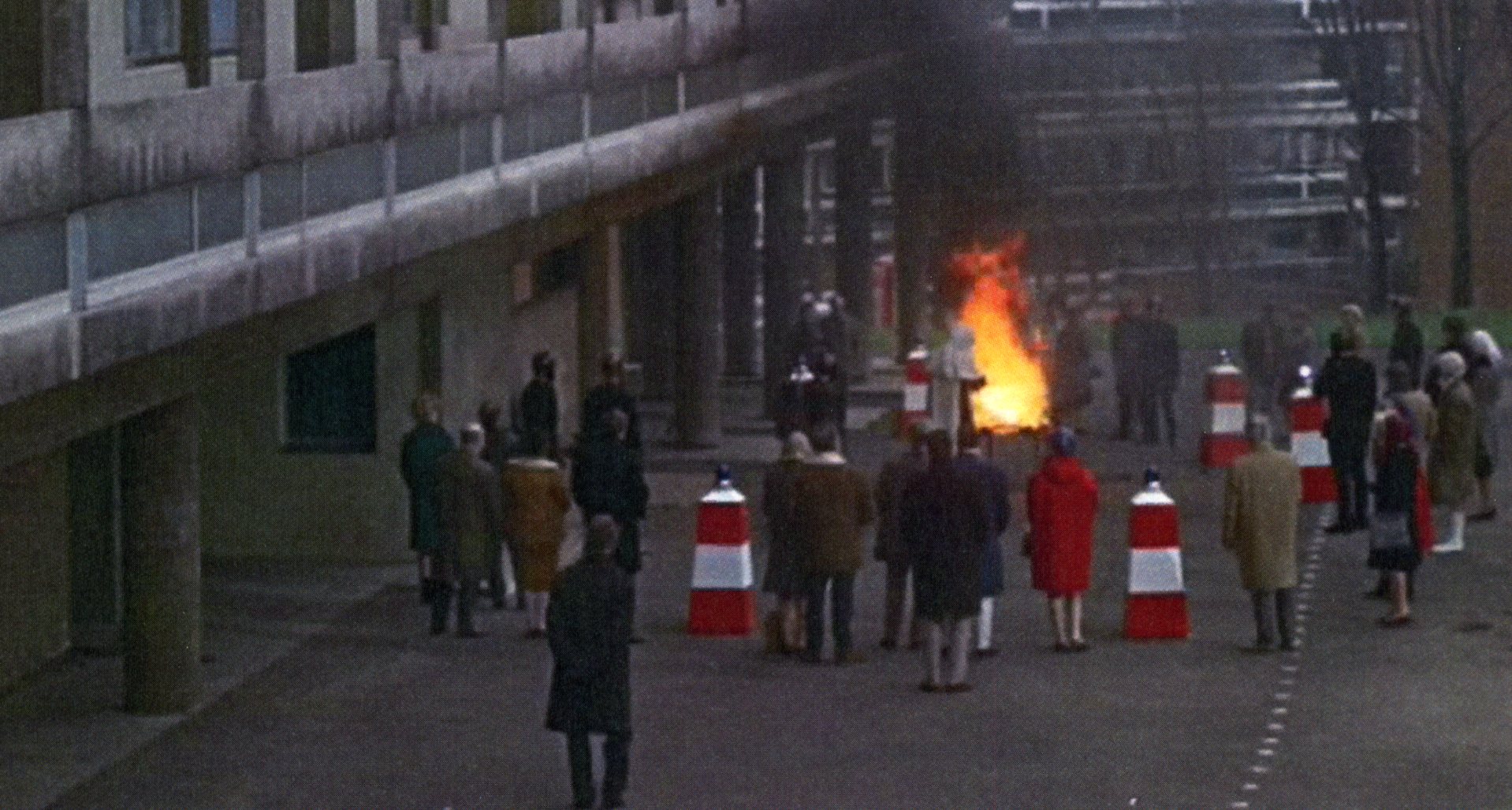
The institutionalized conflagrations of this story can appear far-fetched. Yet when Bradbury wrote this in 1953 the Nazi book burnings were in recent memory and the dirty dealings of the House Un-American Committee were in full swing. The state-sanctioned pyromaniacs of “Fahrenheit 451” were more broadly symbolic of the casting off of all independent knowledge and self-determination.
Behind the visual hyperbole of the black-shirted firemen with their brass kerosene squirters and fascist salutes, Truffaut tweaks some of the book’s subtler messages to great effect. Although this is supposed to be a totalitarian society, there is no overarching Big Brother; the local fire department zipping around in their pyromobile is about the only representation we really see. Instead, the tiresome tirades of some blowhard dictator has been effectively supplanted by ingratiating TV hosts making every one of their “cousins” feel as if they are Special just by tuning in.
This personal neediness, so well evoked by Christie’s nuanced performance as the wife, is all too indicative of an attention-starved 21st century Western population. Instead of Orwell’s 1984-style eternal-boot-in-the-face, the people are kept in place by being incessantly flattered. Instead of widespread state censorship, we get instead access to everything in a completely commodified environment. (The child-less Linda remarks that “when you have a second wall screen put in, it’s like having your family grow around you.”)
But access is a long way from enlightenment. In our own age, ads endlessly hawk Internet speeds “ten times faster” than speeds that are already all but instantaneous, an age of aggressive techno-snobbery where people wait in overnight lines to trade in their “old” I-phones that were state of the art six months before. Relatively recent analog technologies are dismissed and even disdained while we barely bother to shrug at the widespread loss of personal privacy and make no distinction between reasonable progress and a runaway train. Meanwhile, deep-seated problems like income inequality and a ticking environmental time bomb, while not exactly ignored, fight for attention in a 24/7 overflow of content where melting Arctic pack ice and the latest celebrity baby bump are two equal drops of information and bookstores close left and right.
The brutalist architecture of Alton Estate in the London suburbs frames the firemen’s handiwork
Truffaut’s film is an uncanny time-indefinite fable, where such technology, as far as it could be imagined back then, has rendered a population inured to any causes but their hedonism. In the world of “Fahrenheit 451” there are few options left, which make’s Christie’s housewife Linda more sympathetic than her counterpart in the book, who was named the less-appealing Mildred. But Bradbury made clear in the book that the totalitarian state came about in part because the over-abundance of pleasure-delivering technologies sapped the populace of their willpower to challenge authority, and the jackbooted thugs just stepped in to finish the job with flamethrowers. We still have something of a choice left, but it doesn’t appear to stretch out indefinitely. If our own era is the start of an invisible dystopia, then give me the film’s version, where at least you can ride home from work in an awesome monorail (that lets you off in a meadow!) and walk back to your house chatting with a mini-skirted bookworm subversive.
Oskar Werner (who was best known for his role in Truffaut’s “Jules and Jim”) is quietly impressive as the conflicted Montag. The Austrian actor (who was a pacifist) had fled the Nazis in the latter stages of World War II and with his young child and half-Jewish wife, waited out a battle by hiding in the Vienna Woods. This scenario is echoed in the film’s final scenes when Montag, who is found out and forced to take part in a raid on his own house, takes drastic action before fleeing. (Even the clunky process shot of jetpacking policemen in pursuit–the film’s one big visual miscue—-seems endearing in retrospect). He follows an old railroad line to a forest populated by the Book People, each committing one volume to memory so as to carry forth the world’s knowledge while staying within the law. Of course, too-hip critics gagged at the achingly sincere tableau of societal holdouts introducing themselves to Montag as their title. Ray Bradbury may have liked many things about the adaptation, including the decision to not kill off Clarisse and to have one of the Book People introduce himself as “The Martian Chronicles” (a surprise tribute from the director). But the official consensus was that the film was a Disappointment and the monolingual Truffaut would not make another English-language film nor would he attempt another genre movie—although an admirer of the novel he was not a big science fiction fan. Too bad, “Fahrenheit 451” is a great embodiment of the old saying that “if you don’t stand for something, you’ll fall for anything” and this worthy cinematic complement to the book drives home that ever-salient point even further. Check it out and see if you agree, cousins.
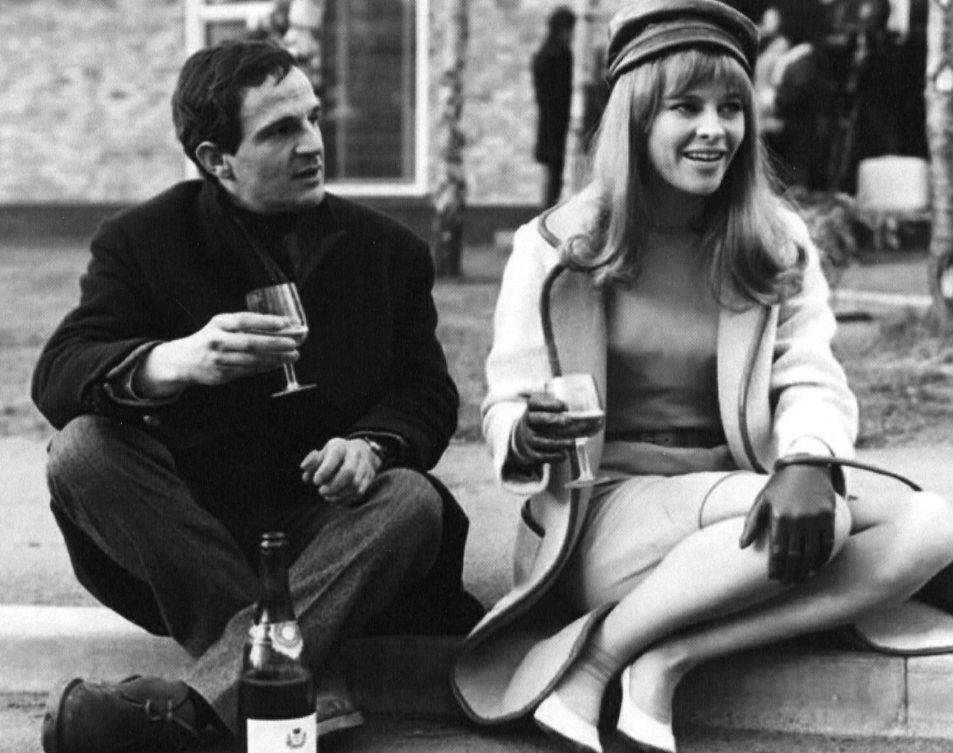
Truffaut and Christie after a day’s shooting in Roehampton, England 1966
Lucky for the director, Julie speaks French
My psychic antenna doesn’t always pick up on National Poetry Month when April rolls around. Early April is more like the time that we in New England are kept busy searching the weather reports for any viable sign of real springtime. Typical of this seasonal limbo is my current disinclination to put pen to paper even though, as Bobby Dylan once put it, “I have a head full of ideas that are driving me insane.”
I did spend some quality procrastination time this week going over old notes and clippings and perusing photos I took long ago with my first camera, a brown-and-cream colored instamatic that used 126 cartridge film (see above). I also found a torn-out notebook page that I knew would come in handy some day. Back in the late 90s, while living in Cambridge, Mass. the city put up several magnetic poetry boards in Central Square. You know the kind, with hundreds of individual little magnets made up of one word each. I was quite enamored at the beguiling and beautiful poetic snippets that arose from scrambled word combinations and wrote down my favorites. So I’m marking NPM with a celebration of the inner poet that apparently resides in us all. I also got into the spirit yesterday by going to a site that tells you how to make your own magnetic poetry kit. I printed out a page of random words, closed my eyes, and put a pencil down on several words then fashioned them into a half-haiku that uncannily seemed to be saying something to me that I ordinarily wouldn’t have found a voice for (see the header above). I’m sure many of the people that came up with these little gems below felt the same way at the time.
Start to end winter inside; you are born in our desire
Elaborate green garden remember
Some swim like rain forest picture
Listen: all yesterday my fever and fire like moose did sail in liquid star
Every marble which must always shine
Lie like a cat this game this game may die
By sky look at I am joy
Magic perfume went blindly into the night
A girl once flew to get together and out
For the castle the moon, a bare angel
Soft like no boy of sweet summer
Forgive live as magic it may wake up or go
Love grow fast and free girl
Did owl have feline heart?
Round and wet blue, song-fed dinosaur
Stop once in peace
Dad that cried do not get sad
Slowly happy together grow
We were green and are
My bath may smoke up and have sun on the breeze
One silly day you were bleeding and went into my box
Born on yellow farm, summer night glow
Homeless child of night cried “friend!”
Yesterday went away like a slow song of woman’s desire
Joy ran from a friend, she went round slowly
A blue sky whispering yes
Smart rain round my night, moon turn out poison
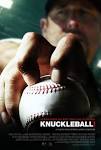
Knuckleball!
Directed by Ricki Stern and Anne Sundberg—2012—85 minutes
It’s nearly a lost calling, like a shoe repair shop or a pen-and-stationery store hanging on in a world otherwise dominated by Apple and Wal-Mart. A patient craft that is difficult to master in an age of instant gratification and performance-enhancing drugs. The confounding knuckler, like the hidden ball trick or stealing home, is almost gone from baseball. This pitch, delivered at a velocity some 20-30 miles per hour slower than standard-setting fastball, flutters and floats in on the batter. If swung on and missed, he’ll look ridiculous, if he connects he could hit it into the next time zone.
America’s oldest professional team sport may be losing this eccentric part of its legacy, but not many players and managers are mourning the near demise of the knuckleball. The pitch infuriates many habit-obsessed hitters and knuckleball throwers usually require special coaches and catchers. So in celebration of baseball’s opening week, let’s take a look at the recent DVD release of Ricki Stern and Anne Sundberg’s winsome 2012 documentary on the small and misunderstood cult of the knuckleball, referred to by non-believers as “fraudulent” or “a freak pitch.” It’s a celebration of non-conformity and persistent humility now fleshed out with almost two hours of featurettes.
As a fan of my hometown Boston Red Sox, I got to see one of the filmmakers’ two primary subjects up close. Tim Wakefield started out as a first baseman in the Pittsburgh Pirates organization but developed the knuckleball pitch after being told he would likely never make the Major Leagues as a position player. After a sensational first season with the Pirates, the knuckleball magic abandoned him (walking ten men in a game at one point) and he was cut loose, surfacing next year in Boston for a 17-year career where fans would become intimately familiar with fickle fortunes of one who depends on such an unusual skill.
Tim Wakefield and the unorthodox fingernail grip
Wakefield was 45 years old and already a member of two World Series champion Red Sox teams when seen here playing in his last year; much of the focus here is on his protracted efforts to secure his 200th career win before the season ends. The only other current knuckleballer, the much younger R.A. Dickey of the New York Mets, is also profiled and the usual slings and arrows of outrageous fortune that come with his craft are compounded with a health issue that threatens his livelihood. The filmmakers cut back and forth between these parallel tracks during the 2011 season, often blending in the players’ personal stories and putting the lie to the easy notion that all pro players are spoiled and overpaid. Dickey, for instance, bounced around the minors for a long time making $1800 a month (summers only) and sometimes moving his young family two or three times a year, trying to keep the faith that his big-league dream would pay off in the end. On the verge of making it to “The Show”, a medical review found a congenital anomaly in Dickey’s pitching elbow, but in a gutsy move he took a drastically reduced contract offer instead of cashing in a million-dollar insurance policy.
Battle Cry of the Knuckler: R.A. Dickey in action
Elsewhere, Stern and Sundberg review of a bit of the knuckleball’s mystery history (no one’s sure who started it and it’s only had 70 or 80 true practitioners in the last century plus) and emphasizing its true outsider status: Wakefield unpretentiously declares that a knuckler is “on a little island by yourself.” Never has that been truer than in the 2003 American League playoffs. Wakefield had dominated the Red Sox’ age-old rivals, the New York Yankees, in two of the series’ previous games and would have been the hero had the Sox won and gone on to the World Series with a good chance to win it for the first time since World War I. But he was called in from the bullpen late in the deciding seventh game because the Sox manager had left their starting pitcher in too long, allowing the Yankees to tie the game. When Wake gave up a game-winning home run, it was one of the most ignominious defeats in the team’s history and the film makes the viewer live the pain of an athlete (and a person) who has quietly done all that’s been asked of him, including being put into an untenable position. When the Red Sox went on to win a championship the next year they had to beat the Yankees in another epic 7-game series (winning four in a row after losing the first three)along the way. Wakefield played a crucial role in the second of those victories, the winning pitcher in a six-hour game that helped pave the way for Boston’s first World Series win in 86 years (you’re welcome!). Tim’s redemption was almost biblical in it’s serendipity, though the directors curiously underplay it (unlike me).
Tim Wakefield has the Yankees “turning Japanese” as they try in vain to fathom the elliptical flight path of an in-form knuckleball during the 2003 playoffs while the Boston fans eat it up.
The knuckleball pitch, being both unpredictable and easy on the arm, destines these pitchers to be used either too often or too seldom or treated unfairly: being shuttled between a starting role and the bullpen, being brought into games when the score is lopsided, dropped from playoff rosters. Little wonder that one of the more enjoyable parts of “Knuckleball!” is the get together of Wakefield and Dickey with two old-timer practitioners, Charlie Hough and the incomparable Phil Niekro. Hall of Famer Niekro won an amazing 318 games as a knuckleballer and pitched in the pros until the age of 48. The self-deprecating camaraderie of knuckleballers and the way this fraternity helps each other (Niekro tutored Wakfield who in turn offered advice to Dickey) will appeal to viewers jaded by the media over-hype that so often dominates sports coverage.
Maybe it’s not surprising, given their built-in status as sporting underdogs, that many of these guys would be doing good works outside of their profession. Yankee knuckleballer Jim Bouton, best known for his classic expose bestseller “Ball Four”, was also a liberal activist who protested the South Africa’s apartheid government way back at the 1968 Summer Olympics. Both Wakefield and Phil Niekro are past winners of the Roberto Clemente Award, named after the Pirates’ superstar who lost his life in a plane crash on the way to delivering supplies to victims of the 1973 Nicaraguan earthquake. R.A. Dickey is involved in the Bombay Teen Challenge, which aids victims of overseas human trafficking. The good karma seems to be paying off for Dickey the way it did for Wakefield in 2004: the season after this doc was filmed R.A. won twenty games and became the first knuckleballer to win the Cy Young award as his league’s best pitcher.
Happy to announce that my book, “Documentary 101: A Viewer’s Guide to Non-Fiction Film”, previously available only in paperback, has now been released as an e-book in all formats—in most cases selling for the low low price of only $4.99. The list of the various online outlets is below; all of these sites allows you to “look inside”, usually meaning a peek at the first 40 pages that before now was only available on my author page of the publisher BookLocker.com
BookLocker has done a great job on the e-book conversion, allowing readers to land on any of the over 300 reviews by clicking on the title in the table of contents.
In my Catergories list to the right,the “Documentary 101 Samplers” features highlights from a more varied cross-section of the book, along with film stills only seen there.