I come to praise Cesar (Catalina), not bury him. For many, “Megalopolis” is an easy film to dislike, but it’s a rewarding one to give an honest look at. Francis Ford Coppola’s long-gestating mega-project is messy and often unfocused, with moments of unintentional hilarity. But those moments are not nearly as laughable as some of the negative opinions lobbed at it.
In an age where cynical slasher movies and DC/Marvel sequels are puked off a cinematic assembly line at record pace, calling “Megalopolis” the “worst movie of all time” with “no redeeming qualities” is kind of like settling on Milli Vanilli’s “All or Nothing” as your favorite album because you thought the Beatle’s “White Album” was too sprawling.
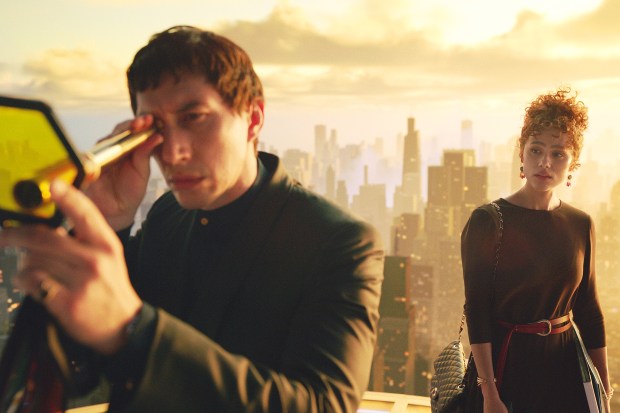
In a re-imagined New York City called New Rome, superstar architect Cesar Catilina (Adam Driver) has altruistic ideas for rebuilding a city that is a teetering empire very obviously based on its namesake. Against a backdrop of garish decadence (there are orgy-like parties and even a chariot race) Cesar’s proposal, as chief of the city’s Design Authority, is opposed by the old-school mayor Franklyn Cicero—played by Giancarlo Esposito who bears a strong resemblance to NYC’s current embattled mayor Eric Adams.
In its own loopy way, “Megalopolis” is a sincere plea for an idealistic way forward for a world society in a time of debilitating tribal and nationalistic divisions. Comparing the bitterly polarized America of today to the approaching fall of the Roman Empire is not exactly a novel idea, but Coppola’s visual representation of this concept is the film’s strongest element.
From the late 19th century to the mid-1940s, New York was built to a majestic, inspirational scale comparable to what the Eternal City was in the ancient world. Cesar’s apartment/studio is in the defunct Cloud Club atop the Chrysler Building. Imposing low angle views of the Helmsley Building, Grand Central and other classic Manhattan structures are used to great dramatic effect, and we get to go underground to get a glimpse of the faded glory that is the old City Hall subway station. Colossal living statues sit despondently or crumble in alleyways, their great allegorical symbolism forgotten.
At the core of “Megalopolis” is a factor often overlooked but important enough to warrant its own section in the movie’s Wikipedia entry: “Artistic Idealism as Antidote to Polarization.” That is, the role of the creative class in helping create more inclusive and livable cities. I can only hope that Coppola’s vision at least inspires some younger artists to foster a new generation of bold, humane visions (and in all the various ways they can be attained) in a world that so surely needs it.
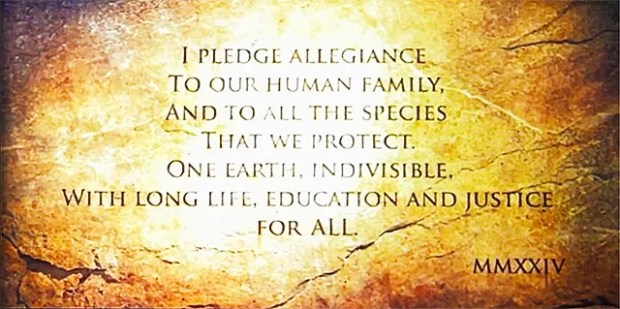
The film’s closing title card attempts to transcend both nationalism and identity politics.
I did, however, have a problem with Cesar Catalina’s use of the word “utopia” which Mayor Cicero correctly identifies as a fantasy land. What Cesar really strives for is a “protopia,” a practical way forward to a better world for all. I think it was a deft move by Coppola to have the cerebral Cesar allied with the more grounded mayor for the film’s corny but uplifting closing scene.
Hopefully, this noble-but-flawed valediction for the 85 year-old filmmaker will outlast the confidence of the naysayers who to me sound too smart to know any better. “Is this way we’re living the only one available to us?” Cesar memorably asks at one point. I would like to think so, but I’m far from sure about it.
It’s a funny thing, the long tradition of rock artists recording songs written by others. The origin story of untold thousands of bands has them cutting their teeth on an old Chuck Berry number or blues standard, or maybe “Louie Louie” and/or “Gloria.” Many groups soon to be famous for penning their own tunes, from the Beatles and Stones on down, peppered their early albums with cover material. Hell, even Bob Dylan’s 1962 debut only featured two songs written by the man himself.
But from the mid-Sixties on, the only true way forward in the rock business was to be performing your own compositions. Unlike the Sinatras or Tony Bennetts of an earlier era, the pantheon of Boomer-era acts featured few song “interpreters” (Linda Ronstadt and Joe Cocker are two that spring to mind). If you can’t write ‘em, your outfit may soon be relegated to eternal bar-band status.
Yet no matter how good a band’s own material may be, musicians are always fans first. A well-placed cover song can really add to an album’s success, whether it be Jimi Hendrix’ definitive take on Dylan’s “All Along the Watchtower,” the Clash’s “Police and Thieves,” the Talking Heads’ “Take Me to the River” or name your favorite.
But an album full of other’s material by those well known for penning their own songs rarely turns out to be a triumph. Is it because many are contractual obligations, or place markers when one is a little thin on new material? While some are fun, rarely is it a discographical highlight. Let’s have a look.
“Pin Ups” David Bowie (1973)
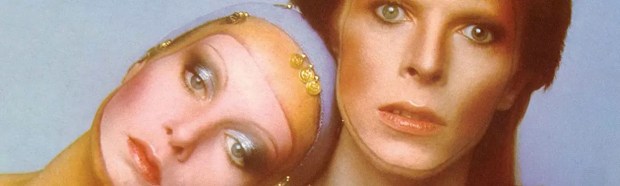
Let’s start with a good one, so we can see what makes for a successful covers album. The reason Pin Ups ranks so high is that it has a workable concept and there is an effort made on some tracks to put a new spin on the material. David gives props to the British bands that inspired him in the years 1963-67, just prior to his own recording career taking off.
He does a slowed-down version of the Who’s “I Can’t Explain,” playing a sexy sax refrain to go with it. The wild instrumental coda he gives “See Emily Play” makes it even more acid-drenched than the Pink Floyd original. True, elsewhere he sticks close to the original, as on the two Pretty Things selections and the Kinks’ great anti-anthem “Where Have All the Good Times Gone.” But these are helped by the fact that they are backed up by the Ziggy Stardust band, featuring guitarist Mick Ronson on guitar. Another highlight is Bowie’s lovely, doleful take on the Mersey’s “Sorrow” which was a hit single in several countries. Grade: A-
“Moondog Matinee” The Band (1973)
“Why don’t we just do our old nightclub act” the late Levon Helm recalled someone in the Band saying, but the drummer/vocalist can’t recall who, per his lively memoir “This Wheel’s on Fire.”
The group was in the middle of a ten-record deal with Capitol Records and short of new material. They were also in the middle of a group relocation from the Catskills to Malibu and cutting a quick record of tributes bought them some time. It’s more a well-curated and well-performed selection of early R&B and rock ‘n’ roll chestnuts than a nightclub act, though they deliver some potential crowd-pleasing things like the cheeky Lieber-Stoller rug cutter “Saved.”
Elsewhere, songs from Sam Cooke, Allen Toussaint, Fats Domino and Chuck Berry abound. There a few twists: keyboard wizard Garth Hudson has a great go at the timeless “Third Man Theme” and Helm used a then-newfangled talkbox to get the needed croaking part on Clarence “Frogman” Henry’s “Ain’t Got No Home.” A fun listen but inessential, like many in this category. Grade: B
“Rock ‘n’ Roll” John Lennon (1975)
John Lennon was well known for his deep-rooted love for Fifties music but the actual impetus for this album came from a court settlement. The notorious music publisher Morris Levy sued Lennon because the music to the Beatles’ “Come Together” (though slowed down) and one line (“Here come old flat-top”) bore a strong resemblance to Chuck Berry’s “You Can’t Catch Me,” which Levy owned. The agreement read that John would record three songs from Levy’s publishing company on his next album.
When word got out in the fall of ’73 that Lennon was recording a tribute album in Los Angeles, all his musician friends/drinking buddies showed and it was quite a scene. Producer Phil Spector shot a hole in the roof and a bottle of whisky spilled onto the console, amongst other hijinks. Some material managed to get recorded but then Spector ran off with the master tapes. Lennon shelved the project and recorded Walls and Bridges instead. The tapes were eventually recovered, and the rest of the album was knocked out (under further legal duress from Levy) in three days in the fall of 1974 for an early ’75 release.
The results were predictably patchy but there are some fine moments: an energetic stomp thru “Bony Moronie,” a reggae-inflected “Do You Want to Dance,” and a soulful take on Ben E. King’s “Stand by Me” that was a Top 20 single. Elsewhere, several tracks sound rushed or uninspired, and admittedly one of the best things about Rock ‘n’ Roll is Jurgen Vollmer’s great photo of a young, leather-jacketed Lennon leaning in a doorway from the Fab’s Hamburg years. Grade: B-
“Givin’ it Back” The Isley Brothers (1971)
Well, here’s a bit of a “twist” in the covers album scheme of things. The Isley Brothers, whose songs had been covered by many Sixties rock bands (esp. in the case of the Beatles’ “Twist and Shout”) return the favor by covering an eclectic collection of (mostly) white artists. Side One consists of three extended tracks, marching out of the gate with a powerful protest medley of Neil Young’s “Ohio” and Jimi Hendrix’ “Machine Gun.” The Vietnam War was still very much happening in 1971, and there’s no missing the urgency in Ron Isley’s lead vocal. Meanwhile, kid brother Ernie, not quite twenty at the time, gets to show off his already prodigious guitar chops. Hendrix was briefly in Isley’s backing group and his influence was quite clear on Ernie, who knew Jimi as a kid.
Turning James Taylor’s regretful ballad of a friend’s suicide into an Issac Hayes-style psychedelic soul number may not have been the best decision, but their “Fire and Rain” is interesting, nonetheless. More successful is their ten-minute slow jam on Bob Dylan’s “Lay Lady Lay” which gives Ron plenty of time for seductive ad-libbing, stopping just short of Barry White territory. (On successive albums, the Brothers would continue to produce extended soulful covers of soft-rock hits like “Summer Breeze” and “It’s Too Late,” often featuring dramatic guitar workouts from Ernie). The album rounds out with two Steve Stills’ numbers (the single release of “Love the One You’re With” hit #18 on the pop charts) and Bill Withers’ “Cold Bologna” with the songwriter guesting on guitar. Grade: B+
“Compliments of Garcia” Jerry Garcia (1974)
When I was in high school, I received a complimentary (if you will) armful of Grateful Dead-related vinyl from my girlfriend’s neighbor who worked as a publicist for the band. There were acknowledged classics (Workingman’s Dead), a few oddities (the outré soundscape Seastones on which a couple of Dead members appeared), and a few solo albums, including this covers album which for some time was a left-field favorite of mine. It presents as a record to be lightly regarded, as Jerry gives low-key props to some of his wide-ranging influences. But as soon as the train whistle and shuffling beat kicks off the album (with Chuck Berry’s “Let it Rock”), I was drawn into the record’s laid-back appeal.
Maybe it hasn’t aged all that well in this less laid-back time. His takes on Smokey Robinson and Dr. John are pleasant if unspectacular, and Garcia maybe should have second-thought the inclusion of “Let’s Spend the Night Together” (one reviewer quipped that this version made it seem like the couple in question spent the night playing cards). But there are also well-considered versions: his in-the-pocket rendition of Van Morrison’s “He Ain’t Give You None” is preferrable to the author’s undisciplined original on T.B. Sheets. Best of all is a beatific, slowed-down take on Seatrain’s “Mississippi Moon.” And it ends nicely with “Midnight Town,” an atmospheric number by Garcia Band bassist John Kahn. Grade B-
“The Hit List” Joan Jett (1990)
I was a bit surprised at how quickly this album flat-lined for me. Maybe because Jett’s breakout solo LP (1982’s I Love Rock ‘n’ Roll) featured three definitive cover tunes. The title track she made completely her own, turning it into a worldwide #1 single. Another breakout performance was on Tommy James’ “Crimson and Clover,” where her breathy, come-hither vocal memorably mixed with crunching power chords. And it ended with one of the best-ever holiday rock songs, a bratty “Little Drummer Boy” that concluded with an instrumental rave-up worthy of the Who’s Live at Leeds.
So where did The Hit List go so wrong? For one, randomness never bodes well—Jett goes from ZZ Top to the Sex Pistols to Credence as if all three bands were cut from the same cloth. Secondly, her vocals range from pro forma to uninspired. She practically sleepwalks thru “Love Hurts,” only serving to remind one of the full-throated drama of Nazareth’s hit version or the plaintive charm in the way Gram Parsons did it. And strangely enough all we get is autopilot mode on AC/DC’s “Dirty Deeds,” which should have been a natural for her.
There are a couple of modest highlights. There’s the one left-field choice (the Hendrix obscurity “Up From the Skies”) and an appealing version of the Kinks Klassic “Celluloid Heroes.” Here we get the Sweet Joanie voice and a convincing arrangement that leads up to one of her patented shouts, maybe the only one on the whole record. Saved from a D+ for the glamourous cover photo. Grade: C-
“Thank You” Duran Duran (1995)
In deference to some of the selections above, being uninspired is one thing but being downright bizarre is quite another. And so we have New Wave glamour boys Duran Duran. They may have peaked in popularity in the early 80s but in the mid-90s their records were still regularly in the Top 20, esp. in their native UK. So I’m not sure what inspired them to foist this rummage sale of a covers LP on the world. Taking on vintage R&B, hip-hop, classic rock and ballads with the same dilettantish insolence, Thank You was voted the worst album of all-time by staff of Q magazine in 2006.
Probably most galling for the critics, were DD’s take on two notable rap numbers. Their Beck-like version of Public Enemy’s “9-11 is a Joke” is a joke. But it’s not as bad as the presumptuous run-thru on Grandmaster Flash/Melle Mel’s classic “White Lines.” You can’t fault the boys on their energy level but the cognitive dissonance is too pronounced to overcome. Let’s just say it’s a long way from a Bronx block party to a Notting Hill boutique.
Elsewhere, there are very unimpressive takes on oft-covered material like “Ball of Confusion,” “Lay Lady Lay” and Lou Reed’s ubiquitous “Perfect Day.” I will give bassist John Taylor props for his work on the “funkier” numbers, but singer Simon Le Bon didn’t get the memo that there is more to paying tribute in song than just knowing the words. Worst of all is a regrettable version of the Sly Stone’s “I Wanna Take You Higher” which concludes with some teenybopper girl dumbly asking the guys where they wanna take her and when they dumbly reply “higher” you realize that this giant mistake of an album couldn’t get any lower. Grade: D
More coming up soon in Part Two, including entries from the Ramones, Patti Smith, Cat Power and Elvis Costello. —Rick Ouellette
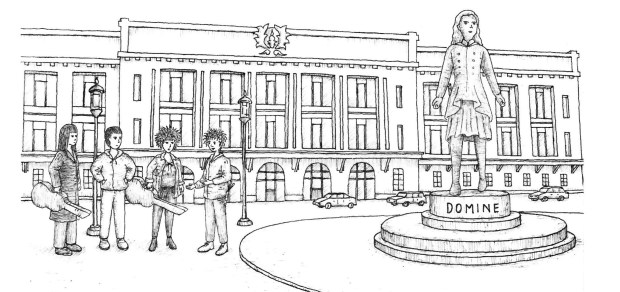
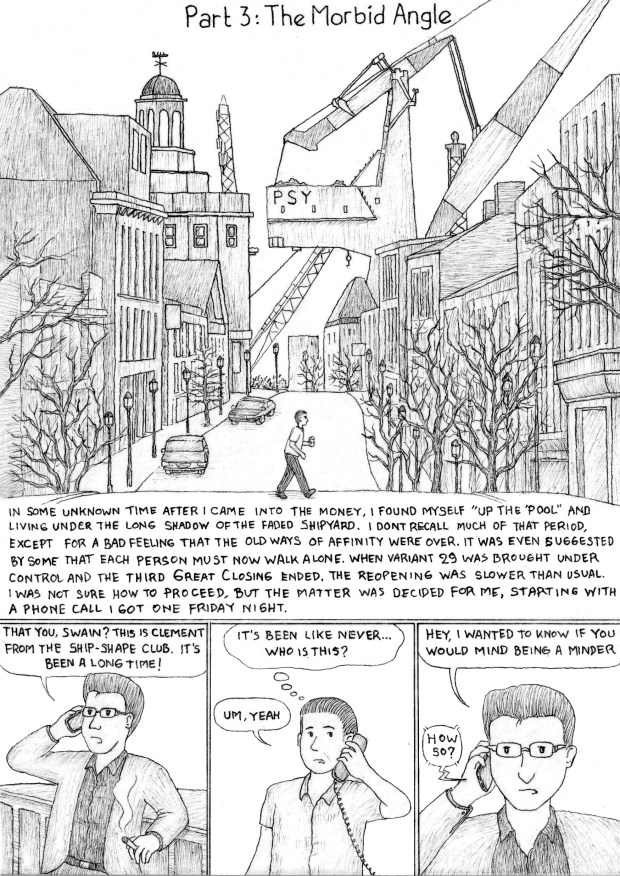
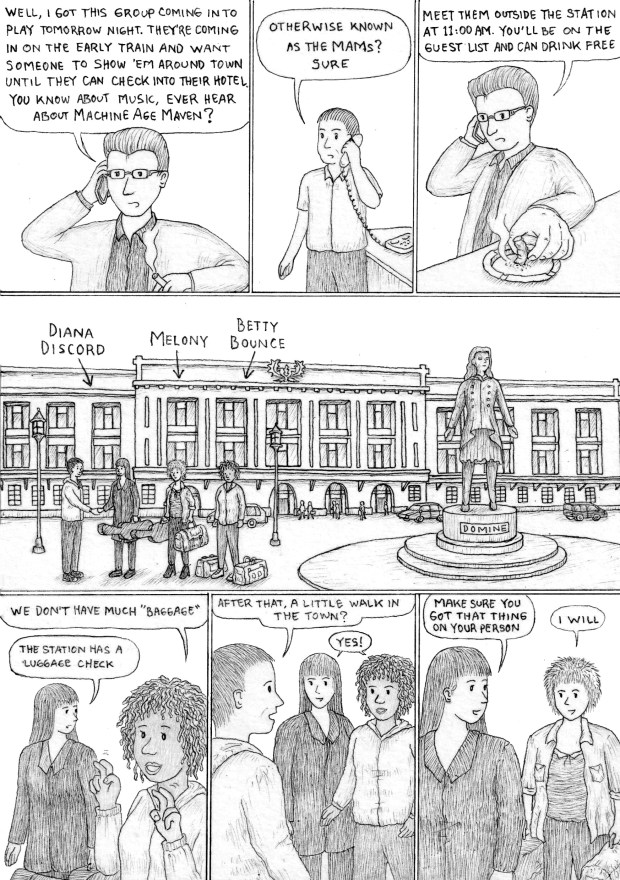
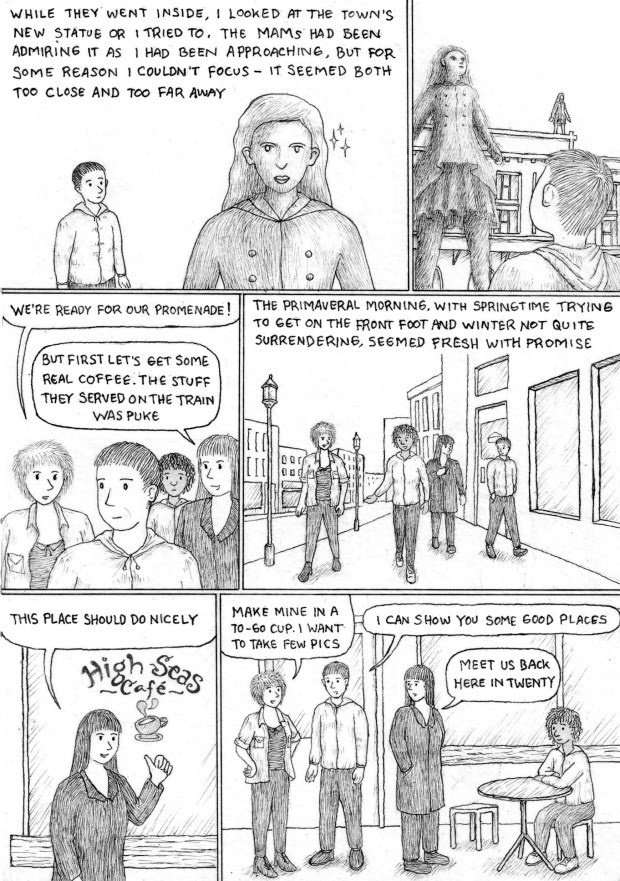
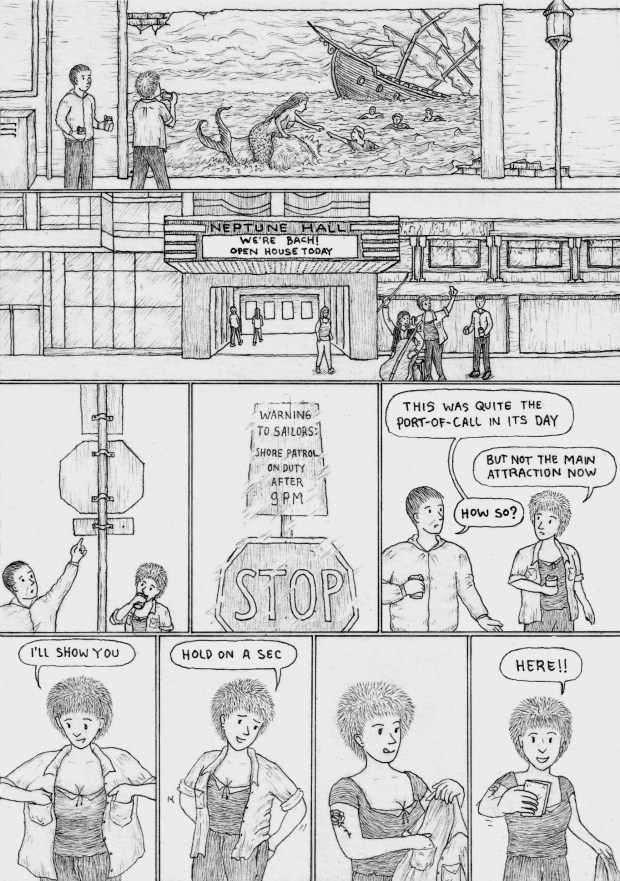
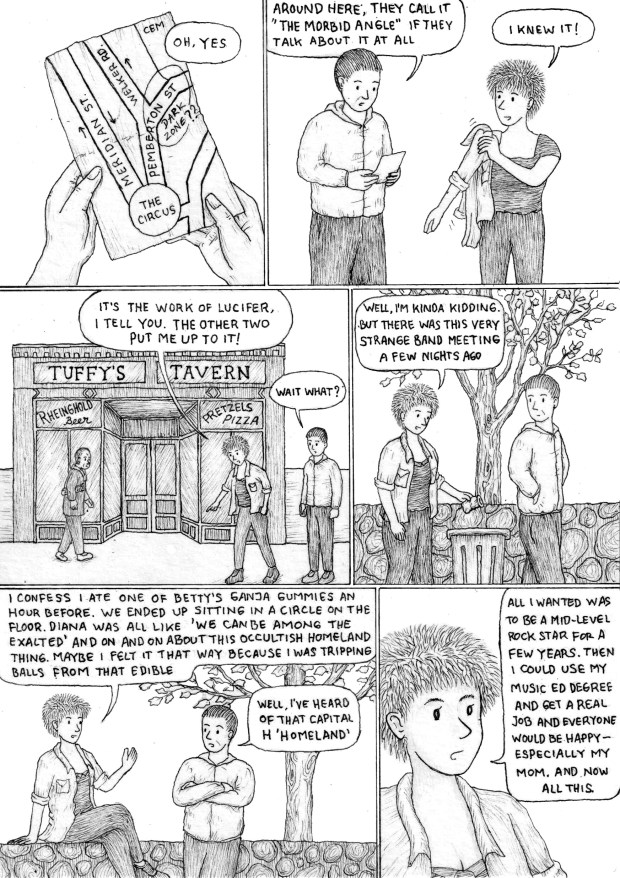
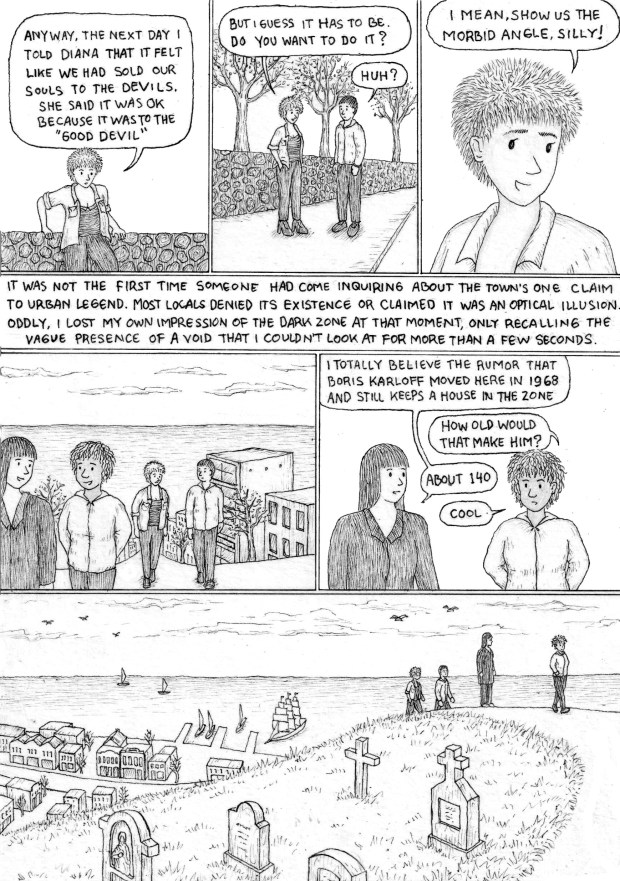
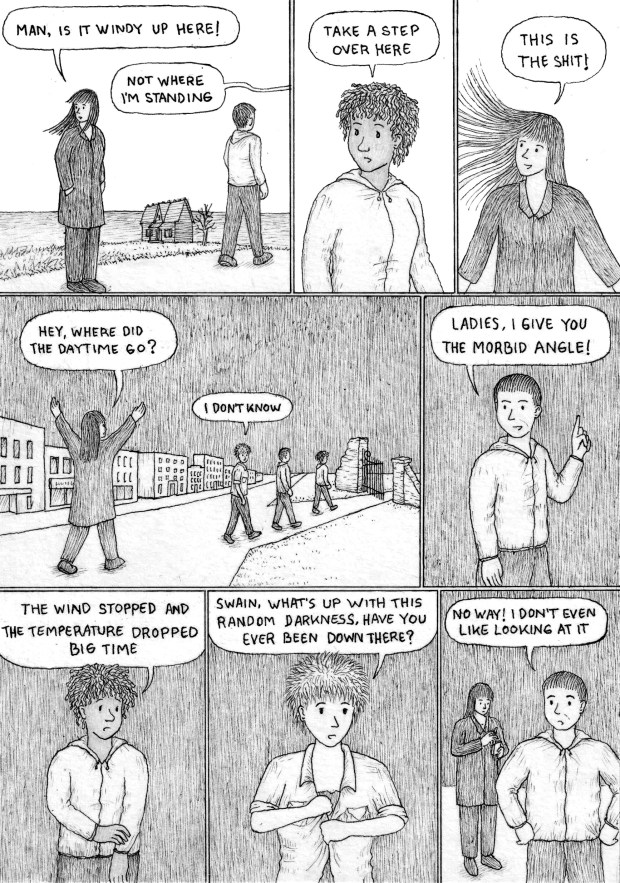
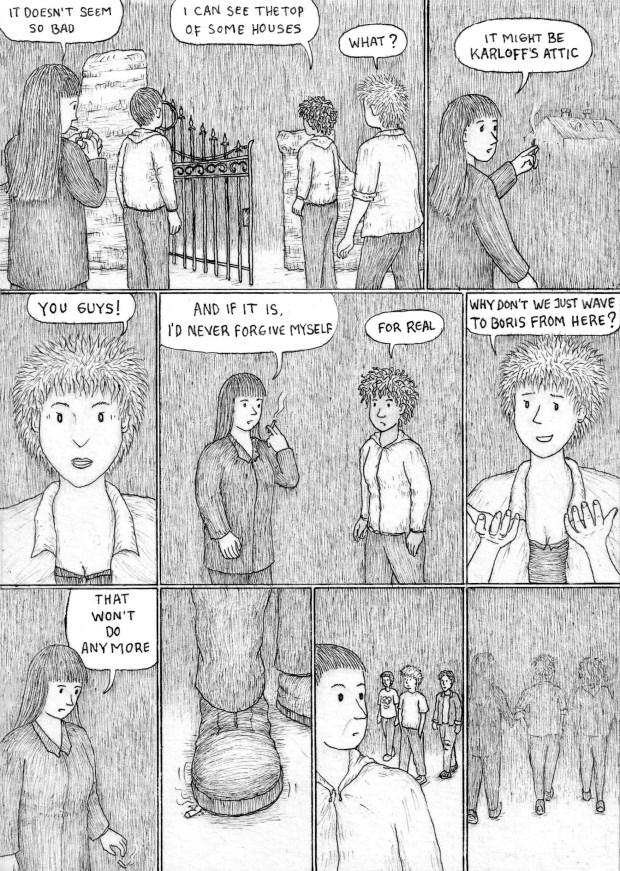
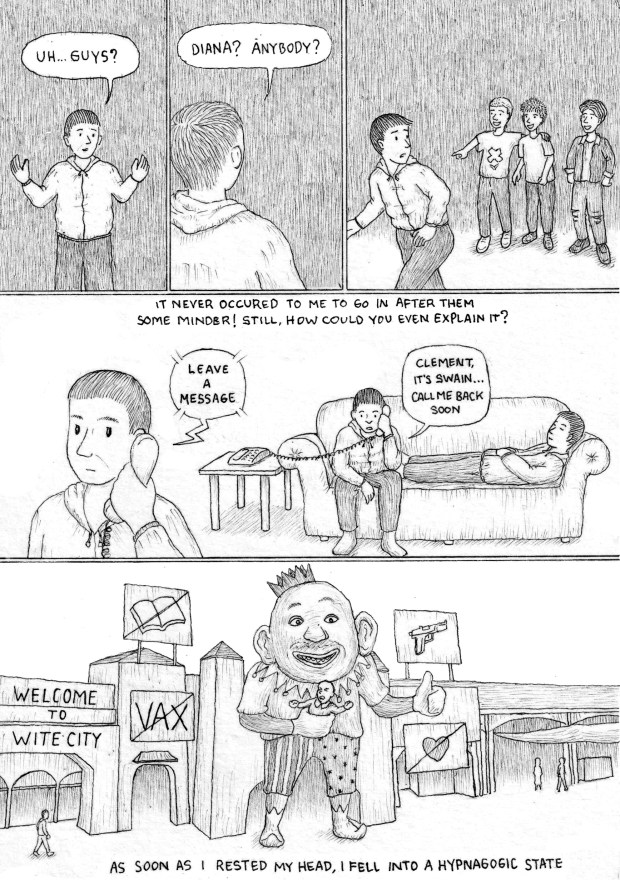
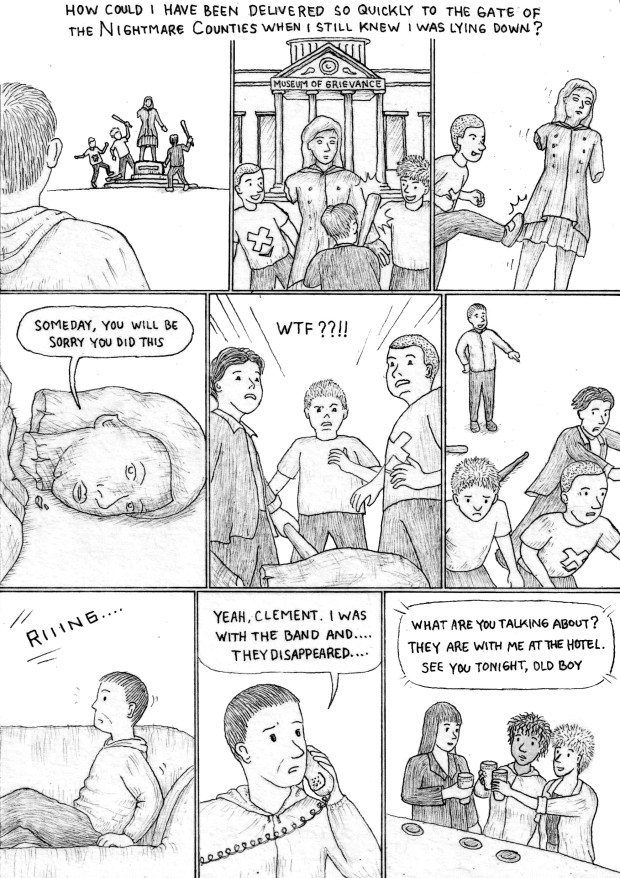
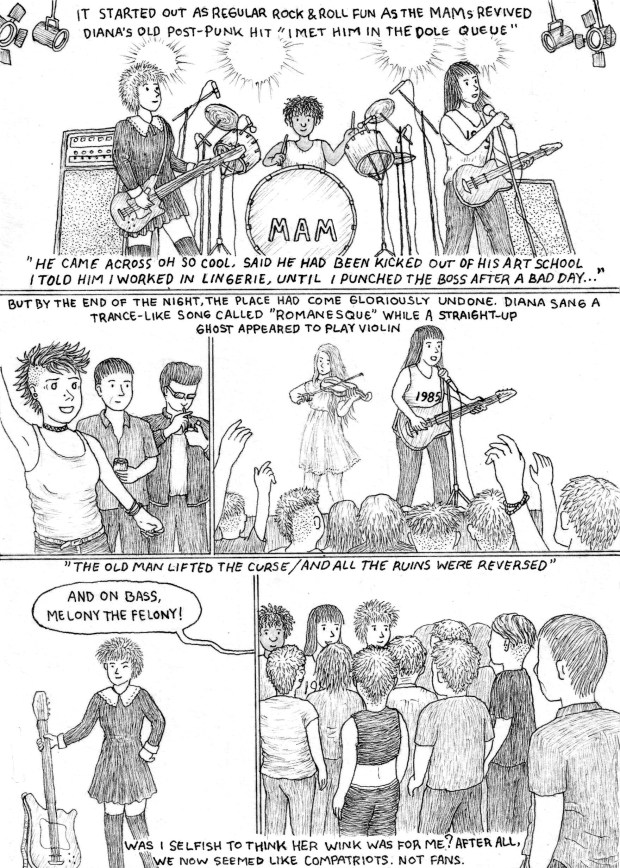
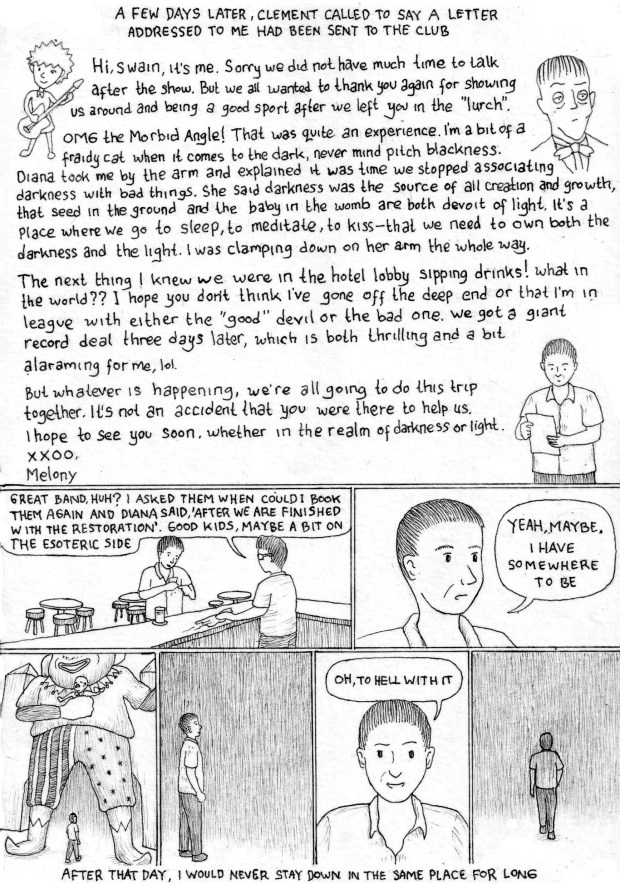
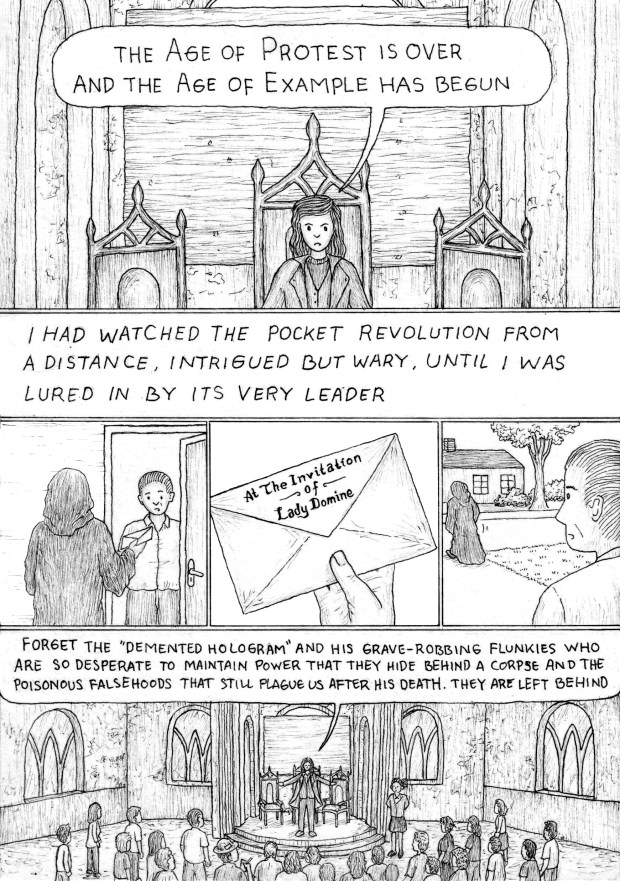
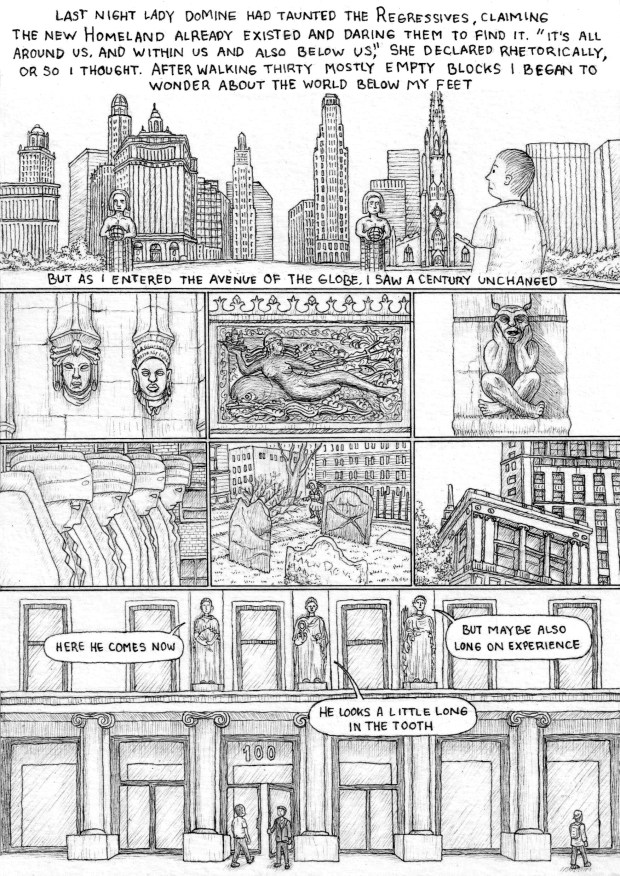
The third installment of my comic “In a Dream of Strange Cities” is below. Written and conceived by myself (Rick Ouellette), illustrations by Ipan. Here, our protagonist Swain, now well into his extended visit to the “Second World,” begins to perceive that he may be called into the service of the protopian leader, Lady Domine, helped along by the members of the charismatic band Machine Age Maven. If interested in the previously published IAD edition (“Chthonic Days,” a self-contained story) click on the to-buy link on the right column of this blog, thanks!)
The places we walk through or drive past, the sites we visit or that simply fall into our frame of vision, all have a heritage and inner spirit of their own. Even in our familiar everyday world, we are often just steps away from some location rich in hidden history and forgotten associations.
The ideational term “psychogeography” refers to the attainment of deep connections with man-made environments, usually by way of unplanned walks thru cities. It has been described as a “charmingly vague” practice by no less a man the French Situationist philosopher Guy Debord, who coined the phrase himself in 1953. It can also be seen as a more risk-averse cousin of today’s urban explorer subculture, which I’ve written about many times in this blog.
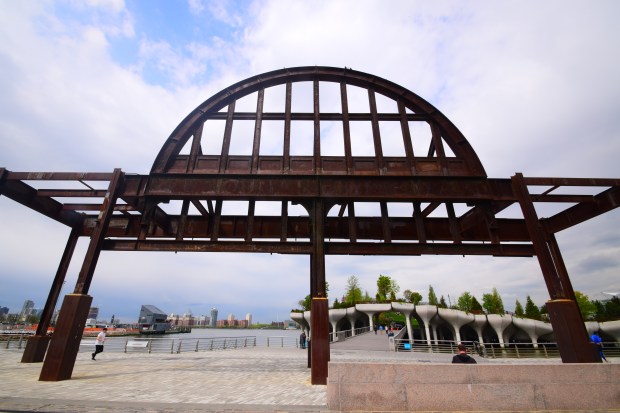
The preserved archway frame of Pier 54, where survivors of the Titanic disembarked from the Carpathia, now serves as the south entrance to New York’s Little Island.
But there is also a very practical side to psychogeography, that would do us all good to be aware of. The theory goes that the distractions and pressures of modern society have caused people to become disconnected from the public realm, leaving the one-percenters to run roughshod over the greater public interest. Understanding and appreciating our common built heritage can lead to thoughtful historic preservation and the design of more livable cities thru greater community involvement.
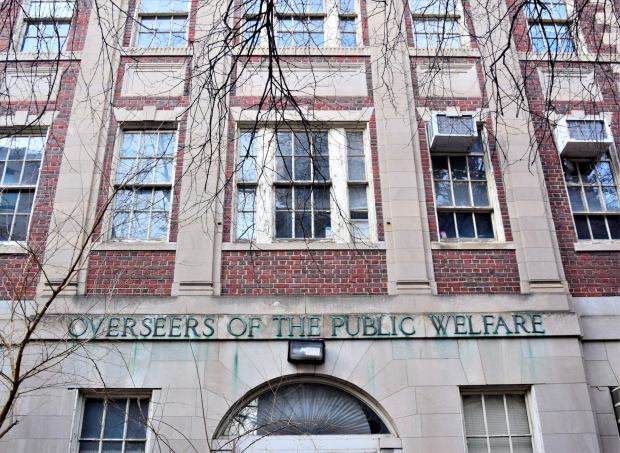
Winter’s bare trees reveal the vestigial facade of a paternalistic institution on Hawkins Street in Boston.
So while coming to understand the effects of the built environment can lead to a greater good, psychogeography can be both a passive pleasure or a wildcat experience. It’s something almost everyone has experienced, whether consciously or not. It can be the satisfaction of finding a great hole-in-the-wall eatery or tucked-away antique store because you wandered away from a usual walking route. It could mean tiptoeing into an off-limits but unguarded location to do a photo session with friends or discovering a fascinating historical vestige steps away from a throng of selfie-taking tourists, as in my photo below.
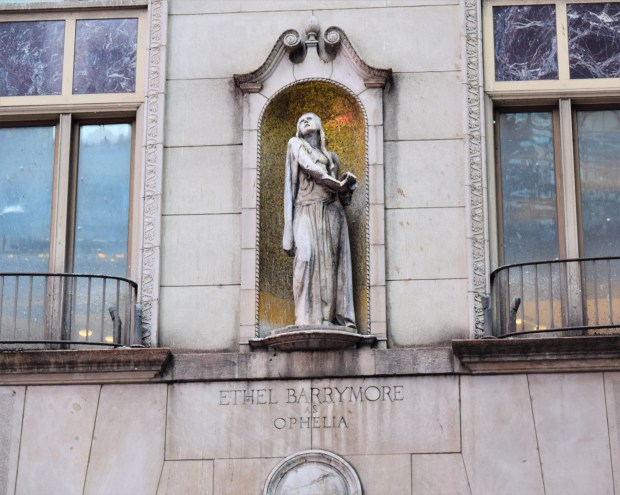
This statue of Ethel Barrymore, and of two other former stage icons, evoke an earlier era of Broadway, just a few feet away from the back of a gigantic electronic billboard in Times Square.
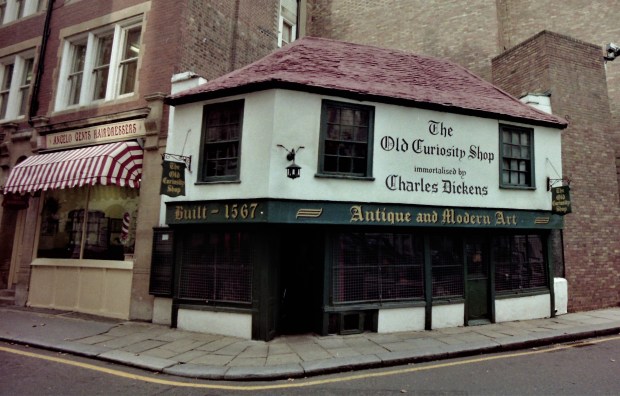
In his 2006 book “Psychogeography,” writer Merlin Coverley, traces this concept back to its immediate roots: French Marxists and Situationists. But he also vividly digs back to an earlier era and the “urban gothic” stylings of authors like Charles Baudelaire, Edgar Allan Poe, Charles Dickens and Robert Louis Stevenson, showing how their “obsessive drifting (yielded) new insights.” Poe’s 1840 story “The Man of the Crowd” is perhaps the first examination of the mysteries and perplexities of the modern teeming metropolis. In “Dr. Jekyll and Mr. Hyde,” Stevenson shows not only the duality of man’s nature but the stark dichotomy of the different parts of London his split protagonist inhabits. Dickens was a famously keen observer of the same city (often engaging in all-night walks) and had the fame and power to influence social reforms in the darker aspects of the city he witnessed, the exploitation of children, the workhouses, slum conditions etc.
I stumbled on this Dickens landmark during a London walkabout in 1994.
It’s Baudelaire, quoted by Cloverley, who has the most telling description of the psychogeographer, which has as its alpha the Parisian flaneur (or boulevardier). “For the perfect flaneur it is an immense joy to set up house in the heart of the multitude… to be away from home and yet to find oneself everywhere at home… to be at the center of the world and yet remain hidden from the world.”
Sounds cool? If so, try out some psychogeography yourself. Put away the GPS and get to know your town. Stick up for livable cities and against gentrification. Patronize independent small businesses and out-of-the-way points of interest. Lastly, LOOK UP AND AROUND to see what I call the Museum of the Street, and feel a little of what it means to be “everywhere at home.”
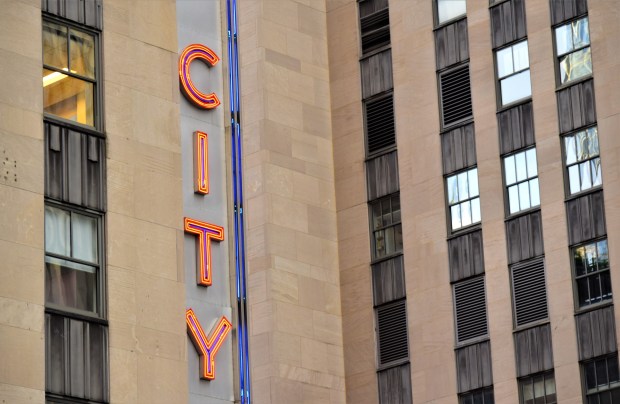
All photos and text by Rick Ouellette. Top Photo is Radio CITY Music Hall, NYC.
More info on my “Placeology” photo series coming soon!
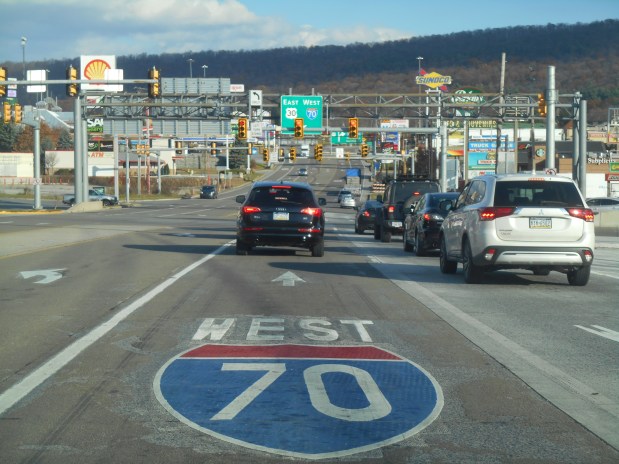
If you ever want to get one of those definitive telephoto pictures of American car culture run amok, there are few places better to trip the shutter than Breezewood, Pennsylvania. Located in the southern central part of the Keystone State, it’s a notorious “choke point” where Interstate 70, the Pennsylvania Turnpike (I-76) and the historic Lincoln Highway (Rte. 30) all meet, sort of.
Breezewood, where the Interstate is also a street.
Because of some arcane law that once proclaimed I-70 could not directly connect to the tolled Turnpike, the Interstate shares a one-mile connector with Rte. 30. This corridor is a densely packed jumble of gas station/convenience stores, fast food joints, chain hotels—all announcing themselves with signs that can reach up to about 70 feet high. There are also two truck washes and plenty of room to park your rig after tear-assing your way thru the six-lane main drag, which seems to be a local sport.
Yes, it’s all very uber-American in a way. There may be no better a democratic leveler than the free breakfast room at the Holiday Inn Express or being in line behind a couple of hunters at Sheetz, the ubiquitous convenience store/coffee shop round these parts. But just beyond the narrow limits of unincorporated Breezewood, it’s a different story. My hotel room had a view of a picturesque farm. And if you head due east, you’ll be driving down the historic and scenic Lincoln Highway as soon as you clear the hill at the end of the strip.
But just before you do, there’s a rutted dirt parking lot next to a paved path you can walk up on. If you do, you’ll be entering one of the state’s strangest and most intriguing points of interest, the Abandoned Pennsylvania Turnpike.
Surrender all hope ye who enter….
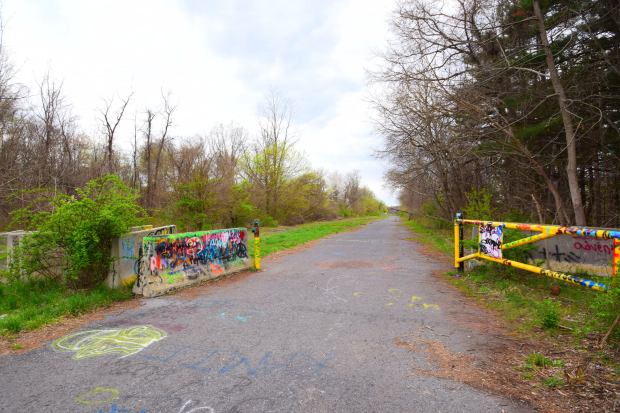
The Turnpike opened in 1940 and was an engineering marvel at the time, and a precursor to the massive American Interstate system that followed. But by 1968, car culture had long expanded and so had the Pike, except for this 13-mile stretch. It was logistically too difficult to widen it here and was re-routed. It is now an accessible (but unmaintained and unmonitored) public walking and biking trail.
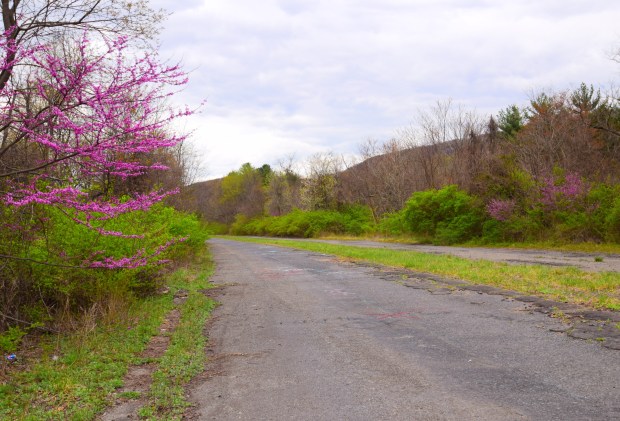
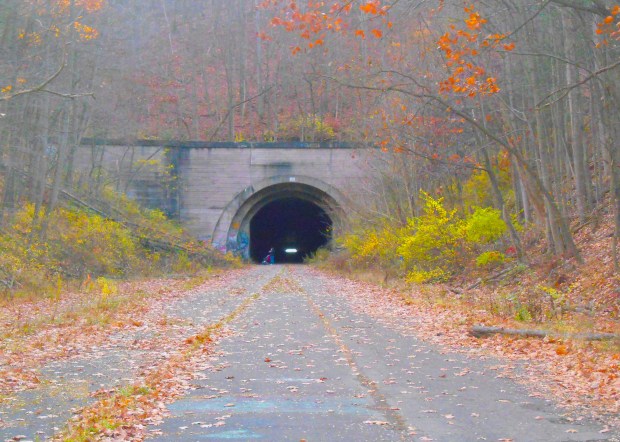
As a devoted (but not hardcore) member of the urban exploring subculture, I had long wanted to visit the APT. I got my first chance a few springtimes ago. I was on foot, and it was almost two miles from the Breezewood parking area to the first of the two tunnels on the trail. The way to Ray’s Hill Tunnel is a bit eerie, and evocative of an age of simpler automobiles and slower driving speeds. It presents as four rather narrow lanes but drops down to two at the tunnel. It was cool to see one of the turnpike’s original scalloped tunnels, not matter how defaced it is with graffiti.
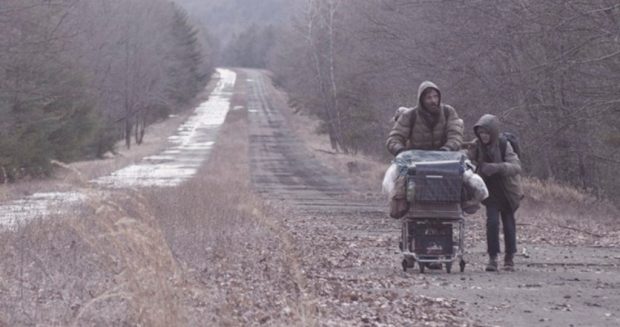
Along with the taggers, curiosity-seekers and photographers, the APT has attracted at least one major film production. The 2009 screen adaptation of the Cormac McCarthy novel “The Road” takes place in the wake of an undefined extinction event (Apocalypse How?) and has many scenes filmed there.
Vito Mortensen and Kodi Smit-McPhee in “The Road.”
It’s curious how highways are such ideal settings for post-apocalypse movies. “The Road” does not feature the fiendishly modified vehicles tearing down outback highways like in the “Mad Max/Road Warrior” series. Things are even worse here, and a key scene is the confrontation between Vito’s protagonist and a wandering member of a violent cannibal gang when the group’s ragtag truck stalls out after emerging from the grim interior of Ray’s Hill Tunnel.
On my second visit to Abandoned Pennsylvania Turnpike last fall, I had my new foldable Zizzo Bike and was ready to explore a bigger chunk of the ruined roadway. After pedaling past the strollers and the Goth kids doing Instagram pics at the mouth of the forbidding tunnel, I sailed thru the underpass with a big assist from a nifty little head lamp I bought for the occasion. On the other side, the atmosphere became more desolate in a hurry.
The far end of Ray’s Hill Tunnel.
Surely, not as desolate as the scenario in “The Road,” where the populace seems divided between killer cannibal gangs and those who retain the minimum standards of civilization, hoping to reach a promised safe haven once they follow the bleak highway all the way to the coast. Still, it is interesting to note that central Pennsylvania is on a sort of political fault line. The more liberal (blue) eastern part of the state can stand in stark contrast to the western hinterlands, where people have been warned to not even have a Joe Biden bumper sticker on their car to guard against reprisals from a hard-core MAGA constituency.
In the book “Divided Highways: Building the Interstate Highways, Transforming American Life,” author Tom Lewis details the passing of the massive legislation that authorized this epic road-building program was initiated by Republican President Dwight Eisenhower and eventually approved by a Democratic-controlled Congress—in an election year, no less! A transcontinental public-benefitting triumph that would “bind the nation.” It would hard to imagine an accomplishment (or agreement) like that with the toxically divided Washington of today.
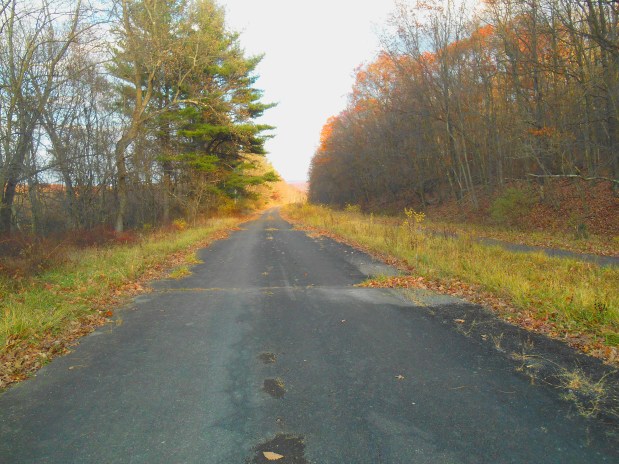
It was twilight time as I reached the lonely halfway section of the APT (see above), and with little time to make the whole route before dark, I turned the Zizzo back towards the parking lot. Riding into the gloaming is enough to make you conjure your own dystopia—the kind where cars are all but obsolete and the world is hard under the heel of ecocide and/or a disastrous civil conflict.
The next morning I was in the better disposition as I checked out of the Holiday Inn, and said good-bye for now to Breezewood, the Las Vegas of service areas. I hope I can get back again to bike the whole ghostly trail. I topped the hill and drove into the immediate rural area on the Lincoln Highway, the road that kicked off America’s Highway Century (it opened in 1913). But that vague dystopic notion from the twilight of the previous day reentered my head when I thought of the next stop on my road trip: the Gettysburg national park.
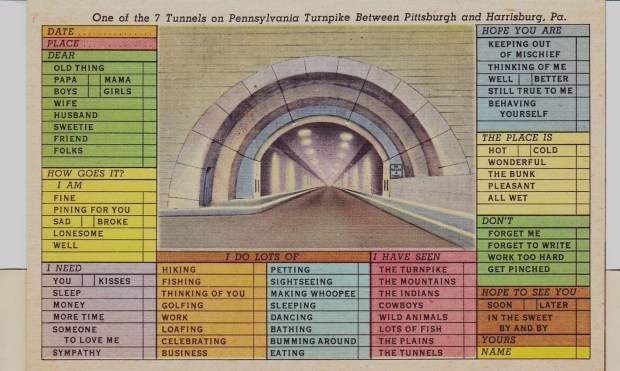
Text and all photos by Rick Ouellette, except “The Road” film still and the circa 1940 postcard.
The live album holds a curious place in many discographies of rock bands and solo artists. It can be many things: a peak-career highlight for some (The Who’s Live at Leeds, the Stones’ Get Yer Ya-Yas Out, James Brown’s live-at-the-Apollo recording) and a career maker for others (Frampton Comes Alive). Many others are seen as placeholders between studio albums or as a de facto souvenir for fans who have seen their favorites in concert.
Sometimes though, an official live release can end up being a millstone in the canon of even the best musical artists, scoffed at by both critics and fans alike. It could be a case of shoddy production, sloppy performance, a group in career downturn or even an excess of success. Creem magazine was once so put off by the rank triumphalism Quenn’s Live Killers they compared it to the sound of “someone peeing on your grave.”
Over time I have gathered up a list these bad-rep concert documents and re-visited them, wondering if they really deserved all those one-star reviews. In some cases, time has been kinder, initial victims of a hot-take hostility in a tougher age of music criticism. Others are still big-time stinkers.
Who’s Last—The Who (1984)
I’ve always wondered about this one. Dismissed and derided at the time, Who’s Last was a document of the band’s at-the-time Farewell tour back in 1982. I mean it couldn’t be as bad as all that, right? Yes and no. On one hand it is the Who and there are gobs of great tunes that are played well enough. But on the other hand, don’t expect anything transformative. The galvanizing versions of “Magic Bus” and “My Generation” on the celebrated Live at Leeds put the ones here to shame, not to mention how poorly this “See Me, Feel Me/Listening to You” stacks up to victorious version on the Woodstock soundtrack. True, people thought it was a swan song back then and a release was justified (though it only hit #81 in America) but after Pete and the boys resumed touring in 1989 it seemed irrelevant, esp. after the sublime Leeds was expanded from 6 to 14 tracks in the CD era. Grade: C-
Take No Prisoners—Lou Reed (1978)
“What do I look like, Henny Youngman up here?” Yeah, kinda. This smart-ass double album was reportedly Lou’s answer to those who said he never talked on stage. True to Reed’s incorrigible nature he goes too far in the other direction, ad-libbing over opener “Sweet Jane” until the song is just an afterthought. True, he does get out a few good lines (“Give me an issue, I’ll give you a tissue”) and a sick burn on Patti Smith (“Fuck Radio Ethiopia, this is Radio Brooklyn!”) but it sets the tone for what is really a punk novelty record.
The music, such as it is, starts at 2:20
The crowd at the Bottom Line nightclub in NYC seem to be there as much for the cult of personality as for the music, and “Walk on the Wild Side” becomes a rambling 16-minute monologue a la Lenny Bruce. When Lou does manage to get thru a whole song without ragging on rock critics or his old Factory friends the results can be pretty good, as on “Coney Island Baby” and “Satellite of Love,” but they add up to a relatively small fraction of the album’s long 98-minute run time. Grade: C
Coast to Coast: Overture and Beginners—Rod Stewart/Faces (1974)
The Faces were on borrowed time when this concert record came out, maybe accounting for the poor press it got. Some saw it as a quick cash-out before Rod Stewart finally split to commit full-time to his burgeoning solo career. Key contributor Ronnie Lane had already left, replaced by Japanese bassist Tetsu Yamauchi. Coast to Coast is an enjoyable (if slapdash) mix of Rod solo numbers, a couple of Faces songs and clutch of covers. Most successful is a top-shelf take on the Motown lament “I Wish it Would Rain,” featuring an impassioned vocal by Rod and a great blues guitar solo from Ronnie Wood. Grade: B-
On the Road—Traffic (1973)
Traffic were another stalwart British group who were heading down the home stretch when this leisurely live double hit the shops. They released one more studio album before disbanding the following year. This was the end of their expanded-lineup era, with the core trio of Steve Winwood, Jim Capaldi and Chris Wood were joined by percussionist Rebop and three Muscle Shoals session men. This period was marked by a certain languid jam-band sound and most of the material here was drawn from the previous two studio sets, Low Spark of the High-Heeled Boys and Shoot Out at Fantasy Factory. The only nod to the “old” Traffic was a 21-minute medley of “Glad/Freedom Rider.” The band may have set themselves up for rock-mag ridicule by including the recent “(Sometimes I Feel So) Uninspired.” But that one turns out to be a highlight, with some electrifying lead guitar from Winwood, so go figure. Grade: B-
David Live—David Bowie (1974)
This is a textbook case of a concert album being recorded at precisely the wrong time. Bowie’s ’74 show started off as the “Diamond Dogs” tour and ended as the start of his “plastic soul” era. (His next album would be Young Americans). The album is unfocused and lacking in true energy, his vocals careless and strained. Hard drugs were an issue. It tends to sound better if you don’t know the studio version and have nothing to compare it against (I rather like his version of the Ohio Players “Here Today, Gone Tomorrow”). But the only one of his many famous songs here that maybe outdoes the original is a strong version of “Rock ‘n’ Roll Suicide,” that closes this misbegotten release. Grade: D+
T.V. Eye Live—Iggy Pop (1977)
Speaking of Mr. Bowie, the year 1977 brought him renewed recognition not only for two of his classic Berlin-era albums (Heroes and Low) but also reviving the career of a certain James Osterberg, who was at loose ends after the dissolution of his proto-punk band the Stooges. Iggy Pop, as he was better known, joined Bowie at his digs hard by the Berlin Wall, both trying to kick long-standing drug habits and get new inspiration in their bleak Cold War surroundings.
Iggy also released two great albums in ’77 (The Idiot and Lust for Life), both produced and largely co-written by his pal Dave. This single live album also got a release but was panned across the board (one meager star at AllMusic) but nowadays it’s hard to see why. It’s a pretty strong set, some of it from an American tour where Bowie supported him on keyboards and backing vocals. The sound quality is not so hot, probably because RCA gave him a $90,000 advance to produce the album (he owed them one more LP) but then spent five grand on it and pocketed the rest. That alone bumps it up half a grade. B+
Bob Dylan at Budokan—Bob Dylan (I think) 1978
Perhaps we will never know just what compelled Zimmy to release this album of his revolutionary repertoire performed as a vacuous Vegas lounge act (and presented as such). On the heels of his divorce and the epic flop that was his “Renaldo and Clara” movie, maybe he thought he could release a quicky double live album and recoup his losses before anyone noticed, it did hit #13 in America.
It did have a few critical defenders and of course if you go by the YouTube fanboys, Budokan ranks right up there with the Sistine Chapel at the apex of Western Civilization. But unless it’s enjoyed as a perverse form of performance art, I don’t know how anyone can like the Wayne Newton arrangements, the cloying back-up singers, the overwrought saxophone and Dylan singing his visionary back catalogue as if it were the collected works of Tony Orlando and Dawn. Just take this encore version of “The Times They are A-Changing” (please) and listen to the fake sincerity of the spoken intro and then Dylan actually telling the crowd “We’re here for four more nights” as if he really were at a casino cocktail lounge and not one of the world’s most revered concert halls. Wow. Grade: D
Still Life—The Rolling Stones (1982)
The era of the true mega concert tour, complete with corporate sponsorship, was under way in the early 80s and naturally the Stones were on the leading edge. That means fans packed in like 80,000 sardines at a place like Arizona’s Sun Devil Stadium and the band trying to fill it with sound and vision no matter how impersonal the setting. (You can see some of that scene in the Hal Ashby-directed tour film, “Let’s Spend the Night Together”). The stage is so big that Mick Jagger and Charlie Watts seem to be in different zip codes). This dynamic comes thru in the unfortunately- titled Still Life.
Like Who’s Last, there are lots of great songs here and the notes are all in the right place (mostly). Yet, it comes down to a business model that just doesn’t work—for me, anyway. I’ve never been to a football stadium concert, and this shows me why. Sure, it’s quite possible to have a good time at this kind of show (many have) but to me the possibility of a good aesthetic return on your monetary investment seems low. I can’t see the band and they can’t reach me; that dubious dynamic carries over to the album. Like David Live, this album sounds OK when you don’t have any previous recording to compare it to, so I chose their new cover of Smokey Robinson’s “Going to a Go-Go” as the best of the lot. Grade: C
Live ‘n’ Kicking—West, Bruce and Laing (1974)
Twin Peaks—Mountain (1974)
When you apply the contemporary phrase “Go big or go home” to the classic rock era, it’s hard not to think of Leslie West. He was a “mountain” of a man (his girth inspired the band’s name), his bellowing vocals and scorched-earth guitar solos known far and wide since the band made a big splash at Woodstock. By 1972, Mountain were on hiatus and West and Mountain drummer Corky Laing joined ex-Cream bassist/singer Jack Bruce to form a blooze-rock supergroup that released two studio albums and this single live set, released just after announcing their break-up in early ’74.
As a group, Mountain, as heavy as they were, also had a melodic sign, seen in deft compositions like “For Yasgur’s Farm” and “Nantucket Sleighride.” WBL cast away most of that. To start off Live ‘n’ Kicking, they turn the Stones’ refined and brooding ballad “Play With Fire” into a 13-minute marauding metal warhorse, complete with drum solo. The “96-decibel freaks” in the audience eat it up. Jack Bruce, replacing the more refined Felix Pappalardi as West’s frontline partner, was rougher-edged. He fills the space between songs with arena-rock bravado and his bass is turned up to overload levels nearly as loud as West’s guitar, if that’s even possible. True, there is some nimble trip interplay on the WBL original “The Doctor” but things go happily off the rails with closer “Powerhouse Sod” which turns into a Bruce showcase, because everyone knows the best way to end a 70s live album is with a bass solo!
Around the same time that West, Bruce and Laing were dissolving due to internal dissension and hard-drug abuse, West was and Pappalardi were re-uniting with a new lineup. Corky Laing, for whom the drug issues were hitting esp. hard, was replaced this time by Alan Schwartzberg. Original keyboardist Steve Knight was subbed off in favor of Bob Mann, who also doubled on second guitar for added sonic impact. My roommate at the time called the Japan-recorded Twin Peaks “the album with the biggest tits in the world” (riffing on Monty Python) and it did seem like the band was out to prove scale new heights of heavyosity.
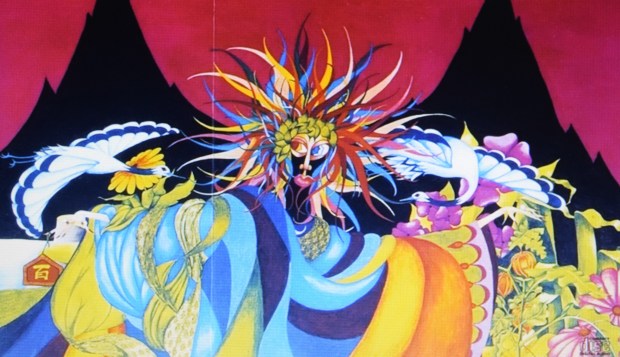
Twin Peaks, with its confident air attractive artwork (see banner image at top of this post) did fare a little better in the critical arena than Live ‘n’ Kicking, which got an E+ (?) in the Village Voice. However, many scribes headed for the exits at the prospect of a 32-minute “Nantucket Sleighride.” Of course, fans, in this age of bong hits and good stereo systems, loved every long minute of it and didn’t mind having to get up and flip the record halfway thru. The glorious noise continues right through to side four, as the band run over the “Mississippi Queen” with a Mack truck and play “Roll Over Beethoven” at such volume that it would have made ol’ Ludwig van deaf all over again. Best of all is West’s signature “Guitar Solo,” where he gets free reign to indulge himself for five uninterrupted minutes, to the point where he injects a bit of “Jingle Bells” even though it’s August in Osaka. The Seventies, they were a thing, man.
Grades: Live ‘n’ Kicking: B-, Twin Peaks: A (fight me).
And speaking of “Jingle Bells,” Happy Holidays, everyone!
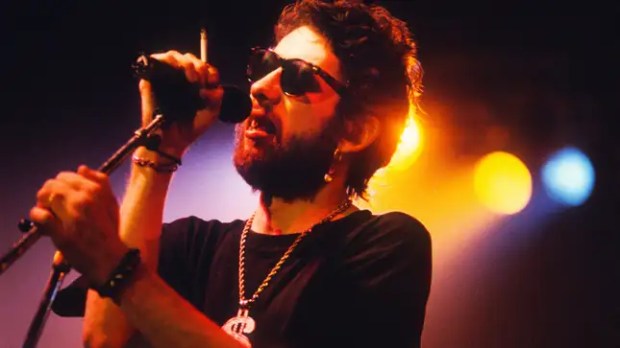
“He took the road to heaven in the morning.” RIP to Shane MacGowan, principal singer and songwriter for the Pogues, and the poet laureate for the modern Irish diaspora. Though he was born and (mostly) lived in and around London, his childhood experiences in Tipperary seemed to inhabit him as profoundly and completely as did Dublin to James Joyce, who left Ireland as a young man.
With a super-talented group of players behind him, Shane wrote dozens of beautiful and incorrigible booze-infused songs on themes of wanderlust, bittersweet romance, camaraderie, Irish social history, political indignation and London street life. His songwriting compromised a universe unto itself: this was a guy who could make the demolition of an old greyhound racetrack (“White City”) sound mythic (Oh, the torn-up ticket stubs of a hundred thousand mugs/Now washed away like dead dreams in the rain”).
The same goes for “Sally MacLennane” which covers an entire lifetime in 2:40. MacGowan sings the tale of Jimmy, who “played harmonica in the pub where I was born” (brilliant) and goes off to America to make his fortune while the narrator grows up to tend the same bar. Jimmy eventually returns to a very changed homeland and you come to realize that the fateful walk to the train station is in fact a funeral procession.
So let’s sing Shane “a song of times long gone” and remember him well, as he remembered the world around him in a way that touched so many so deeply.
“Those English boys, they want to play the blues so bad. And they do play it so bad,” Sonny Boy Williamson once said, looking back in humor to the times he went to tour in Europe in the early Sixties, sometimes supported by the Yardbirds or the Animals. It’s a classic quote and a bit unfair (the Yardbirds were just starting out) but it does point up the fact that most of the bands that made up the epochal British rock explosion of the later Sixties were steeped in reverence to the blues, despite the geographical and experiential distance from their heroes.
But nobody could question their sincerity and when the English blues-rock thing really took off a meeting of the minds was bound to happen. The legendary blues (and early rock ‘n’ roll) performers found their commercial fortunes fading, overtaken by R&B, Motown and funk. For the Brits, the legitimacy conferred and the fun to be had jamming with these legends was a no-brainer. When a Chess Records producer, after watching a Cream concert at the old Fillmore West, asked Eric Clapton if he would like to do an album with Howlin’ Wolf the die was cast. Although the record would not get recorded for another couple of years, it would set the pace for a notable mini-genre of “London Sessions” projects that would hit the market in the early Seventies.
The London Howlin’ Wolf Sessions (1971)
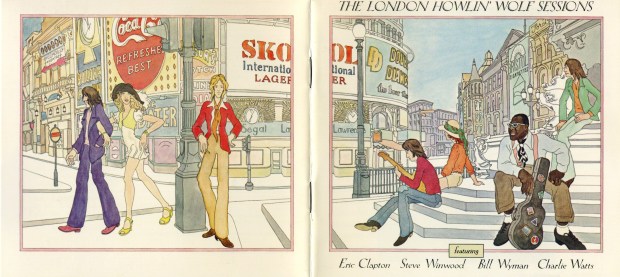
So the Wolf album would be the first of these, the Chess label would follow with three others, listed chronologically below. It could be argued that this is the best of them; it certainly had the best cover art (see banner image. Chess followed the formula of having illustrated covers showing their subject in London-themed settings. While the other three are a bit cartoonish, this one has a handsome drawing of the Big Guy surveying the Piccadilly Circus scene while seated with his guitar case under the Eros statue, while a chap who looks like Clapton plays on a lower step.
Eric certainly wasn’t going to waste an opportunity like this and he brings his A-game, pealing off any number of torrid solos on his trusty Stratocaster. Wolf brought along right-hand man Hubert Sumlin to set the pace on rhythm guitar, while Rolling Stones’ Charlie Watts and Bill Wyman laid the foundation for an energetic set of blues classics. The devotion to this Chicago blues legend was undeniable: the Stones’ insisted on Wolf as a guest when they appeared on the American TV music show “Shindig,” while Slowhand had been tapping the Wolf songbook for years (all but two of these twelve songs are credited to him—Chester Burnett—or his go-to guy Willie Dixon) and Cream’s 16-minute version of “Spoonful” is the stuff of acid-rock lore.
With the bedrock of Sumlin and this trio, plus either Steve Winwood or “sixth Stone” Ian Stewart on keyboards, Wolf fronts a strong collection of his well-known 12-bar tunes, in great voice and seemingly high spirits. You get “I Ain’t Superstitious,” “Sitting on Top of the World,” “Built for Comfort,” “Do the Do” and trademark numbers, all expertly played and well produced by Chicago bluesologist Norman Dayron. And if their was any question as to who was in charge here, listen to the practice take of “Little Red Rooster.” The imperious Wolf is showing the young guns how the intro should be done by playing it on his acoustic when Clapton tries to get him to play on the final: “Nah, man, come on!” The album was well-reviewed and made a respectable chart showing, leading the way for what was to come. Grade: A-
The London Muddy Waters Sessions (1972)
The mighty Muddy Waters was the next to get the UK treatment and this was another well-done effort. Already a pattern was established. There was the illustrated cover, though this one looked like a half-finished Peter Max reject (though Waters wearing a bobby’s helmet was kinda funny). There was the trusty wing man brought over from the Windy City (Muddy’s harmonica player Carey Bell). Again, the roll call at the London studio proved impressive (Rory Gallagher, Ric Grech, Georgie Fame, Steve Winwood again, and former Hendrix drummer Mitch Mitchell).
Gallagher, the revered Irish blues guitarist, and Bell really stand out here, trading solos on several tracks. And while Waters is in fine fettle, the album is held back at times by the Americans’ unfamiliarity with the surroundings and the Brits reverence. In other words, good but not off-the-hook good. Like on the Howlin’ Wolf album, the material consists mostly of artist originals and Willie Dixon standards, including a new MW version of his immortal “I’m Ready,” (“I’m drinking TNT/I’m smoking dynamite/I hope some screwball starts a fight”). Grade: B
The London Chuck Berry Sessions (1972)
I think it’s safe to say that Chuck’s UK album was the most financially successful of this lot, even if it was for all the wrong reasons. That is because it included the execrable novelty song “My Ding-a-Ling,” which, believe it or not was Berry’s only #1 single in America. But at least the 45 edit was only about four minutes, the juvenile singalong goes on for eleven minutes on the album’s live second side. It is sandwiched between this record’s highlights. Helped along by two future members of the Average White Band, he treats the Lancaster festival crowd to a frisky rave-up on “Reeling and Rocking” and then sends them into a frenzy with “Johnny B. Goode” (probably because they are secretly relieved that “Ding-a-Ling” is finally over). Chaos ensues at the end when the crowd belligerently demand an encore while a flustered MC begs the crowd to leave so they can make way for a show by “The Pink Floyd.”
The studio side has little of value, despite the presence of Kenney Jones and Ian McLagan from the Faces. Chuck sounds uninspired and the only real bright spot is “I Love You” which shows a more contemporary spin on his trademark sound. Grade: C
The London Bo Diddley Sessions (1973)
The pioneering rock ‘n’ roller born Ellis McDaniel was not one to rest on his laurels. Bo had spent the late 60s and early 70s updating his sound to fit in with the more contemporary funk style. It never really caught on and he was still making most of his income on the oldies circuit where his patented hambone “Bo Diddley beat” was ever popular. His London sojourn was bound to be a colorful affair and the old pro didn’t disappoint, even if it did nothing to help his flagging record sales.
There’s a great funk workout (“Get Out of My Life),” a couple of cheeky numbers written by his former Chess label mate Sam Dees (“Husband-in-Law” and “Sneakers on a Rooster”) featuring singer and female foil Cookie Vee, and a good version of his “Bo Diddley” signature song. There is less overt star power here, but Diddley is well served by a tight and sympathetic supporting cast centered around Spencer Davis Group alumni Eddie Hardin on organ and guitarist Ray Fenwick, while ELO founder Roy Wood contributes some supple bass work. Bo’s stature, if not his commercial standing, continued into the next rock generation and by 1979 he was knocking ‘em dead as a supporting act on the Clash’s first American tour. Grade: B+
B.B. King in London (1971)
King recorded this LP at London’s famed Olympic Studios in June of 1971 and it was released in November of that year, just prior to a tour of England. It’s a decent outing by the Blues Boy, though not much here that you haven’t heard before from him. He’s supported by a staunch roster of classic-rock supporting players and regulars from the British blues club/festival circuit. Drumming is by the Jims (Gordon and Keltner), the bass work is supplied by the ever-reliable (and ever-available Klaus Voorman), and the second guitar spot (backing up King and his famous Gibson ES-355 named Lucille) rotates between Fleetwood Mac founder Peter Green, John Uribe and Dr. John.
There are a couple of changes of pace which help a lot. The instrumental “Alexis’ Blues” has both Mr. Korner and BB on acoustic guitar while Steve Marriott blows some mean harp. Guest keyboardist Gary Wright gets to do his piano shuffle with King adding some of his piquant picking on this platter (sorry). He also does some fine singing and soloing on his own “Ghetto Woman,” the best of the straight blues number. The tasty string arrangement shows that a lot of care went into the making of the, even if the results are less than revelatory. Grade: B-
Jerry Lee Lewis: The Session…Recorded in London (1973)
As mentioned before, some of these London recordings are held in check by the double dynamic of the headliner’s unfamiliar surroundings and the kid-glove tendencies of the admiring supporting players. In one sense, this was also the case when Jerry Lee Lewis made his way across the pond in 1973. Although only in his late thirties, Jerry Lee was on the cusp of his elder statesman years and initially felt ill-at-ease during the sessions. He had rarely recorded outside of Memphis or Nashville and here he was surrounded by long-haired whipper snappers.
But this was still the same Lewis who was the incorrigible wild man of rock ‘n’ roll and he let it loose with a sprawling, freewheeling, braggadocious double album that yielded his last hit song on the pop charts (“Drinking Wine Spo-Dee-O-Dee”) and cemented his status as an early rock ‘n’ roll icon. The album kicks off with “Drinking Wine,” setting the stage for what’s to come. It’s a great ol’ roadhouse boogie with Jerry leading the charge, singing enthusiastically of hedonistic pursuits and pounding away at his piano in that familiar staccato style. Alvin Lee of Ten Years After, the first of many hotshot guitarists to heed the star’s command to “Pick it, son,” gives some 70s firepower to a 50s-style solo. These “sons” are generally only 5-10 younger than “The Killer” but none of them would dare complain. His offspring include and impressive collection of guitarists (Rory Gallagher, Albert Lee, Peter Frampton, Delaney Bramlett and future Foreigner Mick Jones) and keyboardists (Gary Wright, Tony Ashton and Procol Harum’s Matthew Fisher) and Brian Parrish (then vocalist with Badger) on harmonica. Several of Lewis’ usual band also appear.
When these disparate elements come together the record can be great fun, with the accompanists’ amped-up backing giving Lewis a solid platform to hit his attitudinal sweet spot halfway between blasé and berserk. It’s a rush to hear Gallagher and Frampton trading solos as the man bulls his way thru “Johnny B. Goode” and to have pro’s pro Albert Lee move the crew full-steam-ahead on “Sea Cruise” as Captain Killer runs thru his paces of piano razzle-dazzle, esp. in those sweeping glissandos that flash by like Zorro’s sword. Country and blues numbers are also present as are a couple of more contemporary songs (CCR’s “Bad Moon Rising” and Gordon Lightfoot’s “Early Morning Rain”).
It comes all together for the concluding “Rock & Roll Medley” as the Killer whiplashes thru four Little Richard classics before climaxing with his immortal “Whole Lotta Shakin’ Going On.”Jerry Lee whoops it up like it’s 1957 and attacks his piano keys with karate-chop comping while Alvin Lee flies off into Woodstock guitar-hero land. It’s a satisfying ending to an entertaining, loosey-goosey record and will be a fun time no matter which of the four sides you drop the needle on. Grade: B+
The familiar turns fantastical as “sleep voyager” Swain roams through fractured cities and societies, falling in with a group of utopian separatists.
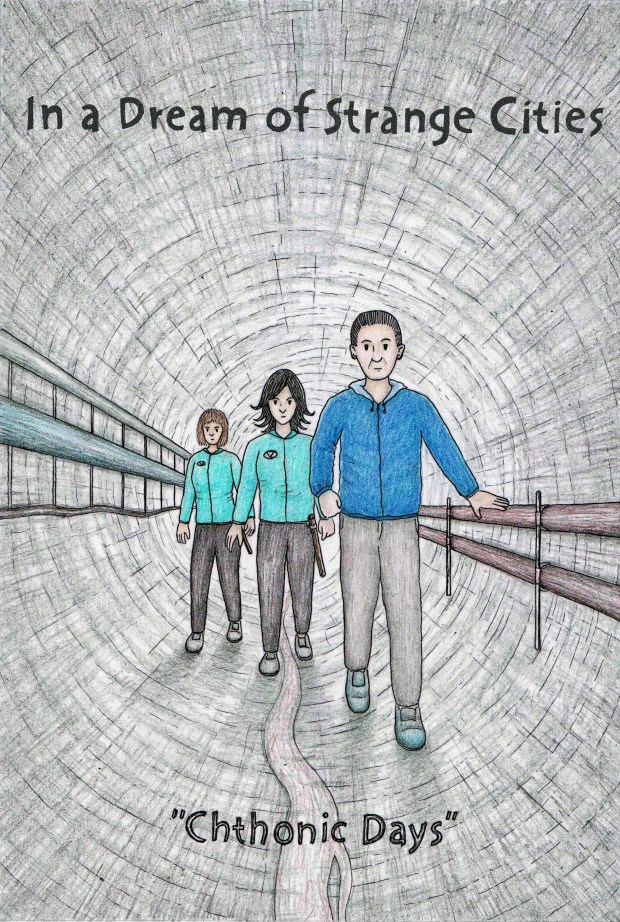
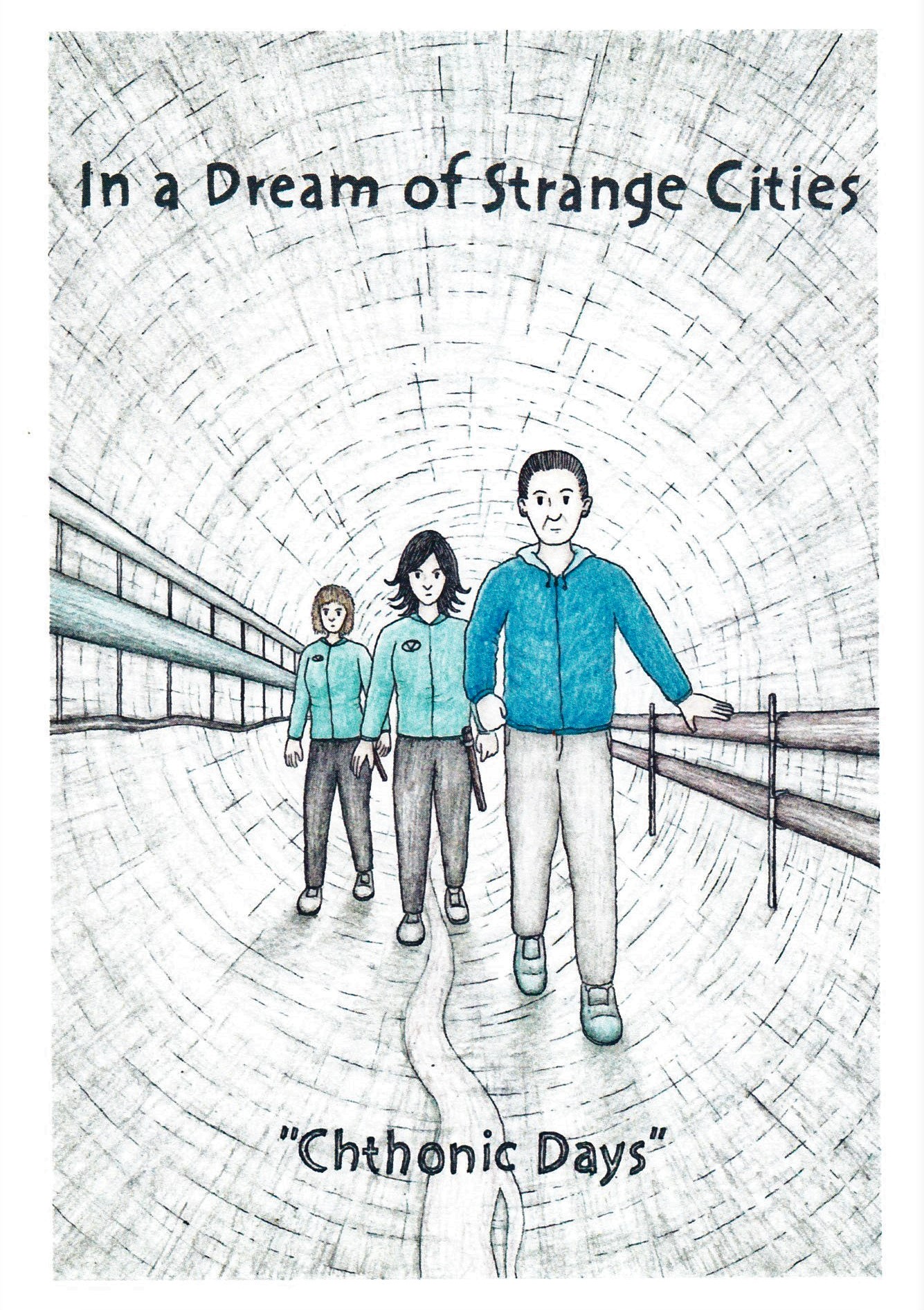
“Chthonic Days” is a 20-page, magazine-size short story comic that is culled from two pivotal chapters of the graphic-novel-in-progress “In a Dream of Strange Cities”. The title of the story indicates the underground quest to find a space large enough to construct a prototype independent sub-city, envisioned by an idealistic group called the Homelanders. Lady Domine, their charismatic and overstanding leader, lays out their vision in the speech that opens the story.
At first, Swain has no idea about how and why he has been drawn into this “Second World” or that it is even a different plane of existence. But his flair for urban exploring and psychogeographic observation make him an ideal recruit for Domine and the forces of “love, logic and learning” at existential odds with a late autocratic leader. Kept alive by a haranguing electronic video-audio loop, he encourages his followers to continue to follow his lead and meet every act of social empathy with scorn and even violence, with no end in sight.
Swain, at the conscripted call-up from the now autonomous “World Subconscious” will find out if there is “a way forward in peace” against the abusive cult of personality that pervades half the citizens of the story’s city-state.
The price of $5 includes mailing within the U.S. and will be so helpful and artist Ipan and I continue work of the first volume of a proposed trilogy. And you can keep up with our progress by Liking the In a Dream of Strange Cities Facebook page. Thanks! –Rick Ouellette
“Chthonic Days”
A short-story comic taken from the upcoming series “In a Dream of Strang Cities.”
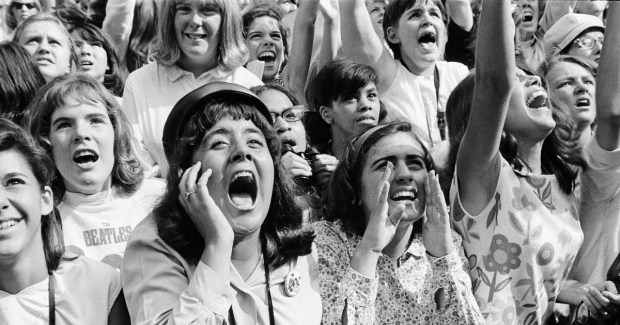
When it comes to signifying images of 20th century pop culture, the screaming girls of Beatlemania are right up there. Of course, the siren-pitch of their collective hysteria is also unforgettable to those who watched the Fab Four on television or especially for those who saw them in person, where the din was so epic one could barely hear what they were playing.
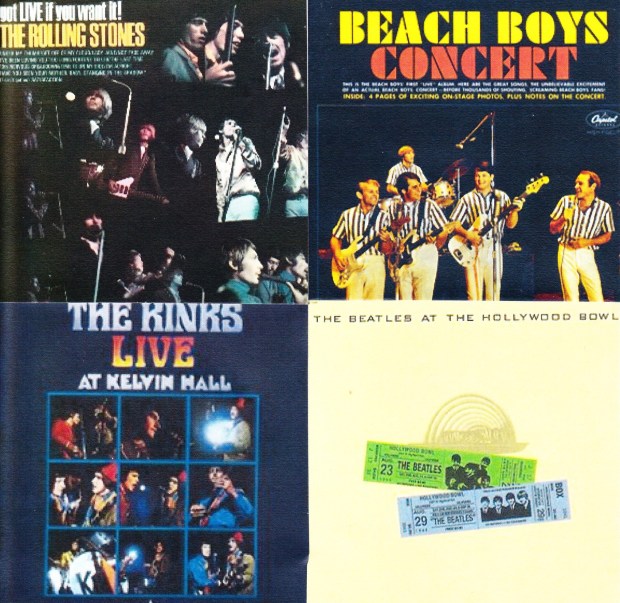
This kind of hysterical fan reaction was not limited to the Beatles. A lot of other British Invasion bands got a similar reception in concert. A look back at the legendary “T.A.M.I. Show” filmed in late 1964 shows the young Los Angeles audience (about 75% female) going completely bonkers over everyone from Lesley Gore to Jan & Dean to James Brown. But for this post, let’s concentrate on four titles that were recorded in those exuberant days of the mid-Sixties, while also noting that the Beatles entry was not released until 1977.
Over time, it became de rigeuer that every major rock group post-1964 would eventually release at least one live album. The problem with the early ones was that the amplification and recording equipment had not caught up yet with what the bands were doing. As the 60s progressed, the technology dovetailed with the heaviness of the sound and the kids had grown up and gotten past their Shrieking Stage.
Got Live If You Want It? Nowadays, all but the most hardcore Stones’ fans would say “no thanks, I’m good” to their first live album, released in the fall of 1966. It’s an interesting artifact in its way but these renditions of hits like “19th Nervous Breakdown,” “Under My Thumb” and “Get Off My Cloud” will have you running back to the studio originals. Andrew Loog Oldham’s production is woefully tinny (sometimes it seems like Charlie Watts’ cymbals are the lead instrument) and at times it can barely compete with the audience cacophony.
Considering that Stones’ concerts often ended in riots back then, it’s remarkable that a quieter number like “Lady Jane” comes off reasonably well. The same could be said of Mick Jagger’s take on Otis Redding’s “I’ve Been Loving You Too Long” although it turns out that song and “Fortune Teller” were studio tracks with crowd sounds added on. See below for a nice up-close glimpse of an early Stones show looked like.
The post-Pet Sounds Beach Boys were most noted for the creative dominance of Brian Wilson’s songwriting and studio wizardry. Later touring editions of the band often did not include Brian but did feature everyone from Glen Campbell to Blondie Chaplin, Daryl “Capt. and Tennille” Dragon and even Ricky Fataar, later of the Rutles.
So it is interesting to get a live taste of the original quintet, the three Wilson brothers, cousin Mike Love and neighborhood pal Al Jardine. This period piece stems from an enthusiastic 1964 show at the Sacramento Memorial Auditorium, with some post-production touching up to follow. The gatefold liner notes claims that unlike other live albums where they pump up the crowd sounds to add excitement, here they had tone it down. Such bragging! If so, I wonder what the decibel level was really like in the hall when fan fave Dennis Wilson stepped out from behind the kit to sing Dion’s “The Wanderer.” Shriek City, man!
All in all, this is a fun throwaway album, a mix of amped-up hits of their own (“I Get Around,” “Little Deuce Coupe” etc.) and a batch of covers, some well considered (Jan & Dean’s “Little Old Lady from Pasadena,” Dick Dale’s “Let’s Go Tripping,” a lead guitar showcase for Carl Wilson) and some just silly (Mike Love doing “Monster Mash”??). Beach Boys Concert was the first pop live album to top the charts, the guys’ only #1 LP aside from the 1974 compilation Endless Summer.
By the time The Kinks Live at Kelvin Hall came out in 1967, the band were already in the midst of a run of classic albums that were known for an introspective approach that was a marked progression from the teen-beat appeal of their early sound (their wistful masterpiece “Waterloo Sunset” was recorded the same month, April ’67, as this LP was released in the US as The Live Kinks). But at Glasgow’s Kelvin Hall it was all “this-one-goes-to-eleven” frenzy. The group don’t seem to mind: the audience was give one full channel on the 4-track recording and Ray and Dave Davies often egged on the screamers, as they do here before launching into “Dandy,” their astute ditty about an aging Casanova that teen-idols Herman Hermits would take to #5 on the Billboard charts.
The Kinks never turned their back on those early ravers: they open here with “Til the End of the Day” and encore with the world-beating “You Really Got Me” after a bizarre but entertaining medley of “Milk Cow Blues/Batman Theme/Tired of Waiting for You.”
Even the Beatles could not lay total claim for initiating this kind of hormonally-induced musical insanity. Frank Sinatra inspired similar reactions in the Forties, as did Elvis in the Fifties. But the Fabs really went level up when they broke in America, and the wild scenes of them playing the Ed Sullivan Show and at Shea Stadium are the stuff of legend.
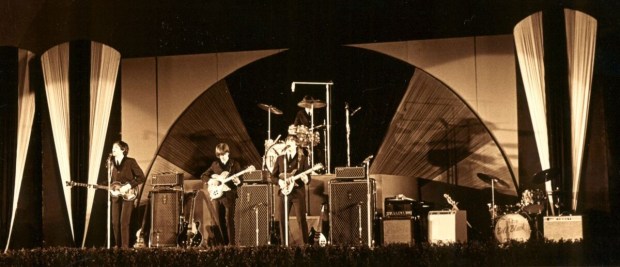
Two of their more high-profile gigs on the West Coast were their appearances at the Hollywood Bowl in August, 1964 and in the same month the next year. Both were recorded but for various licensing reasons did not see the light of day until 1977 when highlights from both shows were combined for a 13-song, 33-minute album in what added up to a complete Beatles concert back then. Naturally, the screaming is super-intense and you got to give the lads credit for their energy level and musical precision (and good humor) given that they could hardly hear themselves.
On certain songs, like this 1965 take on “Ticket to Ride,” the girls seem to be taking a collective breather from the really crazy stuff and instead give the impression of a distant plague of locusts. Here, the band’s sound booms around the venue’s natural amphitheater. Elsewhere, they tinker with arrangements, like adding a pumped-up middle section to the pensive “Things We Said Today.” But nothing could negate the fact that this was not an optimal arrangement, especially with their growing musical sophistication in the studio. The Beatles last paying concert was the next August, at Candlestick Park on 8/29/1966, three weeks after releasing the game-changing Revolver.
That last factoid points up perfectly how rock and roll was quickly being transformed from a teen-scream sensation into a more cerebral, counter-culture art form. All four of these iconic bands were gearing themselves to the new studio-as-instrument ethos (esp. the Beatles and Beach Boys) while the Stones and Kinks had roadblocks to touring in the late Sixties: the former due to Brian Jones drug-bust-induced visa restrictions, the Kinks via a 4-year ban after a punch-up with officials from the American Federation of Musicians.
By the time they returned, the technology and amplification had caught up with the heavier sound of the new decade (see the Who’s thunderous Live at Leedsand the Stones’ own Get Yer Ya-Yas Out). The Kinks did a series of theater-rock presentations before making their own arena-rock move in the late 70s. Of course, the teen-hysteria thing never really went away and can be seen at shows by acts like Taylor Swift and the boy band of the moment. For us fans of the more classic rock type, the distractions at today’s show run more to people talking during the performance and impulsively holding up their smartphones. But that’s a story for another day.
 Reel and Rock