David Bowie

For The Records: The Cover Albums, Part Two

Well, here’s the concluding entry in my survey of recordings in that most star-crossed category, the covers album. Star-crossed in an almost literal way: here are stars performing the songs of other stars.

After listening to so many of these albums I can only conclude that placing one or two well-chosen covers on an album of your own original tunes works a lot better. The reason is a whole collection of tributes usually tends to lack coherence and make even the best artists look like a bar band.

The best way around this is for your covers album to have some sort of concept. The highest-ranking record of Part One of this survey (David Bowie’s Pin-ups) worked so well because of its tight focus. Bowie was paying homage to British bands and key songs from the 1964-67 period, just before he broke thru himself. A similar concept guides the first record reviewed here, the only one other than Pin-ups to gain an A- rating.

Songs From a Haunted Ballroom—The Skids (2021)

While not a household name, most fans of early UK punk will recall this tenacious band who moved down to London from their native Dunfermline in the late 70s. The Skids gained notoriety not just for their tough-guy rep (legend has it that they picked fights in clubs to get their names in the English music press) but also for their aggressive-but-artistic musical approach. That included at least two Brit punk classics: “Into the Valley” and “The Saints are Coming,” both of which are featured here in re-recorded versions.

The rest of Songs From a Haunted Ballroom have an association with the Kinema Ballroom, a vital but volatile music venue in their hometown. The Skids, whose guitarist was future Big Country leader Stuart Adamson, got their start here, playing live sets opening for the likes of the Clash before the place changed over to a discotheque later at night.

Both aspects of the Kinema are celebrated here. Mainstay vocalist Richard Jobson is joined here by ex-Big Country second guitarist Bruce Watson and his guitarist son Jamie Watson. The lads come charging out of the gate with Ultravox’s “Young Savage,” one of many allusions to the club’s stormy history (“Anything goes where no one knows your name”). They tip their hat to the Clash with a nice take on “Complete Control.” In light of the father-son axe duo backing him up, Jobson is obliged to use the song’s proclamation “You’re my guitar hero!” not once but twice.

Elsewhere, there are enthusiastic, high-energy tributes to the Adverts, Sex Pistols, Iggy Pop, Mott the Hoople and Magazine. Just as welcome are some of the less obvious choices like Ace Frehley’s “New York Groove” and Garland Jeffrey’s “35mm Dreams.” The key track is probably their ominous take on David Essex’s glam hit “Rock On.” As an after-hours disco, the Kinema was a magnet for the region’s various violent gangs and apparently “Rock On” was the signal for the trouble to start. Jobson describes the scene in a mid-song monologue as the AV Toi (“the most mental gang in Scotland”) get ready to rumble. Grade: A-

Acid Eaters—The Ramones (1993)

As punk-rock pioneers, the Ramones need no introduction, but once you get past their mid-to-late 70s heyday, they become a lot less examined. By the late Eighties, original bassist and key songwriter Dee Dee Ramone had left, leaving CJ Ramone to man the front line with Joey and Johnny. CJ, who took some lead vocals, was an energizing figure but the band’s run was almost over.

On this, the Ramones’ penultimate studio album, the band matter-of-factly reposition themselves as acid-rock casualties: just look at the disconcerting covert art. Of course, it’s still them so don’t expect Dead-style noodling or Floydish space jams. Opener “Journey to the Center of the Mind” (sung by CJ) may be trippy but it also rocks.

The results here are entertaining if a bit predictable. The Ramones are in a comfort zone when covering their antecedents like the Animals, Seeds and Troggs. And it’s a blast to hear Joey’s long-loved voice singing the Who’s “Substitute” with no less than Pete Townsend guesting on guitar. The same goes when ol’ Bobby Dylan gets the Ramones’ patented faster-and-louder treatment. Their buzzsaw rendition of “My Back Pages” (check out Marky’s triple-time drumming and Joey’s rare lead guitar shredding) gives the Byrds’ celebrated version a run for its money

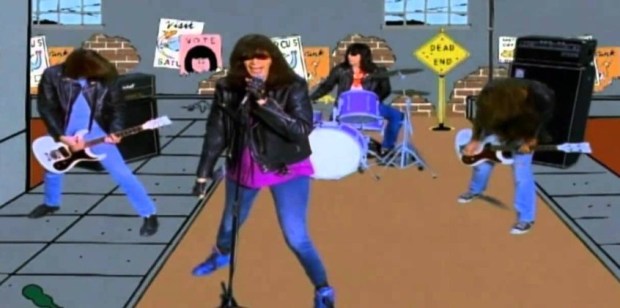
As usual, though, the results here vary. The Credence vibe (as in “Have You Ever Seen the Rain”) doesn’t seem to suit da brothers and their take on “Somebody to Love” (despite backing vocals by porn star Traci Lords) won’t make any baby boomer forget about Grace Slick. For my money, the Ramones’ best cover came on their next (and last) album Adios Amigos. Their version of “I Don’t Wanna Grow Up,” Tom Waits’ seriocomic take on the old Peter Pan trope, is made all the more affecting by being the final bittersweet salvo of the group’s perpetual teenage rebellion. (The video’s witty animation was done by famed comic artist Daniel “Ghost Story” Clowes). Grade: B (B+ if you add in the Tom Waits tune).

12—Patti Smith (2007)

Rising up from the same Lower East Side scene that birthed the Ramones, New York punk poetess Patti Smith showed a great knack for incorporating others’ work into her own on her revolutionary debut album in 1975. Horses kicked off with her radical recasting of the Van Morrison warhorse “Gloria” with her famous opening line, “Jesus died for somebody’s sins but not mine.” On side two her group seamlessly added “Land of a Thousand Dances” to the outré 9-minute “Land.”

It wouldn’t be until 2007 that the covers-album bug would give Patti a bite. Smith is famously expansive in her fandom, so it’s no surprise that 12 is a grab-bag of songs of different eras and genres. If you want to know how to get from Jimi Hendrix to Tears for Fears to Neil Young in three easy steps, here you are. If you’ve been yearning for a slow-paced version of “Smells Like Teen Spirit” complete with banjo and fiddle, your wait is over.

This will be a pleasurable listen for Patti Smith fans like me. But the fact that her take on “Everybody Wants to Rule the World” is my favorite thing here (despite not being even close to my favorite tune covered) goes to show just how random these records are. Grade: B-

Dylan—Bob Dylan (1973)

This long-derided album can’t be blamed on the artist. A record of traditional songs and covers, they are outtakes from 1970’s lowly-rated 2-LP set Self Portrait It was released against Dylan’s wishes by Columbia Records in “revenge” after Dylan had the audacity to jump ship to Asylum (he came back two albums later).

His largely indifferent takes of various non-originals made up about two-thirds of Self Portrait, and these are the leftovers. There are lackluster tributes to contemporaries (“Big Yellow Taxi” and “Mr. Bojangles”), a few deep oldies (“Spanish is the Loving Tongue” dates to 1907) and a three-hankie Elvis ballad (see below). Bob sings in his appealing “Nashville Skyline” voice but his delivery is lazy, and the record is marred by the overuse of a shrill female chorus too high in the mix. Some have suggested that the ever-cryptic Dylan was engaged in some perverse self-sabotage during this period. I tend to believe it. In his re-issue series, a collection from the same period, called Another Self Portrait, was released in 2013 and it’s freaking great. Grade: C-

Covers—Cat Power (2022)

Chan Marshall, the Atlanta-born singer/songwriter who goes by the stage name Cat Power, has been beguiling fans since she came on the scene in 1992. Her brand of subtle intensity may not be for everyone, but her unique musical stylings make her esp. suitable for doing other people’s material (this is her third, and most recent, covers album). Not everything here sticks the landing, but when it does it’s quietly captivating.

The best to my ears are her artful renditions of two poignant slow numbers. First is the Pogues’ “A Pair of Brown Eyes,” with Marshall accompanying herself on Mellotron (see below). Second is the Replacements’ barroom ballad “Here Comes a Regular.” There are other selections that show the depth of her musical appreciations: Nick Cave’s “I Had a Dream, Joe” and Kitty Wells’ proto-feminist anthem “God Didn’t Make Honky Tonk Angels,” the first C&W #1 hit by a solo woman. On the flip side, she does a song by lesser-chanteuse Lana Del Ray, Bob Seeger’s “Against the Wind” (barely recognizable) and a number from Ryan Gosling’s short-lived group. But with cover albums, variety is the spice of life. Grade: B

Kojak Variety—Elvis Costello (1995)

More “variety.’ First off, I’m glad that this album was named after a store near where it was recorded in Barbados, and not after the charmless TV detective played by Telly Savalas. Secondly, most know that Costello, a generational songwriting talent, has a keen ear for and encyclopedic knowledge of other great tunesmiths—he did a country covers LP (Almost Blue) only a few years into his career. This one also wisely sticks to a plan (the cover touts “Rhythm & Blues, Popular Ballads”) and said tunes are delivered in Elvis’ familiar self-assured style. You get them coming and going: songs by Willie Dixon, Mose Allison, Screamin’ Jay Hawkins, Little Richard, Jesse Winchester etc. Your favorite will depend on your preference for a particular tune. I love his emotive take on Dylan’s “I Threw It All Away” and esp. his elegiac take on Ray Davies’ bittersweet “Days.” This Kinks Klassic Kover was originally from the soundtrack of the Wim Wenders’ film “Until the End of the World,” where it was also a group sing-along during a campfire scene. Grade: B

Through the Looking Glass—Siouxsie and the Banshees (1987)

The distinctive, imperious voice of goth icon Siouxsie Sioux was well known by the time she and the Banshees decided to do this tribute album of early influences a la David Bowie’s Pin-Ups. And like Bowie, she was able to put a unique stamp on many of the well-chosen covers here. Dark and delectable tunes like John Cale’s “Gun,” the Doors’ “You’re Lost Little Girl,” and Kraftwerk’s “Hall of Mirrors” are naturals for her and delivered in excellent style.

Other tracks go next level: Iggy Pop loved Siouxsie’s version of his nocturnal road-tripping “The Passenger” (which added a neat brass section) so much that he asked to do a later duet version with her. Her goth take on the Billie Holiday nightmare classic “Strange Fruit” is not afraid to sit up right up there in the pantheon. And her eerie vocal on Television’s “Little Johnny Jewel” gives that early punk gem a second life, with guitarist John Valentine Carruthers ably reproducing the song’s infamous 8-note guitar motif while wisely avoiding a go at Tom Verlaine’s nervy, virtuoso solo. Grade B+

I didn’t have time to fully review Nick Cave and the Bad Seeds 1986 covers LP Kicking Against the Pricks but was taken by its closing number. It became a signature song (along with “Georgy Girl”) for fellow Australians the Seekers. Written by Tom Springfield, it seems an appropriate place to close. Like a carnival, cover albums have plenty of fleeting pleasure before they move on to another town, while you turn back to your favorite artists doing original material.
For the Records #6: Got Live if You Can Bear It

The live album holds a curious place in many discographies of rock bands and solo artists. It can be many things: a peak-career highlight for some (The Who’s Live at Leeds, the Stones’ Get Yer Ya-Yas Out, James Brown’s live-at-the-Apollo recording) and a career maker for others (Frampton Comes Alive). Many others are seen as placeholders between studio albums or as a de facto souvenir for fans who have seen their favorites in concert.

Sometimes though, an official live release can end up being a millstone in the canon of even the best musical artists, scoffed at by both critics and fans alike. It could be a case of shoddy production, sloppy performance, a group in career downturn or even an excess of success. Creem magazine was once so put off by the rank triumphalism Quenn’s Live Killers they compared it to the sound of “someone peeing on your grave.”

Over time I have gathered up a list these bad-rep concert documents and re-visited them, wondering if they really deserved all those one-star reviews. In some cases, time has been kinder, initial victims of a hot-take hostility in a tougher age of music criticism. Others are still big-time stinkers.

Who’s Last—The Who (1984)

I’ve always wondered about this one. Dismissed and derided at the time, Who’s Last was a document of the band’s at-the-time Farewell tour back in 1982. I mean it couldn’t be as bad as all that, right? Yes and no. On one hand it is the Who and there are gobs of great tunes that are played well enough. But on the other hand, don’t expect anything transformative. The galvanizing versions of “Magic Bus” and “My Generation” on the celebrated Live at Leeds put the ones here to shame, not to mention how poorly this “See Me, Feel Me/Listening to You” stacks up to victorious version on the Woodstock soundtrack. True, people thought it was a swan song back then and a release was justified (though it only hit #81 in America) but after Pete and the boys resumed touring in 1989 it seemed irrelevant, esp. after the sublime Leeds was expanded from 6 to 14 tracks in the CD era. Grade: C-

Take No Prisoners—Lou Reed (1978)

“What do I look like, Henny Youngman up here?” Yeah, kinda. This smart-ass double album was reportedly Lou’s answer to those who said he never talked on stage. True to Reed’s incorrigible nature he goes too far in the other direction, ad-libbing over opener “Sweet Jane” until the song is just an afterthought. True, he does get out a few good lines (“Give me an issue, I’ll give you a tissue”) and a sick burn on Patti Smith (“Fuck Radio Ethiopia, this is Radio Brooklyn!”) but it sets the tone for what is really a punk novelty record.

The music, such as it is, starts at 2:20

The crowd at the Bottom Line nightclub in NYC seem to be there as much for the cult of personality as for the music, and “Walk on the Wild Side” becomes a rambling 16-minute monologue a la Lenny Bruce. When Lou does manage to get thru a whole song without ragging on rock critics or his old Factory friends the results can be pretty good, as on “Coney Island Baby” and “Satellite of Love,” but they add up to a relatively small fraction of the album’s long 98-minute run time. Grade: C

Coast to Coast: Overture and Beginners—Rod Stewart/Faces (1974)

The Faces were on borrowed time when this concert record came out, maybe accounting for the poor press it got. Some saw it as a quick cash-out before Rod Stewart finally split to commit full-time to his burgeoning solo career. Key contributor Ronnie Lane had already left, replaced by Japanese bassist Tetsu Yamauchi. Coast to Coast is an enjoyable (if slapdash) mix of Rod solo numbers, a couple of Faces songs and clutch of covers. Most successful is a top-shelf take on the Motown lament “I Wish it Would Rain,” featuring an impassioned vocal by Rod and a great blues guitar solo from Ronnie Wood. Grade: B-

On the Road—Traffic (1973)

Traffic were another stalwart British group who were heading down the home stretch when this leisurely live double hit the shops. They released one more studio album before disbanding the following year. This was the end of their expanded-lineup era, with the core trio of Steve Winwood, Jim Capaldi and Chris Wood were joined by percussionist Rebop and three Muscle Shoals session men. This period was marked by a certain languid jam-band sound and most of the material here was drawn from the previous two studio sets, Low Spark of the High-Heeled Boys and Shoot Out at Fantasy Factory. The only nod to the “old” Traffic was a 21-minute medley of “Glad/Freedom Rider.” The band may have set themselves up for rock-mag ridicule by including the recent “(Sometimes I Feel So) Uninspired.” But that one turns out to be a highlight, with some electrifying lead guitar from Winwood, so go figure. Grade: B-

David Live—David Bowie (1974)

This is a textbook case of a concert album being recorded at precisely the wrong time. Bowie’s ’74 show started off as the “Diamond Dogs” tour and ended as the start of his “plastic soul” era. (His next album would be Young Americans). The album is unfocused and lacking in true energy, his vocals careless and strained. Hard drugs were an issue. It tends to sound better if you don’t know the studio version and have nothing to compare it against (I rather like his version of the Ohio Players “Here Today, Gone Tomorrow”). But the only one of his many famous songs here that maybe outdoes the original is a strong version of “Rock ‘n’ Roll Suicide,” that closes this misbegotten release. Grade: D+

T.V. Eye Live—Iggy Pop (1977)

Speaking of Mr. Bowie, the year 1977 brought him renewed recognition not only for two of his classic Berlin-era albums (Heroes and Low) but also reviving the career of a certain James Osterberg, who was at loose ends after the dissolution of his proto-punk band the Stooges. Iggy Pop, as he was better known, joined Bowie at his digs hard by the Berlin Wall, both trying to kick long-standing drug habits and get new inspiration in their bleak Cold War surroundings.

Iggy also released two great albums in ’77 (The Idiot and Lust for Life), both produced and largely co-written by his pal Dave. This single live album also got a release but was panned across the board (one meager star at AllMusic) but nowadays it’s hard to see why. It’s a pretty strong set, some of it from an American tour where Bowie supported him on keyboards and backing vocals. The sound quality is not so hot, probably because RCA gave him a $90,000 advance to produce the album (he owed them one more LP) but then spent five grand on it and pocketed the rest. That alone bumps it up half a grade. B+

Bob Dylan at Budokan—Bob Dylan (I think) 1978

Perhaps we will never know just what compelled Zimmy to release this album of his revolutionary repertoire performed as a vacuous Vegas lounge act (and presented as such). On the heels of his divorce and the epic flop that was his “Renaldo and Clara” movie, maybe he thought he could release a quicky double live album and recoup his losses before anyone noticed, it did hit #13 in America.

It did have a few critical defenders and of course if you go by the YouTube fanboys, Budokan ranks right up there with the Sistine Chapel at the apex of Western Civilization. But unless it’s enjoyed as a perverse form of performance art, I don’t know how anyone can like the Wayne Newton arrangements, the cloying back-up singers, the overwrought saxophone and Dylan singing his visionary back catalogue as if it were the collected works of Tony Orlando and Dawn. Just take this encore version of “The Times They are A-Changing” (please) and listen to the fake sincerity of the spoken intro and then Dylan actually telling the crowd “We’re here for four more nights” as if he really were at a casino cocktail lounge and not one of the world’s most revered concert halls. Wow. Grade: D

Still Life—The Rolling Stones (1982)

The era of the true mega concert tour, complete with corporate sponsorship, was under way in the early 80s and naturally the Stones were on the leading edge. That means fans packed in like 80,000 sardines at a place like Arizona’s Sun Devil Stadium and the band trying to fill it with sound and vision no matter how impersonal the setting. (You can see some of that scene in the Hal Ashby-directed tour film, “Let’s Spend the Night Together”). The stage is so big that Mick Jagger and Charlie Watts seem to be in different zip codes). This dynamic comes thru in the unfortunately- titled Still Life.

Like Who’s Last, there are lots of great songs here and the notes are all in the right place (mostly). Yet, it comes down to a business model that just doesn’t work—for me, anyway. I’ve never been to a football stadium concert, and this shows me why. Sure, it’s quite possible to have a good time at this kind of show (many have) but to me the possibility of a good aesthetic return on your monetary investment seems low. I can’t see the band and they can’t reach me; that dubious dynamic carries over to the album. Like David Live, this album sounds OK when you don’t have any previous recording to compare it to, so I chose their new cover of Smokey Robinson’s “Going to a Go-Go” as the best of the lot. Grade: C

Live ‘n’ Kicking—West, Bruce and Laing (1974)

Twin Peaks—Mountain (1974)

When you apply the contemporary phrase “Go big or go home” to the classic rock era, it’s hard not to think of Leslie West. He was a “mountain” of a man (his girth inspired the band’s name), his bellowing vocals and scorched-earth guitar solos known far and wide since the band made a big splash at Woodstock. By 1972, Mountain were on hiatus and West and Mountain drummer Corky Laing joined ex-Cream bassist/singer Jack Bruce to form a blooze-rock supergroup that released two studio albums and this single live set, released just after announcing their break-up in early ’74.

As a group, Mountain, as heavy as they were, also had a melodic sign, seen in deft compositions like “For Yasgur’s Farm” and “Nantucket Sleighride.” WBL cast away most of that. To start off Live ‘n’ Kicking, they turn the Stones’ refined and brooding ballad “Play With Fire” into a 13-minute marauding metal warhorse, complete with drum solo. The “96-decibel freaks” in the audience eat it up. Jack Bruce, replacing the more refined Felix Pappalardi as West’s frontline partner, was rougher-edged. He fills the space between songs with arena-rock bravado and his bass is turned up to overload levels nearly as loud as West’s guitar, if that’s even possible. True, there is some nimble trip interplay on the WBL original “The Doctor” but things go happily off the rails with closer “Powerhouse Sod” which turns into a Bruce showcase, because everyone knows the best way to end a 70s live album is with a bass solo!

Around the same time that West, Bruce and Laing were dissolving due to internal dissension and hard-drug abuse, West was and Pappalardi were re-uniting with a new lineup. Corky Laing, for whom the drug issues were hitting esp. hard, was replaced this time by Alan Schwartzberg. Original keyboardist Steve Knight was subbed off in favor of Bob Mann, who also doubled on second guitar for added sonic impact. My roommate at the time called the Japan-recorded Twin Peaks “the album with the biggest tits in the world” (riffing on Monty Python) and it did seem like the band was out to prove scale new heights of heavyosity.

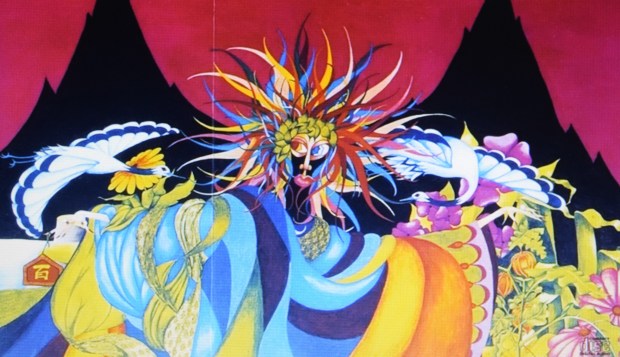
Twin Peaks, with its confident air attractive artwork (see banner image at top of this post) did fare a little better in the critical arena than Live ‘n’ Kicking, which got an E+ (?) in the Village Voice. However, many scribes headed for the exits at the prospect of a 32-minute “Nantucket Sleighride.” Of course, fans, in this age of bong hits and good stereo systems, loved every long minute of it and didn’t mind having to get up and flip the record halfway thru. The glorious noise continues right through to side four, as the band run over the “Mississippi Queen” with a Mack truck and play “Roll Over Beethoven” at such volume that it would have made ol’ Ludwig van deaf all over again. Best of all is West’s signature “Guitar Solo,” where he gets free reign to indulge himself for five uninterrupted minutes, to the point where he injects a bit of “Jingle Bells” even though it’s August in Osaka. The Seventies, they were a thing, man.

Grades: Live ‘n’ Kicking: B-, Twin Peaks: A (fight me).

And speaking of “Jingle Bells,” Happy Holidays, everyone!

We’ve All Gone Solo #9 (Mick Ronson)

ronson

The curious case of Mick Ronson is a great example of why I like doing this series so much. Rock fans can be a sentimental lot and Ronson, who came to prominence as David Bowie’s right-hand man in the heady days of Ziggy Stardust, is still greatly admired long after his untimely death in 1993 at age 46. A classically-trained musician from the craggy port city of Hull, England, Ronson did not find much success in London with his late 60s rock outfit called The Rats. He eventually left the capital, not knowing he had recently attracted the attention of Bowie. Although he had had a hit with “Space Oddity” (considered a bit of a novelty record at the time), Bowie harbored plans to achieve pop immortality via some transformative concept.

As the story goes, one of Mick’s ex-drummers found the guitarist back up in Hull, marking out the end lines on a rugby field, part of his job in the city’s parks dept. Convinced to give London another try, Ronson got the gig as Bowie’s guitarist on the two albums (The Man Who Sold the World and Hunky Dory) leading up to the world-beating The Rise and Fall of Ziggy Stardust and the Spiders from Mars. By the time of Bowie’s alter-ego masterstroke, Ronson was more than just the flashy lead guitarist in the singer’s gender-bender, sci-fi alternate universe. Ronno, as he was now known, was a principal player in the album’s cinematic sweep, as arranger and keyboardist in addition to his incandescent guitar work—not to mention his role as Bowie’s onstage foil when the Ziggy show went on the road.

ronson bowie2

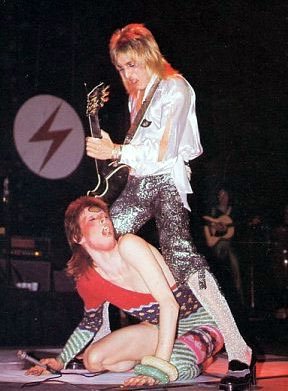
Obliged to dress in the glittery style of the leader, as did drummer Woody Woodmansey and bassist Trevor Bolder, those were special times for Ronson as the top Spider. But as revolutionary as the look and sound was, pointing the way to both the punk era and the image-conscious 80s pop, Bowie was not a guy to stay in one bag for very long. Though Ronson was still an integral part of the Ziggy follow-up Aladdin Sane and the covers album Pinups, he was soon out of the silver suit and would only play with David on a couple of occasions after that.

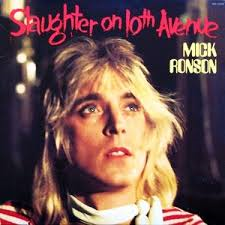
His first solo LP, Slaughter on Tenth Avenue, arrived soon after in Feb. of 1974 and made #9 on the UK charts. This is an album that still gets a lot of love, sometimes to a strange degree. On the extreme fringe, one online true believer, states that Tenth Avenue is the greatest rock music ever produced, with the exception of Jimi Hendrix. Really, even better than Ziggy Stardust? This is obviously the work of a very talented musician but it also gives every indication of being a toe-dipper in the solo-artist waters. Mick makes a very debatable decision opening the record with a version of “Love Me Tender.” Starting off with a soft-serve Elvis cover does not exactly indicate a forward charge up to the rock ‘n’ roll Acropolis. Elsewhere, there are three tunes that David Bowie had a hand in writing, all well sung and played by Ronson in the moonage-daydream style of recent vintage. (The best of the three, “Growing Up and I’m Fine,” is heard above). Most intriguing is the title cut as Ronno delivers a sterling rockist rendition of a Richard Rogers dance piece he loved since the days of his youthful music lessons—the cabaret-style piano and the long line of dramatic sustained guitar notes does justify the hype of the man’s eager-beaver followers.

Like a lot of the folks featured in the series, Ronson found his greatest market value in a support role or behind the scenes. In between this album and his solo follow-up (Play Don’t Worry, #29 UK) he was in the final line-up of Mott the Hoople. Ronson would go on to form a partnership with Mott frontman Ian Hunter that would last for several albums and tours. Later he would appear with Bob Dylan’s Rolling Thunder Revue while producing and/or playing on records from a diverse list of artists that included Lou Reed, Van Morrison, Ellen Foley, the Rich Kids, T-Bone Burnett, Morrissey and even David Cassidy. In 1992, shortly after being diagnosed with cancer, he appeared at the Freddie Mercury Tribute Concert where he was re-united with both Bowie and Hunter. Despite never being as famous as those he helped support (or partly because of it), the secondary spotlight shining on Ronson still burns plenty bright.


Today, “Top of the Pops,” Tomorrow the World!