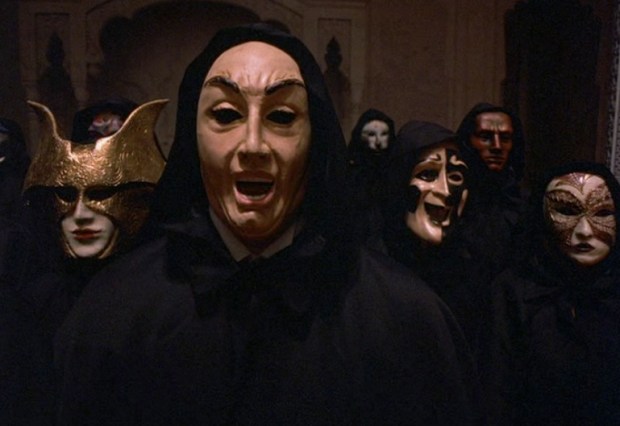
“A dream is never just a dream.”
In an enlightening article published a week before Christmas 2025, New York Magazine writer Lane Brown states that, “Stanley Kubrick’s movies have a habit of aging into new meanings, like monoliths that take time for us apes to figure out.” The enigmatic, maximalist director (2001, Dr. Strangelove, Clockwork Orange, Full Metal Jacket) died in 1999, just four days after completing his final film, Eyes Wide Shut. And it is that psychological fantasy drama, starring then-married Nicole Kidman and Tom Cruise, that is the subject of Brown’s piece. To wit: that “Eyes Wide Shut” could be a coded warning from Kubrick about the horrors of the Jeffrey Epstein sex-ring, which was assumed to have started a few years before. (The “evidence”? There’s a guy who looks like Epstein in the background and Kubrick died right after allegedly having an argument with studio heads, etc.)
Yes, of course, it is bat-shit crazy. The general public should have learned its lesson about pop-culture conspiracy theories way back during the silly “Paul-is-Dead” affair during the latter years of the Beatles. To even assume that reclusive Kubrick, a true artist and not a feckless Reddit rumor-monger, would have had knowledge of this sordid affair and spend years making a 160-minute feature film about it, instead of calling the authorities, is mind-boggling in its inanity.
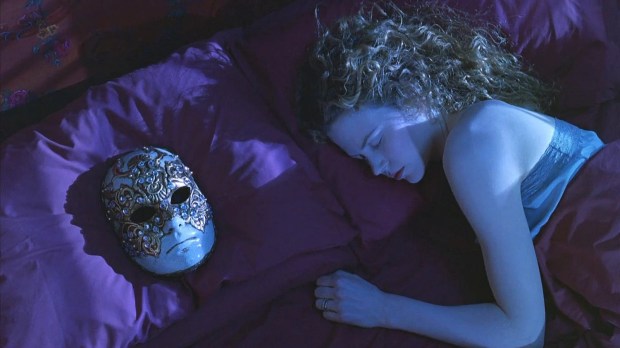
What Kubrick was aware of is the crushing effect of the misused privilege of the upper-upper classes, a theme he also explored in 1975’s “Barry Lyndon.” If the Internet time-wasters focused on this instead of their fictitious figments, it would all be for the better. Eyes Wide Shut is based on the 1926 book “Traumnovelle” (Dream Story) by Austrian author Arthur Schnitzler. It examines the uneasy marriage of upscale Dr. Bill Harford (Cruise) and his wife Alice. Schnitzler was part of European “Decadent” cultural movement, and though the setting is moved from Vienna at Mardi Gras to Christmastime in 1990s New York City, the film doesn’t take long to fit in with this epoch. First there is the ritzy and libertine Christmas party thrown by one of Bill’s super-wealthy patients, Victor Ziegler (Sydney Pollack), where the doctor is called upstairs to administer Victor’s clandestine date, an unclothed hooker who has almost OD’d on a heroin/cocaine binge. After dealing with the situation, Bill is predictably asked to keep it quiet. But a solitary speedballing prostitute is only the tip of this cold-hearted iceberg.
A key scene where the couple talk about their separate flirtations at the party is topped off by Alice revealing her obsession with a handsome naval officer she saw while on vacation, claiming she would leave Bill and their young daughter to be with him. The emotionally upended doctor is then summoned away on a house call. It leads to his all-night series of erotic but unconsummated encounters in a slightly-surreal looking Greenwich Village, and the film’s centerpiece, an elaborate ceremonial orgy scene at a secluded Long Island estate, a place where Bill shouldn’t be and where life is cheap if you’re one of the imported sex workers.
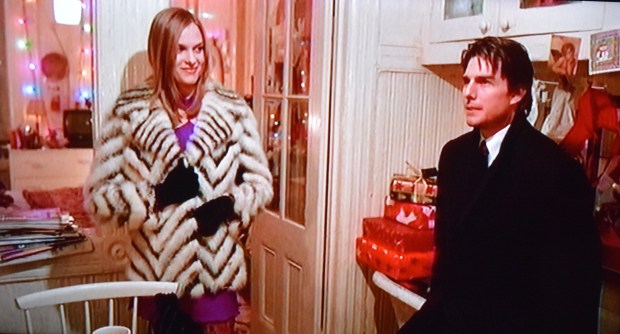
Vinessa Shaw and Tom Cruise discuss Christmas finances.
The tepid response to Kubrick’s last film is partly due to lack of clarity (and subsequent lack of viewer understanding) concerning the work’s origin in dream psychology. (It’s notable that Schnitzler was a contemporary of fellow Austrian Sigmund Freud). “Eyes Wide Shut” is a title indicating “dream awareness,” a kind of window into a deep psychic underworld, where a fantasy like Alice’s would seem to determine a marriage soon to implode. Bill’s Village wanderings, taken at somnambulistic pace, include a vaguely romantic encounter with a streetwalker (see above), interrupted when Alice call him on his cell, being accosted by the betrothed daughter of a freshly dead patient, being shoved aside and gay-baited by a gang of future MAGA assholes, and meeting the sexually promiscuous daughter of a costume-shop owner (played by a 16 year-old Leelee Sobieski).
In one of the film’s most chilling scenes, the costume-shop owner (played by Rade Serbedzija) has suddenly “come to another arrangement” and seems willing to pimp his daughter, hinting at the nefarious workings of secret societies that haunt the movie.
Though it seems like the biggest fever dream of all, Kubrick’s highly stylized orgy scene could be the most plausible aspect of the film. The horrid revelations about the late Jeffrey Epstein, his amoral imprisoned accomplice Ghisane Maxwell, and the numerous powerful men who somehow can’t resist spending time with underage girls, make the orgy seem at first like an elaborate masquerade party, despite the ominous complications caused by Bill’s crashing the scene of the country’s most rich and powerful having it all their way. But the slow-burning but riveting penultimate scene in the billiards room (below) where the untouchable Ziegler uses both tact and veiled threats to make sure to this little Upper West Side doctor will never again spoil the fun. And if someone dies gets themselves killed along the way, so be it. “Someone died, it happens all the time,” Ziegler concludes, sounding like Trump after the latest mass shooting.
At the top of the Epstein list of course, is the Orange Puke From Hell, the current president and convicted sex felon and vile authoritarian-minded degenerate—not to mention a person who built his entire political rise on mendacious conspiracy tropes and toxic social-media exchanges. He has since dragged us so far down into it with him, it feels we can’t stand up for falling down–giving our life over to grievance, rage and fear, both when it’s justified and when it’s not.

Mr. Kubrick, enjoying the holidays his way.
But instead, let’s look into the deeper meanings of what comes across our radar every day, instead of letting everything be a conspiracy or a grievance. And as Stanley Kubrick noted, our dream world is as instructive as the waking one and leads to a reconciliation of this film’s couple (while also acknowledging that “a dream is never just a dream”). The societal reconciliation that would lead all sides to finally come down on the side of stemming the unchecked power of the 1% still seems very far off. So, in the meantime, like in Greg Lake’s famous holiday song, “the Christmas we get we deserve,” meaning the biggest lump of coal that can fit into Santa’s sleigh.
 Reel and Rock