film

Eyes Wider Shut: 25 Years Later, Kubrick Shows Us the Christmas We Deserve

“A dream is never just a dream.”

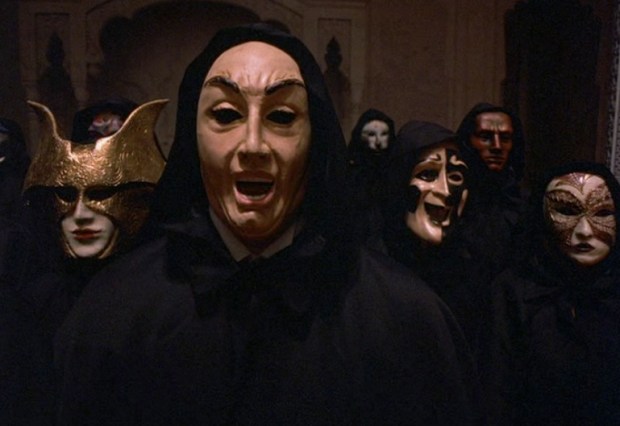
In an enlightening article published a week before Christmas 2025, New York Magazine writer Lane Brown states that, “Stanley Kubrick’s movies have a habit of aging into new meanings, like monoliths that take time for us apes to figure out.” The enigmatic, maximalist director (2001, Dr. Strangelove, Clockwork Orange, Full Metal Jacket) died in 1999, just four days after completing his final film, Eyes Wide Shut. And it is that psychological fantasy drama, starring then-married Nicole Kidman and Tom Cruise, that is the subject of Brown’s piece. To wit: that “Eyes Wide Shut” could be a coded warning from Kubrick about the horrors of the Jeffrey Epstein sex-ring, which was assumed to have started a few years before. (The “evidence”? There’s a guy who looks like Epstein in the background and Kubrick died right after allegedly having an argument with studio heads, etc.)

Yes, of course, it is bat-shit crazy. The general public should have learned its lesson about pop-culture conspiracy theories way back during the silly “Paul-is-Dead” affair during the latter years of the Beatles. To even assume that reclusive Kubrick, a true artist and not a feckless Reddit rumor-monger, would have had knowledge of this sordid affair and spend years making a 160-minute feature film about it, instead of calling the authorities, is mind-boggling in its inanity.
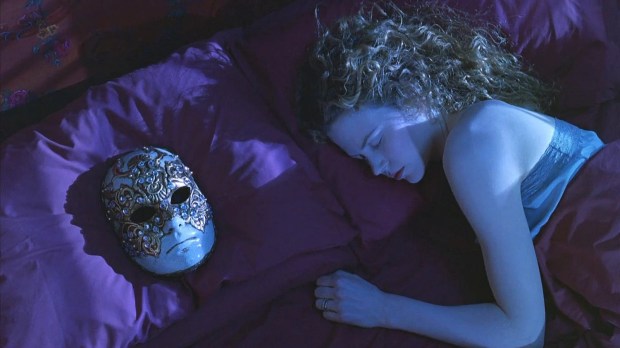
What Kubrick was aware of is the crushing effect of the misused privilege of the upper-upper classes, a theme he also explored in 1975’s “Barry Lyndon.” If the Internet time-wasters focused on this instead of their fictitious figments, it would all be for the better. Eyes Wide Shut is based on the 1926 book “Traumnovelle” (Dream Story) by Austrian author Arthur Schnitzler. It examines the uneasy marriage of upscale Dr. Bill Harford (Cruise) and his wife Alice. Schnitzler was part of European “Decadent” cultural movement, and though the setting is moved from Vienna at Mardi Gras to Christmastime in 1990s New York City, the film doesn’t take long to fit in with this epoch. First there is the ritzy and libertine Christmas party thrown by one of Bill’s super-wealthy patients, Victor Ziegler (Sydney Pollack), where the doctor is called upstairs to administer Victor’s clandestine date, an unclothed hooker who has almost OD’d on a heroin/cocaine binge. After dealing with the situation, Bill is predictably asked to keep it quiet. But a solitary speedballing prostitute is only the tip of this cold-hearted iceberg.

A key scene where the couple talk about their separate flirtations at the party is topped off by Alice revealing her obsession with a handsome naval officer she saw while on vacation, claiming she would leave Bill and their young daughter to be with him. The emotionally upended doctor is then summoned away on a house call. It leads to his all-night series of erotic but unconsummated encounters in a slightly-surreal looking Greenwich Village, and the film’s centerpiece, an elaborate ceremonial orgy scene at a secluded Long Island estate, a place where Bill shouldn’t be and where life is cheap if you’re one of the imported sex workers.
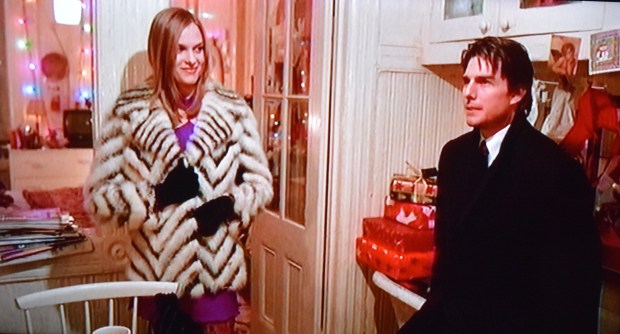
Vinessa Shaw and Tom Cruise discuss Christmas finances.

The tepid response to Kubrick’s last film is partly due to lack of clarity (and subsequent lack of viewer understanding) concerning the work’s origin in dream psychology. (It’s notable that Schnitzler was a contemporary of fellow Austrian Sigmund Freud). “Eyes Wide Shut” is a title indicating “dream awareness,” a kind of window into a deep psychic underworld, where a fantasy like Alice’s would seem to determine a marriage soon to implode. Bill’s Village wanderings, taken at somnambulistic pace, include a vaguely romantic encounter with a streetwalker (see above), interrupted when Alice call him on his cell, being accosted by the betrothed daughter of a freshly dead patient, being shoved aside and gay-baited by a gang of future MAGA assholes, and meeting the sexually promiscuous daughter of a costume-shop owner (played by a 16 year-old Leelee Sobieski).

In one of the film’s most chilling scenes, the costume-shop owner (played by Rade Serbedzija) has suddenly “come to another arrangement” and seems willing to pimp his daughter, hinting at the nefarious workings of secret societies that haunt the movie.

Though it seems like the biggest fever dream of all, Kubrick’s highly stylized orgy scene could be the most plausible aspect of the film. The horrid revelations about the late Jeffrey Epstein, his amoral imprisoned accomplice Ghisane Maxwell, and the numerous powerful men who somehow can’t resist spending time with underage girls, make the orgy seem at first like an elaborate masquerade party, despite the ominous complications caused by Bill’s crashing the scene of the country’s most rich and powerful having it all their way. But the slow-burning but riveting penultimate scene in the billiards room (below) where the untouchable Ziegler uses both tact and veiled threats to make sure to this little Upper West Side doctor will never again spoil the fun. And if someone dies gets themselves killed along the way, so be it. “Someone died, it happens all the time,” Ziegler concludes, sounding like Trump after the latest mass shooting.

At the top of the Epstein list of course, is the Orange Puke From Hell, the current president and convicted sex felon and vile authoritarian-minded degenerate—not to mention a person who built his entire political rise on mendacious conspiracy tropes and toxic social-media exchanges. He has since dragged us so far down into it with him, it feels we can’t stand up for falling down–giving our life over to grievance, rage and fear, both when it’s justified and when it’s not.

Mr. Kubrick, enjoying the holidays his way.

But instead, let’s look into the deeper meanings of what comes across our radar every day, instead of letting everything be a conspiracy or a grievance. And as Stanley Kubrick noted, our dream world is as instructive as the waking one and leads to a reconciliation of this film’s couple (while also acknowledging that “a dream is never just a dream”). The societal reconciliation that would lead all sides to finally come down on the side of stemming the unchecked power of the 1% still seems very far off. So, in the meantime, like in Greg Lake’s famous holiday song, “the Christmas we get we deserve,” meaning the biggest lump of coal that can fit into Santa’s sleigh.

Coppola’s Protopian Messterpiece

I come to praise Cesar (Catalina), not bury him. For many, “Megalopolis” is an easy film to dislike, but it’s a rewarding one to give an honest look at. Francis Ford Coppola’s long-gestating mega-project is messy and often unfocused, with moments of unintentional hilarity. But those moments are not nearly as laughable as some of the negative opinions lobbed at it.

In an age where cynical slasher movies and DC/Marvel sequels are puked off a cinematic assembly line at record pace, calling “Megalopolis” the “worst movie of all time” with “no redeeming qualities” is kind of like settling on Milli Vanilli’s “All or Nothing” as your favorite album because you thought the Beatle’s “White Album” was too sprawling.

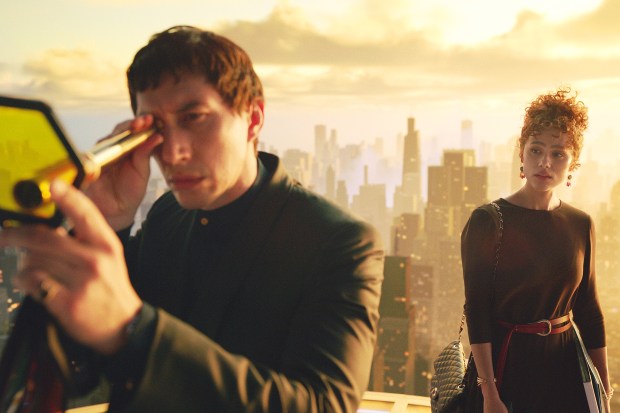
In a re-imagined New York City called New Rome, superstar architect Cesar Catilina (Adam Driver) has altruistic ideas for rebuilding a city that is a teetering empire very obviously based on its namesake. Against a backdrop of garish decadence (there are orgy-like parties and even a chariot race) Cesar’s proposal, as chief of the city’s Design Authority, is opposed by the old-school mayor Franklyn Cicero—played by Giancarlo Esposito who bears a strong resemblance to NYC’s current embattled mayor Eric Adams.

In its own loopy way,  “Megalopolis” is a sincere plea for an idealistic way forward for a world society in a time of debilitating tribal and nationalistic divisions. Comparing the bitterly polarized America of today to the approaching fall of the Roman Empire is not exactly a novel idea, but Coppola’s visual representation of this concept is the film’s strongest element.

From the late 19th century to the mid-1940s, New York was built to a majestic, inspirational scale comparable to what the Eternal City was in the ancient world. Cesar’s apartment/studio is in the defunct Cloud Club atop the Chrysler Building. Imposing low angle views of the Helmsley Building, Grand Central and other classic Manhattan structures are used to great dramatic effect, and we get to go underground to get a glimpse of the faded glory that is the old City Hall subway station. Colossal living statues sit despondently or crumble in alleyways, their great allegorical symbolism forgotten.

At the core of “Megalopolis” is a factor often overlooked but important enough to warrant its own section in the movie’s Wikipedia entry: “Artistic Idealism as Antidote to Polarization.”   That is, the role of the creative class in helping create more inclusive and livable cities. I can only hope that Coppola’s vision at least inspires some younger artists to foster a new generation of bold, humane visions (and in all the various ways they can be attained) in a world that so surely needs it.

The film’s closing title card attempts to transcend both nationalism and identity politics.

I did, however, have a problem with Cesar Catalina’s use of the word “utopia” which Mayor Cicero correctly identifies as a fantasy land. What Cesar really strives for is a “protopia,” a practical way forward to a better world for all. I think it was a deft move by Coppola to have the cerebral Cesar allied with the more grounded mayor for the film’s corny but uplifting closing scene.

Hopefully, this noble-but-flawed valediction for the 85 year-old filmmaker will outlast the confidence of the naysayers who to me sound too smart to know any better. “Is this way we’re living the only one available to us?” Cesar memorably asks at one point. I would like to think so, but I’m far from sure about it.

The Art of the Steal (Doc of the Week #2)

“As through this world I wander, I see lots of funny men,” Woody Guthrie sang back in 1939, “Some will rob you with a six-gun and some with a fountain pen.” Although Guthrie wrote those lines for the song “Pretty Boy Floyd” their relevance echoes far beyond the world of bank robbers and foreclosure-happy branch managers during the Great Depression. An interesting modern manifestation of his bon mot is in the field of art thievery. Here in the Boston area, there’s been much in the news lately about the FBI being close to solving the infamous 1990 heist at the Isabella Stewart Gardner Museum. This is a case where old-school bad guys gained entrance by posing as cops, tied up the guards in the basement and made off with a half a billion dollars worth of Rembrandts, Vermeers and Manets. But now there seems to be a more genteel way of relieving museums of their collections and the public of their cultural heritage. The newly-expanded Gardner Museum, like the Barnes Foundation depicted in the film below, was the quirky end product of a maverick art collector, places that (despite the last will and testament of their founders) can be tampered with in an age where top cultural institutions are beginning to look as monolithic as the too-big-to-fail banks.

art of the steal

The Art of the Steal
(Directed by Don Argott—2009—101 minutes)

In “The Art of the Steal”, the corporatization of culture is seen as an invasive, extra-legal force trampling the legacy of the eccentric and combative inventor/art collector Albert C. Barnes, whose extraordinary inventory of early modern paintings were displayed at his semi-private foundation in a Philadelphia suburb. Argott meticulously traces the battle that began after Barnes’ death in 1951 between his foundation and the cultural/political establishment over ultimate control of a collection that came to be valued at around $25 billion. Barnes was born to working-class parents, worked his way through college, and made a fortune inventing an anti-syphilis drug in the days before antibiotics. He was a passionate and prescient art lover and in the depths of the Depression bought up hundreds of canvasses by the likes Cezanne, Picasso, Matisse, Renoir and Van Gogh. These works were ridiculed by Philadelphia’s cultural elite as “primitive” and “debased”, cementing Barnes’ disdain for high-society and causing him to decamp to nearby Merion (a mere five miles away from the detested Philadelphia Museum of Art) where he hung the works in quirky galleries and ran an egalitarian art school.

Argott deftly works this story along two parallel tracks: first as a parlor mystery that traces the subtle chipping away at Barnes’ will (which stated in no uncertain terms that the paintings were never to leave the Merion location) by elements both inside and outside of his foundation; and secondly to the greater question of what is the correct dispensation of world culture in an era when individual works of art can easily sell for tens or even hundreds of millions. As the controversy came to a head in the first decade of the 21st century, Argott was there as the institutional powers that be (the successors of those who once belittled Barnes’ tastes) slowly asserted themselves in the idea that the collection was now too great to be left so inaccessible—-and while an opposing protest movement started calling it the greatest art theft since World War II. This elegantly paced and visually striking documentary seems to be a staunch defense of the Barnes Foundation as a “handmade thing in a machine world”, a populist outpost against the relentless commodification of modern life. Others have perceived “The Art of the Steal” as being one-sided (probably a lot of the same people that Argott lists as declining to be interviewed) as the articulate group of talking heads seem to concur more with Barnes’ rebellious worldview, as impractical as it is, than with those who he saw as putting themselves on a “pedestal… to pose as patrons of the arts.” Argott is in effect holding accountable those who are going to get their way in the end anyhow, as good a reason as any for a non-fiction film. It certainly has struck a nerve as Q&A sessions after film festival showings have repeatedly turned into shouting matches, pointing out the strong emotions behind a contentious issue that Argott has brought so memorably to light.

(Those interested in this subject should look into the case of the Seward House Historic Museum in upstate New York. The painting “Portage Falls on the Genesee”, by Hudson River School founder Thomas Cole, hung in the house for over 100 years before being summarily removed by museum’s overseer foundation. The canvas, recently appraised for a cool $18 million, was removed under police escort after the foundation’s unilateral decision that it was too valuable to hang in just any old historic home and needed to be sold off to a private collector at auction instead. The shocked museum operators may find only cold comfort in the promise that they will share in the proceeds.)