movies

Ranking the Rankin/Bass Christmas Specials: The Good, the Bad and the Bizarre

The prolific producing-directing team of Jules Bass and Arthur Rankin, Jr. have had a huge impact on our holiday viewing traditions. They made no less than 17 animated Christmastime special between 1964 and 1985. The duo created such iconic Yuletide characters as Rudolph, the Little Drummer Boy and Frosty the Snowman—-and memorable side players like Yukon Cornelius, BurgerMeister MeisterBurger and the Snow Miser/Heat Miser brothers.

Rankin and Bass were among the first American producers to employ Japanese animation teams and the resulting “Animagic” stop-motion puppet films (often mistaken for Claymation) are distinctly hand-crafted, often enchanting (even trippy) and sometimes unsettling. So let’s review those Christmas TV memories, both delightful and disturbing:

THE GOOD

“The Year Without a Santa Claus” (1974)

This entry has shot up the charts in many people’s holiday hit list in recent years, due in large part to the increased popularity of the irrepressible Snow Miser and Heat Miser, who do meteorological battle to control the holiday weather via a vaudeville sing-off. But overall, this is an attractive and well-written entry without the dark psychological underpinnings that lurk in other R/B productions.

Here, a very believable Santa (voiced by Mickey Rooney) is fatigued and under the weather. Suspecting that we mortals have stopped believing in him anyway, he decides on a mental health holiday just as December inconveniently rolls in. But the sensible and resourceful Mrs. Claus (Shirley Booth), showing us that it’s not only the Hubbie who knows how fly a reindeer, conspires to save the day. Features the songs “Here Comes Santa Claus” and a children’s version of “Blue Christmas.”

“Rudolph the Red-Nosed Reindeer” (1964)

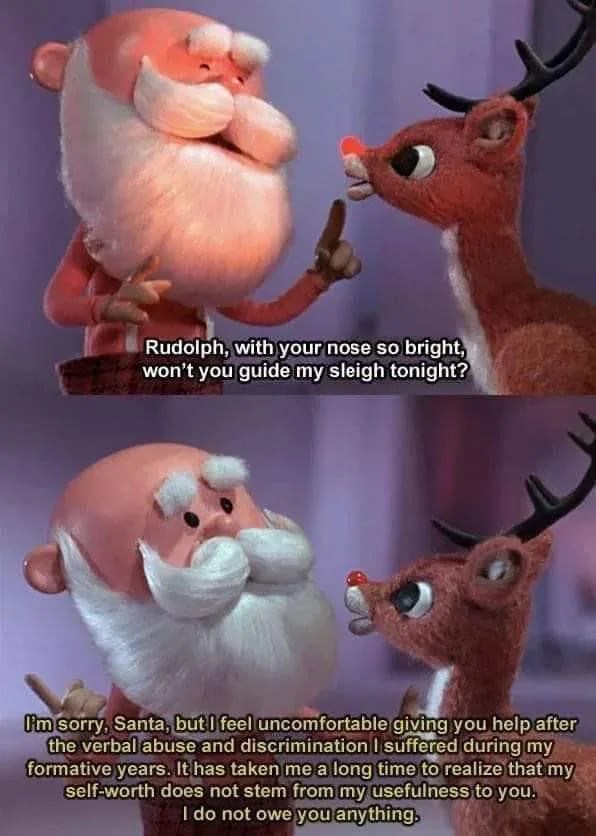
This perennial favorite celebrated its 60th anniversary this month by returning to NBC from whence it first aired. That it came out so long before the “safe space” era makes it great meme fodder for those who want to imagine the magnanimous Rudolph with a different answer to Santa’s famous question. This request for help coming after ol’ Ruddie Red Nose was practically disowned by his dad and bullied and ostracized by nearly everyone at the North Pole, forcing him into a dangerous (but ultimately rewarding) exile.

In these days of everyone-gets-a-trophy, “Rudolph” can stand tall as a great example that the world can be a cruel and callous place, and that a true test of character is not the worst thing. Rudolph “finds his tribe,” first teaming up with would-be dentist elf Hermey who has fled the town’s forced-labor camp, oops, I mean Santa’s workshop. They sing the great non-conformist anthem “We’re a Couple of Misfits” before heading out for their colorfully weird adventures with Yukon, on the Island of Misfit Toys, and against the Abominable Snowman. Note that when Rudolph returns to save the day, only his father straight-up apologizes for his previous cruelty, leaving a lot of unanswered questions about Santa’s alleged kindness.

“The Little Drummer Boy” (1968)

By the late Sixties, Rankin and Bass had hit upon a good dependable working model. This usually involved building a story around a preexisting holiday song (“Drummer Boy” was first recorded in 1951 by the Von Trapp Family), getting celebrity talent to do the voice work (June Foray, Paul Frees and guest narrator Jose Ferrer) and not shying away from subject matter that was a little dark for the kiddies. I confess to traumatizing my own son at a tender age when he witnessed the house of drummer-boy Aaron being torched by bandits while his parents were still inside.

Oopsy! The orphaned and embittered Aaron wanders the Middle Eastern desert, leading on his team of three surviving farm animals, by laying down some beats on the drum he received from his parents before you-know-what. He is exploited by a shady showman, before being led to Bethlehem on the coattails of Three Wise Men. Cue the Vienna Boys’ Choir for the stately rendition of Katherine Kennicott Davis’ revered (and sometimes reviled) carol. Behind that soaring chorus, the scene at the manger with Aaron and his stricken lamb is unabashedly religious and admittedly moving.

“Santa Claus is Coming to Town” (1970)

Fred Astaire gets the “Told and Sung By” honors here, as the R/B team hits on all cylinders. House scriptwriter Romeo Muller pens a succinct origin story for the big guy, and the Animagic cinematography team, led by Kizo Nagashima, do splendid work all the way from the icy-blue Mountain of the Whispering Winds down to the Teutonic grays and browns of Sombertown. The original music by Bass and Maury Laws is Broadway-worthy stuff, especially the two “Toymaker” songs and Claus’ self-improvement tune, “Put One Foot in Front of the Other,” sung to the easily-won-over Winter Warlock.

Voice actor extraordinaire Paul “Boris Badunov” Frees, was the voice of ace villain Burgermeister Meisterburger as well as his assistant Grimley.

This is also the first appearance of Mickey Rooney voicing the part of Santa, a role he would reprise a few times over the next decade. His is a nicer Santa than the ethically dubious one we saw in Rudolph. However, I still have a bit of an issue with the title song, first sung on the radio in 1934 by Eddie Cantor. I mean, here’s a guy who “sees you when you’re sleeping/knows when you’re awake.” Stalker, much?

Jack Frost (1979)

Moving away from the Santa-centric holiday fare, here’s a tale of everyone’s favorite wintertime sprite, one of the team’s most visually appealing entries. But this special’s affecting tale, much of it taking place in a splendorous silvery-blue domain, is hamstrung by a rather odd Groundhog Day framing device, with corny ol’ Buddy Hackett as narrator as Pardon-Me-Pete explaining at length the connection between Jack and his big day on February 2nd.

Otherwise, this is a grown-up story of how lovelorn Jack, crushing hard on the pretty but flighty Elisa, asks Father Winter if he might become human in an attempt to win her hand. She was a fangirl of ol’ Frost in his invisibility mode, but as a real boy it’s more like let’s-be-friends. Nevertheless, Jack proves himself in battle against the fearsome Kubla Khan, the Cossack King, who rules January Junction atop his mechanical horse and has at his disposal a steampunk army and an iron-plated sidekick called Dummy. (Kubla is memorably voiced by Paul Frees in his Boris Badunov voice).

The voice of Elisa is Debra Clinger, of the Clingers. She and her sisters were the first all-girl rock band signed to a major label.

Ultimately though, Jack is obliged to return to his former nipping-at-your-nose occupation, making this maybe the only R/B production with a romantic heartbreak theme.

The Life and Adventures of Santa Claus (1985)

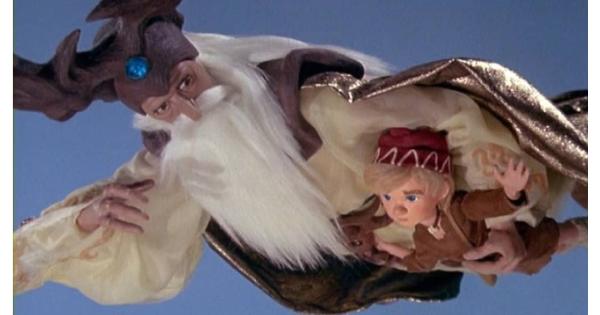
It’s back to the Santa origin story in this adaptation of the 1902 book by “Wizard of Oz” author L. Frank Baum. This is the last, and one of the best, of Rankin/Bass holiday productions, driven by the almost psychedelic visuals inspired by Baum’s ripe imagination. The grand procession of The Immortals that kicks things off in grand style.

The conclave of these pagan bigwigs is called by the Great Ak (“The Master Woodsman of the World”) to decide whether to confer Immortal status on the human orphan named Claus, who they took in after he was abandoned some 50 years previous. Of course, Ak relates the whole backstory, how he and young Claus had travelled the medieval world and got a close-up look at man’s inhumanity to man. Claus is esp. offended at the plight of neglected children and commits himself to their happiness. (But not before the Immortals have to take out the fantastical kid-hating baddies known as the Awgwas).

After a half-century of service, Santa is feeling his age so will the Immortals step up to the plate and make him an Immortal? No spoilers here. Rankin and Bass and their Animagic collaborators in Japan went out on a high note, so don’t miss out on this special special. After all, not all R/B creations we were great, and below we will look at some of their Greatest Misses.

The Bad and the Bizarre

“Frosty the Snowman” (1969)

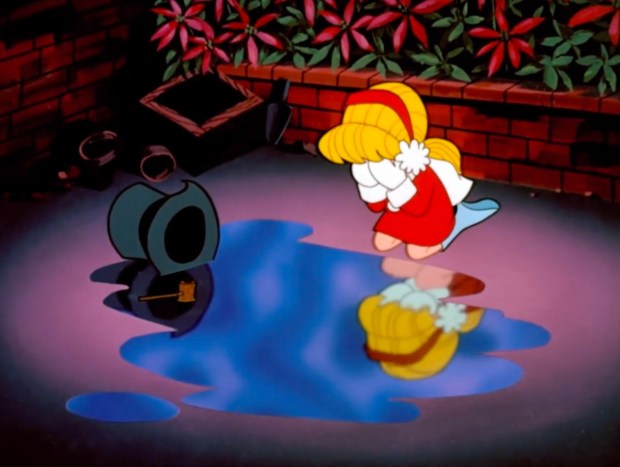
As if the 1950 Gene Autry song wasn’t annoying enough, this cartoon is so appallingly awful that it shouldn’t appeal to anyone over the age of five with at least one working brain cell. Here is the IMDB capsule description: “A living snowman and a little girl struggle to elude a greedy magician who is after the snowman’s magic hat.” Let’s get one thing straight off the bat: the hat belongs to the magician!! He is clearly shown as the owner when he does his rather inept magic show for the school children. That it later accidentally blew unto their snowman is beside the point.

Merry Christmas, kids!

Let’s admit it, Frosty was better off as an inert snowman. As a living being he is a chucklehead always in danger of melting and thus breaking the hearts of the impressionable kids. Jimmy Durante, as the defensive narrator (“That hat DID belong to Frosty and the children, that point must be made very clear”) sees nothing wrong with Frosty taking one of the children along with him to the North Pole, even though the girl almost freezes to death in the process. But, hey, it’s a classic, I guess! Rankin and Bass always had less luck with their cel animation, though this one paid off handsomely.

“Nestor, the Long-Eared Christmas Donkey” (1977)

This well-meaning but derivative program is also based on a Gene Autry ditty, and Roger “King of the Road” Miller does the honors as narrator and singer here. Shades of “Rudolph” abounds as Nestor is discriminated against because his ground-dragging ears make him clumsy. But Mary and Joseph look kindly on him and Nestor is enlisted to help them make it to Bethlehem. Note to parents: this special is rife with savage Roman soldiers, meanie animal merchants and even Bambi-level tragedy. But it all ends well on that fateful night at the manager, so we all good?

“The Stingiest Man in Town” (1978)

In view of their prolific output, it is no surprise that Rankin/Bass would have a crack at Dickens’ timeless tale. But this operetta-style version of “A Christmas Carol” is best left forgotten. The cel animation is uninspired at best and the musical numbers are mediocre, esp. considering the lazy lyrics (Jacob Marley to Ebenezer: “My chain of wrong is very long/But yours is even longer”). And whatever Walter Matthau was paid for voicing Scrooge, it was too much.

The First Christmas: The Story of the First Christmas Snow (1975)

The unwieldy title is not the only awkward thing about this entry. I mean, Christmas at the convent? I had eight years of parochial school, so it’s a hard pass for me. However, I did like Angela Lansbury’s version of “White Christmas.”

‘Twas the Night Before the Christmas (1974)

There are mouses in the houses in this rodent-infested version of the inescapable holiday poem. And they are stirring, unfortunately. Another example of how the R/B team were seemingly indifferent with their cel animation works, this one looks like a Hanna-Barbara reject.

Rudolph and Frosty’s Christmas in July (1979)

The youngsters should love this crossover effort. It has two of Rankin and Bass’ most beloved creations, and the stop-motion work looks great. I continue have doubts about the problematic top-hatted snowman, who still insists on using tobacco products in the company of children. Put away that corncob pipe and I’ll wish even you a Merry Christmas, Frosty!

So what do you think, what’s your most and least favorite Rankin/Bass show? Let me know and have a great holiday season! –Rick Ouellette

Coppola’s Protopian Messterpiece

I come to praise Cesar (Catalina), not bury him. For many, “Megalopolis” is an easy film to dislike, but it’s a rewarding one to give an honest look at. Francis Ford Coppola’s long-gestating mega-project is messy and often unfocused, with moments of unintentional hilarity. But those moments are not nearly as laughable as some of the negative opinions lobbed at it.

In an age where cynical slasher movies and DC/Marvel sequels are puked off a cinematic assembly line at record pace, calling “Megalopolis” the “worst movie of all time” with “no redeeming qualities” is kind of like settling on Milli Vanilli’s “All or Nothing” as your favorite album because you thought the Beatle’s “White Album” was too sprawling.

In a re-imagined New York City called New Rome, superstar architect Cesar Catilina (Adam Driver) has altruistic ideas for rebuilding a city that is a teetering empire very obviously based on its namesake. Against a backdrop of garish decadence (there are orgy-like parties and even a chariot race) Cesar’s proposal, as chief of the city’s Design Authority, is opposed by the old-school mayor Franklyn Cicero—played by Giancarlo Esposito who bears a strong resemblance to NYC’s current embattled mayor Eric Adams.

In its own loopy way,  “Megalopolis” is a sincere plea for an idealistic way forward for a world society in a time of debilitating tribal and nationalistic divisions. Comparing the bitterly polarized America of today to the approaching fall of the Roman Empire is not exactly a novel idea, but Coppola’s visual representation of this concept is the film’s strongest element.

From the late 19th century to the mid-1940s, New York was built to a majestic, inspirational scale comparable to what the Eternal City was in the ancient world. Cesar’s apartment/studio is in the defunct Cloud Club atop the Chrysler Building. Imposing low angle views of the Helmsley Building, Grand Central and other classic Manhattan structures are used to great dramatic effect, and we get to go underground to get a glimpse of the faded glory that is the old City Hall subway station. Colossal living statues sit despondently or crumble in alleyways, their great allegorical symbolism forgotten.

At the core of “Megalopolis” is a factor often overlooked but important enough to warrant its own section in the movie’s Wikipedia entry: “Artistic Idealism as Antidote to Polarization.”   That is, the role of the creative class in helping create more inclusive and livable cities. I can only hope that Coppola’s vision at least inspires some younger artists to foster a new generation of bold, humane visions (and in all the various ways they can be attained) in a world that so surely needs it.

The film’s closing title card attempts to transcend both nationalism and identity politics.

I did, however, have a problem with Cesar Catalina’s use of the word “utopia” which Mayor Cicero correctly identifies as a fantasy land. What Cesar really strives for is a “protopia,” a practical way forward to a better world for all. I think it was a deft move by Coppola to have the cerebral Cesar allied with the more grounded mayor for the film’s corny but uplifting closing scene.

Hopefully, this noble-but-flawed valediction for the 85 year-old filmmaker will outlast the confidence of the naysayers who to me sound too smart to know any better. “Is this way we’re living the only one available to us?” Cesar memorably asks at one point. I would like to think so, but I’m far from sure about it.