travel

Placeology #5: Up, Up and Away into Hotel Heaven

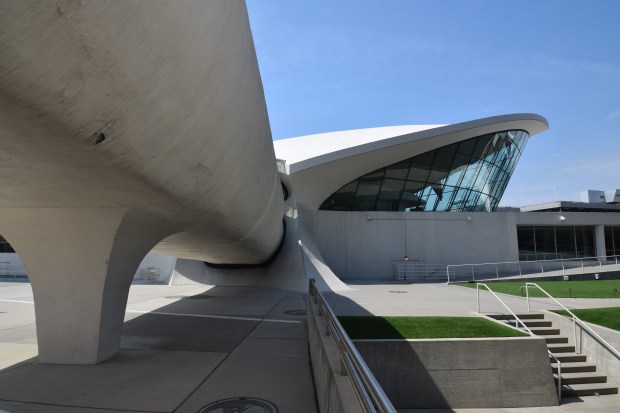
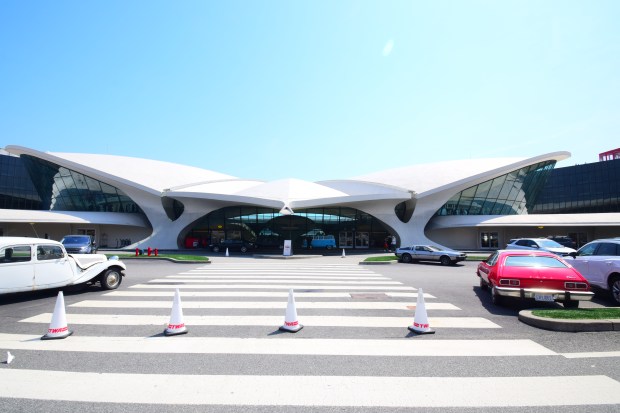
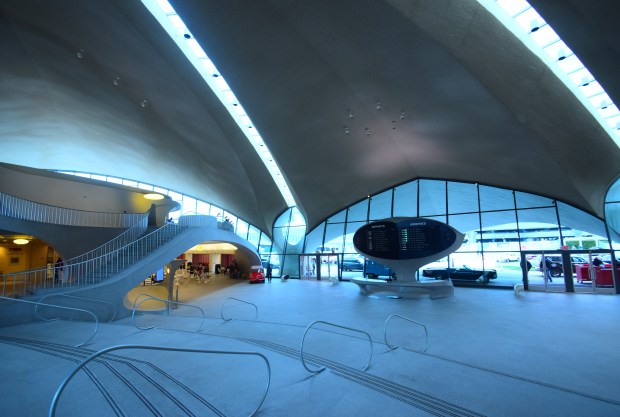
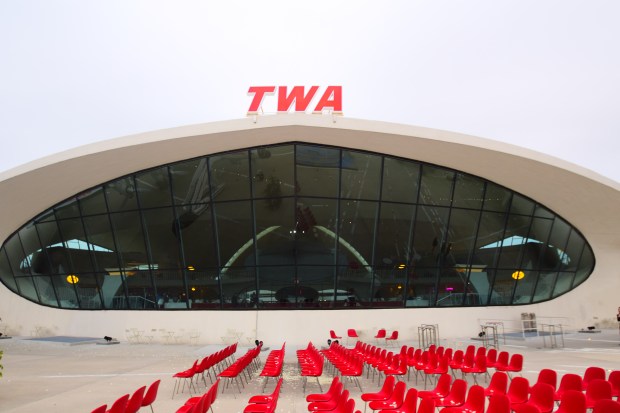
An instant induction into the “Placeology” Hall of Fame goes to the TWA Hotel at the JFK Airport in Queens, New York City. Eero Saarinen’s Jet Age/Space Age masterpiece, opened in 1962, now serves as a gigantic retro-futurist lobby for a hip but friendly destination hotel. The actual guest rooms are in two curved buildings that overlook the great sculptural form of Saarinen’s creation, made to resemble a bird taking flight. You reach the rooms by walking up the terminal’s two iconic red-carpeted tubeways, which may make you feel like you’re living inside the space station scenes in Stanley Kubrick’s “2001.”
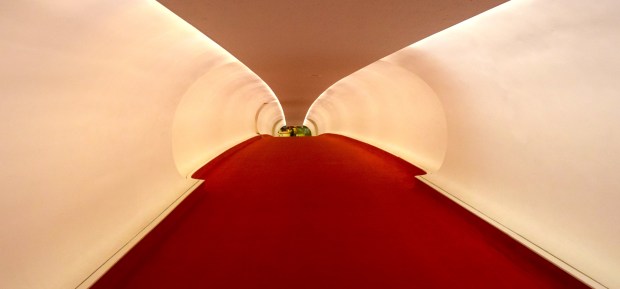
Those ramps once led directly to the jet doors, previously passengers had to head out on the tarmac and climb the roll-up stairs in all sorts of weather. They’re indicative of the efforts of Trans World Airlines, with Howard Hughes still as principal owner, to popularize and glamourize the growing airline industry. The sunken lounges, curvaceous stairways, giant viewing windows, in fact everything down to the chic uniforms and pillbox hats worn by the stewardesses, led to a total implied package of adventure and elegance. (Compare to today!).
So you will see walls lined with photos of the Beatles, Muhammad Ali, Presidents Kennedy and Truman and movie stars ranging from Marilyn Monroe to Paul Newman. Of course, you don’t have to be a big shot to stay at today’s TWA Hotel. It’s a bit pricey but not exorbitant when compared to far less attractive places. Since airports are not standard vacation destinations, the people who are staying at the TWA are usually there because they appreciate it (an exception may be if your flight at the adjacent Jet Blue terminal was cancelled until the next day).
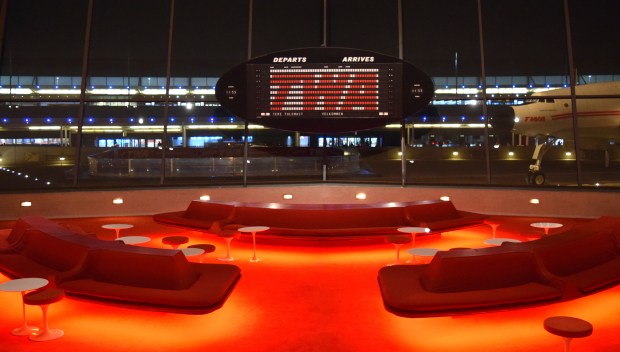
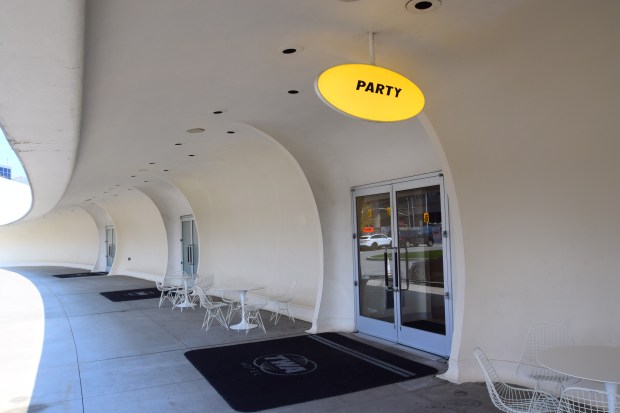
There is certainly lots to appreciate. The hotel is fun and distinctly non-snobby, as amenable to young families as it is to couples on a romantic getaway. The latter can enjoy a drink in the sunken lounger under one of the terminal’s two giant elliptical Arrivals & Departures boards, while the former can entertain themselves by checking out the Twister game room, the many vintage automobiles and the free photo booth. Aside from the soft clattering of electro-mechanical A&D boards, the main sound you’ll hear is the continuous sound of Sixties pop music over the PA, just loud enough to be a nostalgic soundtrack of your stay. Along with the sounds of the British Invasion, Motown, surf, early rock ‘n’ roll and the occasional Frank Sinatra croon, you get a couple of tunes from the girl-group pride of Queens, the Shangri-Las.
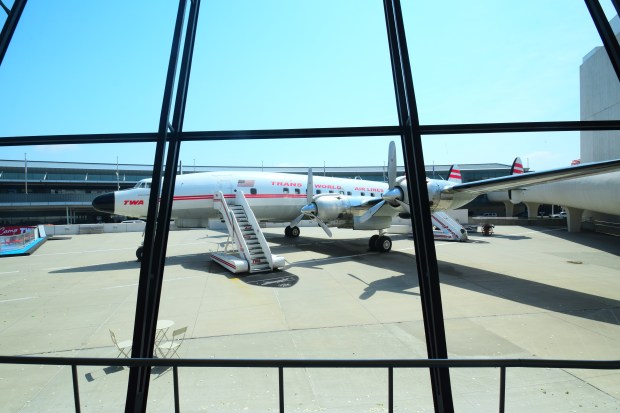
A big attraction for many is a restored propeller-driven Lockheed Constellation, an airliner that was produced between 1943-58. Its bold profile dominates the view outside the terminal’s huge oval rear window. Affectionately known as “Connie,” any guest is free to go outside and walk up the steps, where the interior is now an informal lounge (expect a crowd). But there will much less of a crowd in the terminal’s “hidden” nooks and exhibit rooms, where the hotel’s playful quality really hits a peak. There’s the “Pope Room,” a tiny vestibule where Paul VI decompressed in October of 1965 after becoming the first pontiff to set foot in the U.S. At the end of one of the tubeways you can visit (and hang out in) a recreated Sixties living room, a TWA executive office, and a simulation of Saarinen’s studio.
After settling into the fantastical realm of Eero’s creation, you may notice something which is the most gratifying feature of this whole experience: that to whatever extent possible, the developers of the TWA Hotel left this architectural gem as is. The building had been essentially vacant since the terminal was last used in 2001 until it opened as a hotel about five years back. But there was no Disneyfication in the rehab: the carpets, seat cushions, tiling and concrete sheathing are all original and a bit timeworn, even a little tatty in places.
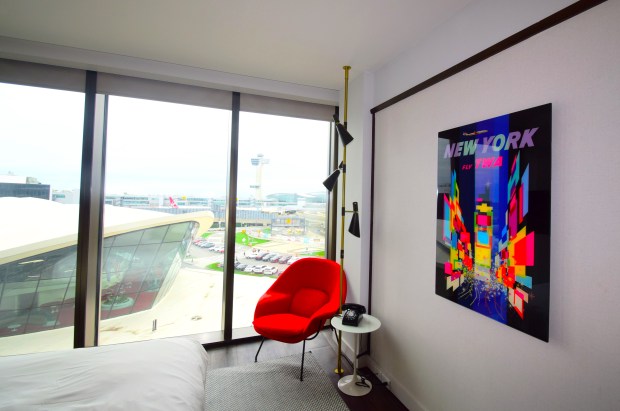
It cost a little more for a room with a “historic view,” but it is worth it.

That’s a good thing. We are invited into (for the price of a room) a real and vital piece of design history, not a replica. As you walk towards the hotel, you will enter this rarefied air with the help of outdoor speakers playing the 5th Dimension’s bouyant hit version of Jimmy Webb’s “Up—Up and Away” which was adapted into a memorable TWA television commercial. Along the way you will see translucent posters, partially blocking views of the construction of a new international terminal, that feature press testimonials of New York’s “sexiest” hotel. The one that stuck with me was from the Wall Street Journal: “They don’t build them like this anymore, and they never will again.” Truth.

Photos and text by Rick Ouellette
Placeology #1: Psychogeography and You

The places we walk through or drive past, the sites we visit or that simply fall into our frame of vision, all have a heritage and inner spirit of their own. Even in our familiar everyday world, we are often just steps away from some location rich in hidden history and forgotten associations.

The ideational term “psychogeography” refers to the attainment of deep connections with man-made environments, usually by way of unplanned walks thru cities. It has been described as a “charmingly vague” practice by no less a man the French Situationist philosopher Guy Debord, who coined the phrase himself in 1953. It can also be seen as a more risk-averse cousin of today’s urban explorer subculture, which I’ve written about many times in this blog.

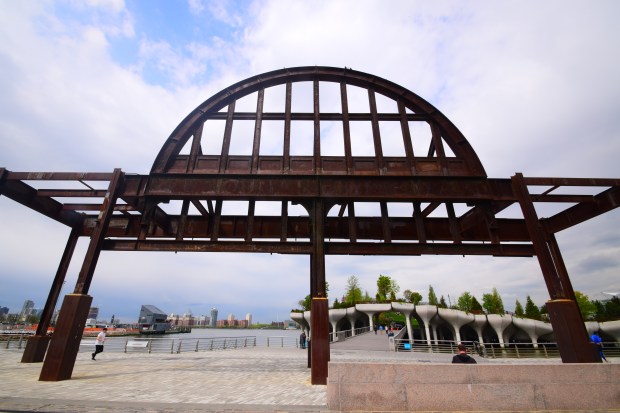
The preserved archway frame of Pier 54, where survivors of the Titanic disembarked from the Carpathia, now serves as the south entrance to New York’s Little Island.

But there is also a very practical side to psychogeography, that would do us all good to be aware of. The theory goes that the distractions and pressures of modern society have caused people to become disconnected from the public realm, leaving the one-percenters to run roughshod over the greater public interest. Understanding and appreciating our common built heritage can lead to thoughtful historic preservation and the design of more livable cities thru greater community involvement.

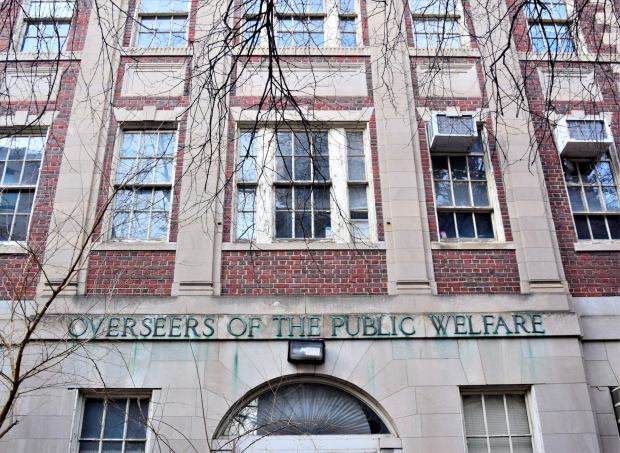
Winter’s bare trees reveal the vestigial facade of a paternalistic institution on Hawkins Street in Boston.

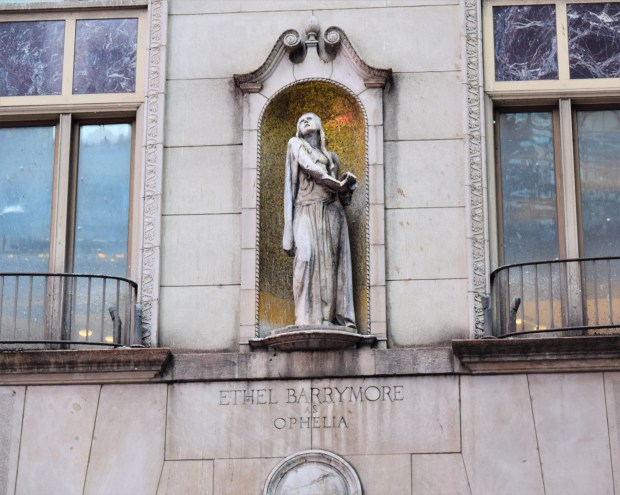
So while coming to understand the effects of the built environment can lead to a greater good, psychogeography can be both a passive pleasure or a wildcat experience. It’s something almost everyone has experienced, whether consciously or not. It can be the satisfaction of finding a great hole-in-the-wall eatery or tucked-away antique store because you wandered away from a usual walking route. It could mean tiptoeing into an off-limits but unguarded location to do a photo session with friends or discovering a fascinating historical vestige steps away from a throng of selfie-taking tourists, as in my photo below.

This statue of Ethel Barrymore, and of two other former stage icons, evoke an earlier era of Broadway, just a few feet away from the back of a gigantic electronic billboard in Times Square.

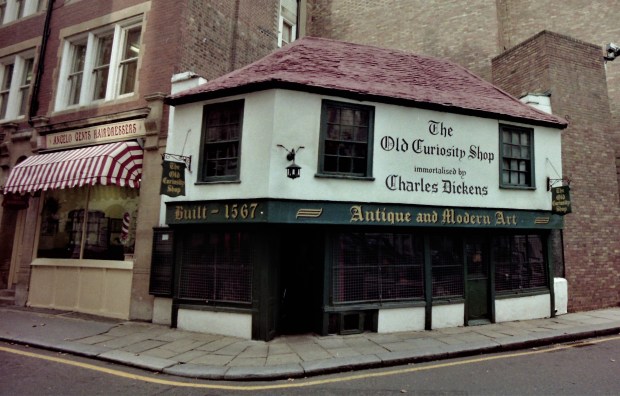
In his 2006 book “Psychogeography,” writer Merlin Coverley, traces this concept back to its immediate roots: French Marxists and Situationists. But he also vividly  digs back to an earlier era and the “urban gothic” stylings of authors like Charles Baudelaire, Edgar Allan Poe, Charles Dickens and Robert Louis Stevenson, showing how their “obsessive drifting (yielded) new insights.” Poe’s 1840 story “The Man of the Crowd” is perhaps the first examination of the mysteries and perplexities of the modern teeming metropolis. In “Dr. Jekyll and Mr. Hyde,” Stevenson shows not only the duality of man’s nature but the stark dichotomy of the different parts of London his split protagonist inhabits. Dickens was a famously keen observer of the same city (often engaging in all-night walks) and had the fame and power to influence social reforms in the darker aspects of the city he witnessed, the exploitation of children, the workhouses, slum conditions etc.

I stumbled on this Dickens landmark during a London walkabout in 1994.

It’s Baudelaire, quoted by Cloverley, who has the most telling description of the psychogeographer, which has as its alpha the Parisian flaneur (or boulevardier). “For the perfect flaneur it is an immense joy to set up house in the heart of the multitude… to be away from home and yet to find oneself everywhere at home… to be at the center of the world and yet remain hidden from the world.”

Sounds cool? If so, try out some psychogeography yourself. Put away the GPS and get to know your town. Stick up for livable cities and against gentrification. Patronize independent small businesses and out-of-the-way points of interest. Lastly, LOOK UP AND AROUND to see what I call the Museum of the Street, and feel a little of what it means to be “everywhere at home.”

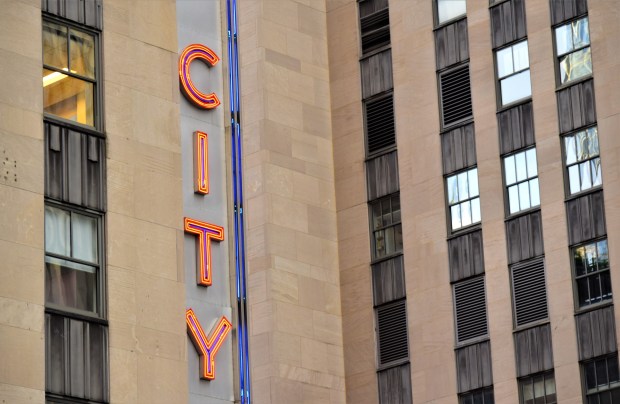
All photos and text by Rick Ouellette. Top Photo is Radio CITY Music Hall, NYC.

More info on my “Placeology” photo series coming soon!

Placeology #3: The Alcatraz of the East

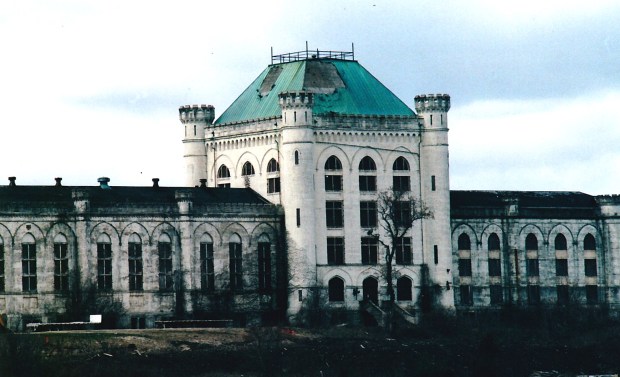
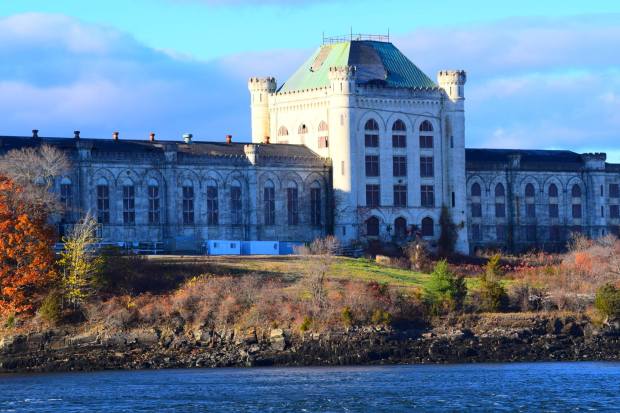
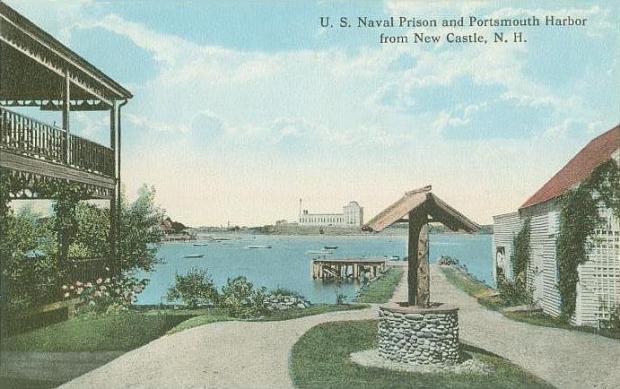
The Portsmouth Naval Prison is located on Seavey Island in New Hampshire. Dark, forebidding, isolated and pointedly medieval, it served as a max security jail for the U.S. Navy from 1905 to 1974. At its peak around World War II, the capacity of the prison (nicknamed “The Fortress”) was 3,008 inmates.

“Impregnable” would be another word for it. To escape this so-called “Alcatraz of the East” (assuming you made it out of building) you’d have to get past the guardhouse on the bridge to the mainland base or make an unlikely swim across the notoriously turbulent currents of the Piscataqua River just east of the cold Atlantic.

But perhaps more interesting is the question, why did the Navy need such an enormous prison? Turns out that around the time of max capacity in the Forties, as much as 40% of the inmates in this brig were in there for sodomy-related offenses. Yikes! This was enough for the top brass, even way back then, to reconsider their policy on homosexuality in the ranks. But it was still decades before even “Don’t Ask, Don’t Tell” and reform likely meant a discharge instead of a lengthy stay in this hellish jail.

The Portsmouth Naval Prison has been closed now for fifty years, but you can’t visit it. Unlike the similarly decommissioned Alcatraz, sitting out there in the middle of San Francisco Bay, you’d have to pass thru the active Naval Shipyard to get there. Too bad, as it would probably be a great tourist attraction for historic and hip Portsmouth, just as the fascinating Eastern States Penitentiary has in central Philadelphia. Oh well. You can still get a good view of it from Route 1B going from Portsmouth to the seaside village of New Castle. Nearby is Fort Stark and Ordiorne State Park, both featuring the remains of giant gun batteries and other WW2 ruins. That could be another entry for this new series, where I will review many of the interesting places, famous or obscure, that I have photographed.

About “Placeology”

The places we walk through or drive past, the sites we visit or that simply fall into our frame of vision, all have a heritage and inner spirit of their own. Even in our familiar everyday world, we are often just steps away from some location rich in hidden history and forgotten associations. Through this “Placeology” photo series, I will strive to give fresh agency to locales both grand and humble, uplifting and foreboding. More coming soon!

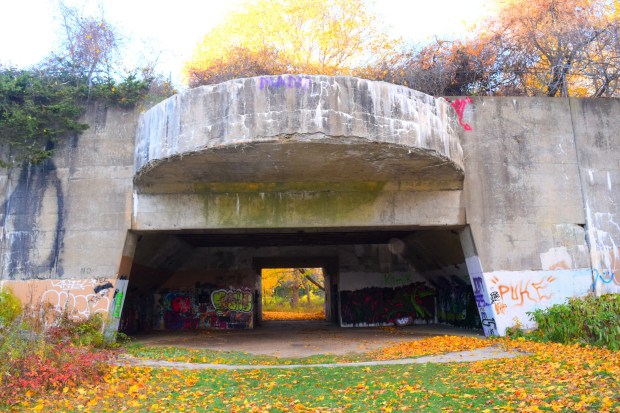
Remains of World War 2 gun emplacement. Battery Seaman, Rye NH

All photos copyright Rick Ouellette