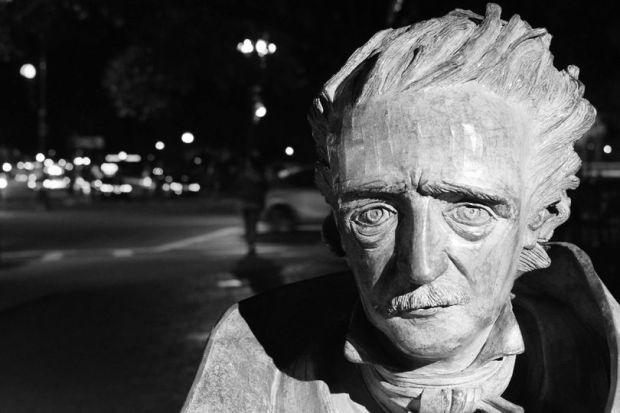
He warned the world about global warming in the 1840s. He had the foresight to know that the application of science and technology without the balancing spirit of poetry would yield a “rectangular obscenity.” He decried the myriad media hoaxes of the middle 19th century and concocted a few of his own as a warning to the gullible. Oh yeah, and he wrote some nifty horror stories as well.
Meet the other Edgar Allan Poe. Everyone knows about the haunted, hard-drinking author of such psychological terror tales as “The Tell-Tale Heart” and “The Pit and the Pendulum” that all but invented the modern Goth aesthetic. Most are familiar with the rigorous poet behind the famous verses of “The Raven” and “Anabel Lee.” But far fewer are aware of Poe the inspired cosmologist, the young man who studied engineering and mathematics at West Point, and who, as America’s first de facto science reporter, cast a very skeptical eye on the era’s centralization of power in that growing field.
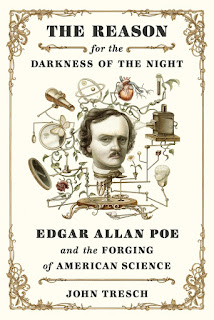
In the extraordinary 2021 book, “The Reason for the Darkness of the Night,” author John Tresch goes a long way into giving this iconic American figure his full due. The fourth and fifth decades of the 19th century saw significant advances in industrialism and science, which had only recently graduated from its previous incarnation as “natural philosophy.”
It was also an age of chicanery, of dubious pseudo-sciences like phrenology, which could be used for racial profiling in an age when the conflict between slavery and abolition were headed to a boiling point. According to Tresch, Poe’s writing (in both fiction and reportage) “dramatized the act of inquiry and the struggles, fears, hopes, and delusions of the human undertaking.”
Foremost in the struggle was Poe’s conflicted feelings regarding the dawning Industrial Revolution. He wrote his “Sonnet to Science” early on (while still in the service), asking this new field “Why prey’st thus upon the poet’s heart/Vulture! Whose wings are dull realities!” and later asking “Hast thou not dragg’d Diana from her car?” In other words, are we now destined to only see the Moon as Earth’s cratered satellite and not perceive the lunar patroness riding her celestial chariot? As both an exceptional book-learner and an amateur astronomer since his youth, Poe could appreciate both.
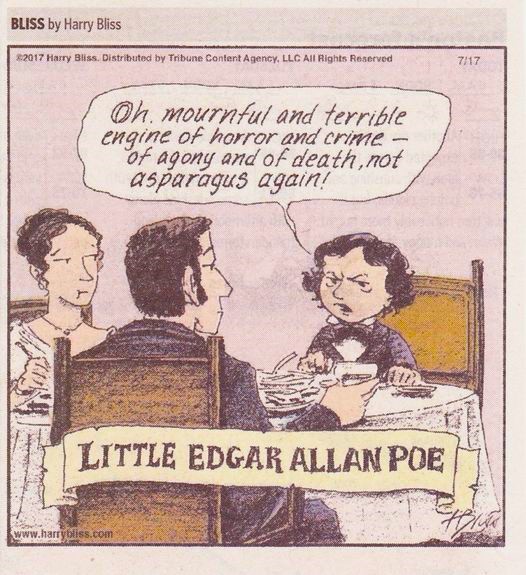
Poe’s enduring popularity even extends to speculation about his childhood, in this personal favorite of cartoonist Harry Bliss.
Around the same time Poe, in a letter, declared “I am a poet… if deep worship of all beauty can make me one.” His deep reverence for—and uneasy awe at the power of—the natural world oozes out of his lesser-known fantasy stories like “The Domain of Arnhiem” and “Tale of the Ragged Mountains.” Oftentimes, Poe depicted a desolate or decayed landscape (read the stark opening of “The Fall of the House of Usher”) a background to what he may have felt in the newly industrializing cities of his East Coast haunts from Boston down to Richmond. A smoke and/or fog blankets many of his tales and while he was no Luddite, the growth of polluting factories free from regulation was indicative to Poe of the at-any-cost mindset when business, science and government were centralized without popular input.
Poe famously had a tough life. His mother, foster mother, brother and wife all died of TB (then called consumption) which he memorably personified in “Masque of the Red Death.” His wealthy rat-fink foster father all but disowned him, undermining his enrollment at the Univ. of Virginia and cutting Poe out of will while providing for several illegitimate children. Poe lived the life of a penurious journeyman writer, struggling to get published and drifting in and out of the employ of various journals and newspapers. Despite fleeting fame for the hugely popular “The Raven,” widespread acclaim avoided Poe in his lifetime.
From 2015, the excellent animated anthology “Extraordinary Tales” is also highly recommended.
But despite (or because) the morbidity of his circumstances and the flavor of his best-known work, Edgar Allan Poe is an enormously popular figure. At his core a man of the people, he’s the guy we need right now. His instinctive opposition to giving great power to those who excel only in a technical sense. One need only look at the barely recognizable human “qualities” of a Mark Zuckerberg or the unstable rantings of an Elon Musk to see where the problem lies into giving such people nearly limitless agency. And that’s not to mention the scourge of the Orange Grotesquerie, whose appeal to grievance and hatred in the pursuit of power is a horror even the master himself would maybe be challenged to depict.
I don’t want to speculate too much on a man that’s been dead for 175 years, but I think Poe today would provide a refreshing antidote to modern society’s pitfalls. Despite his personal tragedies and epic binge drinking, our man Edgar was at heart an idealist. Never afraid to mix it up in the court of public opinion, he would probably be a social media sensation, and a modest Go Fund campaign might alleviate his persistent money problems. A year before his death, he wrote and lectured on his cosmological treatise “Eureka” part of which positioned us all as part of a universal brotherhood united by our common inheritance of a single unitary effect at the beginning of time (Poe was an early proponent of the Big Bang Theory). Tresch begins “The Reason for the Darkness of the Night” with Poe’s last stand, reading “Eureka” before a small but rapt audience in New York City. The author thought that this manifesto would be his defining work, though it was not to be. But still, (in Tresch’s words, “Poe’s work embodies the defining tensions” of both his age and ours: “between popular diffusion and elite control, between empathy and detachment, between inspired enthusiasm and icy materialism.” While we don’t have the Poe we need today, Tresch’s illuminating book and a deep dive into his subject’s lesser-known but still invaluable works, is recommended, if not essential.
 Reel and Rock