Gentle snowflakes fall on an idyllic silver-blue landscape. A group of kids weave around each other on a skating pond, all in time to an angelic children’s chorus. “Christmas Time is here,” they sing, a season that speaks to “olden times and ancient rhymes/of love and dreams to share.” Heading down that way is the comic pages’ most famous underdog, already complaining to his forbearing best friend that despite the many pleasant trappings of the holiday season he can only feel depressed, unable to rise to the way he’s “supposed to feel.” Soon after Charlie Brown and Linus make it to the pond and strap on their skates, the former’s dog has them both has both tangled up in the latter’s security blanket, sending Charlie spinning off the ice and into a tree, where the snow that shakes off the branches reveals the name of one the earliest—and still one of the most popular—TV Christmas specials.
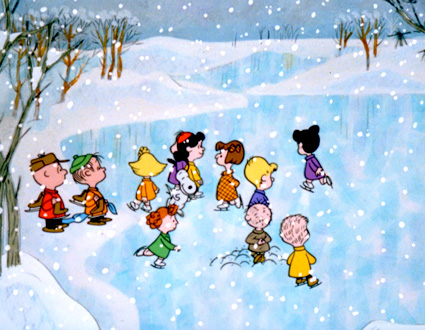
The short-lived skate pond Arcadia
Sure, there are many reasons that “A Charlie Brown Christmas” ranks so high in the now impossibly crowded parade of annual Yuletide specials. The already popular characters of the daily funnies were first brought to life for this project—by a spot-on cast of child voice actors—and were never as vibrant as here. The memorable smooth-jazz score of Bay Area piano great Vince Guaraldi is a legend in its own right. And the fact that the amenable inclusion of a Nativity reading from the Gospel of St. Luke (and the concluding “Hark the Herald Angels Sing” chorus) has kept it in the hearts of the more religious-minded. This is all to the good.
But let’s face it—it’s the script’s dogged search for the nature of “what Christmas is all about” inside the maelstrom of an uncaring, chaotic and profiteering universe that will always be the big takeaway here. Sure, the show’s repeated gripe that the season is getting “too commercial” sounds a bit quaint now—fifty years later the problem is so pervasive it would be like protesting that the ocean is too wet. When we’ve reached a point where it seems the entire American economy is underpinned by the retail activity of the last two months on the calendar, with people being known to do grave violence to each other at 4 AM on Black Friday just in order to get a “bargain”, no wonder the show’s free-floating anxiety resonates. We are all Peanuts.
Of Phobias and Five Cent Co-Pays
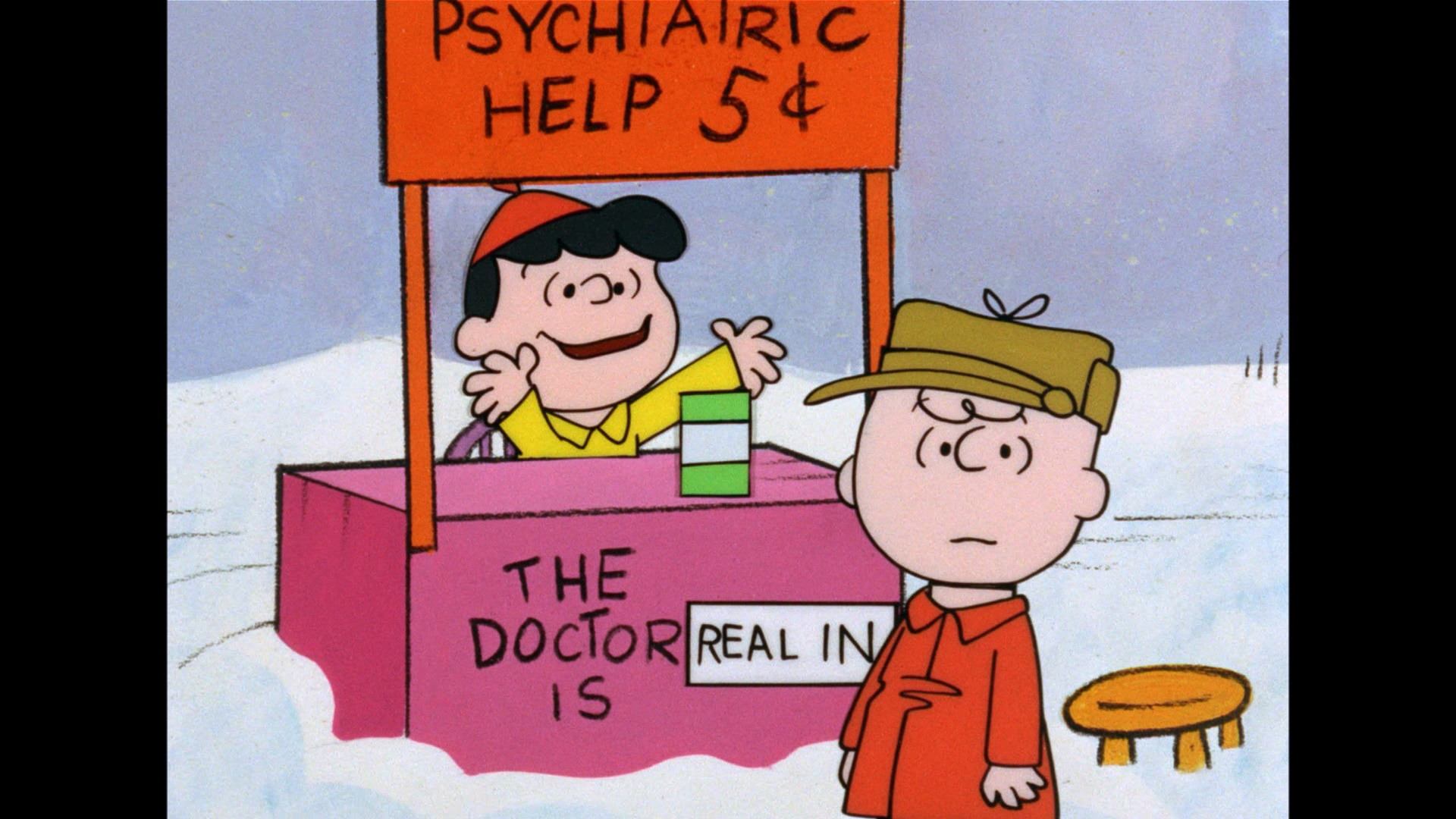
In this strangely de-populated town of mottled skies—not even one honking adult voice in its 25 minutes—the kids fend for themselves even when it comes to mental health services. Of course, this takes the form of the outdoor psychiatric stand run by the gang’s alpha female. Lucy may only charge five cents but seems well-versed in the jargon of her chosen field, picking up bits and pieces from TV and re-purposing them for a small fee. Charlie Brown miserably takes a seat but his plaintive admission (“I’m in sad shape”) is not met with a hug but with a request to pay in advance, and then waiting while the doctor savors the sound of the nickel rattling around in the can.
Just as modern-feeling as the casual indignities of the health care system, is the rush to label Charlie’s neuroses. Lucy famously runs through a bewildering series of possible phobias: hypengyophobia, “ailurophasia” (actually ailurophobia, the fear of cats), thalassophobia and others, before ending with the one she should have started with—pantophobia (aka panphobia), the fear of everything. Welcome to the 20th century. Lucy, who can transition from bully to confidant without batting an eyelash (OK, maybe with batting an eyelash for effect), admits she gets depressed as well, having to settle for getting “stupid toys” under the tree every year when all she wants is the gift of real estate.
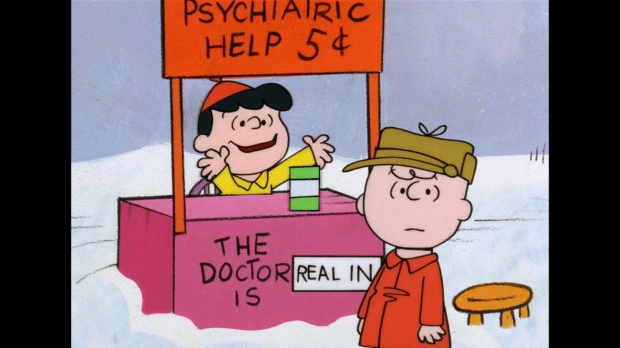
Ailurophasia, screamed in vain.
Let’s Just Dance
Lucy’s suggestion that Charlie Brown direct the school Christmas play as a sort of involvement therapy can only go wrong (naturally). A production never to be sullied by adult interference, Charlie’s half-decent attempts to whip the group into shape are constantly interrupted by the Harpo Marx-like antics of Snoopy, casting disputes and general disorder. In a better world, his efforts may even have been appreciated. He deftly attempts to defuse Frieda’s objection that the cloud of dust emanating from her innkeeper-husband Pigpen “is taking the curl out of my naturally-curly hair” by suggesting that that it may have originated in ancient Babylon, thereby enhancing the play’s authenticity. But it’s all for naught. Lucy has merely drawn Charlie out the manageable discontents he finds outside (his “commercial dog” decorating its doghouse in hopes of a cash prize, taking down a letter-to-Santa dictated by his sister, Sally “Tens and Twenties” Brown) and into a group setting where his status as a social outcast can be magnified. (His installation as director is met with cries of “We’re doomed!”). Every time Charlie calls for “Action!” the gang break out into the spontaneous free-form dancing that is a hallmark of this special, where the kids can be kids and forget their status as part-time adult stand-ins.
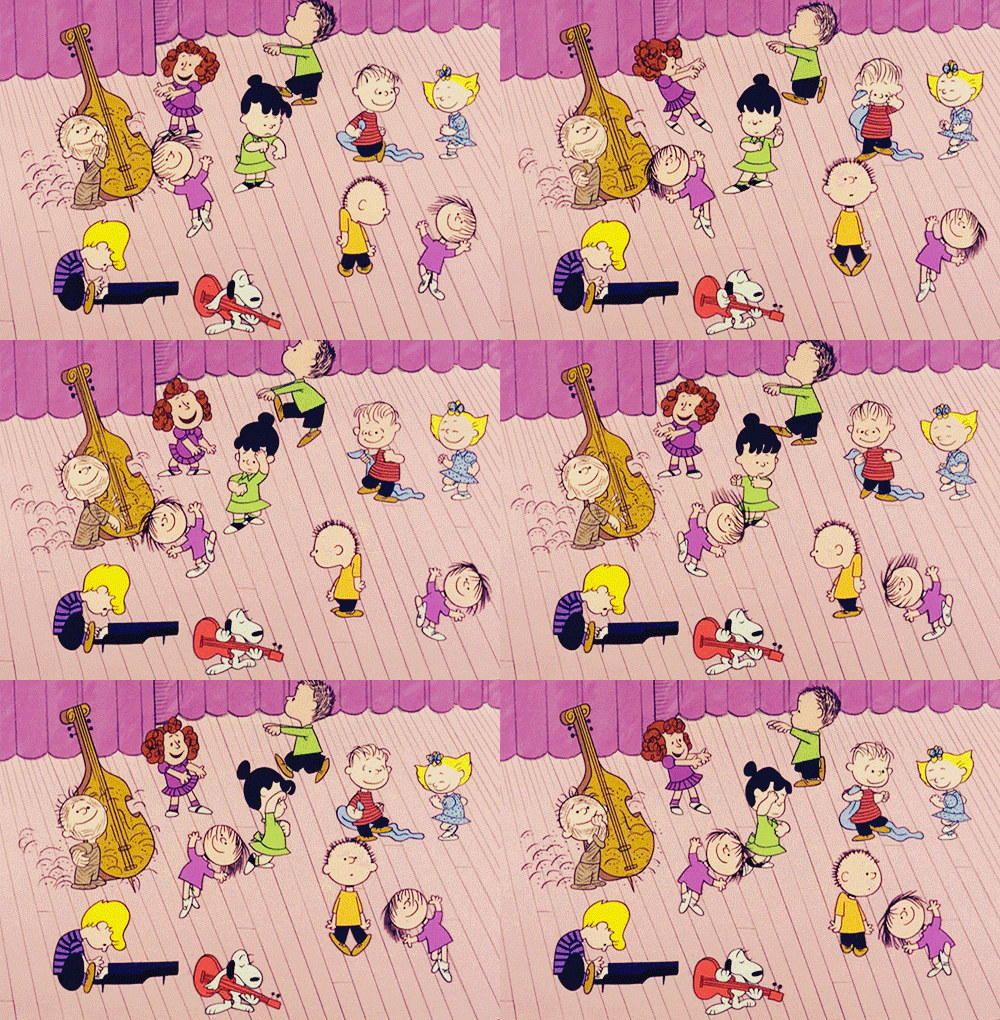
“Isn’t it a great play?” (Research by your diligent blogger has revealed that the three children in the middle (the purple-dress twins and the yellow-shirted boy doing the head-bobbing shuffle) are all siblings from the obscure “95472” family, the girls’ first names being 333 and 444 and their brother’s 555. Their parents apparently were preparing them for the impersonal, data-driven world ahead of them.)
I Suggest We Try Those Searchlights
Nagging dissatisfaction with the play leads Lucy to admit that the whole season is little better than a Mob racket (“It’s run by a big Eastern syndicate, you know,” she whispers conspiratorially) and although Charlie suggests getting a Christmas tree as a countermeasure, that idea instantly evolves to mean an aluminum tree, preferably “painted pink.” Uh-oh. With Lucy’s mean-girl lieutenants (Violet, Patti, Frieda) already primed for the kill, Charlie walks off and, despite Linus’ mild objections, picks the comically scrawny natural tree in a forest of exaggerated metal replicas.
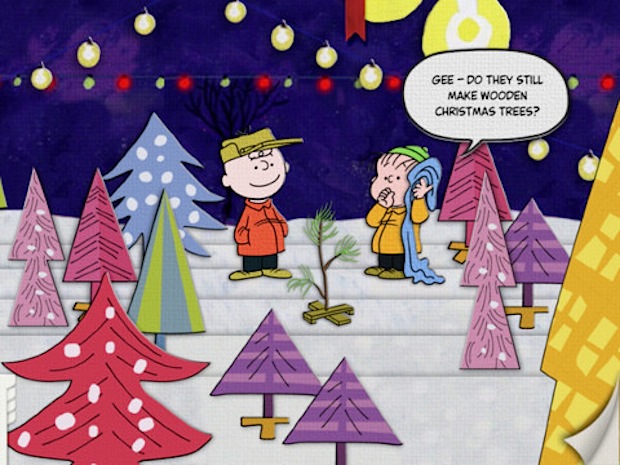
“Fan-tastic!” Inside the aluminum forest
Interestingly, the faddish popularity of aluminum trees—esp. those silver ones that came with a rotating color wheel—had already peaked by 1965 and this show proved to be the nail in the coffin. They went out of general production two years later, relegated to novelties.
“This little one seems to need a home,” Charlie suggests, and marches it back to the auditorium where his charitable instinct is lost on everyone in a hailstorm of derision (“Can’t you even tell a good tree from a poor tree?”) save for Linus who seizes the day with his impromptu Gospel reading. He quietly reprimands the kids without once speaking to them and in doing so forever shields the show from the “War on Christmas” numbskulls at Fox News. Well played, my thumb sucking friend.
As in life, however, our protagonist’s redemption is still tempered by life’s tiny indignities. Even after Linus suggests the application of a little TLC, which turns this plus-sized twig into a regal fir, Lucy is still hedging her bets. “Charlie Brown may be a blockhead, but he did get a nice tree.”
It is strange to think now that so many folks behind the scenes thought that “A Charlie Brown Christmas” was going to go down in flames faster than Snoopy’s doghouse after a fight with the Red Baron. CBS execs, and some people who were working on the project (which had a mere six-month production window), thought the combination of the adultish kids, jazz music, modest animation style and the religious element that Charles Schultz insisted on keeping, was a mish-mash that would never work. Instead, it played to half the TV sets in America on its first airing and was heaped with praise by critics the next day. It seemed like only animation team member Ed Levitt could see his way clear before the broadcast, insisting to producer Bill Melendez that “This show is going to run for a hundred years.” It’s halfway there now.
(If you liked this post, please check out last year’s Christmas entry, “The Education of Ebenezer.” To find, click on the Uncategorized section to the right. Also, please feel free to friend me on Facebook. I’m the Rick Ouellette from Bedford, Mass. Thanks for reading!)


 Reel and Rock