Month: February 2019

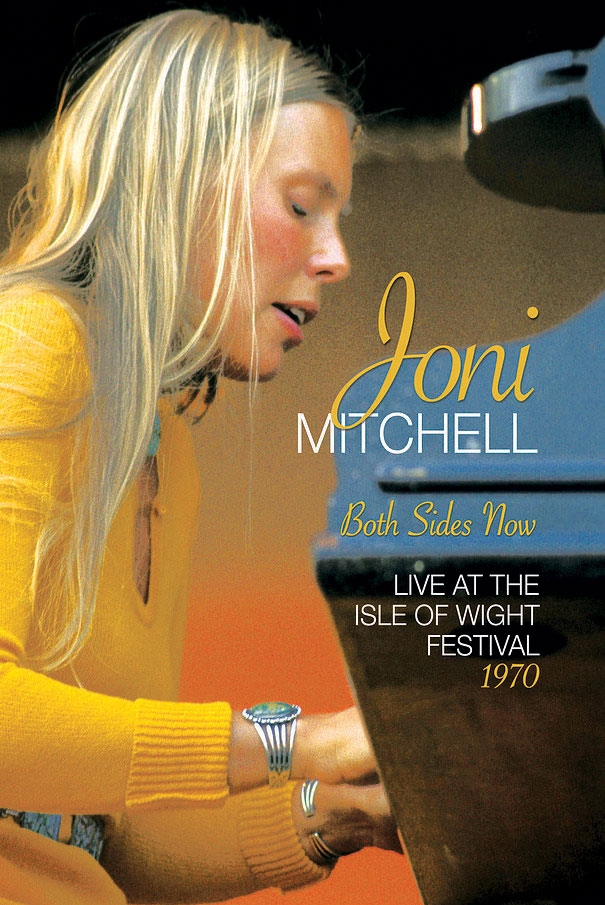
Rock Doc spotlight: “Both Sides Now: Joni Mitchell at the Isle of Wight 1970”

Directed by Murray Lerner—1970/2018—76 minutes

We are just a few months away from the outpouring of tributes and remembrances marking the 50th anniversary of the Woodstock festival. A lot of that of course will focus on that weekend’s legendary line-up of performers. But what of one artist who didn’t end up on that stage in Bethel, New York, even though she wrote the definitive anthem of the event? Joni Mitchell was scheduled to play for the masses gathered on Max Yasgur’s famous field. But as travel logistics to and from the festival got worse, Joni was held back at the urging (or insistence) of David Geffen and Ramblin’ Jack Elliott. They wanted to make sure that they had at least one guaranteed performer for a scheduled post-Woodstock edition of the Dick Cavett Show. This left a very disappointed Ms. Mitchell to write her brooding but beatific “Woodstock” after watching news coverage of it from a hotel room.
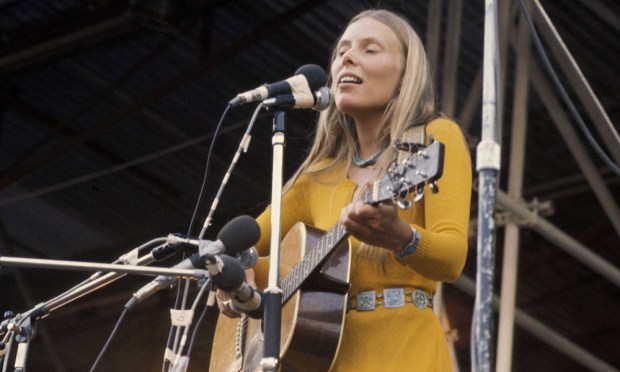
But Joni would appear at a larger multi-day festival the following summer. The 1970 edition of England’s Isle of Wight event (where attendance topped out at some 600,000), was marked by an acrimonious struggle between radical elements of the audience and what was perceived as greedy owners who cordoned off the grounds and had the audacity to charge admission. Anyone who has seen Murray Lerner’s exemplary documentary of the festival (Message to Love) will know of the fence-busting and the rhetorical fireworks emanating from the stage by both sides. And they would also recall Joni Mitchell’s segment from the film, where she is interrupted by a man trying to borrow her microphone for an impromptu rant.

Both Sides Now faces those troubles head-on, beginning with a sneak preview of Joni doing the famous title intercut with scenes of the general turmoil. The line “it’s life’s illusions I recall” takes on a new meaning here. Symbolically, the 1970 Wight festival was the smudging of the rose-colored lenses thru which Woodstock’s Aquarian ideal was viewed. The commodification of the rock music marketplace, with its vast legions of potential consumers, was well under way. Murray Lerner, who died in 2017, produced several single-artist offshoot videos from his extensive footage, including those of headlining acts like the Who, Jimi Hendrix and the Doors. But this edition, graced with the astute reminisces of Mitchell from a 2003 interview, stands with the best of them both musically and thematically.
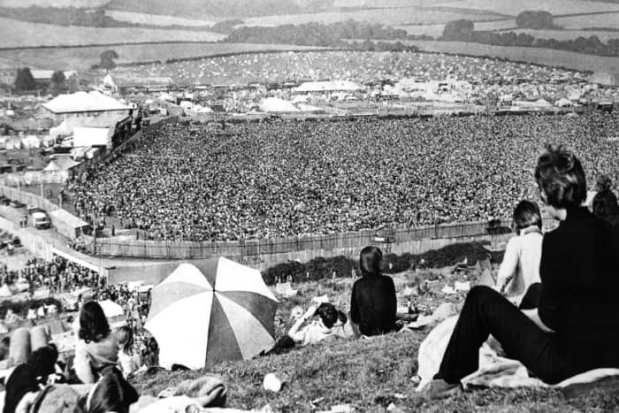

Everywhere there was song and celebration… and insurgency? The 1970 Isle of Wight festival as seen from the top of the non-paying section dubbed Desolation Row. Many would try to bust in thru the fencing. Photo Copyright: Chris Weston

Certainly, fans of Joni should not pass this one by, either by viewing the full set on YouTube or by obtaining the keepsake Blu-ray edition. Right from the top, as she straps on her acoustic guitar and starts into the lovely “Song about the Midway,” you can tell this is some special stuff. At this point, she had three albums worth of her uniquely introspective and romantic songs to draw on and her star was on the rise, her current single (“Big Yellow Taxi”) hitting #11 on the U.K. charts. Mitchell was a seasoned performer, confident enough to do three songs from her future classic album, Blue, which wouldn’t come out until the next summer.

Joni performs “Song about the Midway” and “Gallery.”

Joni, whose father’s ancestry was Norwegian, was famously described as a “Nordic princess” in Sheila Weller’s popular 2008 book Girls Like Us, was a luminous presence in her long flaxen hair, tangerine-colored maxi dress and turquoise necklace. The cameramen, after days of shooting hairy guys in hard-rock bands, couldn’t get enough of her. Even when there’s a flub she makes something out of it; after a couple of verses of “Chelsea Morning” she tells the crowd she doesn’t feel like singing that much, but not before finishing the abbreviated number with an impressive flurry of her distinctive open-tuned guitar stylings.

But playing solo acoustic to such a huge and restive crowd proved a little dicey: in Message to Love we see a glib Kris Kristofferson getting nearly booed off the stage. For Joni, the trouble starts when a man who seems like he’s on a bad acid trip is extracted from the crowd close in front of her. She has sat down at the piano for a couple of tunes, singing about a street musician playing “For Free” while her world consists of limo rides and “velvet curtain calls.” Then she tries in vain to get the crowd to sing “we are stardust, we are golden” in the chorus to “Woodstock.” When a man who had been sitting behind her tries to borrow her mike he is all but wrestled off the stage. With the masses ready to erupt, Mitchell exhorts the crowd (at the 2:00 mark of the video below) to give the musicians “some respect” while the man, freaky as he may seem, tells the organizers at the end of that clip that we are indeed “caught in the devil’s bargain.”

https://youtu.be/qrSlgBIyWoA
Joni Mitchell SINGS “Woodstock.” Then, though visibly nervous, she confronts the unruly isle of Wight crowd after having her performance interrupted by the head of the Committee to Paint the Fence Invisible.

In the interview segments, Joni reflects on just how unnerving the experience was for her 26 year-old self. She remarks on how the 1970 Wight event was the “Hate-the-Performers Festival” and that some of the stars brought it on themselves by arriving in luxury cars or in custom caravans. The event was running behind the schedule and she agreed to play in the tension-filled afternoon instead of at night, in effect being “fed to the beast.” The trouble was stirred up by a faction (which included a pack of French anarchists) called the “Free Festival Radicals.” They were camped out on the hillside behind the site and spent much of their time trying to tear down the fence. The idea that music is some sort of natural occurrence, like the sun setting over an ocean, instead of the end result of a laborious creative process, was a thing at the time (also evident in the film Festival Express, filmed the same year). It is as galling as the idea of illegal downloading that started with Napster and that has made life nowadays even more difficult for musicians not in the upper echelons.

Also in the interviews, Mitchell explains her revelation that a large audience is like a giant dragon with the first five rows like the head. If you placate that part of it, it will send a calming message back down to the rest. Joni finished the set to a won-over audience and one of the best shots Lerner has is the sight of her running back onto the stage for an encore. Yes, the beast of a mass-market rock ‘n’ roll marketplace was about to take over and Mitchell would be one of its most visible jet-setting stars. But in this case, it’s because her talents were rewarded by paying fans who allowed her to keep doing her thing. In view of the lowest-common-denominator, computer-enhanced pop stars that dominate today’s scene, we have indeed paved paradise and put up a parking lot.

You can check out the excerpt of my book “Rock Docs: A fifty-Year Cinematic Jorney” at http://booklocker.com/books/8905.html or by clicking on the book cover image above. If interested in purchasing, you can contact me directly for a special offer and free shipping! Thanks, Rick.
rick.ouellette@verizon.net

Stairway to Purgatory: Greta van Fleet in an age where baby boomers still walk the earth

Back in 1971-72 when I was still in my early teens, there was a guy named Bob Hegarty who did an FM freeform-style radio show on a small station in Danvers, Mass. He also wrote about rock music for a weekly arts-and-entertainment paper called North of Boston. I semi-idolized this guy. His radio show was pretty awesome: he was spinning all the great stuff of the era: the Who, the Stones, Cream, Bowie, Hendrix, Tull etc. as well as some blues and jazz. I was probably one of his younger fans and would call in a request almost every week and always be included in his roll call of regular listeners that he would read off at the end of the show: I was the proverbial “Rick from Peabody.” His weekly record reviews in NOB were erudite and free-wheeling. He liked all the stuff that I was getting into at the time with one big exception: to him, Led Zeppelin were a no-go zone.

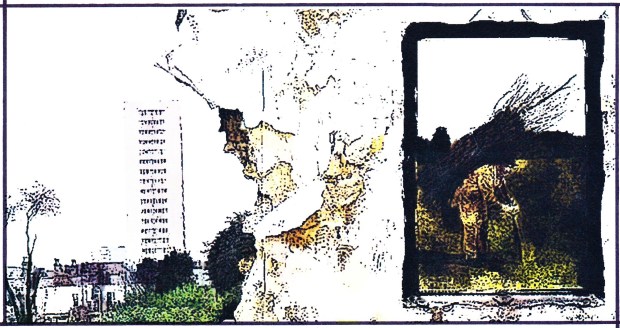
Of course, as a 13-year-old American male I loved them and already had Led Zeppelin IV on cassette by the time Hegarty’s review of it showed up in NOB. And it was a doozy. Bob did have nice things to say about “Battle of Evermore” and “Stairway to Heaven” and even paid Jimmy Page a nice back-handed compliment on the latter, saying that the guitar solo on “Stairway” showed that “Page can still play his axe.” Hey, thanks! As for the rest of the LP, to him it was the same old stuff: so loud “that it doesn’t even matter what they’re playing.” In fact, by the time he got halfway thru the closer “When the Levee Breaks” Hegarty was so fed up that he wanted to take the platter off the turntable and smash it to pieces, “until I remembered I just paid FOUR BUCKS for it.” Classic. Despite my LZ fandom, this didn’t make me mad. It made me want to become a writer, too.

The Greta van Fleet of their time? Led Zeppelin raising the roof at Madison Square Garden in 1973. From the film “The Song Remains the Same”

Which brings me to Greta van Fleet. The young Michigan quartet have been the beneficiary of much press in the last year or so, much of it along the lines of them reviving the dormant genre of heavy rock. (Dormant to the hype-spinners, of course). Their guitarist has admitted he taught himself every riff off the first two Zeppelin albums and let’s just say it shows. Those two LZ albums got panned in Rolling Stone by John Mendelsohn, in prose that toggled between dismissive and sarcastic. (This is the same Rolling Stone that recently did a fawning teenybopper-style piece on GVF). Of course, a lot of that was generational (inter-generational, really). The first wave of baby-boomer rock freaks had a chip on their shoulder about Jimmy Page and Co. (a real creation of the 70s), believing the band were bulldozing the cherished blues foundation upon which rock ‘n’ roll was built, all to appeal to their younger siblings with volume and bombast. Sure, some of this is the old generational certitude that your era is better. But there is more to it now, which I will get to in a bit.

https://youtu.be/3B0QHAwtvbE

Greta van Fleet had been making a bit of a splash for months but it all came to a head when they made their high-profile appearance on Saturday Night Live. Audio-wise, their first number, “Black Smoke Rising,” showed them to be a capable if derivative hard rock act. But there was one big problem: you were looking at them as well. Granted, I’m not the band’s target demographic but I find it hard to think that even today’s teenage girls would be ga-ga over their mismatched patterned cast-offs, sandals and the type of satin jackets that haven’t been in style since Blue Oyster Cult fired their first publicist. But that’s just me, I guess. Singer Josh Kiszka’s self-conscious yelping and arm-waving, not to mention the awkward and vaguely inauthentic stage moves of his two brothers (guitarist Jake and bassist Sam), bordered on self-parody, if that were possible this early in a career. When they returned later for the ballad “You’re the One” (a decent song in search of a credible singer), Josh spent most of the song posing like an eight-armed Bodhisattva with six of them missing.


GVF singer Josh Kiszka. Even the Rock & Roll Fashion Police were left speechless on viewing this.

With a band like this, acting dorky almost on purpose while riding the sonic coattails of a beloved classic-rock icon like Zeppelin, the social media backlash was as fun as one could hope for. I was too happy to pile on, dubbing them “Greta van WTF-R-U-Wearing” and clicking on the Ha-Ha icon when someone declared “Every generation gets the Led Zeppelin they deserve” or asked “Why is the singer dressed like Greg Brady’s bedroom door?” But there was also the backlash to the backlash, with people getting dubbed “haters” (does that mean nothing is open to criticism?) or just boring old farts. Apparently, some people in my age group have convinced themselves they like GVF and that’s their prerogative.

“Highway Tune,” a sort of learner’s-permit variation on Deep Purple’s “Highway Star” was one of the songs on their Grammy-winning Best Rock Album. Or as the voters probably thought of it, Only Rock Album.

But what is ignored (or,frankly, not even realized) is that standards were simply a lot higher then and many boomers have stuck to them. Fans and reviewers alike were a lot more discerning and that was for the better. Despite their exaggerations, Hegarty and Mendelsohn were not that off base in their anti-Zep attitudes. Parts of Led Zeppelin II in particular sound grating nowadays and they were taking songwriting credits that should have (and in some cases eventually did) go to the blues greats they were emulating. But they grew by leaps and bounds over the next few albums. Some people suggest using similar patience with GVF but I’m not holding my breath. We may joke about “Stairway to Heaven” (remember the guitar-shop scene in Wayne’s World?)but if they ever wrote anything with 10% of the eloquence of Robert Plant’s lyrics to that song, I would probably drop dead on the spot.

No, it doesn’t seem to be in the DNA anymore. Today, “we walk on down the road/our shadows taller than our souls” for real. In the one issue of North of Boston that I still have there is one of those State-of-the-Rock articles that were popular once. The writer, one Mike Howell, begins by stating, “The question of whether or not rock has lost its vitality is very much in the air today. Huh? This was 1972, the same year of Exile on Main St./Ziggy Stardust/The Harder They Come/Eat a Peach/Close to the Edge/Transformer etc. So now is the time to keep your own to your own. I’m not upset that Greta van Fleet won the Grammy for best album instead of what would have been my choice: Merrie Land, the stirring post-Brexit concept album by The Good, The Bad and the Queen, the group led by Blur/Gorillaz frontman Damon Albarn and ex-Clash bassist Paul Simonon. Why would I be, they don’t even reside on the same plane of existence. So if you’re looking for something young and new in rock & roll, dig a little deeper (I would suggest someone like Nashville’s All Them Witches). But the important thing is to keep thinking for yourself: in other words, to be a rock and not to roll over for the kind of bargain-basement hype that is Greta van Fleet.

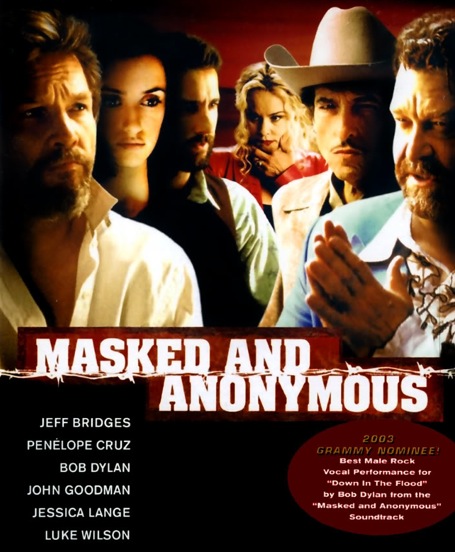
Tinseltown Rock #1: “Masked and Anonymous” (2003)

My 2016 book Rock Docs: A Fifty-Year Cinematic Journey was ultimately conceived as a parallel history of pop music thru the prism of documentary film. Before I settled on that I had considered something of broader scope but decided the inclusion of rock-centric fictional feature films was too heavy a load. But that left me with a lot of unused notes, unused that is until now! Here is the first in a series of what I left behind.

“We live in a tawdry and vulgar age,” says an unscrupulous concert promoter looking to stage a charity concert in a Third World country, all to bolster the image of a heavy-handed regime. The planning of this televised benefit gig is the main premise of this loosely-plotted fantasia, directed by Larry Charles (Seinfeld, Borat) starring, and co-written by, Bob Dylan. Masked and Anonymous veers close to vanity project territory and was widely planned on its initial release in 2003. But its entrenched depiction of a dystopic place where the hopelessness of geo-politics meets the implied futility of idealism, is worth a good second look. If things were tawdry and vulgar back then, just look at us now. The absurdities of the Trump Age make it seem like this film was ahead of its time.


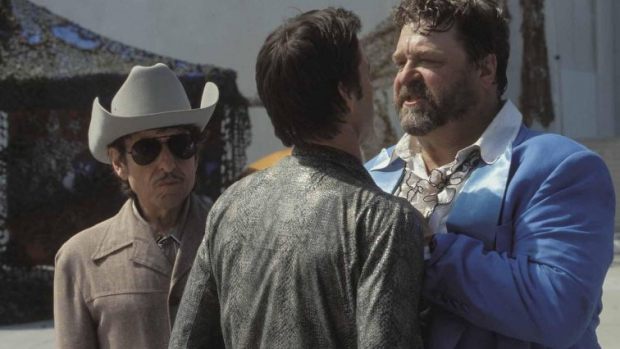
“What, another movie critic? I’ll take care of this one, Bob!”

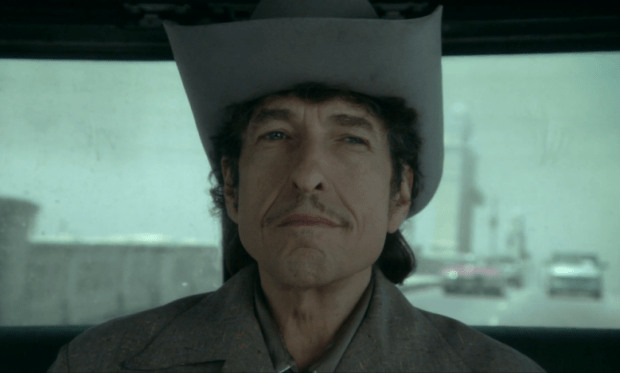
After an opening montage dealing in images of global conflict and protest (set to a cover of Bob’s “My Back Pages” in French) we meet the shady promoter played by John Goodman working well within his wheelhouse. He has promised the ruling regime that he will deliver a star act for the benefit show. Hypocritically, the proceeds are meant for civilian victims of violence in the strife-torn nation. After getting the cold shoulder from the likes of U2, he goes to Plan B and gets living legend/has-been Jack Fate (Dylan) to agree to perform in return for being let out of a near-by jail, where he is being kept for unspecified crimes. Jack then rides in a ramshackle bus thru scenes of hard times in the outskirts of the capital to the soundstage where the event will take place. Ostensibly, the tension of the film lies in the moral dilemma of doing such a gig “for a barbarian that can barely spell his name.” Hmm…

The main problem here is that as an actor and a personality, Dylan is far too wily and inscrutable to make much hay out of this. Granted, he did get a lot of big name Hollywood stars to join in and work for scale, but it’s a mixed bag. Aside from Dylan and Goodman, the main players are Jeff Bridges as cynical but conscientious journalist doing a story on the show and Jessica Lange as the steely network honcho with her eyes set on the bottom line. There are a lot of other big names here, but folks like Penelope Cruz (as Bridges’ ragamuffin girlfriend) and Luke Wilson (as Jack Fate’s musician pal) are underused, while others (Ed Harris, Val Kilmer, Christian Slater) are barely noticeable. And until I saw Masked and Anonymous I never imagined that I would be viewing a cinematic love scene between a sexagenarian Bob Dylan and Angela Bassett. But it’s that kind of flick.

On the plus side? Well, the promoter hooks up his star with a Jack Fate (i.e. Dylan) tribute band and the music kicks in with a garage version of “Down in the Flood” from their sideshow stage. There are strong renditions of “I’ll Remember You” and “Cold Irons Bound” as well as a few sweet surprises such a young black girl’s a capella rendition of “The Times They are A-Changing” which raises a half-smile from Uncle Bob. Much of the film is shot inside a hangar-type building, sectioned off into different stage sets, not unlike Frank Zappa’s film vehicle 200 Motels. The carnival ambiance sometimes evokes the feel of such Dylan evergreens as “Desolation Row.” This feel is enhanced by the sharp art direction and evocative location work. When Mr. Fate hops a bus to “Quadrant 4” it looks like it could be bedraggled Venezuela though the whole movie was shot in Los Angeles. Which sort of tells you something right there.

And that is where Masked and Anonymous begins to get under your skin. It’s atmosphere of slow, creeping dread, of being caught up in a dream world of absurdities where heroes are hard to identify,that makes it seem more relevant and relatable now. Dylan himself was one of those heroes for a lot of us growing up but now he looks as bewildered at us moving thru this landscape of “toil and blood, where blackness is a virtue and the road is full of mud.” He may be as sphinx-like as ever but as he meets our gaze as he rides way at the end, we feel he’s at least still there with us on the side of the angels. Long may he mumble.