I'm a freelance writer and photographer and the author of the graphic novel in-progress "In a Dream of Strange Cities. My previous non-fiction works include "Rock Docs: A Fifty Year Cinematic Journey" and "Documentary 101: A Viewer's Guide to Non-Fiction Film," was released in 2013. My other activities, like psychogeography, bicycling, and a little urban exploring tie into the content of this blog, which is dedicated to the celebrating the rich history of rock music, film, literature and popular culture.
I come to praise Cesar (Catalina), not bury him. For many, “Megalopolis” is an easy film to dislike, but it’s a rewarding one to give an honest look at. Francis Ford Coppola’s long-gestating mega-project is messy and often unfocused, with moments of unintentional hilarity. But those moments are not nearly as laughable as some of the negative opinions lobbed at it.
In an age where cynical slasher movies and DC/Marvel sequels are puked off a cinematic assembly line at record pace, calling “Megalopolis” the “worst movie of all time” with “no redeeming qualities” is kind of like settling on Milli Vanilli’s “All or Nothing” as your favorite album because you thought the Beatle’s “White Album” was too sprawling.
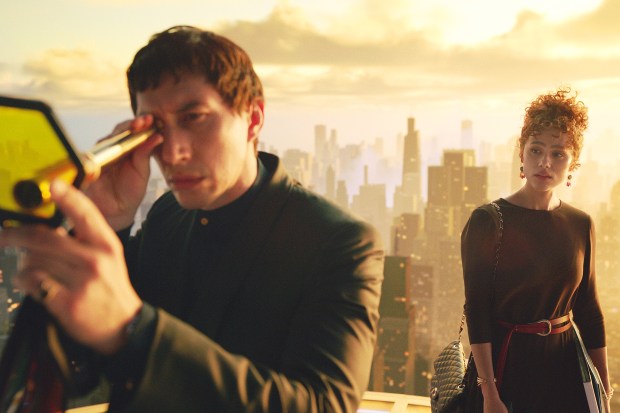
In a re-imagined New York City called New Rome, superstar architect Cesar Catilina (Adam Driver) has altruistic ideas for rebuilding a city that is a teetering empire very obviously based on its namesake. Against a backdrop of garish decadence (there are orgy-like parties and even a chariot race) Cesar’s proposal, as chief of the city’s Design Authority, is opposed by the old-school mayor Franklyn Cicero—played by Giancarlo Esposito who bears a strong resemblance to NYC’s current embattled mayor Eric Adams.
In its own loopy way, “Megalopolis” is a sincere plea for an idealistic way forward for a world society in a time of debilitating tribal and nationalistic divisions. Comparing the bitterly polarized America of today to the approaching fall of the Roman Empire is not exactly a novel idea, but Coppola’s visual representation of this concept is the film’s strongest element.
From the late 19th century to the mid-1940s, New York was built to a majestic, inspirational scale comparable to what the Eternal City was in the ancient world. Cesar’s apartment/studio is in the defunct Cloud Club atop the Chrysler Building. Imposing low angle views of the Helmsley Building, Grand Central and other classic Manhattan structures are used to great dramatic effect, and we get to go underground to get a glimpse of the faded glory that is the old City Hall subway station. Colossal living statues sit despondently or crumble in alleyways, their great allegorical symbolism forgotten.
At the core of “Megalopolis” is a factor often overlooked but important enough to warrant its own section in the movie’s Wikipedia entry: “Artistic Idealism as Antidote to Polarization.” That is, the role of the creative class in helping create more inclusive and livable cities. I can only hope that Coppola’s vision at least inspires some younger artists to foster a new generation of bold, humane visions (and in all the various ways they can be attained) in a world that so surely needs it.
The film’s closing title card attempts to transcend both nationalism and identity politics.
I did, however, have a problem with Cesar Catalina’s use of the word “utopia” which Mayor Cicero correctly identifies as a fantasy land. What Cesar really strives for is a “protopia,” a practical way forward to a better world for all. I think it was a deft move by Coppola to have the cerebral Cesar allied with the more grounded mayor for the film’s corny but uplifting closing scene.
Hopefully, this noble-but-flawed valediction for the 85 year-old filmmaker will outlast the confidence of the naysayers who to me sound too smart to know any better. “Is this way we’re living the only one available to us?” Cesar memorably asks at one point. I would like to think so, but I’m far from sure about it.
It’s a funny thing, the long tradition of rock artists recording songs written by others. The origin story of untold thousands of bands has them cutting their teeth on an old Chuck Berry number or blues standard, or maybe “Louie Louie” and/or “Gloria.” Many groups soon to be famous for penning their own tunes, from the Beatles and Stones on down, peppered their early albums with cover material. Hell, even Bob Dylan’s 1962 debut only featured two songs written by the man himself.
But from the mid-Sixties on, the only true way forward in the rock business was to be performing your own compositions. Unlike the Sinatras or Tony Bennetts of an earlier era, the pantheon of Boomer-era acts featured few song “interpreters” (Linda Ronstadt and Joe Cocker are two that spring to mind). If you can’t write ‘em, your outfit may soon be relegated to eternal bar-band status.
Yet no matter how good a band’s own material may be, musicians are always fans first. A well-placed cover song can really add to an album’s success, whether it be Jimi Hendrix’ definitive take on Dylan’s “All Along the Watchtower,” the Clash’s “Police and Thieves,” the Talking Heads’ “Take Me to the River” or name your favorite.
But an album full of other’s material by those well known for penning their own songs rarely turns out to be a triumph. Is it because many are contractual obligations, or place markers when one is a little thin on new material? While some are fun, rarely is it a discographical highlight. Let’s have a look.
“Pin Ups” David Bowie (1973)
Let’s start with a good one, so we can see what makes for a successful covers album. The reason Pin Ups ranks so high is that it has a workable concept and there is an effort made on some tracks to put a new spin on the material. David gives props to the British bands that inspired him in the years 1963-67, just prior to his own recording career taking off.
He does a slowed-down version of the Who’s “I Can’t Explain,” playing a sexy sax refrain to go with it. The wild instrumental coda he gives “See Emily Play” makes it even more acid-drenched than the Pink Floyd original. True, elsewhere he sticks close to the original, as on the two Pretty Things selections and the Kinks’ great anti-anthem “Where Have All the Good Times Gone.” But these are helped by the fact that they are backed up by the Ziggy Stardust band, featuring guitarist Mick Ronson on guitar. Another highlight is Bowie’s lovely, doleful take on the Mersey’s “Sorrow” which was a hit single in several countries. Grade: A-
“Moondog Matinee” The Band (1973)
“Why don’t we just do our old nightclub act” the late Levon Helm recalled someone in the Band saying, but the drummer/vocalist can’t recall who, per his lively memoir “This Wheel’s on Fire.”
The group was in the middle of a ten-record deal with Capitol Records and short of new material. They were also in the middle of a group relocation from the Catskills to Malibu and cutting a quick record of tributes bought them some time. It’s more a well-curated and well-performed selection of early R&B and rock ‘n’ roll chestnuts than a nightclub act, though they deliver some potential crowd-pleasing things like the cheeky Lieber-Stoller rug cutter “Saved.”
Elsewhere, songs from Sam Cooke, Allen Toussaint, Fats Domino and Chuck Berry abound. There a few twists: keyboard wizard Garth Hudson has a great go at the timeless “Third Man Theme” and Helm used a then-newfangled talkbox to get the needed croaking part on Clarence “Frogman” Henry’s “Ain’t Got No Home.” A fun listen but inessential, like many in this category. Grade: B
“Rock ‘n’ Roll” John Lennon (1975)
John Lennon was well known for his deep-rooted love for Fifties music but the actual impetus for this album came from a court settlement. The notorious music publisher Morris Levy sued Lennon because the music to the Beatles’ “Come Together” (though slowed down) and one line (“Here come old flat-top”) bore a strong resemblance to Chuck Berry’s “You Can’t Catch Me,” which Levy owned. The agreement read that John would record three songs from Levy’s publishing company on his next album.
When word got out in the fall of ’73 that Lennon was recording a tribute album in Los Angeles, all his musician friends/drinking buddies showed and it was quite a scene. Producer Phil Spector shot a hole in the roof and a bottle of whisky spilled onto the console, amongst other hijinks. Some material managed to get recorded but then Spector ran off with the master tapes. Lennon shelved the project and recorded Walls and Bridges instead. The tapes were eventually recovered, and the rest of the album was knocked out (under further legal duress from Levy) in three days in the fall of 1974 for an early ’75 release.
The results were predictably patchy but there are some fine moments: an energetic stomp thru “Bony Moronie,” a reggae-inflected “Do You Want to Dance,” and a soulful take on Ben E. King’s “Stand by Me” that was a Top 20 single. Elsewhere, several tracks sound rushed or uninspired, and admittedly one of the best things about Rock ‘n’ Roll is Jurgen Vollmer’s great photo of a young, leather-jacketed Lennon leaning in a doorway from the Fab’s Hamburg years. Grade: B-
“Givin’ it Back” The Isley Brothers (1971)
Well, here’s a bit of a “twist” in the covers album scheme of things. The Isley Brothers, whose songs had been covered by many Sixties rock bands (esp. in the case of the Beatles’ “Twist and Shout”) return the favor by covering an eclectic collection of (mostly) white artists. Side One consists of three extended tracks, marching out of the gate with a powerful protest medley of Neil Young’s “Ohio” and Jimi Hendrix’ “Machine Gun.” The Vietnam War was still very much happening in 1971, and there’s no missing the urgency in Ron Isley’s lead vocal. Meanwhile, kid brother Ernie, not quite twenty at the time, gets to show off his already prodigious guitar chops. Hendrix was briefly in Isley’s backing group and his influence was quite clear on Ernie, who knew Jimi as a kid.
Turning James Taylor’s regretful ballad of a friend’s suicide into an Issac Hayes-style psychedelic soul number may not have been the best decision, but their “Fire and Rain” is interesting, nonetheless. More successful is their ten-minute slow jam on Bob Dylan’s “Lay Lady Lay” which gives Ron plenty of time for seductive ad-libbing, stopping just short of Barry White territory. (On successive albums, the Brothers would continue to produce extended soulful covers of soft-rock hits like “Summer Breeze” and “It’s Too Late,” often featuring dramatic guitar workouts from Ernie). The album rounds out with two Steve Stills’ numbers (the single release of “Love the One You’re With” hit #18 on the pop charts) and Bill Withers’ “Cold Bologna” with the songwriter guesting on guitar. Grade: B+
“Compliments of Garcia” Jerry Garcia (1974)
When I was in high school, I received a complimentary (if you will) armful of Grateful Dead-related vinyl from my girlfriend’s neighbor who worked as a publicist for the band. There were acknowledged classics (Workingman’s Dead), a few oddities (the outré soundscape Seastones on which a couple of Dead members appeared), and a few solo albums, including this covers album which for some time was a left-field favorite of mine. It presents as a record to be lightly regarded, as Jerry gives low-key props to some of his wide-ranging influences. But as soon as the train whistle and shuffling beat kicks off the album (with Chuck Berry’s “Let it Rock”), I was drawn into the record’s laid-back appeal.
Maybe it hasn’t aged all that well in this less laid-back time. His takes on Smokey Robinson and Dr. John are pleasant if unspectacular, and Garcia maybe should have second-thought the inclusion of “Let’s Spend the Night Together” (one reviewer quipped that this version made it seem like the couple in question spent the night playing cards). But there are also well-considered versions: his in-the-pocket rendition of Van Morrison’s “He Ain’t Give You None” is preferrable to the author’s undisciplined original on T.B. Sheets. Best of all is a beatific, slowed-down take on Seatrain’s “Mississippi Moon.” And it ends nicely with “Midnight Town,” an atmospheric number by Garcia Band bassist John Kahn. Grade B-
“The Hit List” Joan Jett (1990)
I was a bit surprised at how quickly this album flat-lined for me. Maybe because Jett’s breakout solo LP (1982’s I Love Rock ‘n’ Roll) featured three definitive cover tunes. The title track she made completely her own, turning it into a worldwide #1 single. Another breakout performance was on Tommy James’ “Crimson and Clover,” where her breathy, come-hither vocal memorably mixed with crunching power chords. And it ended with one of the best-ever holiday rock songs, a bratty “Little Drummer Boy” that concluded with an instrumental rave-up worthy of the Who’s Live at Leeds.
So where did The Hit List go so wrong? For one, randomness never bodes well—Jett goes from ZZ Top to the Sex Pistols to Credence as if all three bands were cut from the same cloth. Secondly, her vocals range from pro forma to uninspired. She practically sleepwalks thru “Love Hurts,” only serving to remind one of the full-throated drama of Nazareth’s hit version or the plaintive charm in the way Gram Parsons did it. And strangely enough all we get is autopilot mode on AC/DC’s “Dirty Deeds,” which should have been a natural for her.
There are a couple of modest highlights. There’s the one left-field choice (the Hendrix obscurity “Up From the Skies”) and an appealing version of the Kinks Klassic “Celluloid Heroes.” Here we get the Sweet Joanie voice and a convincing arrangement that leads up to one of her patented shouts, maybe the only one on the whole record. Saved from a D+ for the glamourous cover photo. Grade: C-
“Thank You” Duran Duran (1995)
In deference to some of the selections above, being uninspired is one thing but being downright bizarre is quite another. And so we have New Wave glamour boys Duran Duran. They may have peaked in popularity in the early 80s but in the mid-90s their records were still regularly in the Top 20, esp. in their native UK. So I’m not sure what inspired them to foist this rummage sale of a covers LP on the world. Taking on vintage R&B, hip-hop, classic rock and ballads with the same dilettantish insolence, Thank You was voted the worst album of all-time by staff of Q magazine in 2006.
Probably most galling for the critics, were DD’s take on two notable rap numbers. Their Beck-like version of Public Enemy’s “9-11 is a Joke” is a joke. But it’s not as bad as the presumptuous run-thru on Grandmaster Flash/Melle Mel’s classic “White Lines.” You can’t fault the boys on their energy level but the cognitive dissonance is too pronounced to overcome. Let’s just say it’s a long way from a Bronx block party to a Notting Hill boutique.
Elsewhere, there are very unimpressive takes on oft-covered material like “Ball of Confusion,” “Lay Lady Lay” and Lou Reed’s ubiquitous “Perfect Day.” I will give bassist John Taylor props for his work on the “funkier” numbers, but singer Simon Le Bon didn’t get the memo that there is more to paying tribute in song than just knowing the words. Worst of all is a regrettable version of the Sly Stone’s “I Wanna Take You Higher” which concludes with some teenybopper girl dumbly asking the guys where they wanna take her and when they dumbly reply “higher” you realize that this giant mistake of an album couldn’t get any lower. Grade: D
More coming up soon in Part Two, including entries from the Ramones, Patti Smith, Cat Power and Elvis Costello. —Rick Ouellette
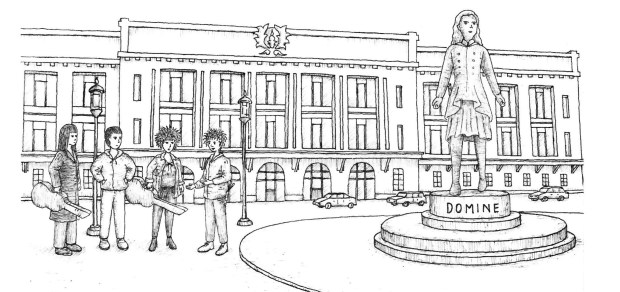
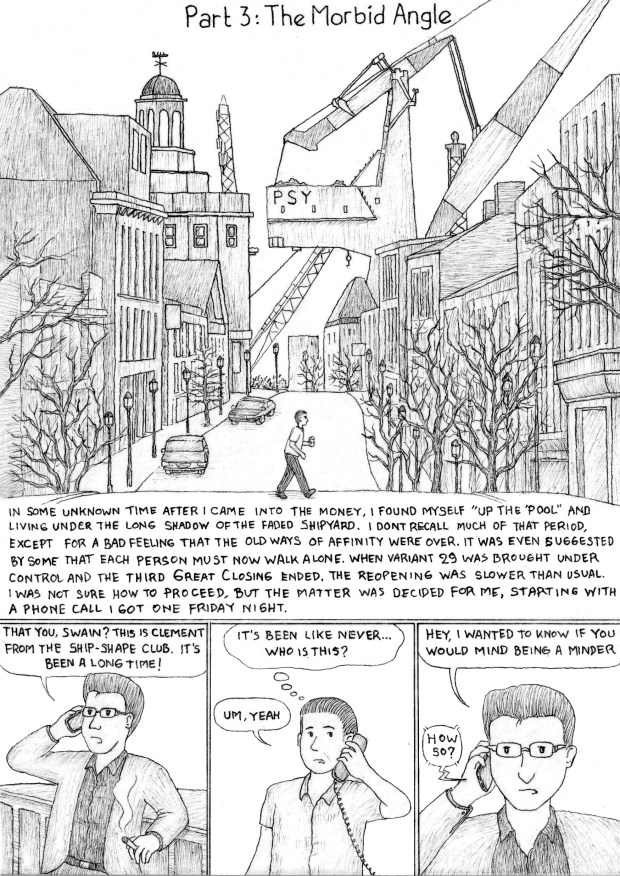
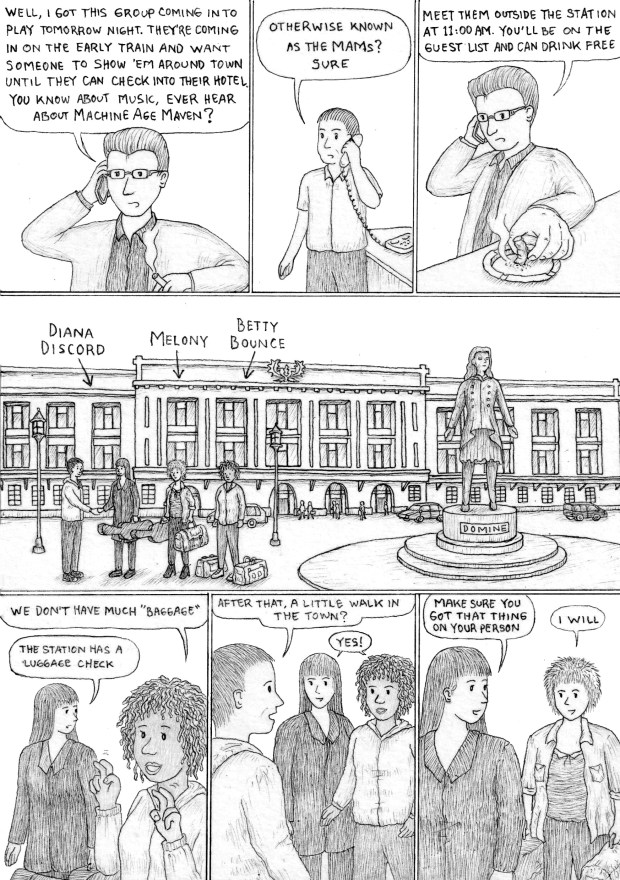
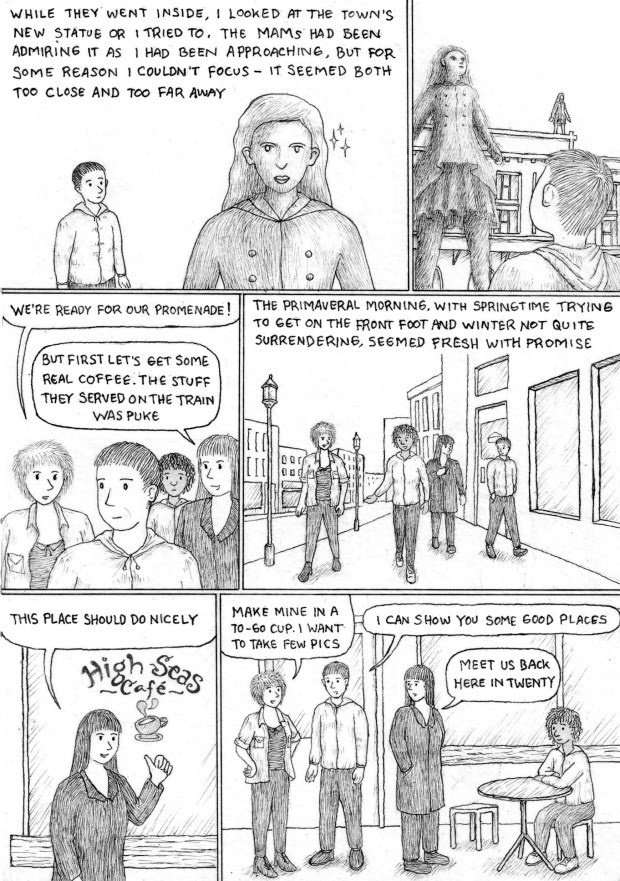
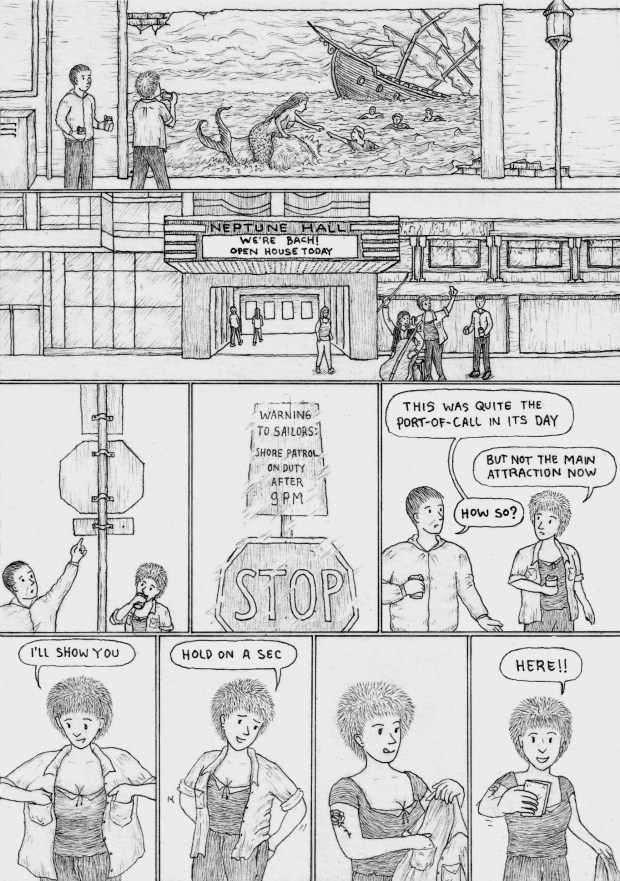
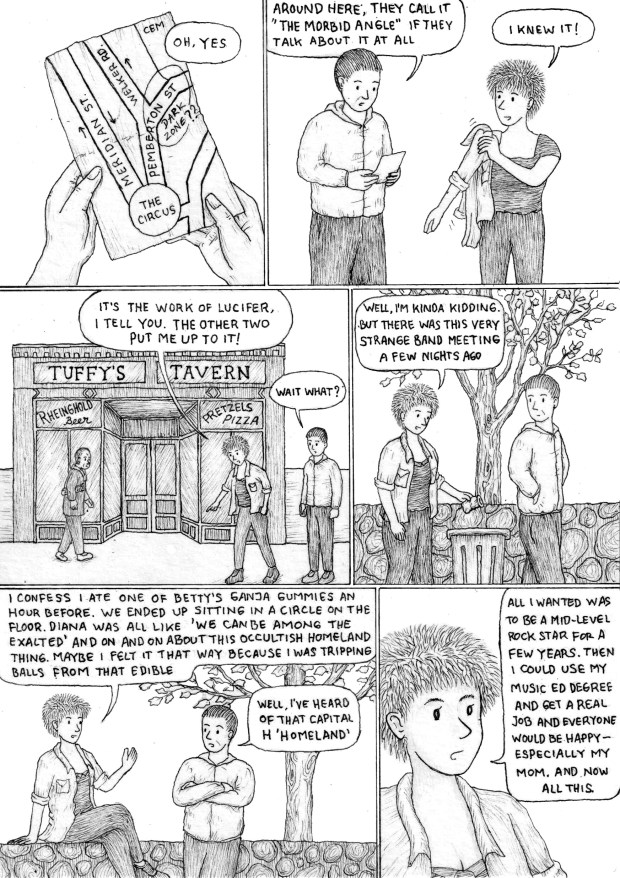
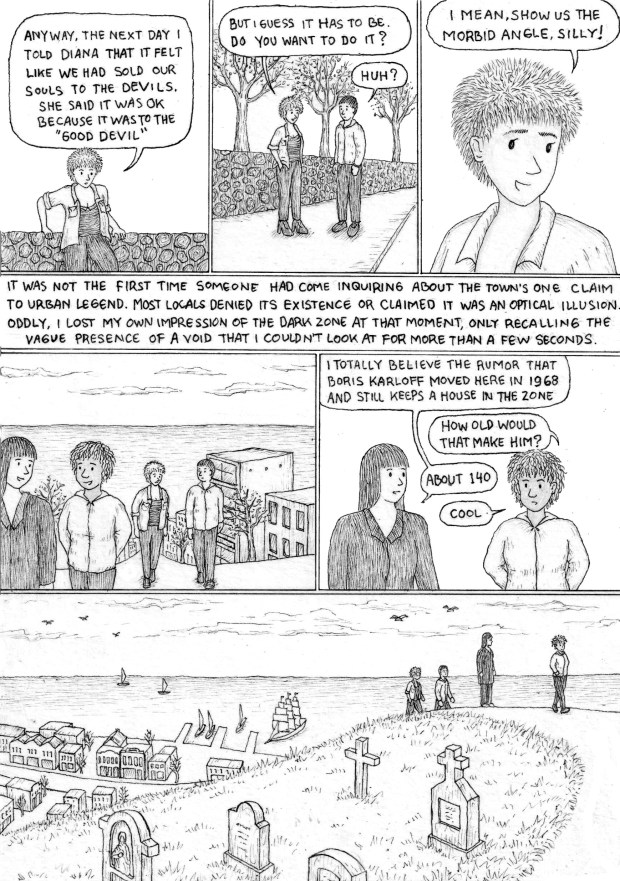
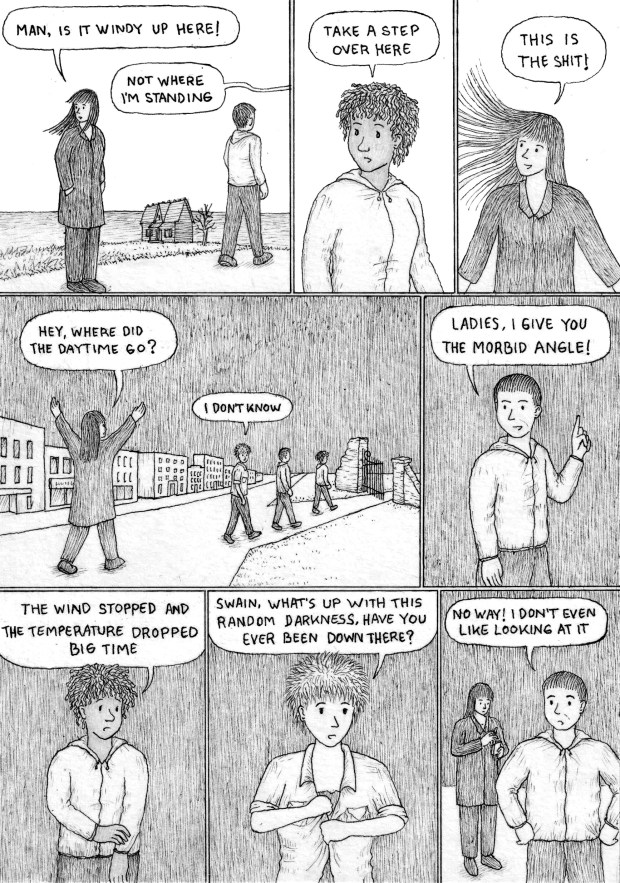
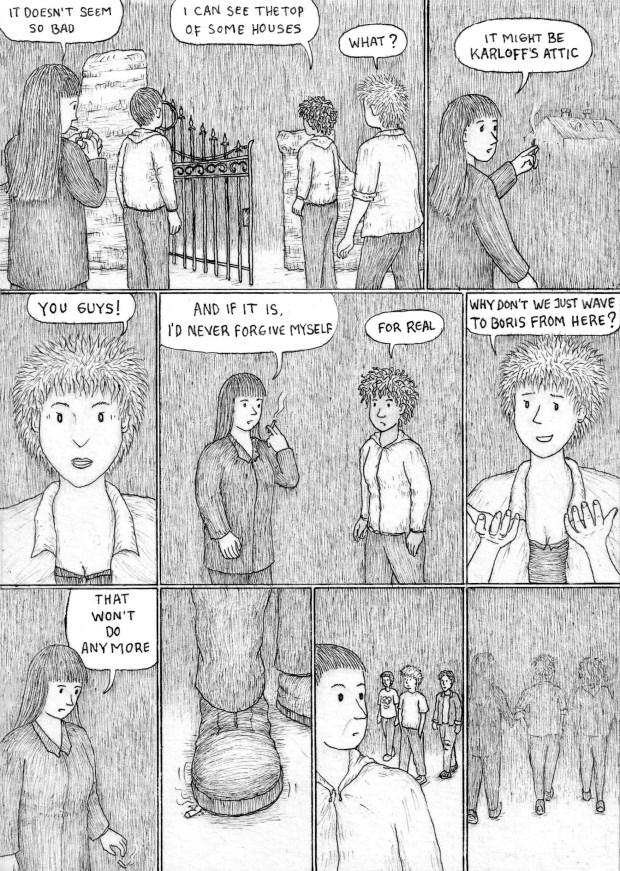
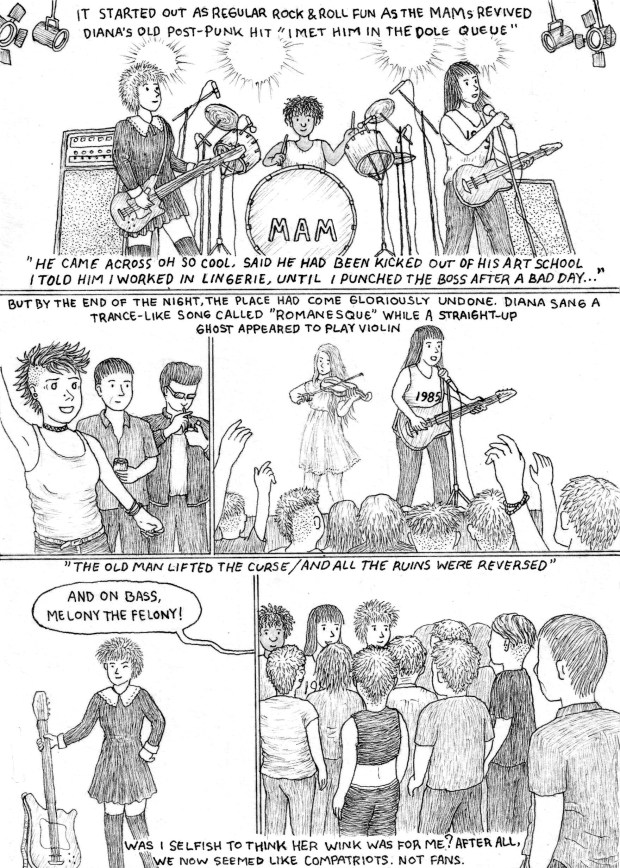
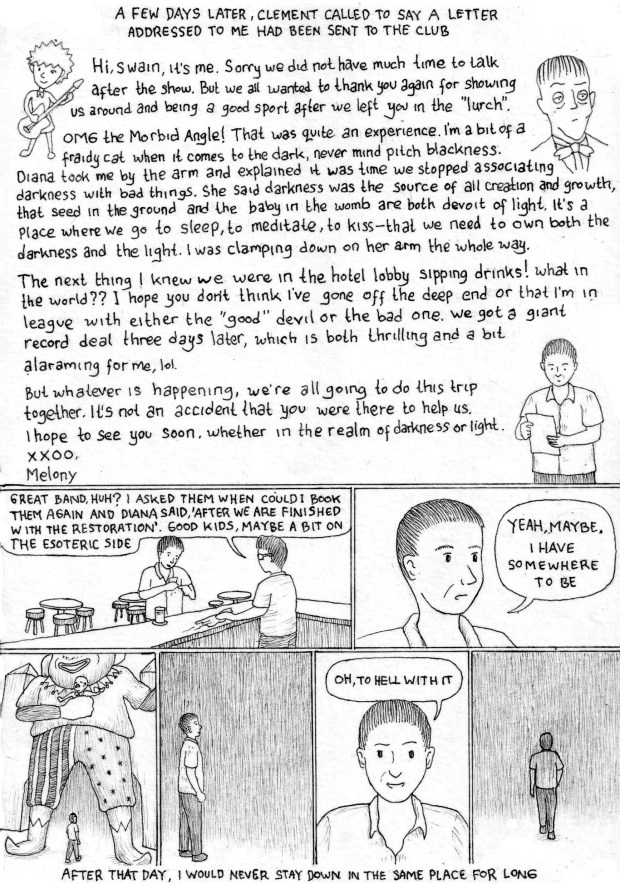
The third installment of my comic “In a Dream of Strange Cities” is below. Written and conceived by myself (Rick Ouellette), illustrations by Ipan. Here, our protagonist Swain, now well into his extended visit to the “Second World,” begins to perceive that he may be called into the service of the protopian leader, Lady Domine, helped along by the members of the charismatic band Machine Age Maven. If interested in the previously published IAD edition (“Chthonic Days,” a self-contained story) click on the to-buy link on the right column of this blog, thanks!)
Visitors—Directed by Godfrey Reggio—2013—87 minutes
Godfrey Reggio’s “Visitors” is probably the best black-and-white photo gallery exhibit ever made into a motion picture. I’m kidding, but only to prep you about what to expect with Reggio’s slow-lane meditation on what it may feel like, deep down, to inhabit our fast-lane 21st century. “Visitors” is a patient, visually sumptuous and occasionally frustrating film. It is also one that, in its wordless succession of images and music, calmly cajoles us to take stock of ourselves.
Reggio is still best known for 1982’s “Koyaanisqatsi,” his sensation-causing experiment in depicting a “life out of balance.” It started off slowly with contemplative images of the natural and indigenous worlds before eventually building up to frantic climax with sped-up images of big-city commuters and commotion, all matched to the ever-increasing tempos of Philip Glass’ celebrated soundtrack.
Two other films followed in the same vein: “Powaqqatsi” from 1988, and 2002’s “Naqoyqatsi.” The director has said that, like those earlier films, “Visitors” was about “humanity’s trancelike relationship with technology.” That may be true in a sense, but this 2013 work has a far different feel than the “Qatsi Trilogy.” Those works tended to bludgeon the viewer with relentless images of a world being nearly crushed under the weight of its own industrialization and materialism. It’s a point well taken, but also one which got tiresome over the course of three films. After a while the accelerated rats-in-a-maze images of train commuters going up escalators felt elitist. When you get right down to it, these are just productive citizens on their way to work.
Here, we are asked to look straight into the faces of our fellow humans, of all races and ages, not to mention meeting the haunting gaze of a female Lowland gorilla, a signature image of this film. Often, these shots last 90 seconds or more. These cinematic staring contests made for a somewhat squirmy viewing experience when I saw “Visitors” in a theater on its original release. In the solitary comfort of one’s home, this same device feels like a bridge to feelings of deeper human connections. If that sounds counterintuitive, so be it. It is so gratifying to take an empathetic look at our fellow travelers free of both the grievance politics and the ankle-deep identity affirmation that draw us away for our collective interests.
Some of this cinematic strategy must relate back to the director’s life story. Reggio was born in New Orleans in 1940, but by age 14 he had left home and soon became a Christian Brothers monk, spending his time in silence, prayer and mediation until age 28 (giving fair indication of his non-verbal filmmaking philosophy). He long since relocated to Santa Fe where he worked with troubled youth and was turned onto cinema after seeing the related “Los Olvidados” by Luis Bunuel. The devastations of Hurricane Katrina in 2005 led Reggio back to his stricken hometown and his location photography, as impressive as ever, features many locations in and around the Crescent City.
There are elegiac, time-lapse images of New Orleans’ Six Flags amusement park and Mercy Hospital (both closed post-Katrina), vaulted cemeteries and ghost-like bayous. These are beautifully filmed in a process that resembles B&W infrared still photography: think black skies and glowing white foliage.
Near the end, we return to an opening shot of sailing serenely over the surface of the Moon, like alien visitors gazing at the marbled planet Earth, accompanied by Philip Glass’ tranquil score. We have spent the last 80 minutes in a queer sort of communion with ourselves and our environment, not always sure if we are the watchers or the watched but assured that in the end it’s all the same. In the age of dizzying discord and snap judgments, Reggio’s hypnotic and humane film invites us to stare at the world until we see ourselves in it, along with everyone else.
The Denver International Airport is the largest such facility in the Wester Hemisphere by land area, encompassing 52 square miles of space in the middle of a vast and nearly treeless plain, some 23 miles from the Colorado capital. It may be the sixth busiest airport in the world, but it is the first busiest when it comes to the number of urban legends and conspiracy theories that swirl around it.
It’s been said that, even before it opened in 1995, people were raising questions. Why so far away, why all that land? Things ratcheted up when the imposing and indelibly strange “Blue Mustang” went up in the middle of a plain on the approach to the airport. This 32-foot statue of an electric blue horse has red laser-light eyes and is rearing up enough to grossly display his prodigious man junk. He was finished only after its sculptor (Luis Jimenez) was killed when a large piece of it fell on him just before its completion. The work soon came to be known as “Blucifer.”
But this strange, unsettling sculpture was only the start. Soon the airport was a hotbed of conspiracy theories, based upon the general idea that it’s the new world headquarters of the Illuminati. The large network of underground tunnels was variously seen as a hideout for officials of the New World Order and/or lizard people. They are supposedly great survival bunkers for the rich and elite and, not coincidental to this line of thinking, are connected to the North American missile command. There are gargoyles in suitcases looming above the baggage claim and, to top it off, the central terminal’s roof is made up of multiple tent-like peaks and are said to symbolize the Ku Klux Klan.
To be fair, the Denver airport authority has kind of brought this on themselves. That statue (a winning design) is pretty demonic-looking—check out some close-ups online—and it can’t be decided if the roof is supposed to represent the Rockies or Native American teepees. Oh yeah, I forgot, the whole thing may be built on Indian burial ground.
Let me go on record as one who believes there is a HUGE difference between being self-aware and vigilant against forces that may do you actual harm, and falling for every batshit-crazy conspiracy that comes down the pike. Honestly, you would think that some disgruntled elite would have ratted out the Illuminati by now. Of course, the response by true believers would probably be that the fact they haven’t been exposed is proof of their existence. How grimly ironic when you learn that the known Illuminati, founded in Bavaria in 1776, was founded in part to combat the forces of superstition and obscurantism, i.e. the restriction of knowledge via misinformation, religious intolerance and the denigration of independent thought.
Some say that the popularity of conspiracy theories is due in part that it makes the less intelligent among us feel smarter and it provides a simplistic and hard-to-refute reason for problems that could be otherwise overcome by sometimes-difficult personal effort.
It’s nearly impossible to convince conspiracy theorists that they are wrong, so the best way to deal with it is with a cheeky sense of humor and that’s exactly what the administration of the Denver airport has done. When I was there during a Thanksgiving weekend, I came across several signs along a wall that is covering some renovation work at the large central terminal:
If any conspiracy aficionado were to walk by one of these lizard-people-hardhat signs and nudge a family member, declaring “See, I was right all along,” they would make a complete fool of themselves. Reverse psychology can be a wonderful thing.
In conclusion, these kind of New World Order tall tales are fun for the purpose of a graphic novel or sci-fi movie, but please don’t get to that bad place where before long you start believing that Democratic lawmakers are eating babies or at that the 1969 American lunar landing was fake but that the Nazis had a moon base as early as 1942. For more info, consult the Internet or check out the prime-time programming of the “History” Channel.
It was also slightly annoying that so many people passed by the Denver terminal’s cheeky billboards without the slightest hint of curiosity. I know it’s an airport and folks are rushing to and for but there is also downtime for many. A better engagement by the general (and reasonable) public would give them a greater understanding on the scope and the inherent danger of those whose baseless beliefs can lead them down a very dark alley, and possibly dragging civil society right down with it.
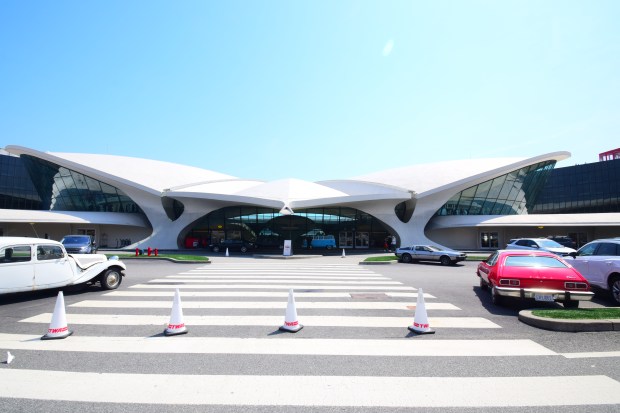
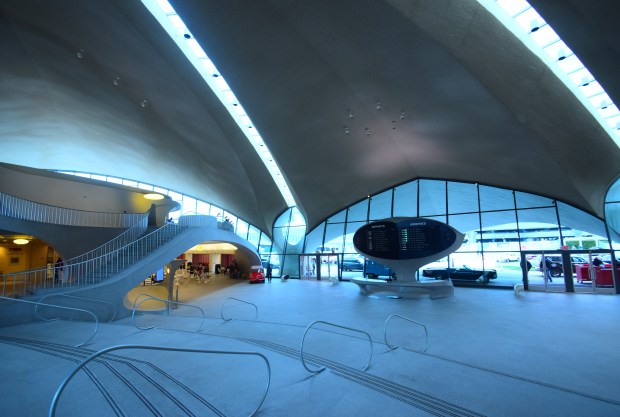
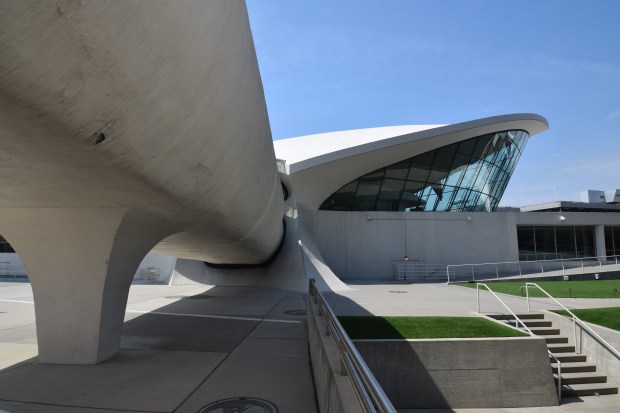
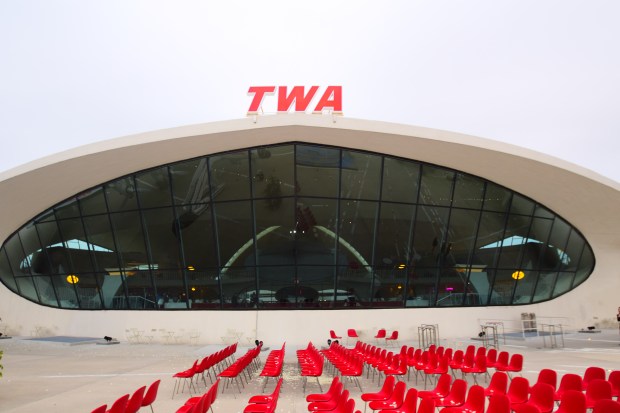
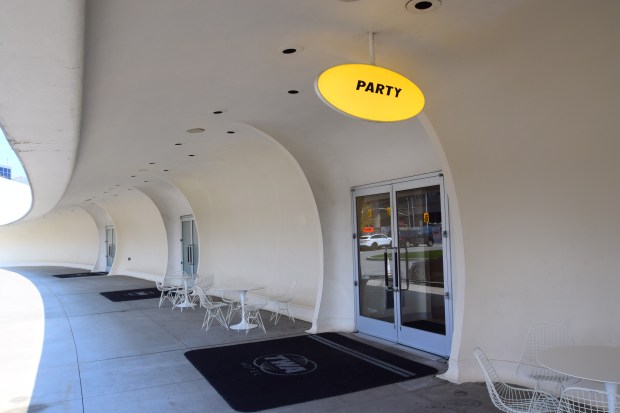
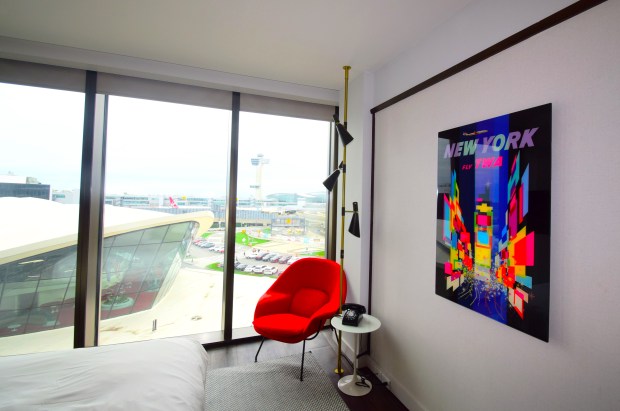
An instant induction into the “Placeology” Hall of Fame goes to the TWA Hotel at the JFK Airport in Queens, New York City. Eero Saarinen’s Jet Age/Space Age masterpiece, opened in 1962, now serves as a gigantic retro-futurist lobby for a hip but friendly destination hotel. The actual guest rooms are in two curved buildings that overlook the great sculptural form of Saarinen’s creation, made to resemble a bird taking flight. You reach the rooms by walking up the terminal’s two iconic red-carpeted tubeways, which may make you feel like you’re living inside the space station scenes in Stanley Kubrick’s “2001.”
Those ramps once led directly to the jet doors, previously passengers had to head out on the tarmac and climb the roll-up stairs in all sorts of weather. They’re indicative of the efforts of Trans World Airlines, with Howard Hughes still as principal owner, to popularize and glamourize the growing airline industry. The sunken lounges, curvaceous stairways, giant viewing windows, in fact everything down to the chic uniforms and pillbox hats worn by the stewardesses, led to a total implied package of adventure and elegance. (Compare to today!).
So you will see walls lined with photos of the Beatles, Muhammad Ali, Presidents Kennedy and Truman and movie stars ranging from Marilyn Monroe to Paul Newman. Of course, you don’t have to be a big shot to stay at today’s TWA Hotel. It’s a bit pricey but not exorbitant when compared to far less attractive places. Since airports are not standard vacation destinations, the people who are staying at the TWA are usually there because they appreciate it (an exception may be if your flight at the adjacent Jet Blue terminal was cancelled until the next day).
There is certainly lots to appreciate. The hotel is fun and distinctly non-snobby, as amenable to young families as it is to couples on a romantic getaway. The latter can enjoy a drink in the sunken lounger under one of the terminal’s two giant elliptical Arrivals & Departures boards, while the former can entertain themselves by checking out the Twister game room, the many vintage automobiles and the free photo booth. Aside from the soft clattering of electro-mechanical A&D boards, the main sound you’ll hear is the continuous sound of Sixties pop music over the PA, just loud enough to be a nostalgic soundtrack of your stay. Along with the sounds of the British Invasion, Motown, surf, early rock ‘n’ roll and the occasional Frank Sinatra croon, you get a couple of tunes from the girl-group pride of Queens, the Shangri-Las.
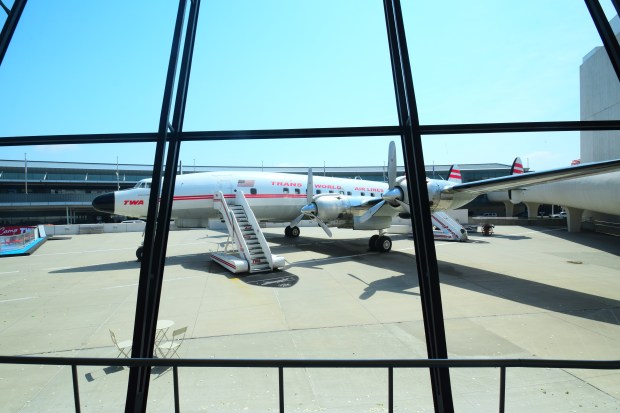
A big attraction for many is a restored propeller-driven Lockheed Constellation, an airliner that was produced between 1943-58. Its bold profile dominates the view outside the terminal’s huge oval rear window. Affectionately known as “Connie,” any guest is free to go outside and walk up the steps, where the interior is now an informal lounge (expect a crowd). But there will much less of a crowd in the terminal’s “hidden” nooks and exhibit rooms, where the hotel’s playful quality really hits a peak. There’s the “Pope Room,” a tiny vestibule where Paul VI decompressed in October of 1965 after becoming the first pontiff to set foot in the U.S. At the end of one of the tubeways you can visit (and hang out in) a recreated Sixties living room, a TWA executive office, and a simulation of Saarinen’s studio.
After settling into the fantastical realm of Eero’s creation, you may notice something which is the most gratifying feature of this whole experience: that to whatever extent possible, the developers of the TWA Hotel left this architectural gem as is. The building had been essentially vacant since the terminal was last used in 2001 until it opened as a hotel about five years back. But there was no Disneyfication in the rehab: the carpets, seat cushions, tiling and concrete sheathing are all original and a bit timeworn, even a little tatty in places.
It cost a little more for a room with a “historic view,” but it is worth it.
That’s a good thing. We are invited into (for the price of a room) a real and vital piece of design history, not a replica. As you walk towards the hotel, you will enter this rarefied air with the help of outdoor speakers playing the 5th Dimension’s bouyant hit version of Jimmy Webb’s “Up—Up and Away” which was adapted into a memorable TWA television commercial. Along the way you will see translucent posters, partially blocking views of the construction of a new international terminal, that feature press testimonials of New York’s “sexiest” hotel. The one that stuck with me was from the Wall Street Journal: “They don’t build them like this anymore, and they never will again.” Truth.
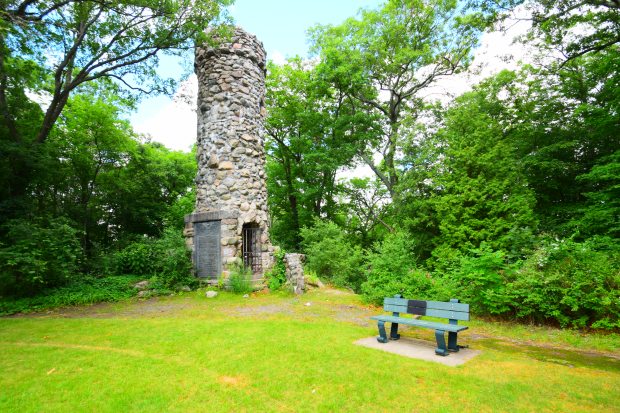
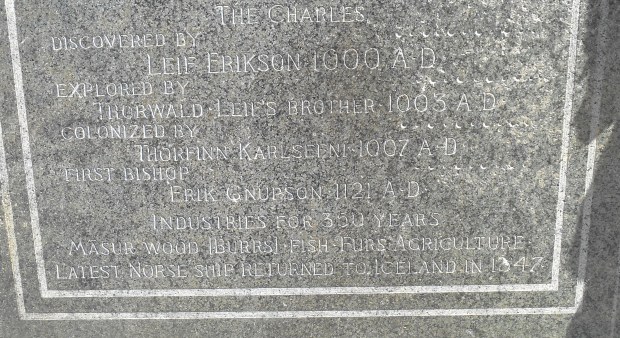
If you live near me have ever chanced upon the Norumbega Tower (on the road of the same name) in Weston, Mass., you’d probably be scratching your head after reading the plaque at its base. It would have you believe that Leif Ericson and other Viking bigwigs established near that spot both a fort and a city of many thousands, at least enough to support the several industries it mentions. The plaque claims that this was the epicenter of the true Vinland, a veritable empire that stretched from present day Rhode Island to the St. Lawrence River! As opposed to say, the established-science location of a tiny patch of land in Newfoundland.
The tower was built in 1889 by Eben Norton Norsford, a guy who made his fortune by refining the manufacture of baking powder. But the dude must have been getting “baked” on something else to believe all that. He may have been the original “I did my own research” guy. Back then, he wrote a “seemingly endless series of books and articles” (Wikipedia) on the subject and built the tower to look down on the location of the alleged settlement (a lake-like section of the Charles River also bordered by present-day Newton and Waltham).
View of the Charles River from the top of Norumbega Tower.
Thing is, Norsford didn’t bother to back up these claims with anything as small-minded as archaeological proof. He just made it all up. He may likely not have believed it himself. In the late 19th century it was not uncommon to have an ulterior motive in trying to establish that America was founded not by swarthy Mediterranean (and Catholic) types like Columbus and Vespucci but by “whiter” Northern Europeans. This at a time of mass immigration from places like Italy.
Norumbega Tower is not the only monument in the annals of false-Viking claims. The Newport Tower in Rhode Island is another well-known example and hoaxes have reached as far away as Minnesota and Oklahoma.
But unlike the wholesale falsehoods and plying of racial grievances being perpetuated in the post-MAGA era, the lack of evidence apparently meant something back then and Norsford’s tall tales were soon discredited. And he did have a good side as well. He was an early supporter of higher education for women—a benefactor of Wellesley College—and built the first public library on Shelter Island in New York City, later Welfare Island and now Roosevelt Island.
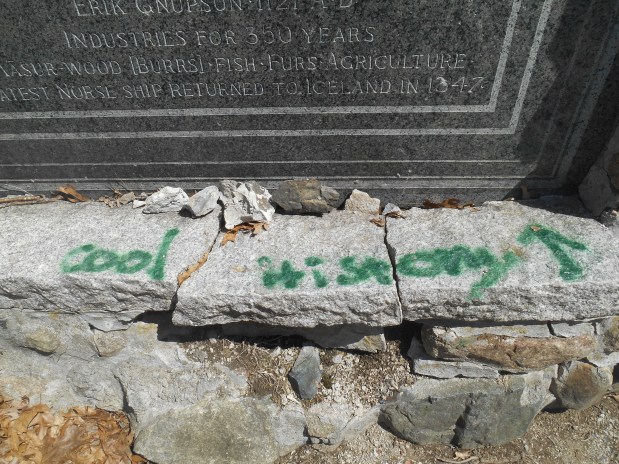
On my most recent visit, the padlock that is usually on the door had been removed and you’re free to walk up to the top of the tower. It is just a hop and skip off the Weston interchange of Interstate 90 (Mass. Pike), so aficionados of the “Old, Weird America” should check it out if in the area. It is mostly free of graffiti (a blessing nowadays) so the “Cool History” tagging, pointing to the plaque, is esp. galling to me. Whoever did that must be a fan of the “History” Channel, which now regularly peddles junk theories about “Ancient Aliens” and such. But more on that in the next installment of “Placeology.”
The places we walk through or drive past, the sites we visit or that simply fall into our frame of vision, all have a heritage and inner spirit of their own. Even in our familiar everyday world, we are often just steps away from some location rich in hidden history and forgotten associations.
The ideational term “psychogeography” refers to the attainment of deep connections with man-made environments, usually by way of unplanned walks thru cities. It has been described as a “charmingly vague” practice by no less a man the French Situationist philosopher Guy Debord, who coined the phrase himself in 1953. It can also be seen as a more risk-averse cousin of today’s urban explorer subculture, which I’ve written about many times in this blog.
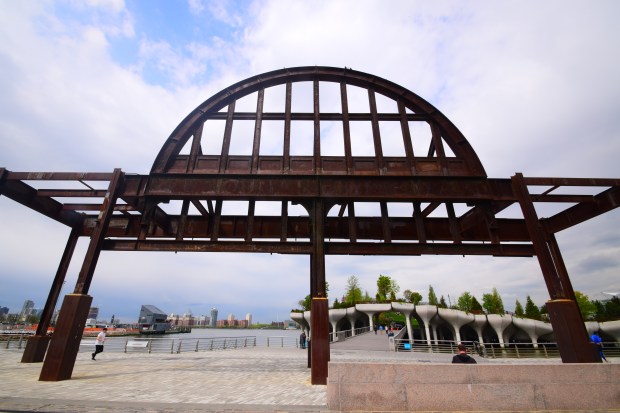
The preserved archway frame of Pier 54, where survivors of the Titanic disembarked from the Carpathia, now serves as the south entrance to New York’s Little Island.
But there is also a very practical side to psychogeography, that would do us all good to be aware of. The theory goes that the distractions and pressures of modern society have caused people to become disconnected from the public realm, leaving the one-percenters to run roughshod over the greater public interest. Understanding and appreciating our common built heritage can lead to thoughtful historic preservation and the design of more livable cities thru greater community involvement.
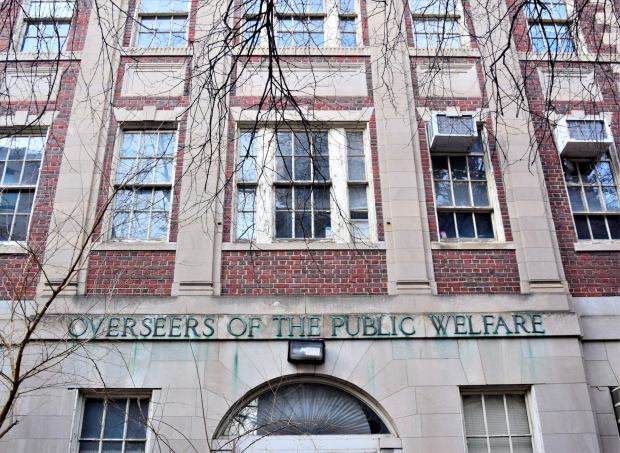
Winter’s bare trees reveal the vestigial facade of a paternalistic institution on Hawkins Street in Boston.
So while coming to understand the effects of the built environment can lead to a greater good, psychogeography can be both a passive pleasure or a wildcat experience. It’s something almost everyone has experienced, whether consciously or not. It can be the satisfaction of finding a great hole-in-the-wall eatery or tucked-away antique store because you wandered away from a usual walking route. It could mean tiptoeing into an off-limits but unguarded location to do a photo session with friends or discovering a fascinating historical vestige steps away from a throng of selfie-taking tourists, as in my photo below.
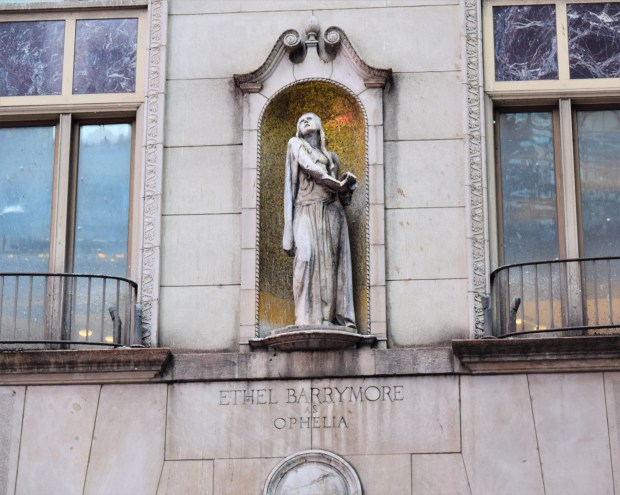
This statue of Ethel Barrymore, and of two other former stage icons, evoke an earlier era of Broadway, just a few feet away from the back of a gigantic electronic billboard in Times Square.
In his 2006 book “Psychogeography,” writer Merlin Coverley, traces this concept back to its immediate roots: French Marxists and Situationists. But he also vividly digs back to an earlier era and the “urban gothic” stylings of authors like Charles Baudelaire, Edgar Allan Poe, Charles Dickens and Robert Louis Stevenson, showing how their “obsessive drifting (yielded) new insights.” Poe’s 1840 story “The Man of the Crowd” is perhaps the first examination of the mysteries and perplexities of the modern teeming metropolis. In “Dr. Jekyll and Mr. Hyde,” Stevenson shows not only the duality of man’s nature but the stark dichotomy of the different parts of London his split protagonist inhabits. Dickens was a famously keen observer of the same city (often engaging in all-night walks) and had the fame and power to influence social reforms in the darker aspects of the city he witnessed, the exploitation of children, the workhouses, slum conditions etc.
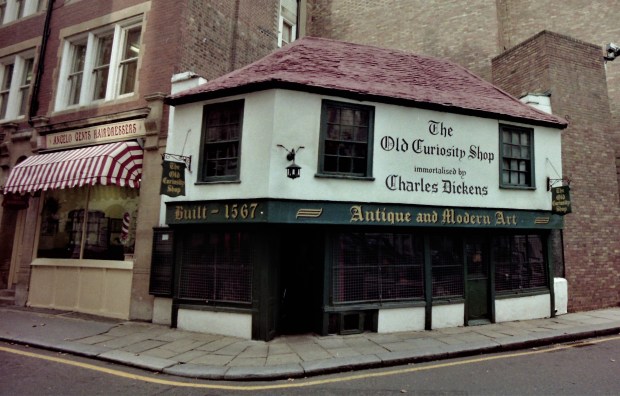
I stumbled on this Dickens landmark during a London walkabout in 1994.
It’s Baudelaire, quoted by Cloverley, who has the most telling description of the psychogeographer, which has as its alpha the Parisian flaneur (or boulevardier). “For the perfect flaneur it is an immense joy to set up house in the heart of the multitude… to be away from home and yet to find oneself everywhere at home… to be at the center of the world and yet remain hidden from the world.”
Sounds cool? If so, try out some psychogeography yourself. Put away the GPS and get to know your town. Stick up for livable cities and against gentrification. Patronize independent small businesses and out-of-the-way points of interest. Lastly, LOOK UP AND AROUND to see what I call the Museum of the Street, and feel a little of what it means to be “everywhere at home.”
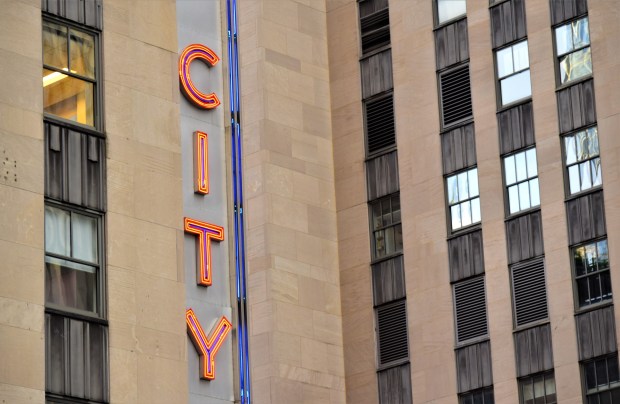
All photos and text by Rick Ouellette. Top Photo is Radio CITY Music Hall, NYC.
More info on my “Placeology” photo series coming soon!
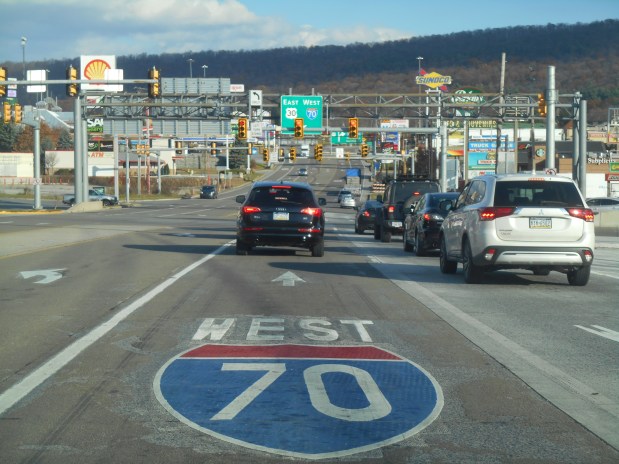
If you ever want to get one of those definitive telephoto pictures of American car culture run amok, there are few places better to trip the shutter than Breezewood, Pennsylvania. Located in the southern central part of the Keystone State, it’s a notorious “choke point” where Interstate 70, the Pennsylvania Turnpike (I-76) and the historic Lincoln Highway (Rte. 30) all meet, sort of.
Breezewood, where the Interstate is also a street.
Because of some arcane law that once proclaimed I-70 could not directly connect to the tolled Turnpike, the Interstate shares a one-mile connector with Rte. 30. This corridor is a densely packed jumble of gas station/convenience stores, fast food joints, chain hotels—all announcing themselves with signs that can reach up to about 70 feet high. There are also two truck washes and plenty of room to park your rig after tear-assing your way thru the six-lane main drag, which seems to be a local sport.
Yes, it’s all very uber-American in a way. There may be no better a democratic leveler than the free breakfast room at the Holiday Inn Express or being in line behind a couple of hunters at Sheetz, the ubiquitous convenience store/coffee shop round these parts. But just beyond the narrow limits of unincorporated Breezewood, it’s a different story. My hotel room had a view of a picturesque farm. And if you head due east, you’ll be driving down the historic and scenic Lincoln Highway as soon as you clear the hill at the end of the strip.
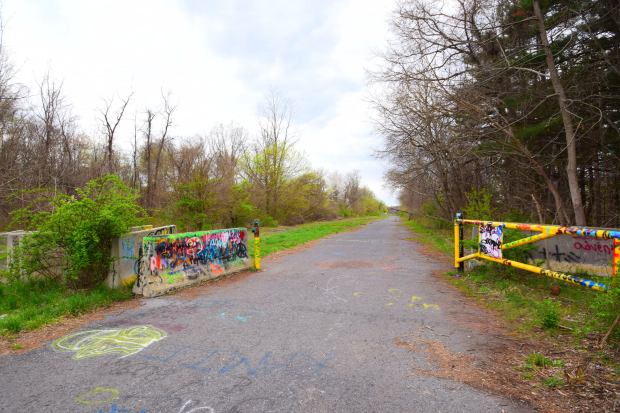
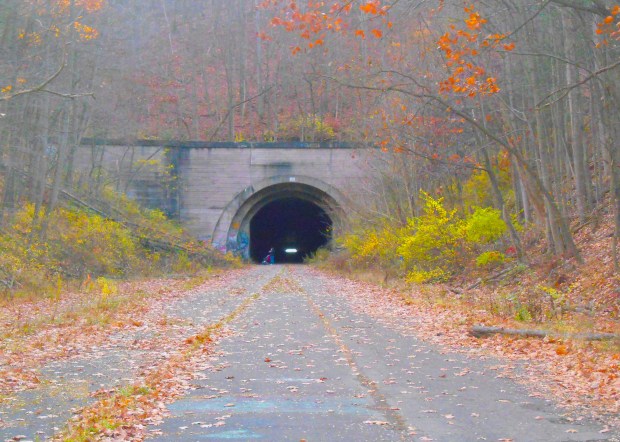
But just before you do, there’s a rutted dirt parking lot next to a paved path you can walk up on. If you do, you’ll be entering one of the state’s strangest and most intriguing points of interest, the Abandoned Pennsylvania Turnpike.
Surrender all hope ye who enter….
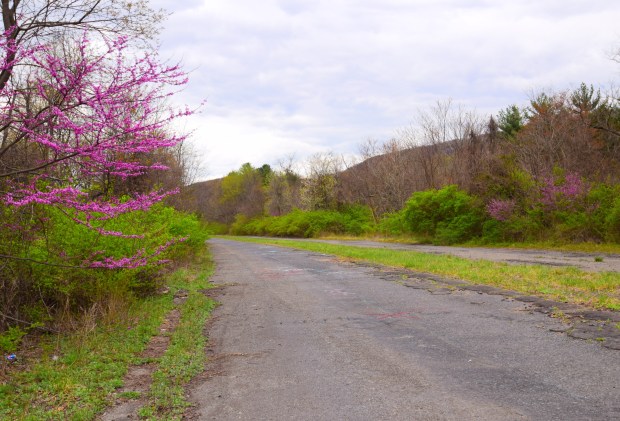
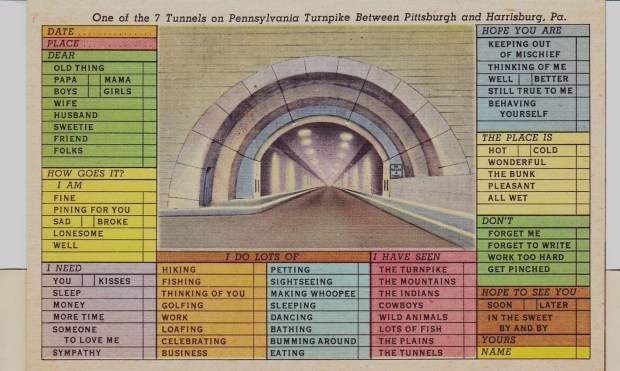
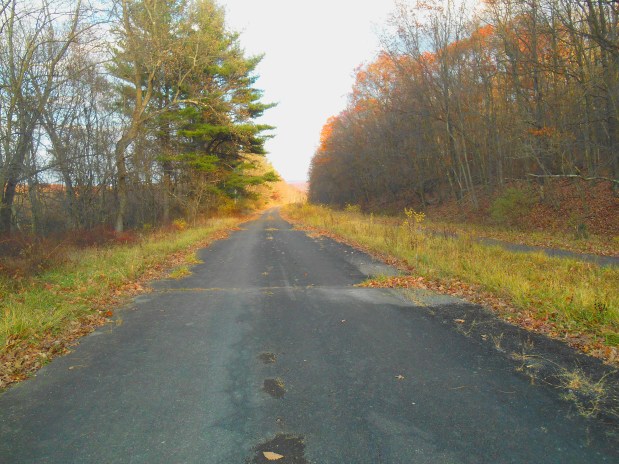
The Turnpike opened in 1940 and was an engineering marvel at the time, and a precursor to the massive American Interstate system that followed. But by 1968, car culture had long expanded and so had the Pike, except for this 13-mile stretch. It was logistically too difficult to widen it here and was re-routed. It is now an accessible (but unmaintained and unmonitored) public walking and biking trail.
As a devoted (but not hardcore) member of the urban exploring subculture, I had long wanted to visit the APT. I got my first chance a few springtimes ago. I was on foot, and it was almost two miles from the Breezewood parking area to the first of the two tunnels on the trail. The way to Ray’s Hill Tunnel is a bit eerie, and evocative of an age of simpler automobiles and slower driving speeds. It presents as four rather narrow lanes but drops down to two at the tunnel. It was cool to see one of the turnpike’s original scalloped tunnels, not matter how defaced it is with graffiti.
Along with the taggers, curiosity-seekers and photographers, the APT has attracted at least one major film production. The 2009 screen adaptation of the Cormac McCarthy novel “The Road” takes place in the wake of an undefined extinction event (Apocalypse How?) and has many scenes filmed there.
Vito Mortensen and Kodi Smit-McPhee in “The Road.”
It’s curious how highways are such ideal settings for post-apocalypse movies. “The Road” does not feature the fiendishly modified vehicles tearing down outback highways like in the “Mad Max/Road Warrior” series. Things are even worse here, and a key scene is the confrontation between Vito’s protagonist and a wandering member of a violent cannibal gang when the group’s ragtag truck stalls out after emerging from the grim interior of Ray’s Hill Tunnel.
On my second visit to Abandoned Pennsylvania Turnpike last fall, I had my new foldable Zizzo Bike and was ready to explore a bigger chunk of the ruined roadway. After pedaling past the strollers and the Goth kids doing Instagram pics at the mouth of the forbidding tunnel, I sailed thru the underpass with a big assist from a nifty little head lamp I bought for the occasion. On the other side, the atmosphere became more desolate in a hurry.
The far end of Ray’s Hill Tunnel.
Surely, not as desolate as the scenario in “The Road,” where the populace seems divided between killer cannibal gangs and those who retain the minimum standards of civilization, hoping to reach a promised safe haven once they follow the bleak highway all the way to the coast. Still, it is interesting to note that central Pennsylvania is on a sort of political fault line. The more liberal (blue) eastern part of the state can stand in stark contrast to the western hinterlands, where people have been warned to not even have a Joe Biden bumper sticker on their car to guard against reprisals from a hard-core MAGA constituency.
In the book “Divided Highways: Building the Interstate Highways, Transforming American Life,” author Tom Lewis details the passing of the massive legislation that authorized this epic road-building program was initiated by Republican President Dwight Eisenhower and eventually approved by a Democratic-controlled Congress—in an election year, no less! A transcontinental public-benefitting triumph that would “bind the nation.” It would hard to imagine an accomplishment (or agreement) like that with the toxically divided Washington of today.
It was twilight time as I reached the lonely halfway section of the APT (see above), and with little time to make the whole route before dark, I turned the Zizzo back towards the parking lot. Riding into the gloaming is enough to make you conjure your own dystopia—the kind where cars are all but obsolete and the world is hard under the heel of ecocide and/or a disastrous civil conflict.
The next morning I was in the better disposition as I checked out of the Holiday Inn, and said good-bye for now to Breezewood, the Las Vegas of service areas. I hope I can get back again to bike the whole ghostly trail. I topped the hill and drove into the immediate rural area on the Lincoln Highway, the road that kicked off America’s Highway Century (it opened in 1913). But that vague dystopic notion from the twilight of the previous day reentered my head when I thought of the next stop on my road trip: the Gettysburg national park.
Text and all photos by Rick Ouellette, except “The Road” film still and the circa 1940 postcard.
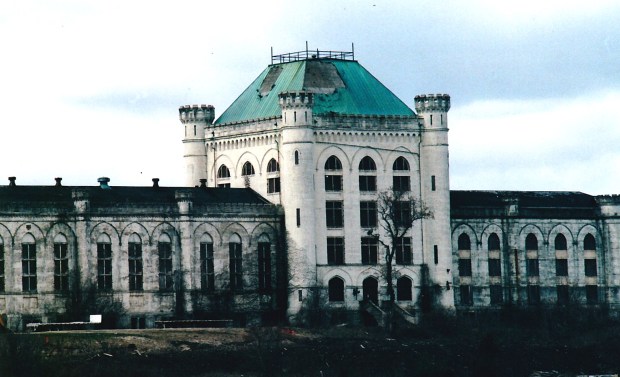
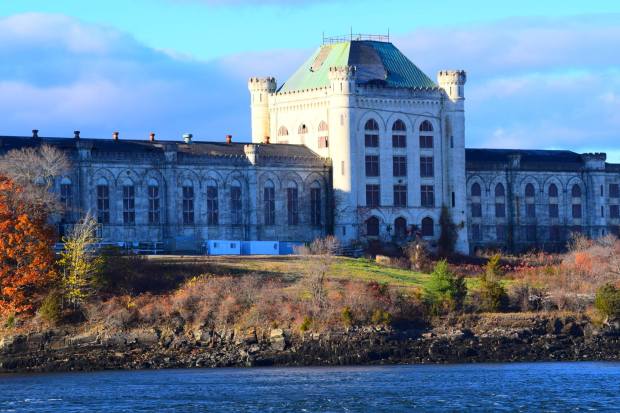
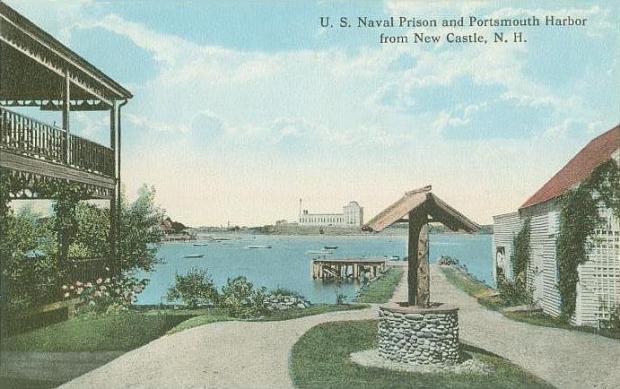
The Portsmouth Naval Prison is located on Seavey Island in New Hampshire. Dark, forebidding, isolated and pointedly medieval, it served as a max security jail for the U.S. Navy from 1905 to 1974. At its peak around World War II, the capacity of the prison (nicknamed “The Fortress”) was 3,008 inmates.
“Impregnable” would be another word for it. To escape this so-called “Alcatraz of the East” (assuming you made it out of building) you’d have to get past the guardhouse on the bridge to the mainland base or make an unlikely swim across the notoriously turbulent currents of the Piscataqua River just east of the cold Atlantic.
But perhaps more interesting is the question, why did the Navy need such an enormous prison? Turns out that around the time of max capacity in the Forties, as much as 40% of the inmates in this brig were in there for sodomy-related offenses. Yikes! This was enough for the top brass, even way back then, to reconsider their policy on homosexuality in the ranks. But it was still decades before even “Don’t Ask, Don’t Tell” and reform likely meant a discharge instead of a lengthy stay in this hellish jail.
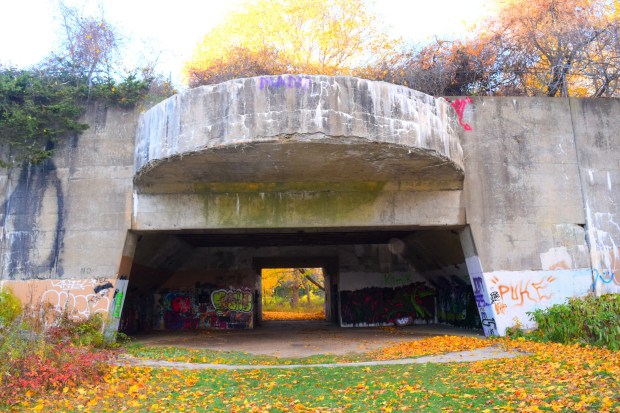
The Portsmouth Naval Prison has been closed now for fifty years, but you can’t visit it. Unlike the similarly decommissioned Alcatraz, sitting out there in the middle of San Francisco Bay, you’d have to pass thru the active Naval Shipyard to get there. Too bad, as it would probably be a great tourist attraction for historic and hip Portsmouth, just as the fascinating Eastern States Penitentiary has in central Philadelphia. Oh well. You can still get a good view of it from Route 1B going from Portsmouth to the seaside village of New Castle. Nearby is Fort Stark and Ordiorne State Park, both featuring the remains of giant gun batteries and other WW2 ruins. That could be another entry for this new series, where I will review many of the interesting places, famous or obscure, that I have photographed.
About “Placeology”
The places we walk through or drive past, the sites we visit or that simply fall into our frame of vision, all have a heritage and inner spirit of their own. Even in our familiar everyday world, we are often just steps away from some location rich in hidden history and forgotten associations. Through this “Placeology” photo series, I will strive to give fresh agency to locales both grand and humble, uplifting and foreboding. More coming soon!
Remains of World War 2 gun emplacement. Battery Seaman, Rye NH












 Reel and Rock