Placeology #8: Please Don’t Ruin the Ruins!

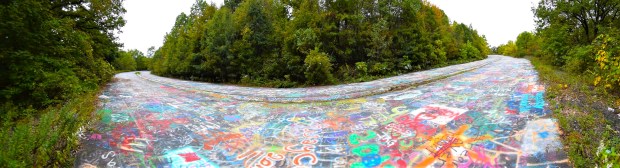
Graffiti Highway (parabolic), Centralia PA. All photos and text by Rick Ouellette except as noted.

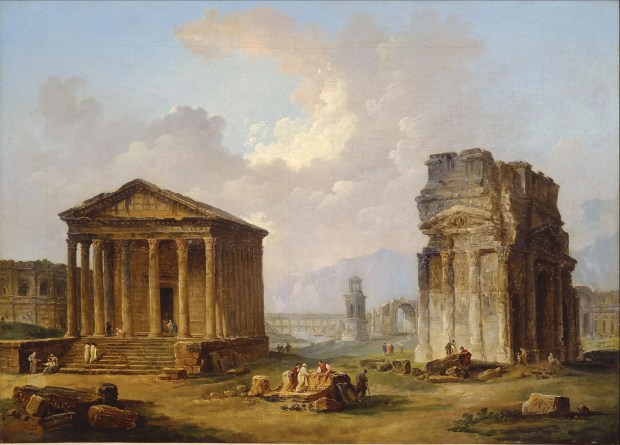
In the late 1700s, towards the tail end of the Age of Enlightenment, the French painter Hubert Robert became well-known for his large-scale canvasses depicting ancient ruins of France and Italy. These romantic (and often semi-fictional) scenes spoke to an age where there was a strong interest in classical antiquity and preserving what remained of it. Hubert and the other artists who followed this trend were surely aware of the evocative power of decay when it came to lost societies.

A typical Hubert Rubert joint.

Flash forward to the 21st century. We may well be deep into the Age of Un-Enlightenment, where hot-takes and online trolling has replaced the philosophical imperative. Yet the “picturesque” art style embodied by Hubert Robert has been carried on into the burgeoning field of ruins photography, the depiction of urban and industrial decay. Closely tied into the subculture of urban exploring, this field of photography has divided opinion. There are commendable practitioners like Matthew Christopher (in his two “Abandoned America” books) and Christopher Payne (the haunting and humane “Asylum: Inside the Closed World of State Mental Hospitals”) that have looked long and hard into the reasons and consequences of how  and why certain American institutions have been left to die on the vine.

Trolley Graveyard #1, Photo by author.

Critics have pointedly taken aim at some aspects this “urbex” photography, namely the exploitation of people’s natural morbid fascination with the wreckage of off-limits locations, not to mention the implied insensitivity to a region’s economic decline. I have seen a lot of that online, where intrepid shutterbugs return from their trespassing adventures and post pics online to curiously adoring fans who practically gloat over the collapsed remains of defunct shopping malls and shuttered Rust Belt factories.

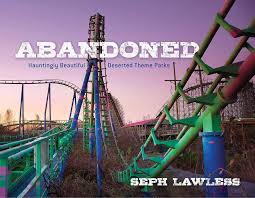
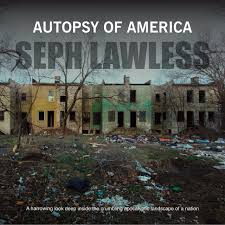
Which brings me to Seph Lawless. Curiously, he released two high-profile photo books in 2017 by two different publishers. “Abandoned: Hauntingly Beautiful Deserted Theme Parks” is exactly as it says, and he put in the big miles to significantly document a big urbex sub-category.

Then somewhere the same year was the boldly presented “Autopsy of America.” In case you don’t get it, you can turn to the back cover where we get in big letters, “Death of a Nation.” Really, the whole nation?? Published by a house called Carpet Bombing Culture (kind of a red flag in itself) the text for this book is so over-the-top that it can only work as self-parody.

“Is this just another recession? Or is this the beginning of the end?”

“America is a giant… mistake.”

“I want Americans to see what is happening to their country from the comfort of their suburban homes and smartphones.”

Oh gawd, spare me the edgelord/drama queen posturing! 😉. As usual, the photography is tremendous, though by this date we’ve all seen enough abandoned houses, darkened shopping centers and the odd isolated ghost town. (Lawless throws in several of his eye-catching theme park images for contrast). Yeah, there is serious income inequality. But it’s preposterous to pretend that cities like Pittsburgh and Cleveland (to name two I have personal evidence of) are hollowed-out landmarks of a country in its immediate death rattle.  Many of those cities have growing, transitional economies and don’t need this. But I get it. He’s Seph LAWLESS for heaven’s sake, and the hype (and apocalyptic rhetoric) often goes with this territory.

Graveyard Trolley #2, photo by author.

So while I may wince when Seph, like a supervillain in waiting, stands on a half-collapsed roof and gazes at a distant metropolis, you got to hand it to him. The logistics and craft it took to depict these places that so many want to know about. I’m just a part-time amateur at this game and have only been to one of the locations featured in “Autopsy of America.” I took a tour of the (now former) Trolley Graveyard outside of Johnstown, Pennsylvania with the aforementioned Matthew Christopher. He had photographed this huge collection of streetcars, owned by a super-hobbyist, many times before, including the pre-smartphone/GPS days. By the time I got around to committing to a tour, vandals had graffitied almost every car and smashed almost every window on them. It just got too easy in the Internet age to popularize and locate these spots, for good or ill.

But Rust Belt tourism is a thing and these cities often have a long-established culture in arts, cultural attractions and professional sports. As soon as we start realizing the value and vitality of such places, the better it will be for everyone, and we can all avoid the “Autopsy.”

Ranking the Rankin/Bass Christmas Specials: The Good, the Bad and the Bizarre

The prolific producing-directing team of Jules Bass and Arthur Rankin, Jr. have had a huge impact on our holiday viewing traditions. They made no less than 17 animated Christmastime special between 1964 and 1985. The duo created such iconic Yuletide characters as Rudolph, the Little Drummer Boy and Frosty the Snowman—-and memorable side players like Yukon Cornelius, BurgerMeister MeisterBurger and the Snow Miser/Heat Miser brothers.

Rankin and Bass were among the first American producers to employ Japanese animation teams and the resulting “Animagic” stop-motion puppet films (often mistaken for Claymation) are distinctly hand-crafted, often enchanting (even trippy) and sometimes unsettling. So let’s review those Christmas TV memories, both delightful and disturbing:

THE GOOD

“The Year Without a Santa Claus” (1974)

This entry has shot up the charts in many people’s holiday hit list in recent years, due in large part to the increased popularity of the irrepressible Snow Miser and Heat Miser, who do meteorological battle to control the holiday weather via a vaudeville sing-off. But overall, this is an attractive and well-written entry without the dark psychological underpinnings that lurk in other R/B productions.

Here, a very believable Santa (voiced by Mickey Rooney) is fatigued and under the weather. Suspecting that we mortals have stopped believing in him anyway, he decides on a mental health holiday just as December inconveniently rolls in. But the sensible and resourceful Mrs. Claus (Shirley Booth), showing us that it’s not only the Hubbie who knows how fly a reindeer, conspires to save the day. Features the songs “Here Comes Santa Claus” and a children’s version of “Blue Christmas.”

“Rudolph the Red-Nosed Reindeer” (1964)

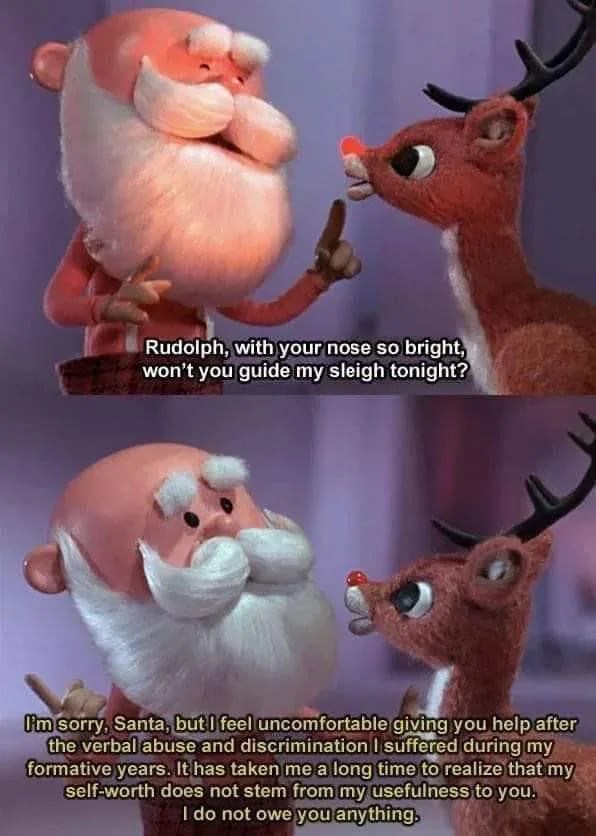
This perennial favorite celebrated its 60th anniversary this month by returning to NBC from whence it first aired. That it came out so long before the “safe space” era makes it great meme fodder for those who want to imagine the magnanimous Rudolph with a different answer to Santa’s famous question. This request for help coming after ol’ Ruddie Red Nose was practically disowned by his dad and bullied and ostracized by nearly everyone at the North Pole, forcing him into a dangerous (but ultimately rewarding) exile.

In these days of everyone-gets-a-trophy, “Rudolph” can stand tall as a great example that the world can be a cruel and callous place, and that a true test of character is not the worst thing. Rudolph “finds his tribe,” first teaming up with would-be dentist elf Hermey who has fled the town’s forced-labor camp, oops, I mean Santa’s workshop. They sing the great non-conformist anthem “We’re a Couple of Misfits” before heading out for their colorfully weird adventures with Yukon, on the Island of Misfit Toys, and against the Abominable Snowman. Note that when Rudolph returns to save the day, only his father straight-up apologizes for his previous cruelty, leaving a lot of unanswered questions about Santa’s alleged kindness.

“The Little Drummer Boy” (1968)

By the late Sixties, Rankin and Bass had hit upon a good dependable working model. This usually involved building a story around a preexisting holiday song (“Drummer Boy” was first recorded in 1951 by the Von Trapp Family), getting celebrity talent to do the voice work (June Foray, Paul Frees and guest narrator Jose Ferrer) and not shying away from subject matter that was a little dark for the kiddies. I confess to traumatizing my own son at a tender age when he witnessed the house of drummer-boy Aaron being torched by bandits while his parents were still inside.

Oopsy! The orphaned and embittered Aaron wanders the Middle Eastern desert, leading on his team of three surviving farm animals, by laying down some beats on the drum he received from his parents before you-know-what. He is exploited by a shady showman, before being led to Bethlehem on the coattails of Three Wise Men. Cue the Vienna Boys’ Choir for the stately rendition of Katherine Kennicott Davis’ revered (and sometimes reviled) carol. Behind that soaring chorus, the scene at the manger with Aaron and his stricken lamb is unabashedly religious and admittedly moving.

“Santa Claus is Coming to Town” (1970)

Fred Astaire gets the “Told and Sung By” honors here, as the R/B team hits on all cylinders. House scriptwriter Romeo Muller pens a succinct origin story for the big guy, and the Animagic cinematography team, led by Kizo Nagashima, do splendid work all the way from the icy-blue Mountain of the Whispering Winds down to the Teutonic grays and browns of Sombertown. The original music by Bass and Maury Laws is Broadway-worthy stuff, especially the two “Toymaker” songs and Claus’ self-improvement tune, “Put One Foot in Front of the Other,” sung to the easily-won-over Winter Warlock.

Voice actor extraordinaire Paul “Boris Badunov” Frees, was the voice of ace villain Burgermeister Meisterburger as well as his assistant Grimley.

This is also the first appearance of Mickey Rooney voicing the part of Santa, a role he would reprise a few times over the next decade. His is a nicer Santa than the ethically dubious one we saw in Rudolph. However, I still have a bit of an issue with the title song, first sung on the radio in 1934 by Eddie Cantor. I mean, here’s a guy who “sees you when you’re sleeping/knows when you’re awake.” Stalker, much?

Jack Frost (1979)

Moving away from the Santa-centric holiday fare, here’s a tale of everyone’s favorite wintertime sprite, one of the team’s most visually appealing entries. But this special’s affecting tale, much of it taking place in a splendorous silvery-blue domain, is hamstrung by a rather odd Groundhog Day framing device, with corny ol’ Buddy Hackett as narrator as Pardon-Me-Pete explaining at length the connection between Jack and his big day on February 2nd.

Otherwise, this is a grown-up story of how lovelorn Jack, crushing hard on the pretty but flighty Elisa, asks Father Winter if he might become human in an attempt to win her hand. She was a fangirl of ol’ Frost in his invisibility mode, but as a real boy it’s more like let’s-be-friends. Nevertheless, Jack proves himself in battle against the fearsome Kubla Khan, the Cossack King, who rules January Junction atop his mechanical horse and has at his disposal a steampunk army and an iron-plated sidekick called Dummy. (Kubla is memorably voiced by Paul Frees in his Boris Badunov voice).

The voice of Elisa is Debra Clinger, of the Clingers. She and her sisters were the first all-girl rock band signed to a major label.

Ultimately though, Jack is obliged to return to his former nipping-at-your-nose occupation, making this maybe the only R/B production with a romantic heartbreak theme.

The Life and Adventures of Santa Claus (1985)

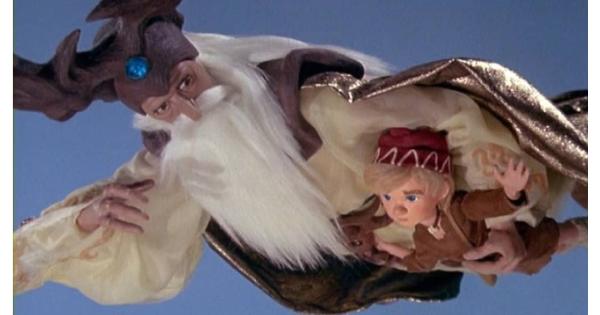
It’s back to the Santa origin story in this adaptation of the 1902 book by “Wizard of Oz” author L. Frank Baum. This is the last, and one of the best, of Rankin/Bass holiday productions, driven by the almost psychedelic visuals inspired by Baum’s ripe imagination. The grand procession of The Immortals that kicks things off in grand style.

The conclave of these pagan bigwigs is called by the Great Ak (“The Master Woodsman of the World”) to decide whether to confer Immortal status on the human orphan named Claus, who they took in after he was abandoned some 50 years previous. Of course, Ak relates the whole backstory, how he and young Claus had travelled the medieval world and got a close-up look at man’s inhumanity to man. Claus is esp. offended at the plight of neglected children and commits himself to their happiness. (But not before the Immortals have to take out the fantastical kid-hating baddies known as the Awgwas).

After a half-century of service, Santa is feeling his age so will the Immortals step up to the plate and make him an Immortal? No spoilers here. Rankin and Bass and their Animagic collaborators in Japan went out on a high note, so don’t miss out on this special special. After all, not all R/B creations we were great, and below we will look at some of their Greatest Misses.

The Bad and the Bizarre

“Frosty the Snowman” (1969)

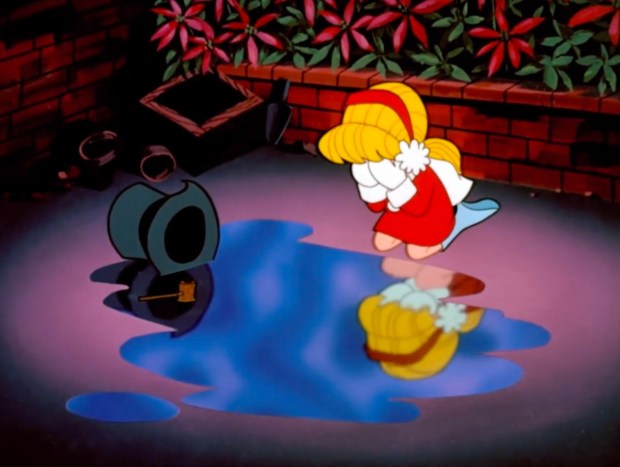
As if the 1950 Gene Autry song wasn’t annoying enough, this cartoon is so appallingly awful that it shouldn’t appeal to anyone over the age of five with at least one working brain cell. Here is the IMDB capsule description: “A living snowman and a little girl struggle to elude a greedy magician who is after the snowman’s magic hat.” Let’s get one thing straight off the bat: the hat belongs to the magician!! He is clearly shown as the owner when he does his rather inept magic show for the school children. That it later accidentally blew unto their snowman is beside the point.

Merry Christmas, kids!

Let’s admit it, Frosty was better off as an inert snowman. As a living being he is a chucklehead always in danger of melting and thus breaking the hearts of the impressionable kids. Jimmy Durante, as the defensive narrator (“That hat DID belong to Frosty and the children, that point must be made very clear”) sees nothing wrong with Frosty taking one of the children along with him to the North Pole, even though the girl almost freezes to death in the process. But, hey, it’s a classic, I guess! Rankin and Bass always had less luck with their cel animation, though this one paid off handsomely.

“Nestor, the Long-Eared Christmas Donkey” (1977)

This well-meaning but derivative program is also based on a Gene Autry ditty, and Roger “King of the Road” Miller does the honors as narrator and singer here. Shades of “Rudolph” abounds as Nestor is discriminated against because his ground-dragging ears make him clumsy. But Mary and Joseph look kindly on him and Nestor is enlisted to help them make it to Bethlehem. Note to parents: this special is rife with savage Roman soldiers, meanie animal merchants and even Bambi-level tragedy. But it all ends well on that fateful night at the manager, so we all good?

“The Stingiest Man in Town” (1978)

In view of their prolific output, it is no surprise that Rankin/Bass would have a crack at Dickens’ timeless tale. But this operetta-style version of “A Christmas Carol” is best left forgotten. The cel animation is uninspired at best and the musical numbers are mediocre, esp. considering the lazy lyrics (Jacob Marley to Ebenezer: “My chain of wrong is very long/But yours is even longer”). And whatever Walter Matthau was paid for voicing Scrooge, it was too much.

The First Christmas: The Story of the First Christmas Snow (1975)

The unwieldy title is not the only awkward thing about this entry. I mean, Christmas at the convent? I had eight years of parochial school, so it’s a hard pass for me. However, I did like Angela Lansbury’s version of “White Christmas.”

‘Twas the Night Before the Christmas (1974)

There are mouses in the houses in this rodent-infested version of the inescapable holiday poem. And they are stirring, unfortunately. Another example of how the R/B team were seemingly indifferent with their cel animation works, this one looks like a Hanna-Barbara reject.

Rudolph and Frosty’s Christmas in July (1979)

The youngsters should love this crossover effort. It has two of Rankin and Bass’ most beloved creations, and the stop-motion work looks great. I continue have doubts about the problematic top-hatted snowman, who still insists on using tobacco products in the company of children. Put away that corncob pipe and I’ll wish even you a Merry Christmas, Frosty!

So what do you think, what’s your most and least favorite Rankin/Bass show? Let me know and have a great holiday season! –Rick Ouellette

Placeology #7: Farewell, Hobby Street

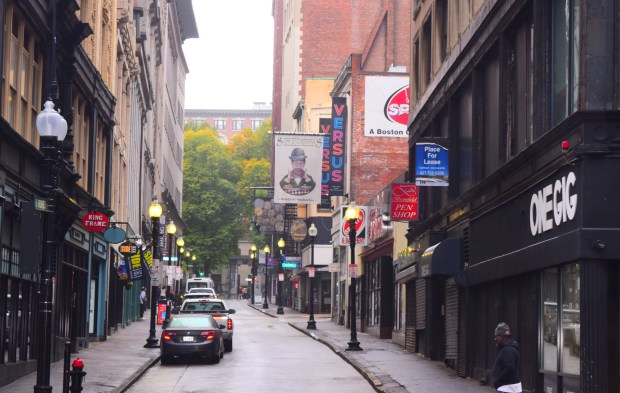
It’s no big surprise that Bromfield Street, a 500-foot long retail strip in Boston’s Downtown Crossing, has lost its informal designation as the city’s “Hobby Street.”  Once it was chock full of shops catering to camera buffs, coin and stamp collectors, baseball card traders and those folks enthusiastic about fountain pens and wrist watches.

Only a couple of those businesses remain and Bromfield is now known for its vacant storefronts. It’s sad, but I know that things change. But what passes for a hobby nowadays? Holding up phones at a concert and blocking the views of others? Cutting off normal cars in traffic in an SUV the size of an armored personnel carrier? Depleting a family’s lifetime savings via online sports gambling?

Oops, sorry. I don’t know how that soapbox got here. Anyway, we do live in a more impulsive age, where the patience required for stamp collecting or model building is at a premium. And when your pocket-size smartphone can take great photos and texting and email are the main form of written communication, there’s little need for once-esteemed shops like Bromfield Camera or the Bromfield Pen Shop (though the latter made it thru the Covid lockdown and only shuttered in early 2024).

Maybe all hope is not lost. Despite gentrification, New York still maintains a Diamond District, Flower District, Meatpacking District, even a Fur District. Industry-specific zones are a key element to a vigorous city life, despite their diminishment. With the transfer of so much retail to online behemoths like Amazon, places like Bromfield Street need a revisioning. People still need a “third place” beyond work and home. Already, a couple of art-related storefronts have opened on Bromfield and on adjacent Province Street, a few popular places of the eating/drinking variety are adding life to an area that hasn’t totally recovered from the pandemic.

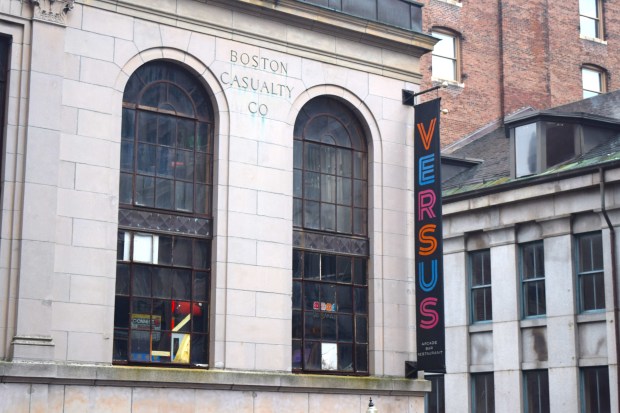
Best of all for this aging “city rat” is Versus, a retro arcade/bar of the type that have been popping up over and over recently. As a lifelong pinball aficionado this has been a later-life boon for someone like me who remembers the large and lively “Amusement Center” that provided many skill-and scheme lunch breaks for us younger office workers back in the day. I’m glad my Gen Z successors are filling those shoes. Now only if someone could resurrect The Littlest Bar, whose shell still sits on Province, even though an obnoxious condo tower sits right on top of it now. I remember going with friends for a pint there after a memorable Pogues concert at the Orpheum Theater, which had a back alley exit that led to Bromfield. Sitting there with the other punters with the place packed to the gills (i.e. about twenty people) is one of those experiences that make the urban experience uniquely special.

Cities never stand still and aren’t meant to. Hopefully, some things that have earned the right to last will last, even if the old Hobby Street is not among them.

Edgar Allan Poe: The American We Need Now

He warned the world about global warming in the 1840s. He had the foresight to know that the application of science and technology without the balancing spirit of poetry would yield a “rectangular obscenity.” He decried the myriad media hoaxes of the middle 19th century and concocted a few of his own as a warning to the gullible. Oh yeah, and he wrote some nifty horror stories as well.

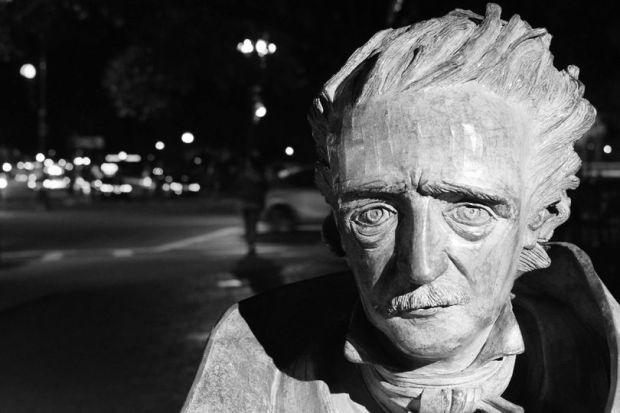
Meet the other Edgar Allan Poe. Everyone knows about the haunted, hard-drinking author of such psychological terror tales as “The Tell-Tale Heart” and “The Pit and the Pendulum” that all but invented the modern Goth aesthetic. Most are familiar with the rigorous poet behind the famous verses of “The Raven” and “Anabel Lee.” But far fewer are aware of Poe the inspired cosmologist, the young man who studied engineering and mathematics at West Point, and who, as America’s first de facto science reporter, cast a very skeptical eye on the era’s centralization of power in that growing field.

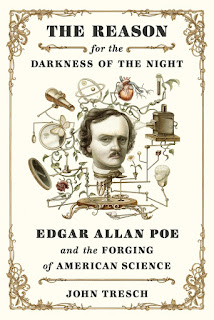
In the extraordinary 2021 book, “The Reason for the Darkness of the Night,” author John Tresch goes a long way into giving this iconic American figure his full due. The fourth and fifth decades of the 19th century saw significant advances in industrialism and science, which had only recently graduated from its previous incarnation as “natural philosophy.”

It was also an age of chicanery, of dubious pseudo-sciences like phrenology, which could be used for racial profiling in an age when the conflict between slavery and abolition were headed to a boiling point. According to Tresch, Poe’s writing (in both fiction and reportage) “dramatized the act of inquiry and the struggles, fears, hopes, and delusions of the human undertaking.”

Foremost in the struggle was Poe’s conflicted feelings regarding the dawning Industrial Revolution. He wrote his “Sonnet to Science” early on (while still in the service), asking this new field “Why prey’st thus upon the poet’s heart/Vulture! Whose wings are dull realities!” and later asking “Hast thou not dragg’d Diana from her car?” In other words, are we now destined to only see the Moon as Earth’s cratered satellite and not perceive the lunar patroness riding her celestial chariot? As both an exceptional book-learner and an amateur astronomer since his youth, Poe could appreciate both.

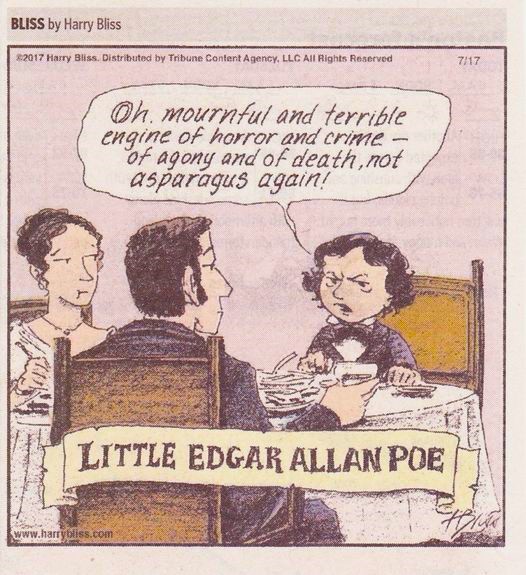
Poe’s enduring popularity even extends to speculation about his childhood, in this personal favorite of cartoonist Harry Bliss.

Around the same time Poe, in a letter, declared “I am a poet… if deep worship of all beauty can make me one.” His deep reverence for—and uneasy awe at the power of—the natural world oozes out of his lesser-known fantasy stories like “The Domain of Arnhiem” and “Tale of the Ragged Mountains.” Oftentimes, Poe depicted a desolate or decayed landscape (read the stark opening of “The Fall of the House of Usher”) a background to what he may have felt in the newly industrializing cities of his East Coast haunts from Boston down to Richmond. A smoke and/or fog blankets many of his tales and while he was no Luddite, the growth of polluting factories free from regulation was indicative to Poe of the at-any-cost mindset when business, science and government were centralized without popular input.

Poe famously had a tough life. His mother, foster mother, brother and wife all died of TB (then called consumption) which he memorably personified in “Masque of the Red Death.” His wealthy rat-fink foster father all but disowned him, undermining his enrollment at the Univ. of Virginia and cutting Poe out of will while providing for several illegitimate children. Poe lived the life of a penurious journeyman writer, struggling to get published and drifting in and out of the employ of various journals and newspapers. Despite fleeting fame for the hugely popular “The Raven,” widespread acclaim avoided Poe in his lifetime.

From 2015, the excellent animated anthology “Extraordinary Tales” is also highly recommended.

But despite (or because) the morbidity of his circumstances and the flavor of his best-known work, Edgar Allan Poe is an enormously popular figure. At his core a man of the people, he’s the guy we need right now. His instinctive opposition to giving great power to those who excel only in a technical sense. One need only look at the barely recognizable human “qualities” of a Mark Zuckerberg or the unstable rantings of an Elon Musk to see where the problem lies into giving such people nearly limitless agency. And that’s not to mention the scourge of the Orange Grotesquerie, whose appeal to grievance and hatred in the pursuit of power is a horror even the master himself would maybe be challenged to depict.

I don’t want to speculate too much on a man that’s been dead for 175 years, but I think Poe today would provide a refreshing antidote to modern society’s pitfalls. Despite his personal tragedies and epic binge drinking, our man Edgar was at heart an idealist. Never afraid to mix it up in the court of public opinion, he would probably be a social media sensation, and a modest Go Fund campaign might alleviate his persistent money problems. A year before his death, he wrote and lectured on his cosmological treatise “Eureka” part of which positioned us all as part of a universal brotherhood united by our common inheritance of a single unitary effect at the beginning of time (Poe was an early proponent of the Big Bang Theory). Tresch begins “The Reason for the Darkness of the Night” with Poe’s last stand, reading “Eureka” before a small but rapt audience in New York City. The author thought that this manifesto would be his defining work, though it was not to be. But still, (in Tresch’s words, “Poe’s work embodies the defining tensions” of both his age and ours: “between popular diffusion and elite control, between empathy and detachment, between inspired enthusiasm and icy materialism.” While we don’t have the Poe we need today, Tresch’s illuminating book and a deep dive into his subject’s lesser-known but still invaluable works, is recommended, if not essential.

Coppola’s Protopian Messterpiece

I come to praise Cesar (Catalina), not bury him. For many, “Megalopolis” is an easy film to dislike, but it’s a rewarding one to give an honest look at. Francis Ford Coppola’s long-gestating mega-project is messy and often unfocused, with moments of unintentional hilarity. But those moments are not nearly as laughable as some of the negative opinions lobbed at it.

In an age where cynical slasher movies and DC/Marvel sequels are puked off a cinematic assembly line at record pace, calling “Megalopolis” the “worst movie of all time” with “no redeeming qualities” is kind of like settling on Milli Vanilli’s “All or Nothing” as your favorite album because you thought the Beatle’s “White Album” was too sprawling.

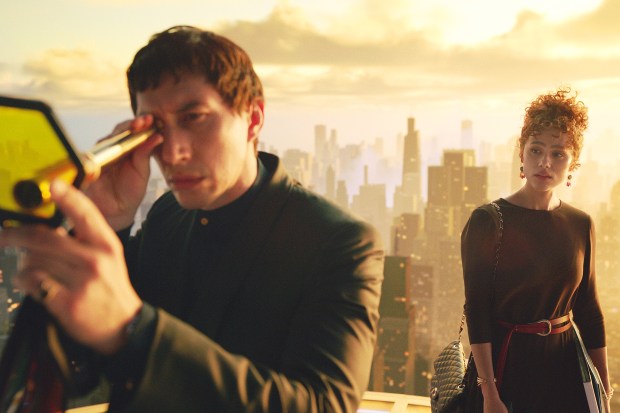
In a re-imagined New York City called New Rome, superstar architect Cesar Catilina (Adam Driver) has altruistic ideas for rebuilding a city that is a teetering empire very obviously based on its namesake. Against a backdrop of garish decadence (there are orgy-like parties and even a chariot race) Cesar’s proposal, as chief of the city’s Design Authority, is opposed by the old-school mayor Franklyn Cicero—played by Giancarlo Esposito who bears a strong resemblance to NYC’s current embattled mayor Eric Adams.

In its own loopy way,  “Megalopolis” is a sincere plea for an idealistic way forward for a world society in a time of debilitating tribal and nationalistic divisions. Comparing the bitterly polarized America of today to the approaching fall of the Roman Empire is not exactly a novel idea, but Coppola’s visual representation of this concept is the film’s strongest element.

From the late 19th century to the mid-1940s, New York was built to a majestic, inspirational scale comparable to what the Eternal City was in the ancient world. Cesar’s apartment/studio is in the defunct Cloud Club atop the Chrysler Building. Imposing low angle views of the Helmsley Building, Grand Central and other classic Manhattan structures are used to great dramatic effect, and we get to go underground to get a glimpse of the faded glory that is the old City Hall subway station. Colossal living statues sit despondently or crumble in alleyways, their great allegorical symbolism forgotten.

At the core of “Megalopolis” is a factor often overlooked but important enough to warrant its own section in the movie’s Wikipedia entry: “Artistic Idealism as Antidote to Polarization.”   That is, the role of the creative class in helping create more inclusive and livable cities. I can only hope that Coppola’s vision at least inspires some younger artists to foster a new generation of bold, humane visions (and in all the various ways they can be attained) in a world that so surely needs it.

The film’s closing title card attempts to transcend both nationalism and identity politics.

I did, however, have a problem with Cesar Catalina’s use of the word “utopia” which Mayor Cicero correctly identifies as a fantasy land. What Cesar really strives for is a “protopia,” a practical way forward to a better world for all. I think it was a deft move by Coppola to have the cerebral Cesar allied with the more grounded mayor for the film’s corny but uplifting closing scene.

Hopefully, this noble-but-flawed valediction for the 85 year-old filmmaker will outlast the confidence of the naysayers who to me sound too smart to know any better. “Is this way we’re living the only one available to us?” Cesar memorably asks at one point. I would like to think so, but I’m far from sure about it.

For the Records: Cover Albums, Part One

It’s a funny thing, the long tradition of rock artists recording songs written by others. The origin story of untold thousands of bands has them cutting their teeth on an old Chuck Berry number or blues standard, or maybe “Louie Louie” and/or “Gloria.”  Many groups soon to be famous for penning their own tunes, from the Beatles and Stones on down, peppered their early albums with cover material. Hell, even Bob Dylan’s 1962 debut only featured two songs written by the man himself.

But from the mid-Sixties on, the only true way forward in the rock business was to be performing your own compositions. Unlike the Sinatras or Tony Bennetts of an earlier era, the pantheon of Boomer-era acts featured few song “interpreters” (Linda Ronstadt and Joe Cocker are two that spring to mind). If you can’t write ‘em, your outfit may soon be relegated to eternal bar-band status.

Yet no matter how good a band’s own material may be, musicians are always fans first. A well-placed cover song can really add to an album’s success, whether it be Jimi Hendrix’ definitive take on Dylan’s “All Along the Watchtower,” the Clash’s “Police and Thieves,” the Talking Heads’ “Take Me to the River” or name your favorite.

But an album full of other’s material by those well known for penning their own songs rarely turns out to be a triumph. Is it because many are contractual obligations, or place markers when one is a little thin on new material? While some are fun, rarely is it a discographical highlight. Let’s have a look.

“Pin Ups” David Bowie (1973)

Let’s start with a good one, so we can see what makes for a successful covers album. The reason Pin Ups ranks so high is that it has a workable concept and there is an effort made on some tracks to put a new spin on the material. David gives props to the British bands that inspired him in the years 1963-67, just prior to his own recording career taking off.

He does a slowed-down version of the Who’s “I Can’t Explain,” playing a sexy sax refrain to go with it. The wild instrumental coda he gives “See Emily Play” makes it even more acid-drenched than the Pink Floyd original. True, elsewhere he sticks close to the original, as on the two Pretty Things selections and the Kinks’ great anti-anthem “Where Have All the Good Times Gone.” But these are helped by the fact that they are backed up by the Ziggy Stardust band, featuring guitarist Mick Ronson on guitar. Another highlight is Bowie’s lovely, doleful take on the Mersey’s “Sorrow” which was a hit single in several countries. Grade: A-

“Moondog Matinee” The Band (1973)

“Why don’t we just do our old nightclub act” the late Levon Helm recalled someone in the Band saying, but the drummer/vocalist can’t recall who, per his lively memoir “This Wheel’s on Fire.”

The group was in the middle of a ten-record deal with Capitol Records and short of new material. They were also in the middle of a group relocation from the Catskills to Malibu and cutting a quick record of tributes bought them some time. It’s more a well-curated and well-performed selection of early R&B and rock ‘n’ roll chestnuts than a nightclub act, though they deliver some potential crowd-pleasing things like the cheeky Lieber-Stoller rug cutter “Saved.”

Elsewhere, songs from Sam Cooke, Allen Toussaint, Fats Domino and Chuck Berry abound. There a few twists: keyboard wizard Garth Hudson has a great go at the timeless “Third Man Theme” and Helm used a then-newfangled talkbox to get the needed croaking part on Clarence “Frogman” Henry’s “Ain’t Got No Home.” A fun listen but inessential, like many in this category. Grade: B

“Rock ‘n’ Roll” John Lennon (1975)

John Lennon was well known for his deep-rooted love for Fifties music but the actual impetus for this album came from a court settlement. The notorious music publisher Morris Levy sued Lennon because the music to the Beatles’ “Come Together” (though slowed down) and one line (“Here come old flat-top”) bore a strong resemblance to Chuck Berry’s “You Can’t Catch Me,” which Levy owned. The agreement read that John would record three songs from Levy’s publishing company on his next album.

When word got out in the fall of ’73 that Lennon was recording a tribute album in Los Angeles, all his musician friends/drinking buddies showed and it was quite a scene. Producer Phil Spector shot a hole in the roof and a bottle of whisky spilled onto the console, amongst other hijinks. Some material managed to get recorded but then Spector ran off with the master tapes. Lennon shelved the project and recorded Walls and Bridges instead. The tapes were eventually recovered, and the rest of the album was knocked out (under further legal duress from Levy) in three days in the fall of 1974 for an early ’75 release.

The results were predictably patchy but there are some fine moments: an energetic stomp thru “Bony Moronie,” a reggae-inflected “Do You Want to Dance,” and a soulful take on Ben E. King’s “Stand by Me” that was a Top 20 single. Elsewhere, several tracks sound rushed or uninspired, and admittedly one of the best things about Rock ‘n’ Roll is Jurgen Vollmer’s great photo of a young, leather-jacketed Lennon leaning in a doorway from the Fab’s Hamburg years. Grade: B-

“Givin’ it Back” The Isley Brothers (1971)

Well, here’s a bit of a “twist” in the covers album scheme of things. The Isley Brothers, whose songs had been covered by many Sixties rock bands (esp. in the case of the Beatles’ “Twist and Shout”) return the favor by covering an eclectic collection of (mostly) white artists. Side One consists of three extended tracks, marching out of the gate with a powerful protest medley of Neil Young’s “Ohio” and Jimi Hendrix’ “Machine Gun.” The Vietnam War was still very much happening in 1971, and there’s no missing the urgency in Ron Isley’s lead vocal. Meanwhile, kid brother Ernie, not quite twenty at the time, gets to show off his already prodigious guitar chops. Hendrix was briefly in Isley’s backing group and his influence was quite clear on Ernie, who knew Jimi as a kid.

Turning James Taylor’s regretful ballad of a friend’s suicide into an Issac Hayes-style psychedelic soul number may not have been the best decision, but their “Fire and Rain” is interesting, nonetheless. More successful is their ten-minute slow jam on Bob Dylan’s “Lay Lady Lay” which gives Ron plenty of time for seductive ad-libbing, stopping just short of Barry White territory. (On successive albums, the Brothers would continue to produce extended soulful covers of soft-rock hits like “Summer Breeze” and “It’s Too Late,” often featuring dramatic guitar workouts from Ernie). The album rounds out with two Steve Stills’ numbers (the single release of “Love the One You’re With” hit #18 on the pop charts) and Bill Withers’ “Cold Bologna” with the songwriter guesting on guitar. Grade: B+

“Compliments of Garcia” Jerry Garcia (1974)

When I was in high school, I received a complimentary (if you will) armful of Grateful Dead-related vinyl from my girlfriend’s neighbor who worked as a publicist for the band. There were acknowledged classics (Workingman’s Dead), a few oddities (the outré soundscape Seastones on which a couple of Dead members appeared), and a few solo albums, including this covers album which for some time was a left-field favorite of mine. It presents as a record to be lightly regarded, as Jerry gives low-key props to some of his wide-ranging influences. But as soon as the train whistle and shuffling beat kicks off the album (with Chuck Berry’s “Let it Rock”), I was drawn into the record’s laid-back appeal.

Maybe it hasn’t aged all that well in this less laid-back time. His takes on Smokey Robinson and Dr. John are pleasant if unspectacular, and Garcia maybe should have second-thought the inclusion of “Let’s Spend the Night Together” (one reviewer quipped that this version made it seem like the couple in question spent the night playing cards). But there are also well-considered versions: his in-the-pocket rendition of Van Morrison’s “He Ain’t Give You None” is preferrable to the author’s undisciplined original on T.B. Sheets. Best of all is a beatific, slowed-down take on Seatrain’s “Mississippi Moon.” And it ends nicely with “Midnight Town,” an atmospheric number by Garcia Band bassist John Kahn. Grade B-

“The Hit List” Joan Jett (1990)

I was a bit surprised at how quickly this album flat-lined for me. Maybe because Jett’s breakout solo LP (1982’s I Love Rock ‘n’ Roll) featured three definitive cover tunes. The title track she made completely her own, turning it into a worldwide #1 single. Another breakout performance was on Tommy James’ “Crimson and Clover,” where her breathy, come-hither vocal memorably mixed with crunching power chords. And it ended with one of the best-ever holiday rock songs, a bratty “Little Drummer Boy” that concluded with an instrumental rave-up worthy of the Who’s Live at Leeds.

So where did The Hit List go so wrong? For one, randomness never bodes well—Jett goes from ZZ Top to the Sex Pistols to Credence as if all three bands were cut from the same cloth. Secondly, her vocals range from pro forma to uninspired. She practically sleepwalks thru “Love Hurts,” only serving to remind one of the full-throated drama of Nazareth’s hit version or the plaintive charm in the way Gram Parsons did it. And strangely enough all we get is autopilot mode on AC/DC’s “Dirty Deeds,” which should have been a natural for her.

There are a couple of modest highlights. There’s the one left-field choice (the Hendrix obscurity “Up From the Skies”) and an appealing version of the Kinks Klassic “Celluloid Heroes.” Here we get the Sweet Joanie voice and a convincing arrangement that leads up to one of her patented shouts, maybe the only one on the whole record. Saved from a D+ for the glamourous cover photo. Grade: C-

“Thank You” Duran Duran (1995)

In deference to some of the selections above, being uninspired is one thing but being downright bizarre is quite another. And so we have New Wave glamour boys Duran Duran. They may have peaked in popularity in the early 80s but in the mid-90s their records were still regularly in the Top 20, esp. in their native UK. So I’m not sure what inspired them to foist this rummage sale of a covers LP on the world. Taking on vintage R&B, hip-hop, classic rock and ballads with the same dilettantish insolence, Thank You was voted the worst album of all-time by staff of Q magazine in 2006.

Probably most galling for the critics, were DD’s take on two notable rap numbers. Their Beck-like version of Public Enemy’s “9-11 is a Joke” is a joke. But it’s not as bad as the presumptuous run-thru on Grandmaster Flash/Melle Mel’s classic “White Lines.” You can’t fault the boys on their energy level but the cognitive dissonance is too pronounced to overcome. Let’s just say it’s a long way from a Bronx block party to a Notting Hill boutique.

Elsewhere, there are very unimpressive takes on oft-covered material like “Ball of Confusion,” “Lay Lady Lay” and Lou Reed’s ubiquitous “Perfect Day.” I will give bassist John Taylor props for his work on the “funkier” numbers, but singer Simon Le Bon didn’t get the memo that there is more to paying tribute in song than just knowing the words. Worst of all is a regrettable version of the Sly Stone’s “I Wanna Take You Higher” which concludes with some teenybopper girl dumbly asking the guys where they wanna take her and when they dumbly reply “higher” you realize that this giant mistake of an album couldn’t get any lower. Grade: D

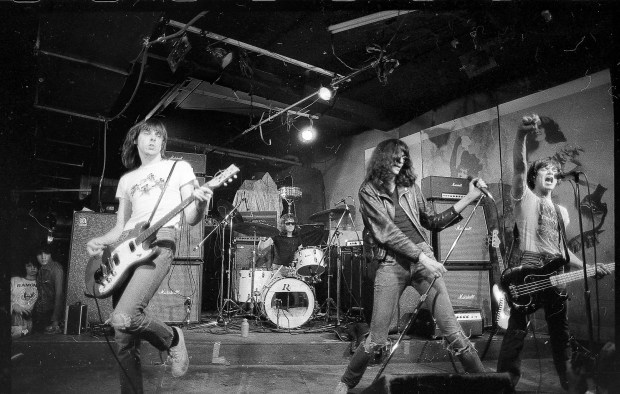
More coming up soon in Part Two, including entries from the Ramones, Patti Smith, Cat Power and Elvis Costello. —Rick Ouellette

“In a Dream of Strange Cities” Part 3

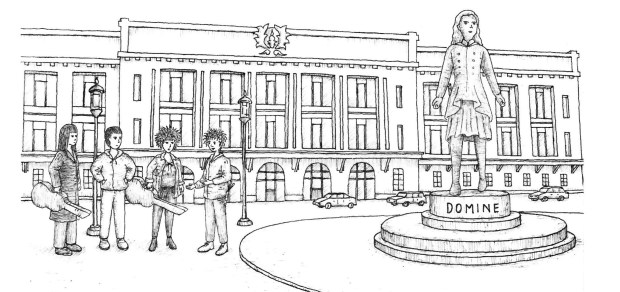
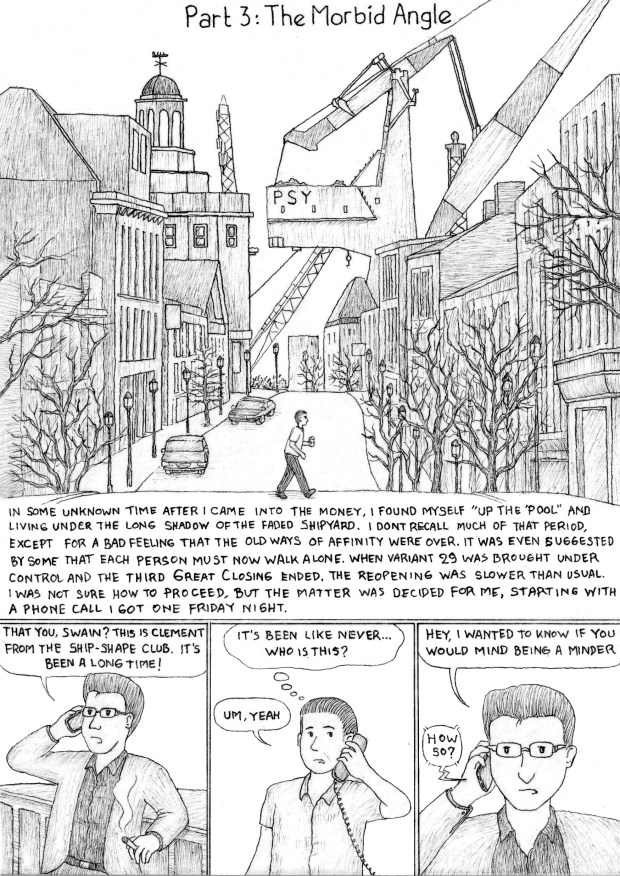
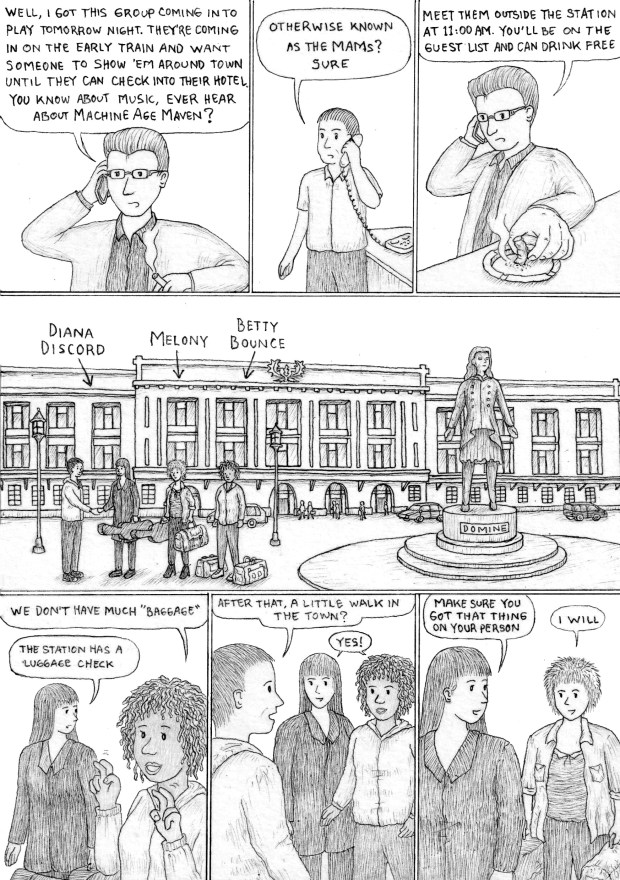
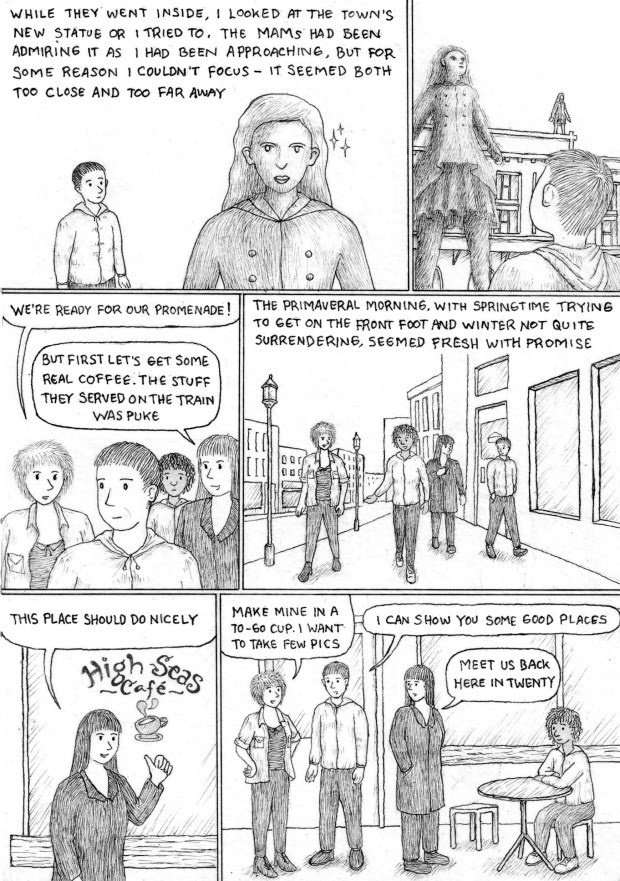
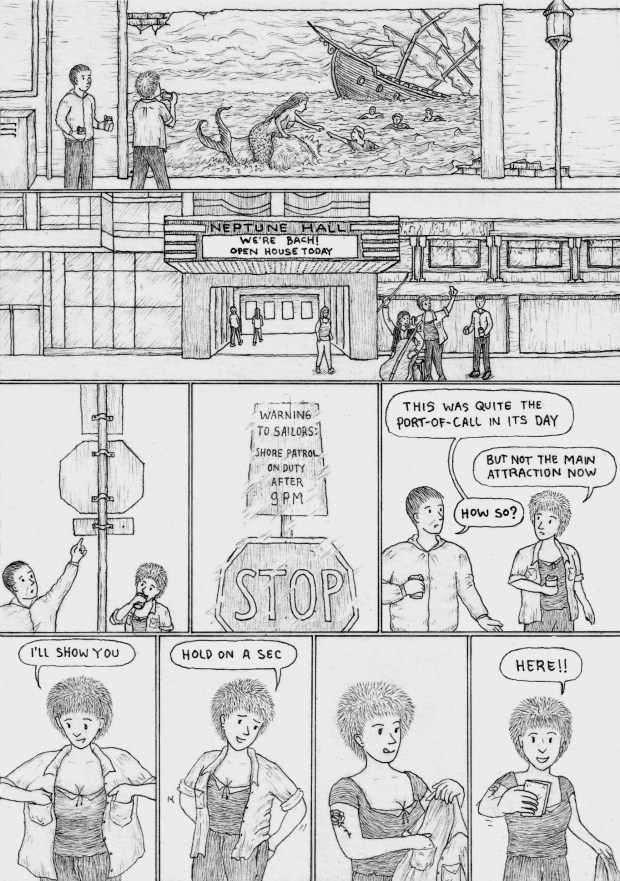
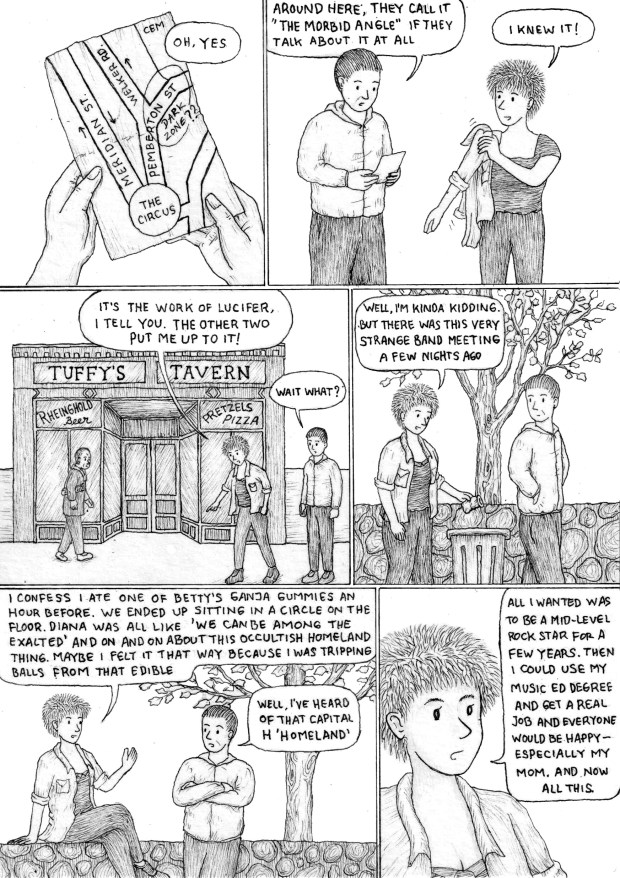
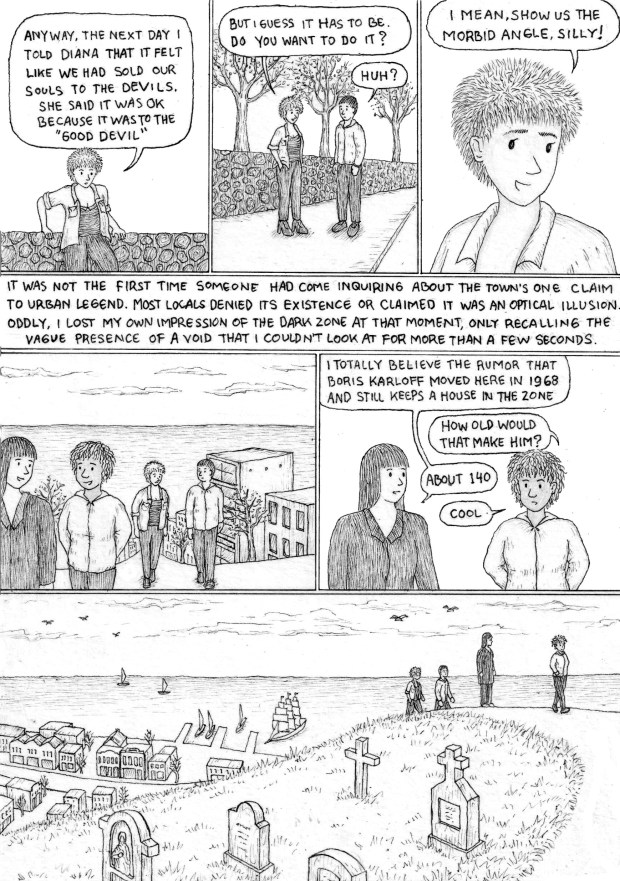
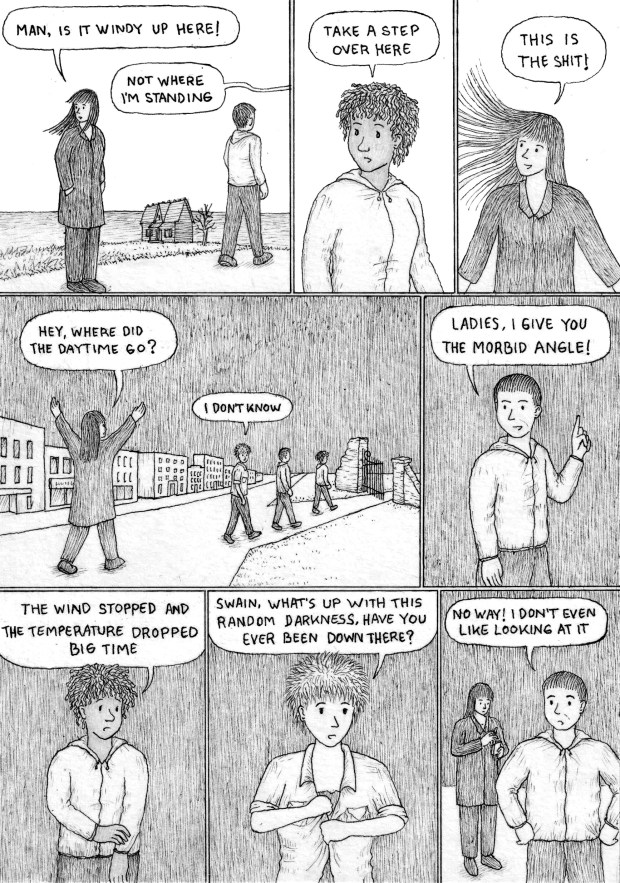
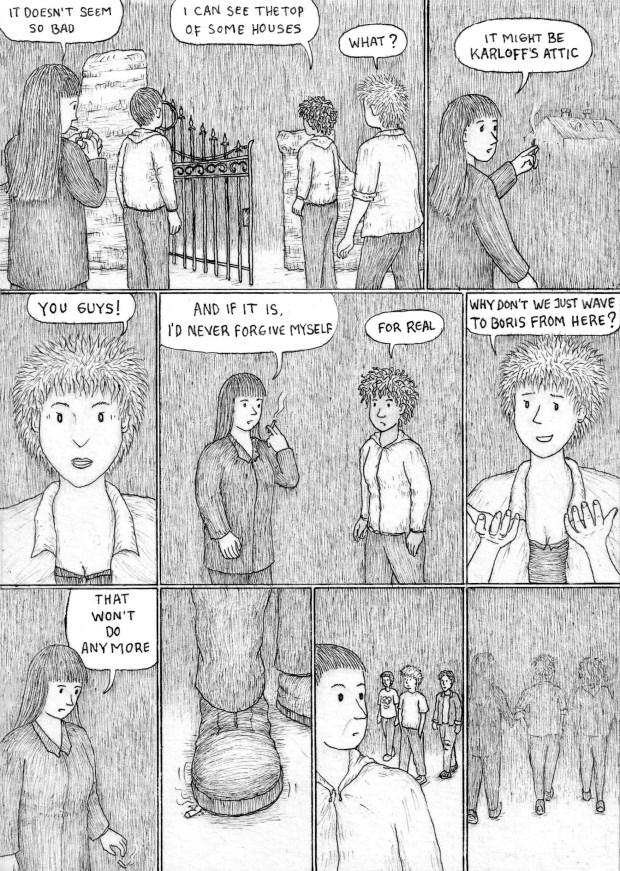
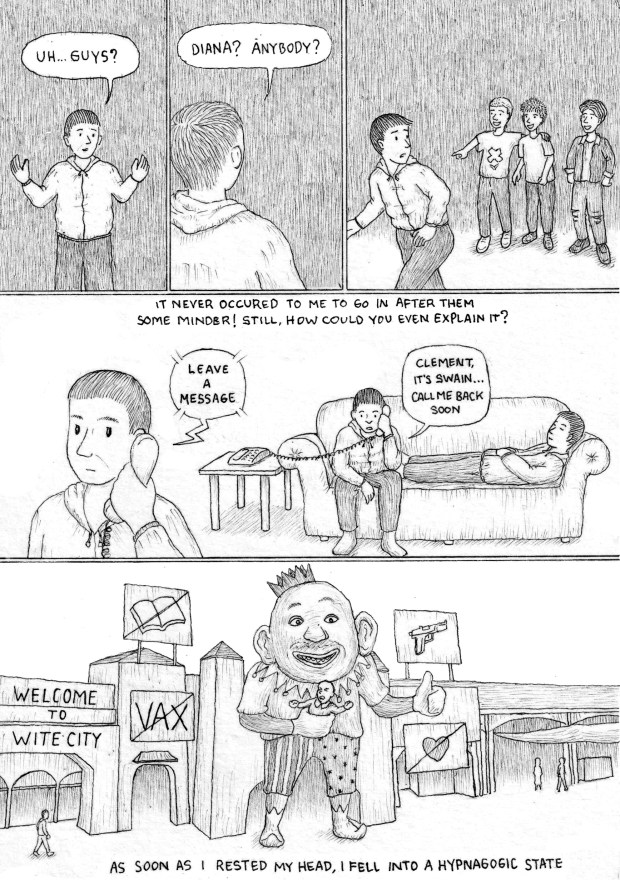
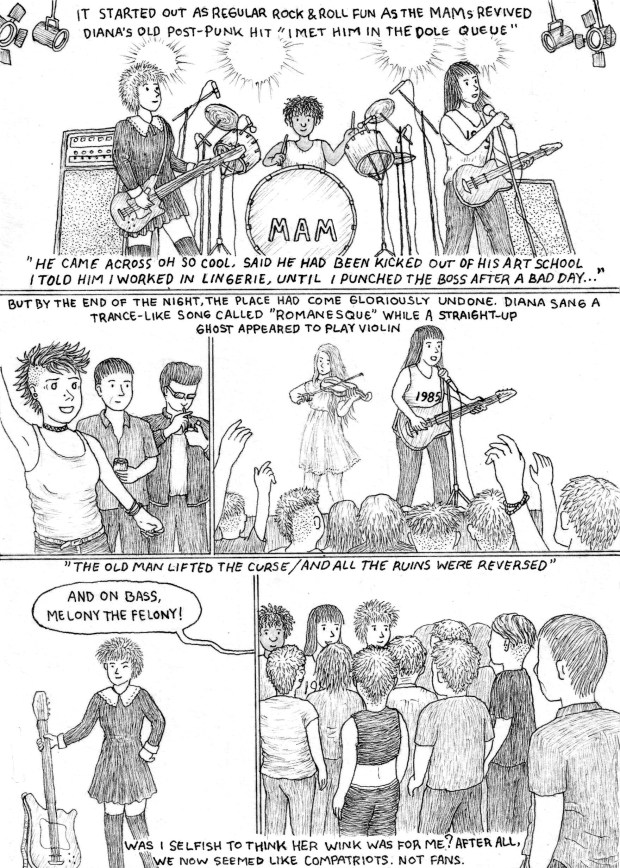
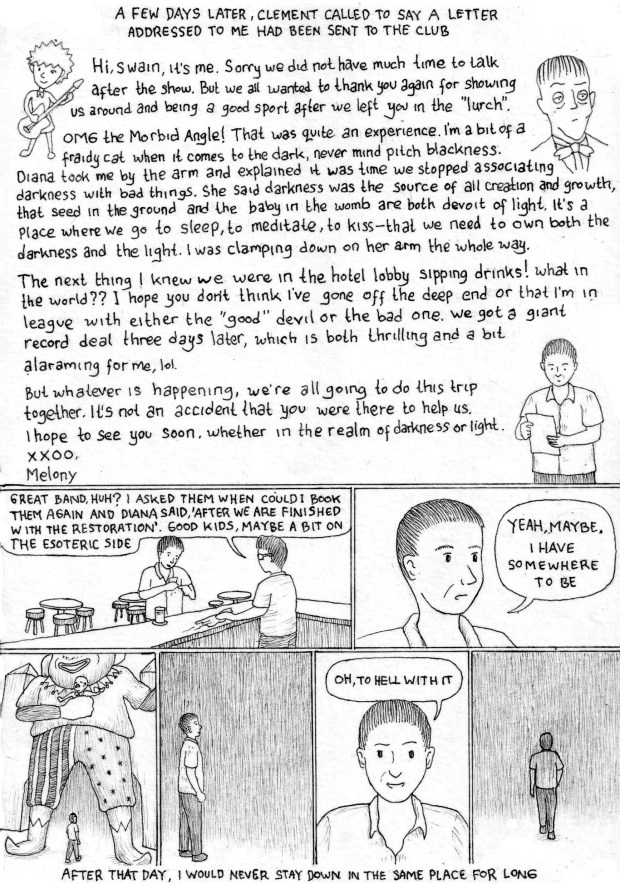
The third installment of my comic “In a Dream of Strange Cities” is below. Written and conceived by myself (Rick Ouellette), illustrations by Ipan. Here, our protagonist Swain, now well into his extended visit to the “Second World,” begins to perceive that he may be called into the service of the protopian leader, Lady Domine, helped along by the members of the charismatic band Machine Age Maven. If interested in the previously published IAD edition (“Chthonic Days,” a self-contained story) click on the to-buy link on the right column of this blog, thanks!)

Documentary Spotlight: We have met the “Visitors” and They is Us

Visitors—Directed by Godfrey Reggio—2013—87 minutes

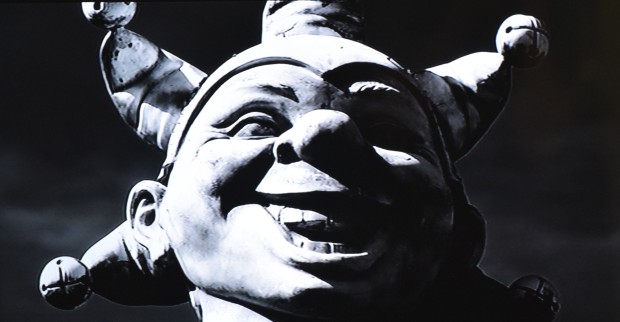
Godfrey Reggio’s “Visitors” is probably the best black-and-white photo gallery exhibit ever made into a motion picture. I’m kidding, but only to prep you about what to expect with Reggio’s slow-lane meditation on what it may feel like, deep down, to inhabit our fast-lane 21st century. “Visitors” is a patient, visually sumptuous and occasionally frustrating film. It is also one that, in its wordless succession of images and music, calmly cajoles us to take stock of ourselves.

Reggio is still best known for 1982’s “Koyaanisqatsi,” his sensation-causing experiment in depicting a “life out of balance.” It started off slowly with contemplative images of the natural and indigenous worlds before eventually building up to frantic climax with sped-up images of big-city commuters and commotion, all matched to the ever-increasing tempos of Philip Glass’ celebrated soundtrack.

Two other films followed in the same vein: “Powaqqatsi” from 1988, and 2002’s “Naqoyqatsi.” The director has said that, like those earlier films, “Visitors” was about “humanity’s trancelike relationship with technology.” That may be true in a sense, but this 2013 work has a far different feel than the “Qatsi Trilogy.” Those works tended to bludgeon the viewer with relentless images of a world being nearly crushed under the weight of its own industrialization and materialism. It’s a point well taken, but also one which got tiresome over the course of three films. After a while the accelerated rats-in-a-maze images of train commuters going up escalators felt elitist. When you get right down to it, these are just productive citizens on their way to work.

Here, we are asked to look straight into the faces of our fellow humans, of all races and ages, not to mention meeting the haunting gaze of a female Lowland gorilla, a signature image of this film. Often, these shots last 90 seconds or more. These cinematic staring contests made for a somewhat squirmy viewing experience when I saw “Visitors” in a theater on its original release. In the solitary comfort of one’s home, this same device feels like a bridge to feelings of deeper human connections. If that sounds counterintuitive, so be it. It is so gratifying to take an empathetic look at our fellow travelers free of both the grievance politics and the ankle-deep identity affirmation that draw us away for our collective interests.

Some of this cinematic strategy must relate back to the director’s life story. Reggio was born in New Orleans in 1940, but by age 14 he had left home and soon became a Christian Brothers monk, spending his time in silence, prayer and mediation until age 28 (giving fair indication of his non-verbal filmmaking philosophy). He long since relocated to Santa Fe where he worked with troubled youth and was turned onto cinema after seeing the related “Los Olvidados” by Luis Bunuel. The devastations of Hurricane Katrina in 2005 led Reggio back to his stricken hometown and his location photography, as impressive as ever, features many locations in and around the Crescent City.

There are elegiac, time-lapse images of New Orleans’ Six Flags amusement park and Mercy Hospital (both closed post-Katrina), vaulted cemeteries and ghost-like bayous. These are beautifully filmed in a process that resembles B&W infrared still photography: think black skies and glowing white foliage.

Near the end, we return to an opening shot of sailing serenely over the surface of the Moon, like alien visitors gazing at the marbled planet Earth, accompanied by Philip Glass’ tranquil score. We have spent the last 80 minutes in a queer sort of communion with ourselves and our environment, not always sure if we are the watchers or the watched but assured that in the end it’s all the same. In the age of dizzying discord and snap judgments, Reggio’s hypnotic and humane film invites us to stare at the world until we see ourselves in it, along with everyone else.

Placeology #6: Denver Airport’s Conspiracy Clearinghouse

The Denver International Airport is the largest such facility in the Wester Hemisphere by land area, encompassing 52 square miles of space in the middle of a vast and nearly treeless plain, some 23 miles from the Colorado capital. It may be the sixth busiest airport in the world, but it is the first busiest when it comes to the number of urban legends and conspiracy theories that swirl around it.

It’s been said that, even before it opened in 1995, people were raising questions. Why so far away, why all that land? Things ratcheted up when the imposing and indelibly strange “Blue Mustang” went up in the middle of a plain on the approach to the airport. This 32-foot statue of an electric blue horse has red laser-light eyes and is rearing up enough to grossly display his prodigious man junk. He was finished only after its sculptor (Luis Jimenez) was killed when a large piece of it fell on him just before its completion. The work soon came to be known as “Blucifer.”

But this strange, unsettling sculpture was only the start. Soon the airport was a hotbed of conspiracy theories, based upon the general idea that it’s the new world headquarters of the Illuminati. The large network of underground tunnels was variously seen as a hideout for officials of the New World Order and/or lizard people. They are supposedly great survival bunkers for the rich and elite and, not coincidental to this line of thinking, are connected to the North American missile command. There are gargoyles in suitcases looming above the baggage claim and, to top it off, the central terminal’s roof is made up of multiple tent-like peaks and are said to symbolize the Ku Klux Klan.

To be fair, the Denver airport authority has kind of brought this on themselves. That statue (a winning design) is pretty demonic-looking—check out some close-ups online—and it can’t be decided if the roof is supposed to represent the Rockies or Native American teepees. Oh yeah, I forgot, the whole thing may be built on Indian burial ground.

Let me go on record as one who believes there is a HUGE difference between being self-aware and vigilant against forces that may do you actual harm, and falling for every batshit-crazy conspiracy that comes down the pike. Honestly, you would think that some disgruntled elite would have ratted out the Illuminati by now. Of course, the response by true believers would probably be that the fact they haven’t been exposed is proof of their existence. How grimly ironic when you learn that the known Illuminati, founded in Bavaria in 1776, was founded in part to combat the forces of superstition and obscurantism, i.e. the restriction of knowledge via misinformation, religious intolerance and the denigration of independent thought.

Some say that the popularity of conspiracy theories is due in part that it makes the less intelligent among us feel smarter and it provides a simplistic and hard-to-refute reason for problems that could be otherwise overcome by sometimes-difficult personal effort.

It’s nearly impossible to convince conspiracy theorists that they are wrong, so the best way to deal with it is with a cheeky sense of humor and that’s exactly what the administration of the Denver airport has done. When I was there during a Thanksgiving weekend, I came across several signs along a wall that is covering some renovation work at the large central terminal:

If any conspiracy aficionado were to walk by one of these lizard-people-hardhat signs and nudge a family member, declaring “See, I was right all along,” they would make a complete fool of themselves. Reverse psychology can be a wonderful thing.

In conclusion, these kind of New World Order tall tales are fun for the purpose of a graphic novel or sci-fi movie, but please don’t get to that bad place where before long you start believing that Democratic lawmakers are eating babies or at that the 1969 American lunar landing was fake but that the Nazis had a moon base as early as 1942. For more info, consult the Internet or check out the prime-time programming of the “History” Channel.

It was also slightly annoying that so many people passed by the Denver terminal’s cheeky billboards without the slightest hint of curiosity. I know it’s an airport and folks are rushing to and for but there is also downtime for many. A better engagement by the general (and reasonable) public would give them a greater understanding on the scope and the inherent danger of those whose baseless beliefs can lead them down a very dark alley, and possibly dragging civil society right down with it.

Placeology #5: Up, Up and Away into Hotel Heaven

An instant induction into the “Placeology” Hall of Fame goes to the TWA Hotel at the JFK Airport in Queens, New York City. Eero Saarinen’s Jet Age/Space Age masterpiece, opened in 1962, now serves as a gigantic retro-futurist lobby for a hip but friendly destination hotel. The actual guest rooms are in two curved buildings that overlook the great sculptural form of Saarinen’s creation, made to resemble a bird taking flight. You reach the rooms by walking up the terminal’s two iconic red-carpeted tubeways, which may make you feel like you’re living inside the space station scenes in Stanley Kubrick’s “2001.”

Those ramps once led directly to the jet doors, previously passengers had to head out on the tarmac and climb the roll-up stairs in all sorts of weather. They’re indicative of the efforts of Trans World Airlines, with Howard Hughes still as principal owner, to popularize and glamourize the growing airline industry. The sunken lounges, curvaceous stairways, giant viewing windows, in fact everything down to the chic uniforms and pillbox hats worn by the stewardesses, led to a total implied package of adventure and elegance. (Compare to today!).

So you will see walls lined with photos of the Beatles, Muhammad Ali, Presidents Kennedy and Truman and movie stars ranging from Marilyn Monroe to Paul Newman. Of course, you don’t have to be a big shot to stay at today’s TWA Hotel. It’s a bit pricey but not exorbitant when compared to far less attractive places. Since airports are not standard vacation destinations, the people who are staying at the TWA are usually there because they appreciate it (an exception may be if your flight at the adjacent Jet Blue terminal was cancelled until the next day).

There is certainly lots to appreciate. The hotel is fun and distinctly non-snobby, as amenable to young families as it is to couples on a romantic getaway. The latter can enjoy a drink in the sunken lounger under one of the terminal’s two giant elliptical Arrivals & Departures boards, while the former can entertain themselves by checking out the Twister game room, the many vintage automobiles and the free photo booth. Aside from the soft clattering of electro-mechanical A&D boards, the main sound you’ll hear is the continuous sound of Sixties pop music over the PA, just loud enough to be a nostalgic soundtrack of your stay. Along with the sounds of the British Invasion, Motown, surf, early rock ‘n’ roll and the occasional Frank Sinatra croon, you get a couple of tunes from the girl-group pride of Queens, the Shangri-Las.

A big attraction for many is a restored propeller-driven Lockheed Constellation, an airliner that was produced between 1943-58. Its bold profile dominates the view outside the terminal’s huge oval rear window. Affectionately known as “Connie,” any guest is free to go outside and walk up the steps, where the interior is now an informal lounge (expect a crowd). But there will much less of a crowd in the terminal’s “hidden” nooks and exhibit rooms, where the hotel’s playful quality really hits a peak. There’s the “Pope Room,” a tiny vestibule where Paul VI decompressed in October of 1965 after becoming the first pontiff to set foot in the U.S. At the end of one of the tubeways you can visit (and hang out in) a recreated Sixties living room, a TWA executive office, and a simulation of Saarinen’s studio.

After settling into the fantastical realm of Eero’s creation, you may notice something which is the most gratifying feature of this whole experience: that to whatever extent possible, the developers of the TWA Hotel left this architectural gem as is. The building had been essentially vacant since the terminal was last used in 2001 until it opened as a hotel about five years back. But there was no Disneyfication in the rehab: the carpets, seat cushions, tiling and concrete sheathing are all original and a bit timeworn, even a little tatty in places.

It cost a little more for a room with a “historic view,” but it is worth it.

That’s a good thing. We are invited into (for the price of a room) a real and vital piece of design history, not a replica. As you walk towards the hotel, you will enter this rarefied air with the help of outdoor speakers playing the 5th Dimension’s bouyant hit version of Jimmy Webb’s “Up—Up and Away” which was adapted into a memorable TWA television commercial. Along the way you will see translucent posters, partially blocking views of the construction of a new international terminal, that feature press testimonials of New York’s “sexiest” hotel. The one that stuck with me was from the Wall Street Journal: “They don’t build them like this anymore, and they never will again.” Truth.

Photos and text by Rick Ouellette