art

“Miles Ahead” of Other Biopics?

Don Cheadle as Mr. Davis in “Miles Ahead”

It’s safe to say that biopics of famous musicians is not everyone’s favorite film genre—esp. when it comes to iconic rock/pop superstars. High expectations can be easily shot down by a fan’s extensive knowledge of their favorites vs. the often formulaic storyline of difficult childhood-rise to fame-wilderness years-redemption.

With the subject or his/her estate often acting as executive producer, one can expect that the rough edges will get sanded down (the uninspired “Marley: One Love”) or omitted entirely: the new “Michael” blockbuster conveniently ends Mr. Jackson’s story in 1987, just before the first child-abuse allegations.

Other times these movies can fly off in the direction of Icarus-style myth (Oliver Stone’s fever dream “The Doors”) or just land with a quiet thud. This could be said of the earnest “Bruce Springsteen: Deliver Me From Nowhere,” where the recording of the Boss’ uncommercial “Nebraska” album, staves off his impending super-duper stardom while he comes to terms with his troubled father and a composite girlfriend. The same goes for Timothee Chalamet as Dylan in the underwhelming “A Complete Unknown.” Uncle Bob’s life is so extremely documented that it would be extraordinary to come up with a fresh angle: and that film didn’t.

Is there any way out of these common pitfalls? Well, you could just give up and commit to the more entertaining parody biopic. The 2007 howler “Walk Hard” (starring John C. Reilly as “Dewey Cox”) features the greatest of all difficult-childhood scenarios when young Dewey gets ostracized after accidentally cutting his brother in half with a machete.

But for films based on an actual person may I submit “Miles Ahead,” the 2016 joint directed by Don Cheadle and starring himself as the tempestuous jazz legend. Cheadle has the Miles Davis look and raspy voice down pat. The movie heads down the “wilderness years” path as the trumpeting icon contemplates and end to his 5-year layoff that began in 1975.

Well, “contemplate” may be too soft a word. Davis was famously contentious, imperious and volatile. Cheadle, instead of filing down the rough edges, doubles down on this reputation. And in a big way: there is so much cocaine and gunplay in “Miles Ahead” that it makes the notorious East Coast-West Coast rap wars look like a kindergarten recess.
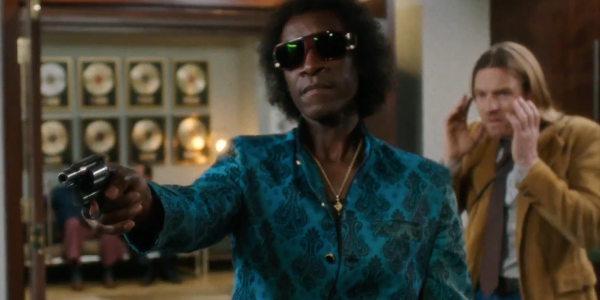
Don Cheadle’s Miles Davis shows Ewan McGregor’s reporter the most effective way to negotiate with the bigwigs at Columbia Records.

The apocryphal storyline concerns the theft of some coveted home-studio tapes that becomes a MacGuffin among various parties (including Columbia Records that wants Davis to deliver some product). The film co-stars the reliable Ewan McGregor as a dodgy (and fictional) Rolling Stone reporter named Dave Brill. He worms his way into Miles’ New York City lair in hopes of getting the comeback scoop—but not before getting punched in the face for his trouble. But eventually, Davis lets the “Irish prick” become his driver and drug buddy while opening up a bit about his life and music.

As hinted at in the trailer, Cheadle employs an impressionistic style that blends the late Seventies plot with glimpses of his popular late Fifties peak, with dynamic concert reconstructions and scenes of his troubled first marriage to dancer Frances Taylor (Emayatzy Corinealdi)

Then it’s straight back to the thug life. There’s an improbable (but really fun) car chase thru nighttime Manhattan with Dave as his reluctant accomplice, although before long the reporter is brandishing a firearm as well.

Sure, this is all a bit off-the-hook but delivered with an irreverence I found easy to like. Plus, Miles’ famously flinty personality makes for some great one-liners: when a fawning white fanboy insists on over-complimenting his idol, Davis can only reply, “Back up off of me, Hitler!”

Of course, the soundtrack here is a big selling point as well. Casual fans will enjoy the snatches from such well-known classics like “Kind of Blue” and “Sketches of Spain” while deep-diving connoisseurs will love the fact that the first sounds heard are from the cosmic cacophony of “Agharta,” the last LP he put out before his hiatus.

To top it off, “Miles Ahead” has a beautifully well-crafted ending. When Cheadle’s Davis wanders onto stage for his expected 1980 comeback and raises his trumpet, we are delighted to find that his band is made up of a couple of his old bandmates (saxophonist Wayne Shorter and pianist Herbie Hancock) as well as some torch-carrying younger players, such as bassist Esperranza Spalding and guitarist Gary Clark, Jr. It is a sweet way to go out and a reminder that maybe if you mix the sentimental vibe with a little irreverence along the way, you may be on your way to a better biopic.
Placeology #8: Please Don’t Ruin the Ruins!

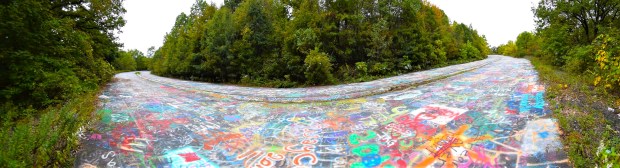
Graffiti Highway (parabolic), Centralia PA. All photos and text by Rick Ouellette except as noted.

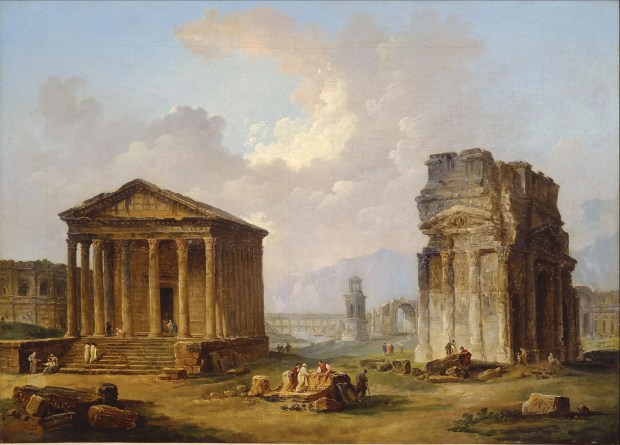
In the late 1700s, towards the tail end of the Age of Enlightenment, the French painter Hubert Robert became well-known for his large-scale canvasses depicting ancient ruins of France and Italy. These romantic (and often semi-fictional) scenes spoke to an age where there was a strong interest in classical antiquity and preserving what remained of it. Hubert and the other artists who followed this trend were surely aware of the evocative power of decay when it came to lost societies.

A typical Hubert Rubert joint.

Flash forward to the 21st century. We may well be deep into the Age of Un-Enlightenment, where hot-takes and online trolling has replaced the philosophical imperative. Yet the “picturesque” art style embodied by Hubert Robert has been carried on into the burgeoning field of ruins photography, the depiction of urban and industrial decay. Closely tied into the subculture of urban exploring, this field of photography has divided opinion. There are commendable practitioners like Matthew Christopher (in his two “Abandoned America” books) and Christopher Payne (the haunting and humane “Asylum: Inside the Closed World of State Mental Hospitals”) that have looked long and hard into the reasons and consequences of how  and why certain American institutions have been left to die on the vine.

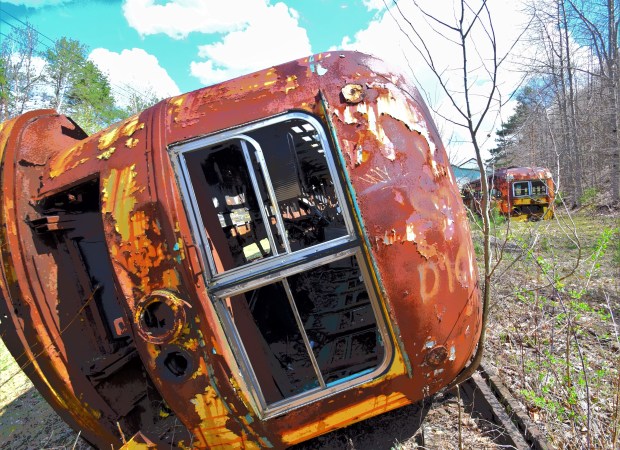
Trolley Graveyard #1, Photo by author.

Critics have pointedly taken aim at some aspects this “urbex” photography, namely the exploitation of people’s natural morbid fascination with the wreckage of off-limits locations, not to mention the implied insensitivity to a region’s economic decline. I have seen a lot of that online, where intrepid shutterbugs return from their trespassing adventures and post pics online to curiously adoring fans who practically gloat over the collapsed remains of defunct shopping malls and shuttered Rust Belt factories.

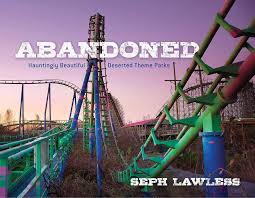
Which brings me to Seph Lawless. Curiously, he released two high-profile photo books in 2017 by two different publishers. “Abandoned: Hauntingly Beautiful Deserted Theme Parks” is exactly as it says, and he put in the big miles to significantly document a big urbex sub-category.

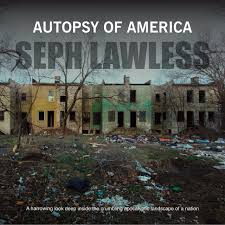
Then somewhere the same year was the boldly presented “Autopsy of America.” In case you don’t get it, you can turn to the back cover where we get in big letters, “Death of a Nation.” Really, the whole nation?? Published by a house called Carpet Bombing Culture (kind of a red flag in itself) the text for this book is so over-the-top that it can only work as self-parody.

“Is this just another recession? Or is this the beginning of the end?”

“America is a giant… mistake.”

“I want Americans to see what is happening to their country from the comfort of their suburban homes and smartphones.”

Oh gawd, spare me the edgelord/drama queen posturing! 😉. As usual, the photography is tremendous, though by this date we’ve all seen enough abandoned houses, darkened shopping centers and the odd isolated ghost town. (Lawless throws in several of his eye-catching theme park images for contrast). Yeah, there is serious income inequality. But it’s preposterous to pretend that cities like Pittsburgh and Cleveland (to name two I have personal evidence of) are hollowed-out landmarks of a country in its immediate death rattle.  Many of those cities have growing, transitional economies and don’t need this. But I get it. He’s Seph LAWLESS for heaven’s sake, and the hype (and apocalyptic rhetoric) often goes with this territory.

Graveyard Trolley #2, photo by author.

So while I may wince when Seph, like a supervillain in waiting, stands on a half-collapsed roof and gazes at a distant metropolis, you got to hand it to him. The logistics and craft it took to depict these places that so many want to know about. I’m just a part-time amateur at this game and have only been to one of the locations featured in “Autopsy of America.” I took a tour of the (now former) Trolley Graveyard outside of Johnstown, Pennsylvania with the aforementioned Matthew Christopher. He had photographed this huge collection of streetcars, owned by a super-hobbyist, many times before, including the pre-smartphone/GPS days. By the time I got around to committing to a tour, vandals had graffitied almost every car and smashed almost every window on them. It just got too easy in the Internet age to popularize and locate these spots, for good or ill.

But Rust Belt tourism is a thing and these cities often have a long-established culture in arts, cultural attractions and professional sports. As soon as we start realizing the value and vitality of such places, the better it will be for everyone, and we can all avoid the “Autopsy.”