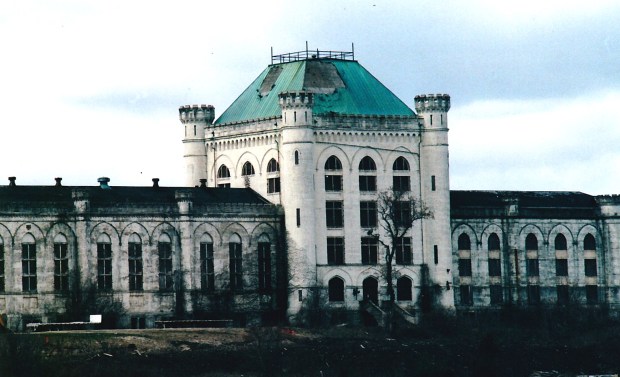
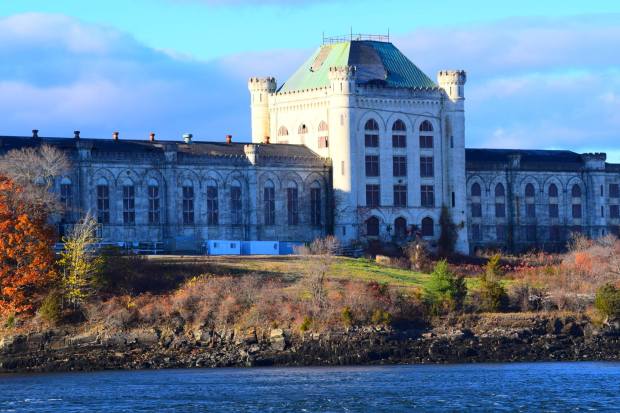
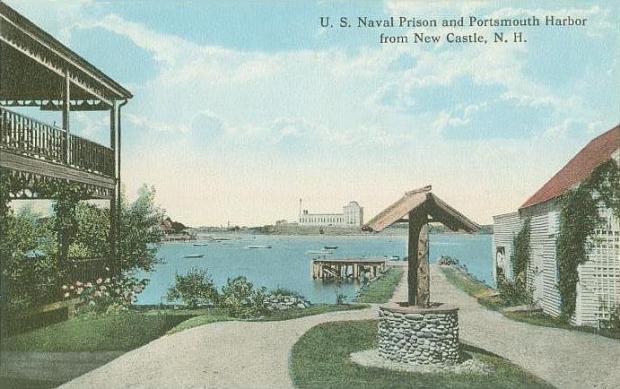
The Portsmouth Naval Prison is located on Seavey Island in New Hampshire. Dark, forebidding, isolated and pointedly medieval, it served as a max security jail for the U.S. Navy from 1905 to 1974. At its peak around World War II, the capacity of the prison (nicknamed “The Fortress”) was 3,008 inmates.
“Impregnable” would be another word for it. To escape this so-called “Alcatraz of the East” (assuming you made it out of building) you’d have to get past the guardhouse on the bridge to the mainland base or make an unlikely swim across the notoriously turbulent currents of the Piscataqua River just east of the cold Atlantic.
But perhaps more interesting is the question, why did the Navy need such an enormous prison? Turns out that around the time of max capacity in the Forties, as much as 40% of the inmates in this brig were in there for sodomy-related offenses. Yikes! This was enough for the top brass, even way back then, to reconsider their policy on homosexuality in the ranks. But it was still decades before even “Don’t Ask, Don’t Tell” and reform likely meant a discharge instead of a lengthy stay in this hellish jail.
The Portsmouth Naval Prison has been closed now for fifty years, but you can’t visit it. Unlike the similarly decommissioned Alcatraz, sitting out there in the middle of San Francisco Bay, you’d have to pass thru the active Naval Shipyard to get there. Too bad, as it would probably be a great tourist attraction for historic and hip Portsmouth, just as the fascinating Eastern States Penitentiary has in central Philadelphia. Oh well. You can still get a good view of it from Route 1B going from Portsmouth to the seaside village of New Castle. Nearby is Fort Stark and Ordiorne State Park, both featuring the remains of giant gun batteries and other WW2 ruins. That could be another entry for this new series, where I will review many of the interesting places, famous or obscure, that I have photographed.
About “Placeology”
The places we walk through or drive past, the sites we visit or that simply fall into our frame of vision, all have a heritage and inner spirit of their own. Even in our familiar everyday world, we are often just steps away from some location rich in hidden history and forgotten associations. Through this “Placeology” photo series, I will strive to give fresh agency to locales both grand and humble, uplifting and foreboding. More coming soon!
Remains of World War 2 gun emplacement. Battery Seaman, Rye NH
The live album holds a curious place in many discographies of rock bands and solo artists. It can be many things: a peak-career highlight for some (The Who’s Live at Leeds, the Stones’ Get Yer Ya-Yas Out, James Brown’s live-at-the-Apollo recording) and a career maker for others (Frampton Comes Alive). Many others are seen as placeholders between studio albums or as a de facto souvenir for fans who have seen their favorites in concert.
Sometimes though, an official live release can end up being a millstone in the canon of even the best musical artists, scoffed at by both critics and fans alike. It could be a case of shoddy production, sloppy performance, a group in career downturn or even an excess of success. Creem magazine was once so put off by the rank triumphalism Quenn’s Live Killers they compared it to the sound of “someone peeing on your grave.”
Over time I have gathered up a list these bad-rep concert documents and re-visited them, wondering if they really deserved all those one-star reviews. In some cases, time has been kinder, initial victims of a hot-take hostility in a tougher age of music criticism. Others are still big-time stinkers.
Who’s Last—The Who (1984)
I’ve always wondered about this one. Dismissed and derided at the time, Who’s Last was a document of the band’s at-the-time Farewell tour back in 1982. I mean it couldn’t be as bad as all that, right? Yes and no. On one hand it is the Who and there are gobs of great tunes that are played well enough. But on the other hand, don’t expect anything transformative. The galvanizing versions of “Magic Bus” and “My Generation” on the celebrated Live at Leeds put the ones here to shame, not to mention how poorly this “See Me, Feel Me/Listening to You” stacks up to victorious version on the Woodstock soundtrack. True, people thought it was a swan song back then and a release was justified (though it only hit #81 in America) but after Pete and the boys resumed touring in 1989 it seemed irrelevant, esp. after the sublime Leeds was expanded from 6 to 14 tracks in the CD era. Grade: C-
Take No Prisoners—Lou Reed (1978)
“What do I look like, Henny Youngman up here?” Yeah, kinda. This smart-ass double album was reportedly Lou’s answer to those who said he never talked on stage. True to Reed’s incorrigible nature he goes too far in the other direction, ad-libbing over opener “Sweet Jane” until the song is just an afterthought. True, he does get out a few good lines (“Give me an issue, I’ll give you a tissue”) and a sick burn on Patti Smith (“Fuck Radio Ethiopia, this is Radio Brooklyn!”) but it sets the tone for what is really a punk novelty record.
The music, such as it is, starts at 2:20
The crowd at the Bottom Line nightclub in NYC seem to be there as much for the cult of personality as for the music, and “Walk on the Wild Side” becomes a rambling 16-minute monologue a la Lenny Bruce. When Lou does manage to get thru a whole song without ragging on rock critics or his old Factory friends the results can be pretty good, as on “Coney Island Baby” and “Satellite of Love,” but they add up to a relatively small fraction of the album’s long 98-minute run time. Grade: C
Coast to Coast: Overture and Beginners—Rod Stewart/Faces (1974)
The Faces were on borrowed time when this concert record came out, maybe accounting for the poor press it got. Some saw it as a quick cash-out before Rod Stewart finally split to commit full-time to his burgeoning solo career. Key contributor Ronnie Lane had already left, replaced by Japanese bassist Tetsu Yamauchi. Coast to Coast is an enjoyable (if slapdash) mix of Rod solo numbers, a couple of Faces songs and clutch of covers. Most successful is a top-shelf take on the Motown lament “I Wish it Would Rain,” featuring an impassioned vocal by Rod and a great blues guitar solo from Ronnie Wood. Grade: B-
On the Road—Traffic (1973)
Traffic were another stalwart British group who were heading down the home stretch when this leisurely live double hit the shops. They released one more studio album before disbanding the following year. This was the end of their expanded-lineup era, with the core trio of Steve Winwood, Jim Capaldi and Chris Wood were joined by percussionist Rebop and three Muscle Shoals session men. This period was marked by a certain languid jam-band sound and most of the material here was drawn from the previous two studio sets, Low Spark of the High-Heeled Boys and Shoot Out at Fantasy Factory. The only nod to the “old” Traffic was a 21-minute medley of “Glad/Freedom Rider.” The band may have set themselves up for rock-mag ridicule by including the recent “(Sometimes I Feel So) Uninspired.” But that one turns out to be a highlight, with some electrifying lead guitar from Winwood, so go figure. Grade: B-
David Live—David Bowie (1974)
This is a textbook case of a concert album being recorded at precisely the wrong time. Bowie’s ’74 show started off as the “Diamond Dogs” tour and ended as the start of his “plastic soul” era. (His next album would be Young Americans). The album is unfocused and lacking in true energy, his vocals careless and strained. Hard drugs were an issue. It tends to sound better if you don’t know the studio version and have nothing to compare it against (I rather like his version of the Ohio Players “Here Today, Gone Tomorrow”). But the only one of his many famous songs here that maybe outdoes the original is a strong version of “Rock ‘n’ Roll Suicide,” that closes this misbegotten release. Grade: D+
T.V. Eye Live—Iggy Pop (1977)
Speaking of Mr. Bowie, the year 1977 brought him renewed recognition not only for two of his classic Berlin-era albums (Heroes and Low) but also reviving the career of a certain James Osterberg, who was at loose ends after the dissolution of his proto-punk band the Stooges. Iggy Pop, as he was better known, joined Bowie at his digs hard by the Berlin Wall, both trying to kick long-standing drug habits and get new inspiration in their bleak Cold War surroundings.
Iggy also released two great albums in ’77 (The Idiot and Lust for Life), both produced and largely co-written by his pal Dave. This single live album also got a release but was panned across the board (one meager star at AllMusic) but nowadays it’s hard to see why. It’s a pretty strong set, some of it from an American tour where Bowie supported him on keyboards and backing vocals. The sound quality is not so hot, probably because RCA gave him a $90,000 advance to produce the album (he owed them one more LP) but then spent five grand on it and pocketed the rest. That alone bumps it up half a grade. B+
Bob Dylan at Budokan—Bob Dylan (I think) 1978
Perhaps we will never know just what compelled Zimmy to release this album of his revolutionary repertoire performed as a vacuous Vegas lounge act (and presented as such). On the heels of his divorce and the epic flop that was his “Renaldo and Clara” movie, maybe he thought he could release a quicky double live album and recoup his losses before anyone noticed, it did hit #13 in America.
It did have a few critical defenders and of course if you go by the YouTube fanboys, Budokan ranks right up there with the Sistine Chapel at the apex of Western Civilization. But unless it’s enjoyed as a perverse form of performance art, I don’t know how anyone can like the Wayne Newton arrangements, the cloying back-up singers, the overwrought saxophone and Dylan singing his visionary back catalogue as if it were the collected works of Tony Orlando and Dawn. Just take this encore version of “The Times They are A-Changing” (please) and listen to the fake sincerity of the spoken intro and then Dylan actually telling the crowd “We’re here for four more nights” as if he really were at a casino cocktail lounge and not one of the world’s most revered concert halls. Wow. Grade: D
Still Life—The Rolling Stones (1982)
The era of the true mega concert tour, complete with corporate sponsorship, was under way in the early 80s and naturally the Stones were on the leading edge. That means fans packed in like 80,000 sardines at a place like Arizona’s Sun Devil Stadium and the band trying to fill it with sound and vision no matter how impersonal the setting. (You can see some of that scene in the Hal Ashby-directed tour film, “Let’s Spend the Night Together”). The stage is so big that Mick Jagger and Charlie Watts seem to be in different zip codes). This dynamic comes thru in the unfortunately- titled Still Life.
Like Who’s Last, there are lots of great songs here and the notes are all in the right place (mostly). Yet, it comes down to a business model that just doesn’t work—for me, anyway. I’ve never been to a football stadium concert, and this shows me why. Sure, it’s quite possible to have a good time at this kind of show (many have) but to me the possibility of a good aesthetic return on your monetary investment seems low. I can’t see the band and they can’t reach me; that dubious dynamic carries over to the album. Like David Live, this album sounds OK when you don’t have any previous recording to compare it to, so I chose their new cover of Smokey Robinson’s “Going to a Go-Go” as the best of the lot. Grade: C
Live ‘n’ Kicking—West, Bruce and Laing (1974)
Twin Peaks—Mountain (1974)
When you apply the contemporary phrase “Go big or go home” to the classic rock era, it’s hard not to think of Leslie West. He was a “mountain” of a man (his girth inspired the band’s name), his bellowing vocals and scorched-earth guitar solos known far and wide since the band made a big splash at Woodstock. By 1972, Mountain were on hiatus and West and Mountain drummer Corky Laing joined ex-Cream bassist/singer Jack Bruce to form a blooze-rock supergroup that released two studio albums and this single live set, released just after announcing their break-up in early ’74.
As a group, Mountain, as heavy as they were, also had a melodic sign, seen in deft compositions like “For Yasgur’s Farm” and “Nantucket Sleighride.” WBL cast away most of that. To start off Live ‘n’ Kicking, they turn the Stones’ refined and brooding ballad “Play With Fire” into a 13-minute marauding metal warhorse, complete with drum solo. The “96-decibel freaks” in the audience eat it up. Jack Bruce, replacing the more refined Felix Pappalardi as West’s frontline partner, was rougher-edged. He fills the space between songs with arena-rock bravado and his bass is turned up to overload levels nearly as loud as West’s guitar, if that’s even possible. True, there is some nimble trip interplay on the WBL original “The Doctor” but things go happily off the rails with closer “Powerhouse Sod” which turns into a Bruce showcase, because everyone knows the best way to end a 70s live album is with a bass solo!
Around the same time that West, Bruce and Laing were dissolving due to internal dissension and hard-drug abuse, West was and Pappalardi were re-uniting with a new lineup. Corky Laing, for whom the drug issues were hitting esp. hard, was replaced this time by Alan Schwartzberg. Original keyboardist Steve Knight was subbed off in favor of Bob Mann, who also doubled on second guitar for added sonic impact. My roommate at the time called the Japan-recorded Twin Peaks “the album with the biggest tits in the world” (riffing on Monty Python) and it did seem like the band was out to prove scale new heights of heavyosity.
Twin Peaks, with its confident air attractive artwork (see banner image at top of this post) did fare a little better in the critical arena than Live ‘n’ Kicking, which got an E+ (?) in the Village Voice. However, many scribes headed for the exits at the prospect of a 32-minute “Nantucket Sleighride.” Of course, fans, in this age of bong hits and good stereo systems, loved every long minute of it and didn’t mind having to get up and flip the record halfway thru. The glorious noise continues right through to side four, as the band run over the “Mississippi Queen” with a Mack truck and play “Roll Over Beethoven” at such volume that it would have made ol’ Ludwig van deaf all over again. Best of all is West’s signature “Guitar Solo,” where he gets free reign to indulge himself for five uninterrupted minutes, to the point where he injects a bit of “Jingle Bells” even though it’s August in Osaka. The Seventies, they were a thing, man.
Grades: Live ‘n’ Kicking: B-, Twin Peaks: A (fight me).
And speaking of “Jingle Bells,” Happy Holidays, everyone!
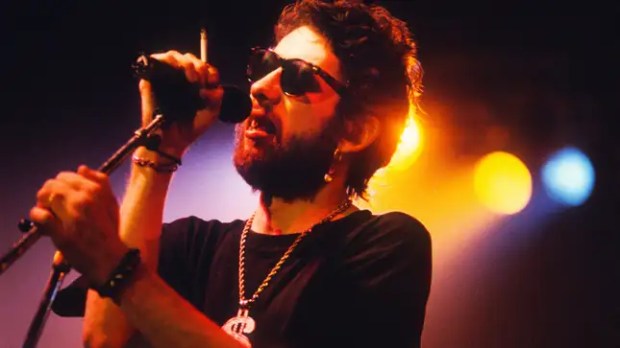
“He took the road to heaven in the morning.” RIP to Shane MacGowan, principal singer and songwriter for the Pogues, and the poet laureate for the modern Irish diaspora. Though he was born and (mostly) lived in and around London, his childhood experiences in Tipperary seemed to inhabit him as profoundly and completely as did Dublin to James Joyce, who left Ireland as a young man.
With a super-talented group of players behind him, Shane wrote dozens of beautiful and incorrigible booze-infused songs on themes of wanderlust, bittersweet romance, camaraderie, Irish social history, political indignation and London street life. His songwriting compromised a universe unto itself: this was a guy who could make the demolition of an old greyhound racetrack (“White City”) sound mythic (Oh, the torn-up ticket stubs of a hundred thousand mugs/Now washed away like dead dreams in the rain”).
The same goes for “Sally MacLennane” which covers an entire lifetime in 2:40. MacGowan sings the tale of Jimmy, who “played harmonica in the pub where I was born” (brilliant) and goes off to America to make his fortune while the narrator grows up to tend the same bar. Jimmy eventually returns to a very changed homeland and you come to realize that the fateful walk to the train station is in fact a funeral procession.
So let’s sing Shane “a song of times long gone” and remember him well, as he remembered the world around him in a way that touched so many so deeply.
It’s been said that your musical identifications and tastes are cemented at a very early age, maybe as young as fourteen. That doesn’t mean you can’t expand your sonic palette later on—I didn’t get into jazz, reggae or classical until my mid-20s or so. But in the pop music universe, the “14 Rule” hold true.
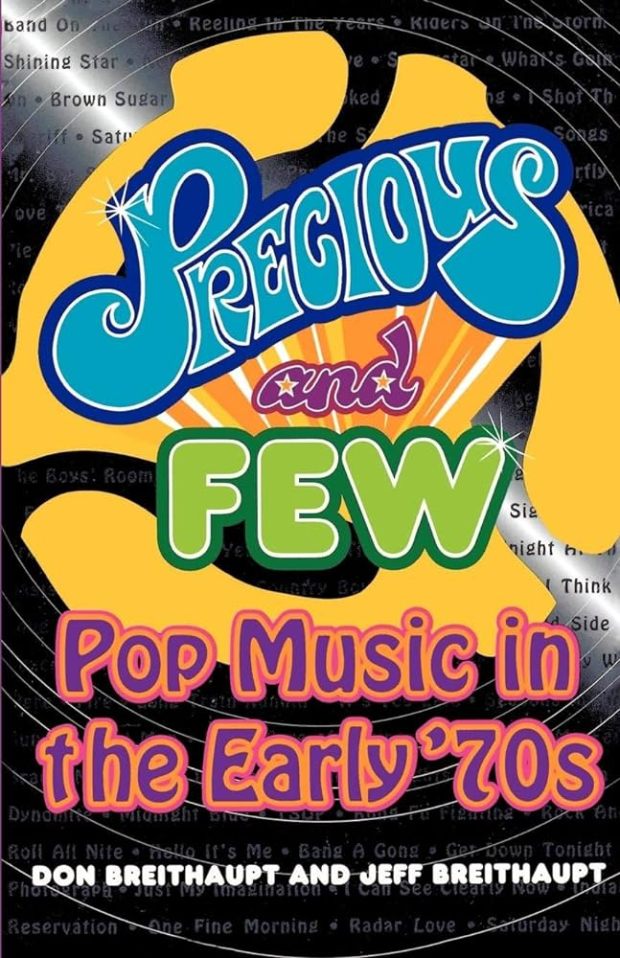
One of my lasting musical fixations is Top 40 radio in the early Seventies, from about when I was 13 to 17 years old. So imagine my delight when I came across this tome at a retro store in Portland, Maine—a little shop stuffed with old albums, cassettes, VHS tapes, comic books and pop culture knick-knacks. I took one look at the cover and said to myself, “These guys get me.”
The guys in question are brothers Don and Jeff Breithaupt. They hail from Toronto, Don is singer in the band Monkey House and Jeff is an arts-fundraiser. In the mid-80s they began to wonder what became of the 45s they collected in the previous decade and found out from Mom that they were up in the attic crawlspace, still in their original faux-denim case.
The book’s “title track.” Go ahead and sing along, you know you want to.
So began their deep-dive journey through a large swatch of Billboard-charting singles dating from 1971-75. They starting with a survey of early 45s by the ex-Beatles and end at the Dawn of Disco. Early in their introduction, the Breithaupts make clear that they won’t abide by any lazy notion of this era being an inferior zeitgeist. Sure, there were questionable fashions and silly fads (with some novelty records to match), but they contend (rightly) that it was also a time of a vital incorporation of the strengths of venerated Sixties. “The rock press has a good ear for innovation,” they write, “but has shown little patience with the slower process of consolidation.”
The early 70s would be the last period of the Big House notion of commercial Top 40 radio. The authors note that the continuation and expansion of the earlier Boomer rock era: this was the end days of when R&B artists, singer-songwriters, hard rockers, foreign pop bands and teenybop idols would all share space on the Billboard charts. This rich audio-cultural diversity, delivered with none of today’s virtue signaling, would soon give way to specialized radio formats, a separation process that would eventually be reflected in America’s culture wars and divisive politics.
A decade-defining case in point. The sublime “Everybody Plays the Fool,” by the Harlem-based trio The Main Ingredient, was a huge hit in 1972 and of the last of the great “advice songs” (see also Petula Clark’s “Downtown” or the Beatles “She Loves You”). From its droll spoken intro to its last buoyant chorus, this was a stone-cold classic. But it was kept from the No. 1 spot by Chuck Berry’s infantile “My Ding-a-Ling.” Such was the Seventies.
The brothers collect these disparate musical trends into a colorful collection of concise chapters, preceded by a list of ten songs which best exemplify them. For instance:
“Revoluncheon: The Sixties Continued” Includes posthumous hits by Jim (“Riders on the Storm”) and Janis (“Me and Bobby McGee”) and post-mortem anthems like “Won’t Get Fooled Again” and “Knockin’ on Heaven’s Door.”
The authors note that some Sixties-identified artists like the Who, Stevie Wonder, Paul Simon and even the Rolling Stones put out much of their best work in the early Seventies, this continuation couldn’t last forever. “The relatively unified front of the Beatles, Stones and Motown,” they note, referring to the musical Sixties, “shattered into a million Hamilton, Joe Frank and Reynoldses.”
“Dancing in the Moonlight: Seventies Pop.” Featuring Carole King’s “It’s Too Late,” Seals and Croft’s “Summer Breeze,” Rod Stewart’s “Maggie May” and Jackson Browne’s “Doctor My Eyes.” Sure it wasn’t as transformative as Monterey Pop, but only a snobby leading-edge Baby Boomer could resist the unabashed good vibes of “Dancing in the Moonlight” or this 3 Dog Night gem:
“The Sound of Philadelphia” Motown began to lose its way a little after moving from Detroit to L.A. in 1972—despite some great records by Stevie, the post-Diana Supremes and Marvin Gaye in his “What’s Going On” era. But in its place came the rise of the Philly Soul sound, led by the songwriting/producing team of Leon Huff and Kenneth Gamble. This is one of the book’s best chapters. Get ready to fall in love all over again with the Spinners, the Stylistics, the O’Jays and Harold Melvin and the Bluenotes. And let’s not forget this timeless adultery anthem by Billy Paul.
“Richard Nixon’s Greatest Hits” The era’s social protest songs were a mixed bag, but I am ready to defend the honor of the 5 Man Electrical Band’s “Signs” despite its many detractors (“the sign says you gotta have a membership card to get inside, ugh!”).
Also getting a going-over in this chapter are the likes of “Bring the Boys Home” (Freda Payne), “Give Ireland Back to the Irish” (Wings), “Fight the Power” (Isley Brothers), and the Raider’s white-guilt classic “Indian Reservation.” Sometimes the execution would get muddled and sentiments would veer more into apathy than action, despite good intentions. Ten Years After frontman Alvin Lee would “Love to Change the World” but didn’t know how so he just decided “to leave it up to you.” The authors also drill down on Chicago’s rather confounding minor hit “Dialogue (Parts 1 and 2).” Here, guitarist Terry Kath, playing a “well-informed progressive,” grills a “spoiled college kid” (sung by Peter Cetera) about his views on the world. The kid is so callow that when asked if he’s angry about the way the disastrous Vietnam War is dragging on, he plainly states that he “Hopes the president (Nixon) knows what he’s into.” And yet he somehow wins the argument by inexplicably convincing the Kath character (without providing evidence) that “everything is fine.” Wow.
By way of comparison, the Breithaupts contend that the “feminist pop” of the era was a lot more effective. Of course, Helen Reddy’s “I am Woman” gets a mention, but they are not too impressed with her “tame delivery.” Instead they rightly rave about the female singers (mostly African-American) who boldly turned the tables on the philandering macho men of the time. The politics here are mostly sexual, spawning a number of memorable, whip-smart singles like “Mr. Big Stuff” (Jean Knight), “Clean-Up Woman” (Betty Wright), “Women’s Love Rights” (Laura Lee) and my favorite, “Want Ads” by Honey Cone. In this infectious soul-groove workout, lead singer Edna Wright serves notice on her cheating-ass (ex) boyfriend by advertising for a new main squeeze in the Personals section of her local newspaper, noting that “experience in love preferred, but we’ll accept the young trainees.” Hell, yeah!
“Want Ads” was #1 on both the pop and soul charts in the spring of 1971. Here is the extra-funky extended version.
There are many other categories covered here, too many to review. Some of them are: Jazz Pop, Religious Pop, Progressive Rock, Hard Rock, Instrumentals, Story Songs (that chapter is named “Harry, Keep the Change” lol) and even “Self-Pity Pop”. This section features the lachrymose likes of “At Seventeen” (Janis Ian), “All By Myself” (Eric Carmen), “Seasons in the Sun” (Terry Jacks) and “Alone Again Naturally,” the suicide-ideation hoot by the regrettable Gilbert O’Sullivan.
But good, bad, or ugly, this music from the last great period of open-format radio do have a lasting virtue. That’s because most of the hits we were digging on back then were marked by a dogged sincerity. This can be hard to reckon with in our own ironic age. When this book came out in the mid-90s, the Seventies were enjoying a moment, but not for all the right reasons. “Generation Xers find it easy to laugh at everything,” the brothers wrote in ‘96, “they aren’t used to pop culture that wants to be taken at face value.”
This recalls a couple of big-charting songs of the time. First is “Brandy,” the only hit by the Jersey Shore band Looking Glass. The story of a lovelorn barmaid in a harborside tavern, this tune is sung in complete earnestness and was listened to in the same spirit as it headed to #1 in June 1972. But upon closer inspection, if was Brandy was such “a fine girl” and desired by all, couldn’t she just dump this sailor guy who has clearly stated “My love and my lady is the sea” (I mean, really). Or conversely, the sailor could finally give up on his stinky old boat, put a ring on it and, I don’t know, open a bait-and-tackle shop?
The other is the inimitable “Sweet City Woman” by the Calgary-based trio, the Stampeders. In this winsome, banjo-driven ditty, the singer hops a train heading out of the boonies to hook up with his lady friend living in town. He even mentions his banjo twice in the song and his anticipation is heightened not just by his girlfriend’s good loving but also her macaroons. Like I said, such was the Seventies. So the next time either song comes over the radio, we late baby boomers will be singing along with affection not irony. But I’m posting “Sweet City Woman” because at least the guy in that song knew when he had a good thing going!
“Those English boys, they want to play the blues so bad. And they do play it so bad,” Sonny Boy Williamson once said, looking back in humor to the times he went to tour in Europe in the early Sixties, sometimes supported by the Yardbirds or the Animals. It’s a classic quote and a bit unfair (the Yardbirds were just starting out) but it does point up the fact that most of the bands that made up the epochal British rock explosion of the later Sixties were steeped in reverence to the blues, despite the geographical and experiential distance from their heroes.
But nobody could question their sincerity and when the English blues-rock thing really took off a meeting of the minds was bound to happen. The legendary blues (and early rock ‘n’ roll) performers found their commercial fortunes fading, overtaken by R&B, Motown and funk. For the Brits, the legitimacy conferred and the fun to be had jamming with these legends was a no-brainer. When a Chess Records producer, after watching a Cream concert at the old Fillmore West, asked Eric Clapton if he would like to do an album with Howlin’ Wolf the die was cast. Although the record would not get recorded for another couple of years, it would set the pace for a notable mini-genre of “London Sessions” projects that would hit the market in the early Seventies.
The London Howlin’ Wolf Sessions (1971)
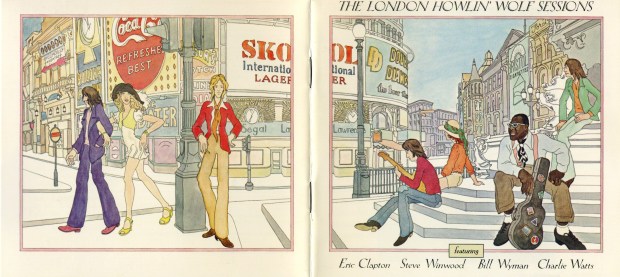
So the Wolf album would be the first of these, the Chess label would follow with three others, listed chronologically below. It could be argued that this is the best of them; it certainly had the best cover art (see banner image. Chess followed the formula of having illustrated covers showing their subject in London-themed settings. While the other three are a bit cartoonish, this one has a handsome drawing of the Big Guy surveying the Piccadilly Circus scene while seated with his guitar case under the Eros statue, while a chap who looks like Clapton plays on a lower step.
Eric certainly wasn’t going to waste an opportunity like this and he brings his A-game, pealing off any number of torrid solos on his trusty Stratocaster. Wolf brought along right-hand man Hubert Sumlin to set the pace on rhythm guitar, while Rolling Stones’ Charlie Watts and Bill Wyman laid the foundation for an energetic set of blues classics. The devotion to this Chicago blues legend was undeniable: the Stones’ insisted on Wolf as a guest when they appeared on the American TV music show “Shindig,” while Slowhand had been tapping the Wolf songbook for years (all but two of these twelve songs are credited to him—Chester Burnett—or his go-to guy Willie Dixon) and Cream’s 16-minute version of “Spoonful” is the stuff of acid-rock lore.
With the bedrock of Sumlin and this trio, plus either Steve Winwood or “sixth Stone” Ian Stewart on keyboards, Wolf fronts a strong collection of his well-known 12-bar tunes, in great voice and seemingly high spirits. You get “I Ain’t Superstitious,” “Sitting on Top of the World,” “Built for Comfort,” “Do the Do” and trademark numbers, all expertly played and well produced by Chicago bluesologist Norman Dayron. And if their was any question as to who was in charge here, listen to the practice take of “Little Red Rooster.” The imperious Wolf is showing the young guns how the intro should be done by playing it on his acoustic when Clapton tries to get him to play on the final: “Nah, man, come on!” The album was well-reviewed and made a respectable chart showing, leading the way for what was to come. Grade: A-
The London Muddy Waters Sessions (1972)
The mighty Muddy Waters was the next to get the UK treatment and this was another well-done effort. Already a pattern was established. There was the illustrated cover, though this one looked like a half-finished Peter Max reject (though Waters wearing a bobby’s helmet was kinda funny). There was the trusty wing man brought over from the Windy City (Muddy’s harmonica player Carey Bell). Again, the roll call at the London studio proved impressive (Rory Gallagher, Ric Grech, Georgie Fame, Steve Winwood again, and former Hendrix drummer Mitch Mitchell).
Gallagher, the revered Irish blues guitarist, and Bell really stand out here, trading solos on several tracks. And while Waters is in fine fettle, the album is held back at times by the Americans’ unfamiliarity with the surroundings and the Brits reverence. In other words, good but not off-the-hook good. Like on the Howlin’ Wolf album, the material consists mostly of artist originals and Willie Dixon standards, including a new MW version of his immortal “I’m Ready,” (“I’m drinking TNT/I’m smoking dynamite/I hope some screwball starts a fight”). Grade: B
The London Chuck Berry Sessions (1972)
I think it’s safe to say that Chuck’s UK album was the most financially successful of this lot, even if it was for all the wrong reasons. That is because it included the execrable novelty song “My Ding-a-Ling,” which, believe it or not was Berry’s only #1 single in America. But at least the 45 edit was only about four minutes, the juvenile singalong goes on for eleven minutes on the album’s live second side. It is sandwiched between this record’s highlights. Helped along by two future members of the Average White Band, he treats the Lancaster festival crowd to a frisky rave-up on “Reeling and Rocking” and then sends them into a frenzy with “Johnny B. Goode” (probably because they are secretly relieved that “Ding-a-Ling” is finally over). Chaos ensues at the end when the crowd belligerently demand an encore while a flustered MC begs the crowd to leave so they can make way for a show by “The Pink Floyd.”
The studio side has little of value, despite the presence of Kenney Jones and Ian McLagan from the Faces. Chuck sounds uninspired and the only real bright spot is “I Love You” which shows a more contemporary spin on his trademark sound. Grade: C
The London Bo Diddley Sessions (1973)
The pioneering rock ‘n’ roller born Ellis McDaniel was not one to rest on his laurels. Bo had spent the late 60s and early 70s updating his sound to fit in with the more contemporary funk style. It never really caught on and he was still making most of his income on the oldies circuit where his patented hambone “Bo Diddley beat” was ever popular. His London sojourn was bound to be a colorful affair and the old pro didn’t disappoint, even if it did nothing to help his flagging record sales.
There’s a great funk workout (“Get Out of My Life),” a couple of cheeky numbers written by his former Chess label mate Sam Dees (“Husband-in-Law” and “Sneakers on a Rooster”) featuring singer and female foil Cookie Vee, and a good version of his “Bo Diddley” signature song. There is less overt star power here, but Diddley is well served by a tight and sympathetic supporting cast centered around Spencer Davis Group alumni Eddie Hardin on organ and guitarist Ray Fenwick, while ELO founder Roy Wood contributes some supple bass work. Bo’s stature, if not his commercial standing, continued into the next rock generation and by 1979 he was knocking ‘em dead as a supporting act on the Clash’s first American tour. Grade: B+
B.B. King in London (1971)
King recorded this LP at London’s famed Olympic Studios in June of 1971 and it was released in November of that year, just prior to a tour of England. It’s a decent outing by the Blues Boy, though not much here that you haven’t heard before from him. He’s supported by a staunch roster of classic-rock supporting players and regulars from the British blues club/festival circuit. Drumming is by the Jims (Gordon and Keltner), the bass work is supplied by the ever-reliable (and ever-available Klaus Voorman), and the second guitar spot (backing up King and his famous Gibson ES-355 named Lucille) rotates between Fleetwood Mac founder Peter Green, John Uribe and Dr. John.
There are a couple of changes of pace which help a lot. The instrumental “Alexis’ Blues” has both Mr. Korner and BB on acoustic guitar while Steve Marriott blows some mean harp. Guest keyboardist Gary Wright gets to do his piano shuffle with King adding some of his piquant picking on this platter (sorry). He also does some fine singing and soloing on his own “Ghetto Woman,” the best of the straight blues number. The tasty string arrangement shows that a lot of care went into the making of the, even if the results are less than revelatory. Grade: B-
Jerry Lee Lewis: The Session…Recorded in London (1973)
As mentioned before, some of these London recordings are held in check by the double dynamic of the headliner’s unfamiliar surroundings and the kid-glove tendencies of the admiring supporting players. In one sense, this was also the case when Jerry Lee Lewis made his way across the pond in 1973. Although only in his late thirties, Jerry Lee was on the cusp of his elder statesman years and initially felt ill-at-ease during the sessions. He had rarely recorded outside of Memphis or Nashville and here he was surrounded by long-haired whipper snappers.
But this was still the same Lewis who was the incorrigible wild man of rock ‘n’ roll and he let it loose with a sprawling, freewheeling, braggadocious double album that yielded his last hit song on the pop charts (“Drinking Wine Spo-Dee-O-Dee”) and cemented his status as an early rock ‘n’ roll icon. The album kicks off with “Drinking Wine,” setting the stage for what’s to come. It’s a great ol’ roadhouse boogie with Jerry leading the charge, singing enthusiastically of hedonistic pursuits and pounding away at his piano in that familiar staccato style. Alvin Lee of Ten Years After, the first of many hotshot guitarists to heed the star’s command to “Pick it, son,” gives some 70s firepower to a 50s-style solo. These “sons” are generally only 5-10 younger than “The Killer” but none of them would dare complain. His offspring include and impressive collection of guitarists (Rory Gallagher, Albert Lee, Peter Frampton, Delaney Bramlett and future Foreigner Mick Jones) and keyboardists (Gary Wright, Tony Ashton and Procol Harum’s Matthew Fisher) and Brian Parrish (then vocalist with Badger) on harmonica. Several of Lewis’ usual band also appear.
When these disparate elements come together the record can be great fun, with the accompanists’ amped-up backing giving Lewis a solid platform to hit his attitudinal sweet spot halfway between blasé and berserk. It’s a rush to hear Gallagher and Frampton trading solos as the man bulls his way thru “Johnny B. Goode” and to have pro’s pro Albert Lee move the crew full-steam-ahead on “Sea Cruise” as Captain Killer runs thru his paces of piano razzle-dazzle, esp. in those sweeping glissandos that flash by like Zorro’s sword. Country and blues numbers are also present as are a couple of more contemporary songs (CCR’s “Bad Moon Rising” and Gordon Lightfoot’s “Early Morning Rain”).
It comes all together for the concluding “Rock & Roll Medley” as the Killer whiplashes thru four Little Richard classics before climaxing with his immortal “Whole Lotta Shakin’ Going On.”Jerry Lee whoops it up like it’s 1957 and attacks his piano keys with karate-chop comping while Alvin Lee flies off into Woodstock guitar-hero land. It’s a satisfying ending to an entertaining, loosey-goosey record and will be a fun time no matter which of the four sides you drop the needle on. Grade: B+
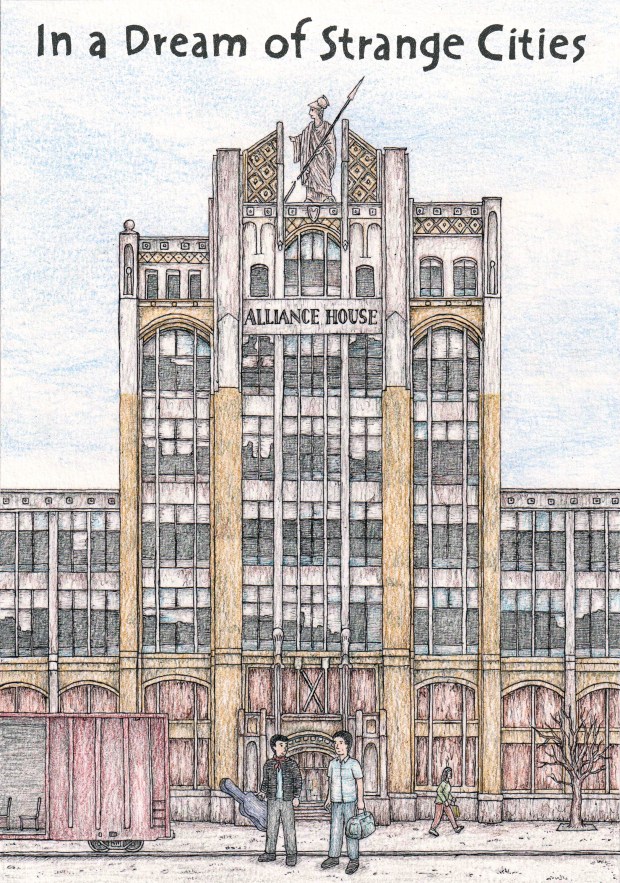
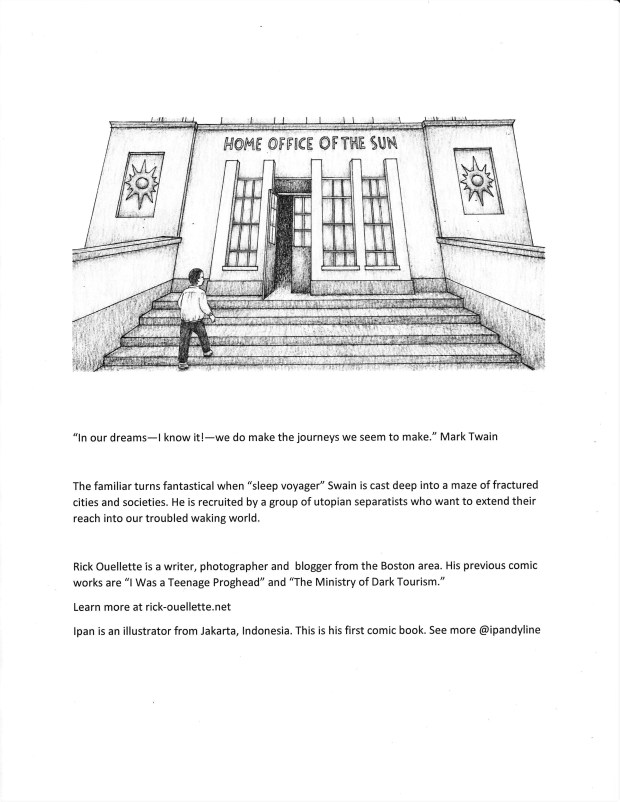
The familiar turns fantastical as “sleep voyager” Swain roams through fractured cities and societies, falling in with a group of utopian separatists.
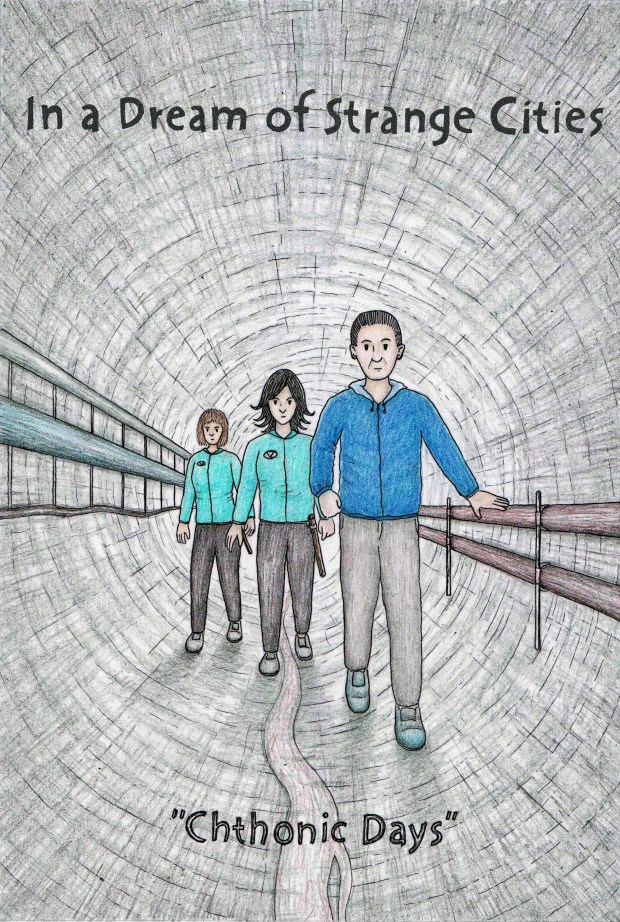
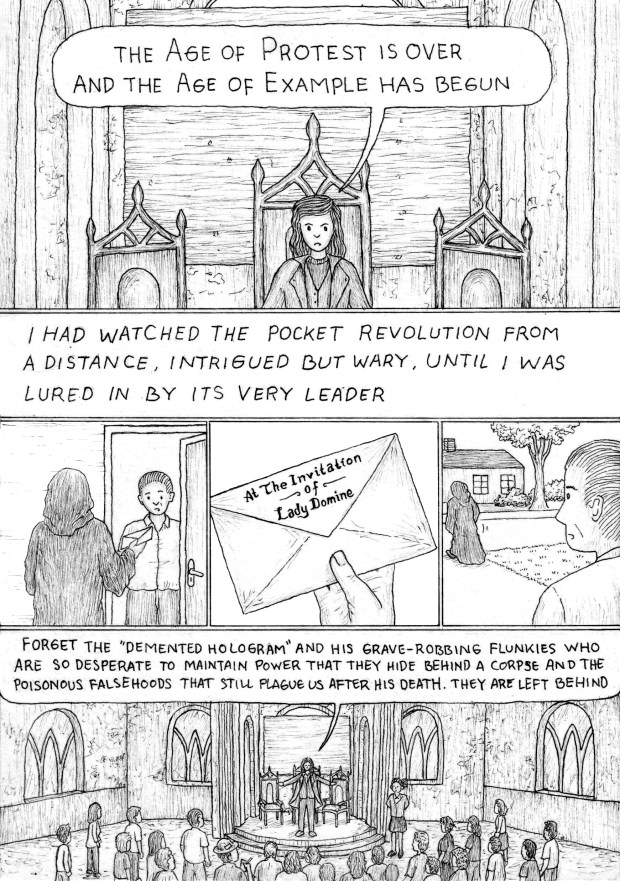
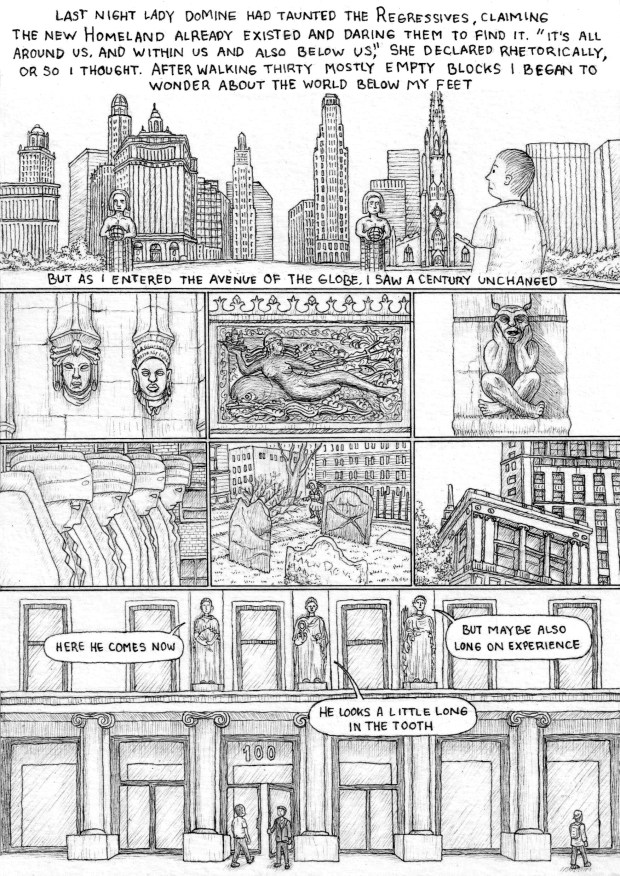
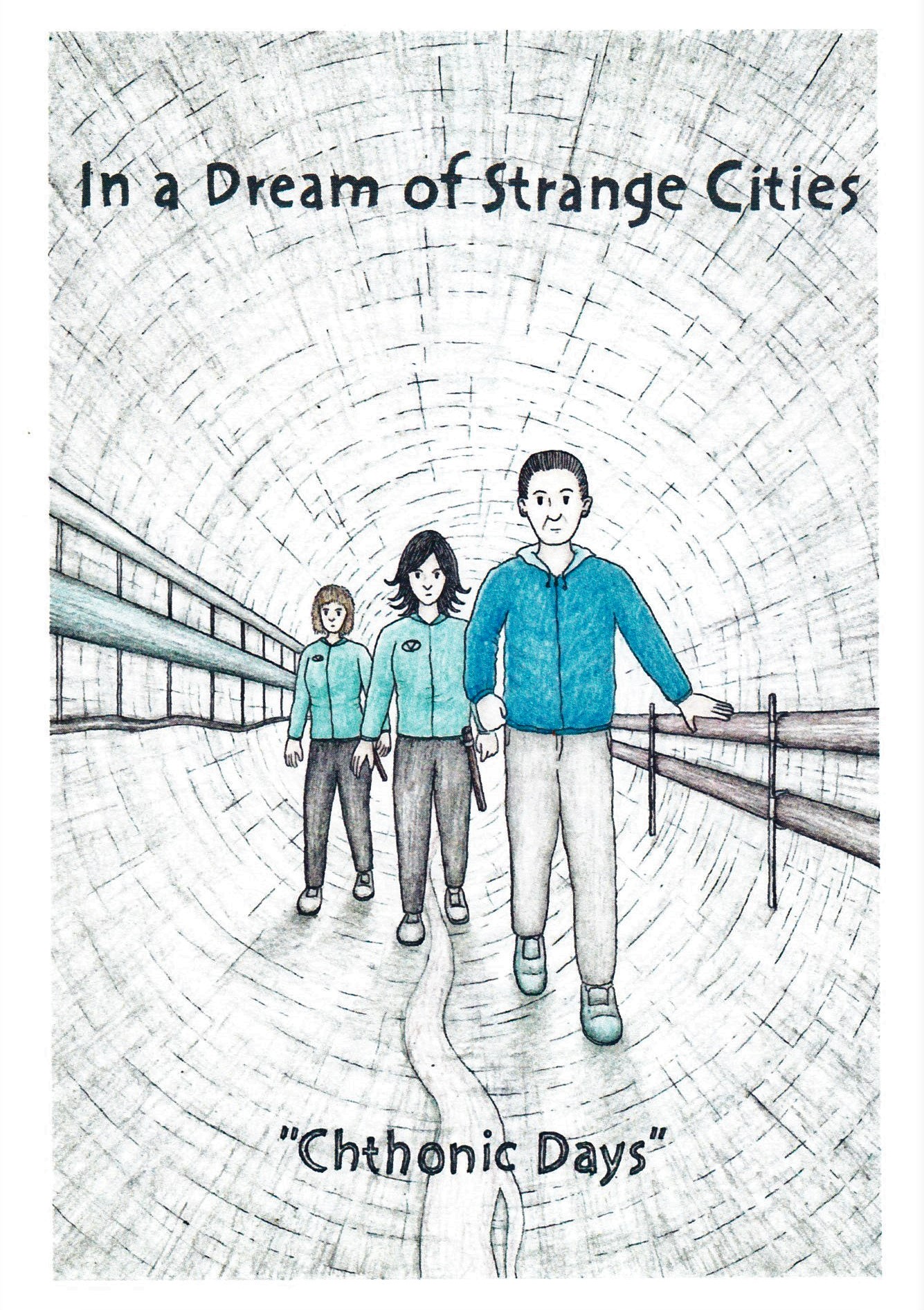
“Chthonic Days” is a 20-page, magazine-size short story comic that is culled from two pivotal chapters of the graphic-novel-in-progress “In a Dream of Strange Cities”. The title of the story indicates the underground quest to find a space large enough to construct a prototype independent sub-city, envisioned by an idealistic group called the Homelanders. Lady Domine, their charismatic and overstanding leader, lays out their vision in the speech that opens the story.
At first, Swain has no idea about how and why he has been drawn into this “Second World” or that it is even a different plane of existence. But his flair for urban exploring and psychogeographic observation make him an ideal recruit for Domine and the forces of “love, logic and learning” at existential odds with a late autocratic leader. Kept alive by a haranguing electronic video-audio loop, he encourages his followers to continue to follow his lead and meet every act of social empathy with scorn and even violence, with no end in sight.
Swain, at the conscripted call-up from the now autonomous “World Subconscious” will find out if there is “a way forward in peace” against the abusive cult of personality that pervades half the citizens of the story’s city-state.
The price of $5 includes mailing within the U.S. and will be so helpful and artist Ipan and I continue work of the first volume of a proposed trilogy. And you can keep up with our progress by Liking the In a Dream of Strange Cities Facebook page. Thanks! –Rick Ouellette
“Chthonic Days”
A short-story comic taken from the upcoming series “In a Dream of Strang Cities.”
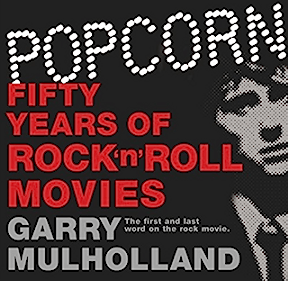
I hadn’t heard of the 2010 book “Popcorn: 50 Years of Rock ‘n’ Roll Movies” until I recently scored a copy for $2 at a library book sale. Penned by British music scribe Garry Mulholland, it was advertised as “The first and last word on the rock movie” six years before I self-published my tome “Rock Docs: A 50-year Cinematic Journey.”
So though I’d beg to differ with that blurb, I also know when to tip my cap to a pro. “Popcorn” is a wildly entertaining and rigorous look at both rockumentaries and music-themed feature films for the half-century starting in the mid-Fifties (my timeline is Beatlemania to 2014). Mulholland is a writer full of original thinking: astute, passionate, contrarian, righteous, risqué and often laugh-out-loud funny. You can’t wait to read the next review and find out what he’ll say about all these major music movies, even when you can tell by the star-rating that you’ll disagree with him.
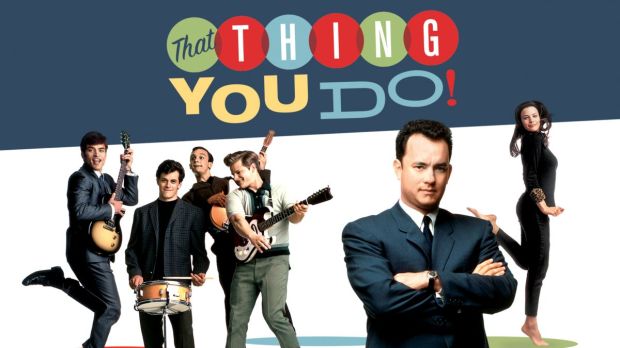
That Thing You Do!: “Sixties rock according to Forrest Gump.”
This is a guy who likes “Help!” and “Yellow Submarine” better than “Hard Day’s Night,” prefers the Bob Dylan obscurity “Masked and Anonymous” over the iconic “Don’t Look Back,” and is as willing to praise John Waters’ “Hairspray” to the high heavens as he is to take the Rutles down a notch or two. But he will champion worthy obscurities like “Slade in Flame” with logic and love and assure us with 5-star ratings for “This is Spinal Tap,” “Quadrophenia,” “Gimme Shelter,” “Performance” and “The Filth and the Fury.”
The Kids are Alright: “Unique, thrilling, and a great reminder of when snotty bands smashing up stuff was still shocking, big and clever”
The films earning one or two stars usually get a (often much-needed) hatchet job. Check out these “plot line” blurbs that appear under the rating.
The Doors: “Twat stops shaving and dies.”
Purple Rain: “A $6 million tribute to Small Man Syndrome.”
The Monkeys’ ‘Head’: “Boy band force fed drugs and abused by hippie fuckwits.”
Pink Floyd’s The Wall: “Walls are bad. But women are worse.”
Control: “The aesthetically pleasing death of Ian Curtis.”
With such stylistic flair and free-ranging opinions, Mulholland can sometimes go a bit daft. About the only thing he likes in “The Last Waltz” are those cloying interviews Martin Scorsese had with Robbie Robertson to sell their cinematic ego trip about a grandiose farewell concert. Meanwhile, he treats the rest of The Band (who did not want to break up the group) as if they were Mumford and Sons. Not cool. The only guest spot he approves of is Muddy Waters, a rare foray into the dubious Rock Critic Guide to Street Cred.
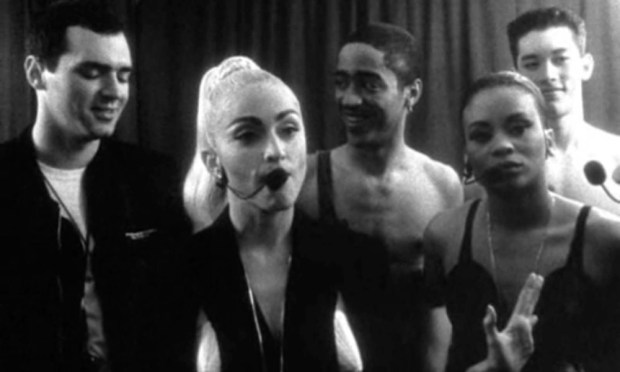
In Bed with Madonna (aka Truth or Dare): “It’s like spending 113 minutes inside a homophobic joke.”
Elsewhere, Mulholland (who is white) delves deep into the ever-issue of white co-option of black musical culture and does so via an intellectual process, not by lazy virtue signaling. Like I said, he has a righteous streak. He uses it to body slam both the likes of “The Blues Brothers” (“trades on the non-existent joke of two ugly sexist white blokes being the Kings of Soul”) and “Ray” (“The sick, cruel, racist America is stylized-to-fuck until it has the requisite glow of nostalgic cool”), exposing the ineptitudes of both low-brow comedies and Oscar-bait star vehicles masquerading as biography.
As for “Ray,” the author dutifully misinforms us that Jamie Foxx won the Oscar for “Best Actor in Sunglasses.” Mulholland may be from England, but his cheeky sense of humor will be much appreciated by rock fans weaned on the good old days of Detroit-based CREEM magazine (“The Wall” is judged to be “the rancid toenail clippings of fetid rotting dogs”). You get the idea. Keep a lookout for “Popcorn” on the discount shelf or see if your library has a copy. Then have yourself a good laugh—and a good think.
But if you’re interested, I still have a few copies of my “Rock Docs” available for sale. Inquire in the comments below. Thanks, Rick Ouellette
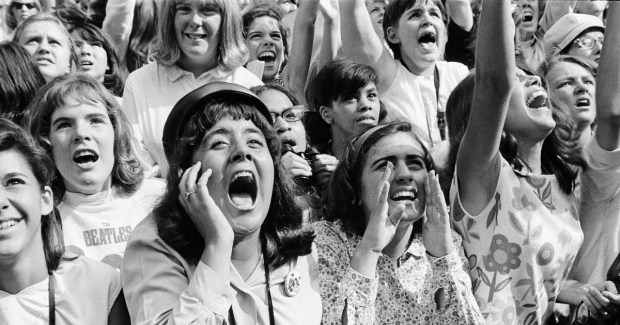
When it comes to signifying images of 20th century pop culture, the screaming girls of Beatlemania are right up there. Of course, the siren-pitch of their collective hysteria is also unforgettable to those who watched the Fab Four on television or especially for those who saw them in person, where the din was so epic one could barely hear what they were playing.
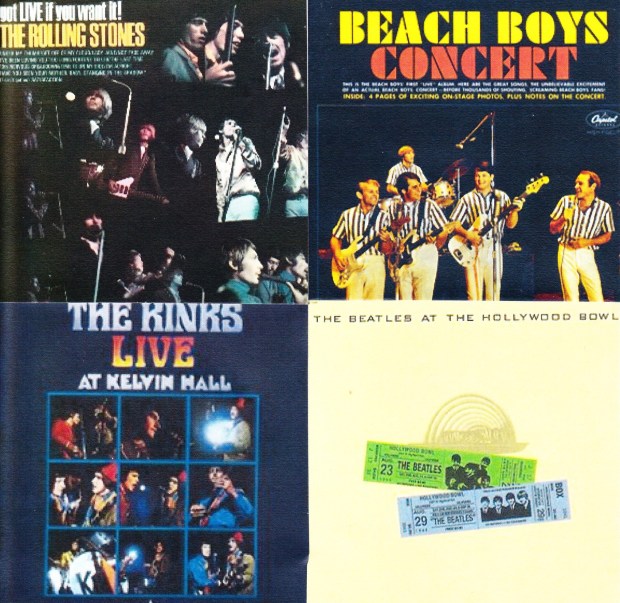
This kind of hysterical fan reaction was not limited to the Beatles. A lot of other British Invasion bands got a similar reception in concert. A look back at the legendary “T.A.M.I. Show” filmed in late 1964 shows the young Los Angeles audience (about 75% female) going completely bonkers over everyone from Lesley Gore to Jan & Dean to James Brown. But for this post, let’s concentrate on four titles that were recorded in those exuberant days of the mid-Sixties, while also noting that the Beatles entry was not released until 1977.
Over time, it became de rigeuer that every major rock group post-1964 would eventually release at least one live album. The problem with the early ones was that the amplification and recording equipment had not caught up yet with what the bands were doing. As the 60s progressed, the technology dovetailed with the heaviness of the sound and the kids had grown up and gotten past their Shrieking Stage.
Got Live If You Want It? Nowadays, all but the most hardcore Stones’ fans would say “no thanks, I’m good” to their first live album, released in the fall of 1966. It’s an interesting artifact in its way but these renditions of hits like “19th Nervous Breakdown,” “Under My Thumb” and “Get Off My Cloud” will have you running back to the studio originals. Andrew Loog Oldham’s production is woefully tinny (sometimes it seems like Charlie Watts’ cymbals are the lead instrument) and at times it can barely compete with the audience cacophony.
Considering that Stones’ concerts often ended in riots back then, it’s remarkable that a quieter number like “Lady Jane” comes off reasonably well. The same could be said of Mick Jagger’s take on Otis Redding’s “I’ve Been Loving You Too Long” although it turns out that song and “Fortune Teller” were studio tracks with crowd sounds added on. See below for a nice up-close glimpse of an early Stones show looked like.
The post-Pet Sounds Beach Boys were most noted for the creative dominance of Brian Wilson’s songwriting and studio wizardry. Later touring editions of the band often did not include Brian but did feature everyone from Glen Campbell to Blondie Chaplin, Daryl “Capt. and Tennille” Dragon and even Ricky Fataar, later of the Rutles.
So it is interesting to get a live taste of the original quintet, the three Wilson brothers, cousin Mike Love and neighborhood pal Al Jardine. This period piece stems from an enthusiastic 1964 show at the Sacramento Memorial Auditorium, with some post-production touching up to follow. The gatefold liner notes claims that unlike other live albums where they pump up the crowd sounds to add excitement, here they had tone it down. Such bragging! If so, I wonder what the decibel level was really like in the hall when fan fave Dennis Wilson stepped out from behind the kit to sing Dion’s “The Wanderer.” Shriek City, man!
All in all, this is a fun throwaway album, a mix of amped-up hits of their own (“I Get Around,” “Little Deuce Coupe” etc.) and a batch of covers, some well considered (Jan & Dean’s “Little Old Lady from Pasadena,” Dick Dale’s “Let’s Go Tripping,” a lead guitar showcase for Carl Wilson) and some just silly (Mike Love doing “Monster Mash”??). Beach Boys Concert was the first pop live album to top the charts, the guys’ only #1 LP aside from the 1974 compilation Endless Summer.
By the time The Kinks Live at Kelvin Hall came out in 1967, the band were already in the midst of a run of classic albums that were known for an introspective approach that was a marked progression from the teen-beat appeal of their early sound (their wistful masterpiece “Waterloo Sunset” was recorded the same month, April ’67, as this LP was released in the US as The Live Kinks). But at Glasgow’s Kelvin Hall it was all “this-one-goes-to-eleven” frenzy. The group don’t seem to mind: the audience was give one full channel on the 4-track recording and Ray and Dave Davies often egged on the screamers, as they do here before launching into “Dandy,” their astute ditty about an aging Casanova that teen-idols Herman Hermits would take to #5 on the Billboard charts.
The Kinks never turned their back on those early ravers: they open here with “Til the End of the Day” and encore with the world-beating “You Really Got Me” after a bizarre but entertaining medley of “Milk Cow Blues/Batman Theme/Tired of Waiting for You.”
Even the Beatles could not lay total claim for initiating this kind of hormonally-induced musical insanity. Frank Sinatra inspired similar reactions in the Forties, as did Elvis in the Fifties. But the Fabs really went level up when they broke in America, and the wild scenes of them playing the Ed Sullivan Show and at Shea Stadium are the stuff of legend.
Two of their more high-profile gigs on the West Coast were their appearances at the Hollywood Bowl in August, 1964 and in the same month the next year. Both were recorded but for various licensing reasons did not see the light of day until 1977 when highlights from both shows were combined for a 13-song, 33-minute album in what added up to a complete Beatles concert back then. Naturally, the screaming is super-intense and you got to give the lads credit for their energy level and musical precision (and good humor) given that they could hardly hear themselves.
On certain songs, like this 1965 take on “Ticket to Ride,” the girls seem to be taking a collective breather from the really crazy stuff and instead give the impression of a distant plague of locusts. Here, the band’s sound booms around the venue’s natural amphitheater. Elsewhere, they tinker with arrangements, like adding a pumped-up middle section to the pensive “Things We Said Today.” But nothing could negate the fact that this was not an optimal arrangement, especially with their growing musical sophistication in the studio. The Beatles last paying concert was the next August, at Candlestick Park on 8/29/1966, three weeks after releasing the game-changing Revolver.
That last factoid points up perfectly how rock and roll was quickly being transformed from a teen-scream sensation into a more cerebral, counter-culture art form. All four of these iconic bands were gearing themselves to the new studio-as-instrument ethos (esp. the Beatles and Beach Boys) while the Stones and Kinks had roadblocks to touring in the late Sixties: the former due to Brian Jones drug-bust-induced visa restrictions, the Kinks via a 4-year ban after a punch-up with officials from the American Federation of Musicians.
By the time they returned, the technology and amplification had caught up with the heavier sound of the new decade (see the Who’s thunderous Live at Leedsand the Stones’ own Get Yer Ya-Yas Out). The Kinks did a series of theater-rock presentations before making their own arena-rock move in the late 70s. Of course, the teen-hysteria thing never really went away and can be seen at shows by acts like Taylor Swift and the boy band of the moment. For us fans of the more classic rock type, the distractions at today’s show run more to people talking during the performance and impulsively holding up their smartphones. But that’s a story for another day.
In the annals of rock history, many bands are liable to be remembered only for their biggest hit. And so it is with Bloodrock, the Fort Worth-based outfit that graced the American Top 40 but one time. That single, of course, was the infamous “D.O.A.,” an exceptionally graphic dirge that depicted the immediate aftermath of a plane crash—told from the point of view of one of its soon-to-expire victims!
Against a morbid musical backdrop of funeral organ and blaring sirens, Bloodrock vocalist Jim Rutledge spares us no detail, whether it’s his missing limbs or the blood-soaked sheets applied by a paramedic who is overheard saying, “There’s no chance for me.” The song ends with Rutledge’s over-the-top cry of “God in heaven, teach me how to die!” before the final chorus yields to the sound of multi-tracked sirens sounding off on route to the morgue.
Brilliant stuff, to be sure. Just enough of us twisted teenagers bought the 45 (the full LP version ran past 8 minutes) to enable “D.O.A.” to claw its way to #36 in early 1971. I still have my copy. The b-side (“Children’s Heritage”) was more typical of the band’s output, a righteous if plodding boogie typical of the era. While the band’s signature song may not have been intended as a novelty (their guitarist Lee Pickens had witnessed a small aircraft crash), Bloodrock were to be identified with “D.O.A.” as closely as the Baha Men will be stuck forevermore with “Who Let the Dogs Out.”
For their first three albums, Bloodrock were under the clientage of both John Nitzinger, the sketchy kingpin of Texas blooze-rock who penned many of their songs, and manager/producer Terry Knight, who was also the combative Machiavelli behind Grand Funk Railroad. But by 1972, Rutledge and Pickens had left the band and Bloodrock had a new frontman in the person of fresh-faced Warren Ham. Ham was the lead singer and quite handy with the flute, saxophone and harmonica.
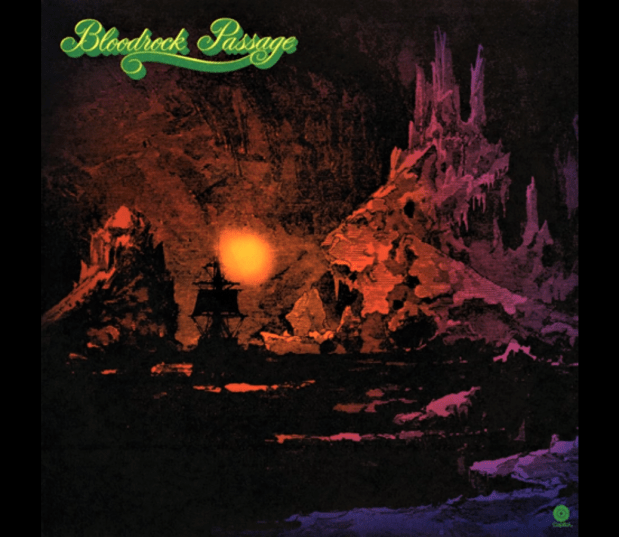
In late ’72, two years after recording “DOA,” came their fourth album, Passage. Gone was Terry Knight and his brainchild that their every LP sleeve design had to have dripping blood somewhere. Instead, the cover was a cryptical woodcut-like illustration of a clipper ship passing an underground cave, a nice touch. Similarly, the new Bloodrock sound was imaginative, and suggestive of the era’s preeminent progressive-rock sound.
The biggest and best surprise being the second track, “Scotsman,” an outright ringer and tribute to Jethro Tull leader Ian Anderson. With its scootering flute riff, weighty Hammond organ accompaniment (by key band holdover, Stevie Hill) and jaunty jig-rock arrangement, it could have been slotted into a Tull album like War Child or Songs from the Wood, if not for the singing accent.
While this edition of the band would never be mistaken for Yes or Peter Gabriel-era Genesis, other artful touches spice up this record. The buoyant opener “Help is on the Way” has a deft instrumental coda and “Life Blood” has some nimble dynamics and fresh splashes of synth that can stand up there with the best proggers of the day and contains some still-relevant lyrics (“I have seen a picture of hate, formed in a thousand ways/People say it’s all too late, talk of numbered days”).
The 8-minute semi-epic “Days and Nights” is a nice slab of organ-led heavyosity that should appeal to anyone who’s ever enjoyed a Uriah Heep album. There’s even a topical number, a nifty blues shuffle called “Thank you, Daniel Ellsberg,” giving props to the man behind the “Pentagon Papers” expose. Despite this new lease of life, Passage did not catch on and Bloodrock would only be around for one more studio album.
Since this “For the Records” series focuses on the obtaining of records as well as the listening to them, here are the somewhat odd circumstances of how I got my copy of Passage. After a night on the town, I pulled up in front of a used record store in North Cambridge, Mass. The owner of the Blue Bag Records store sometimes puts a pile of free discarded albums outside the door after hours. There was no pile this time, but the place was open despite the late hour (I think the guy was doing his accounts). Since I was likely going to be the only customer at that time, I had to be supportive and buy something. Nothing interested me until I saw this baby for eight bucks. I love the covert art (reminiscent of nautical mysteries like “Rime of the Ancient Mariner” or Poe’s novel “The Narrative of Arthur Gordon Pym of Nantucket”) and I had heard a few of its tunes online. So it came that I bought my second Bloodrock record, some 52 years after purchasing the “D.O.A.” single.
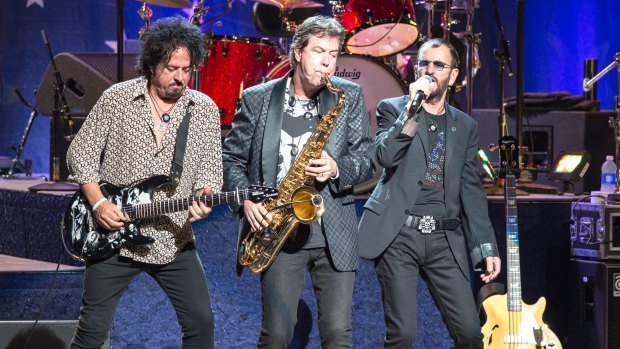
Although Bloodrock were not long for the world by the time that this album was released but Warren Ham went on to a long and successful career (still ongoing) as session and touring saxophonist for everyone from Kansas and Toto to Olivia Newton-John to Donna Summer. He has also been in several iterations of Ringo Starr’s All Starr Band (see above). In fact, I saw him on one of these tours and of course never made the connection then. Too bad. If I ever had the chance to meet him I would love to see his reaction when I told him: “Hey, I loved that “Scotsman” song you did way back when.”
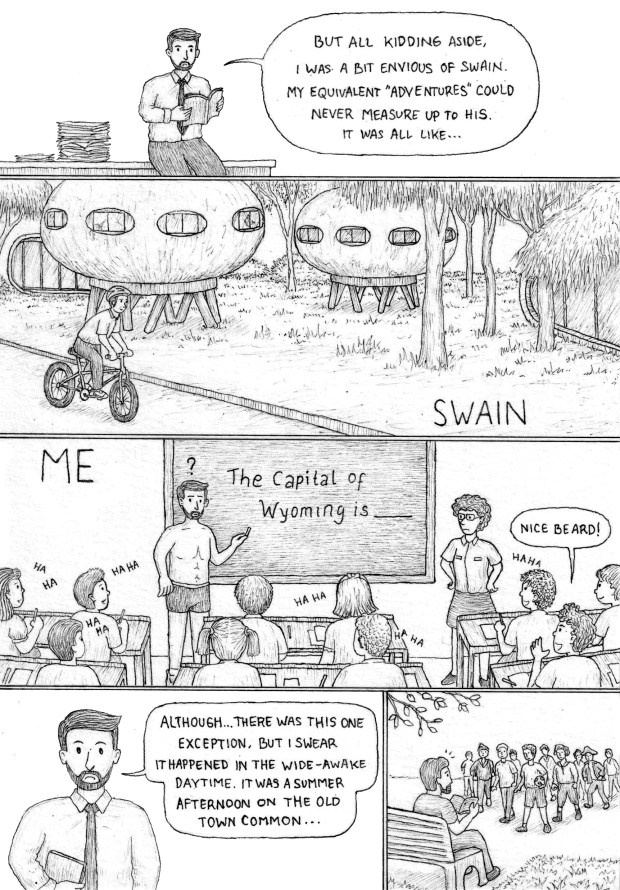
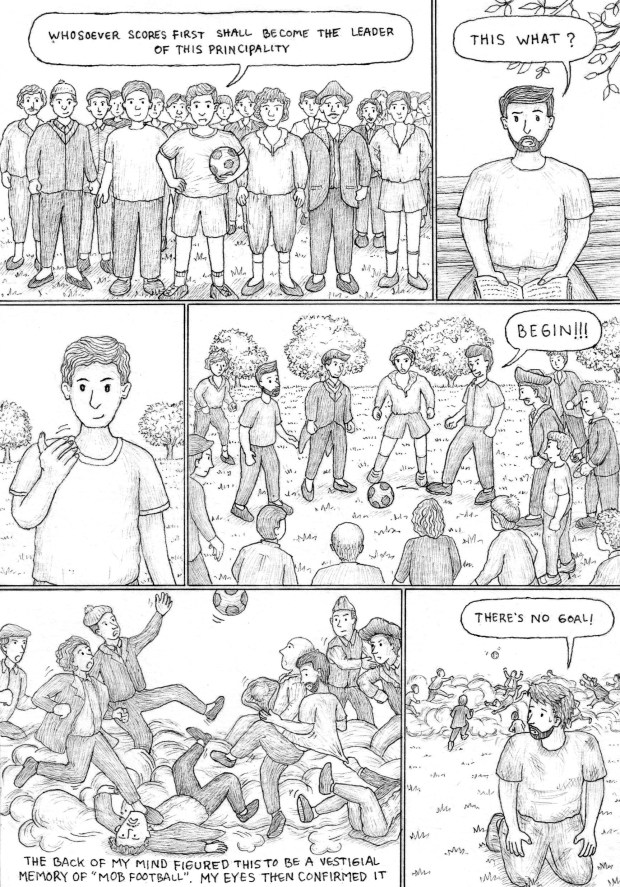
May 6th is Free Comic Book Day and I have a bunch of introductory 20-page mini-comics of my graphic novel-in-progress “In a Dream of Strange Cities” to give away. Here are some sample pages, if you are interested, please leave a message below and/or Like my Facebook page In a Dream of Strange Cities. Thanks! Rick Ouellette (writer) and Ipan (artist).