
In one way, you’ve got to hand it to the ancient astronaut “theorizer” Erich von Daniken. The Swiss author, who passed away on January 10th, built himself a very lucrative career on the preposterous idea that visiting space aliens constructed everything from the Great Pyramids to the Easter Island statues, and just about anything else from the B.C. era. His 1969 book “Chariots of the Gods?” and the subsequent film captured the attentions of millions (including myself) despite not having a shred of evidence to back up its claims.
It did inspire a sense of awe and wonder when it came to the cosmos and the colossal monuments of ancient civilizations. But in a saner world, “Chariots” would have remained a cultural curio of the Seventies. Instead, von Daniken’s stubborn promotion of the ancient astronaut trope—played out over some 25 books and debunked by everyone from Carl Sagan on down—became a gateway drug for the destabilized world we live in today. A world that is filled with conspiracy theories, misinformation, willful ignorance, distrust of expertise and “alternative facts.”
To begin with, Erich von Daniken’s publishing empire was built on fraud, literally. A high-school dropout of no known talents but an interest in UFOs, he swindled his employer (a resort hotel in the Swiss Alps) for $130,000 to finance his travel to far-flung destinations in preparation for his first book. He was convicted and served one year of a 3 and ½ year sentence. “Chariots of the Gods?” was turned down by several different publishers until one agreed on the condition that a professional writer be brought in to fix the manuscript. This was Utz Utermann, previously best known as the editor of a Nazi Party newspaper. Just saying.
One saving grace of the “Chariots” film is the beguiling soundtrack by the Peter Thomas Sound Orchestra. “Book of Ezekiel” is a highlight. Of course, Ezekiel’s Wheel was a UFO according to von Daniken.
If Daniken had any writing chops, he could have turned his ancient astronaut thing into an entertaining science-fiction series. Instead, he plowed ahead with his outlandish theory and exploiting an impressionable public newly inspired by the U.S. moon landings. Most galling is the utter contempt Daniken seemed to have for the human race. To imply out of hand that ancient civilizations were incapable of constructing anything better than a mud hut is profoundly insulting. It also ignores historical and scientific research that traces the ingenuity, technology, and development of ancient human cultures. But of course, ol’ Erich had no use for that and instead endlessly claimed that experts (esp. archaeologists) had something to hide. There’s not much of a leap from that to the present-day Trumpie anti-vax crowd that seemed to think that Dr. Anthony Fauci’s whole life was leading up to his big opportunity to fool them into taking a Covid shot.
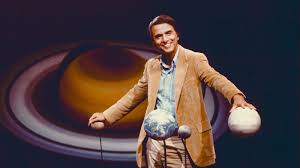
Carl Sagan on von Daniken: “That writing as careless as his, whose principal thesis is that our ancestors were dummies, should be so popular is a sober commentary on the credulousness and despair of our times.” Anybody interested in a point-by-point debunking of the ancient astronaut theory can check out Ronald Story’s “The Space Gods Revealed” and Clifford Wilson’s “Crash Go the Chariots.“
In 2009, von Daniken put it all on the table with a tome called “History is Wrong.” But of course it is. Why believe people who have studied history all their lives, when you can go all in with a convicted embezzler and check-forger who has even admitted to embellishing his claims? Sound familiar? And the man’s twisted legacy lives on in the so-called History Channel and its various “Ancient Aliens” programming. During a single one-hour show, I jotted down all the modifiers:
“There are claims that…”
“There is a theory that…”
“Could it be that…”
“Local legend says…”
Some maintain that…”
“It is rumored that…”
“There’s reason to believe that…”
And my favorite: “You have to wonder…”
Yeah, and I’m wondering right now: how the hell did we get so soft? To have this disregard for the abilities, ideals and aspirations of our own freakin’ species, not just in the ancient world but also in the modern. And left with the hollow phrase of UFO acolytes, “I want to believe.” Believe in what, exactly? Has the world become so daunting that our only hope is that some benevolent alien race is going to come to earth and solve all our problems? Yeah, there was a “Twilight Zone” episode about that once. It ended with that thing about “To Serve Man” being a cookbook.

 Reel and Rock