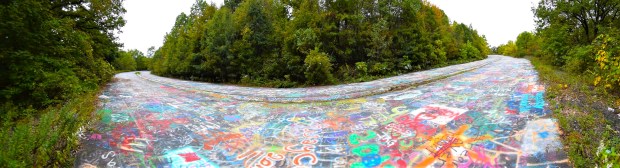
Graffiti Highway (parabolic), Centralia PA. All photos and text by Rick Ouellette except as noted.
In the late 1700s, towards the tail end of the Age of Enlightenment, the French painter Hubert Robert became well-known for his large-scale canvasses depicting ancient ruins of France and Italy. These romantic (and often semi-fictional) scenes spoke to an age where there was a strong interest in classical antiquity and preserving what remained of it. Hubert and the other artists who followed this trend were surely aware of the evocative power of decay when it came to lost societies.
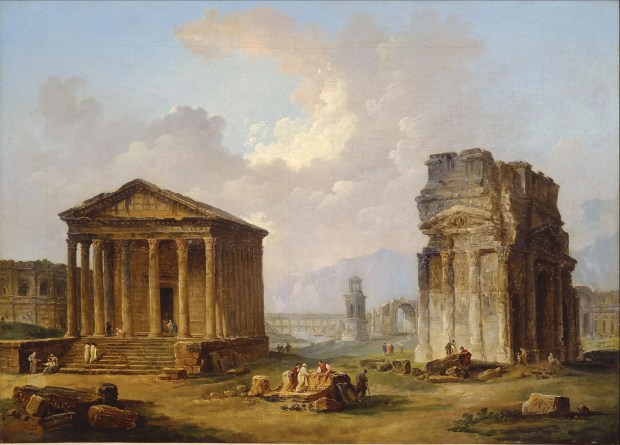
A typical Hubert Rubert joint.
Flash forward to the 21st century. We may well be deep into the Age of Un-Enlightenment, where hot-takes and online trolling has replaced the philosophical imperative. Yet the “picturesque” art style embodied by Hubert Robert has been carried on into the burgeoning field of ruins photography, the depiction of urban and industrial decay. Closely tied into the subculture of urban exploring, this field of photography has divided opinion. There are commendable practitioners like Matthew Christopher (in his two “Abandoned America” books) and Christopher Payne (the haunting and humane “Asylum: Inside the Closed World of State Mental Hospitals”) that have looked long and hard into the reasons and consequences of how and why certain American institutions have been left to die on the vine.
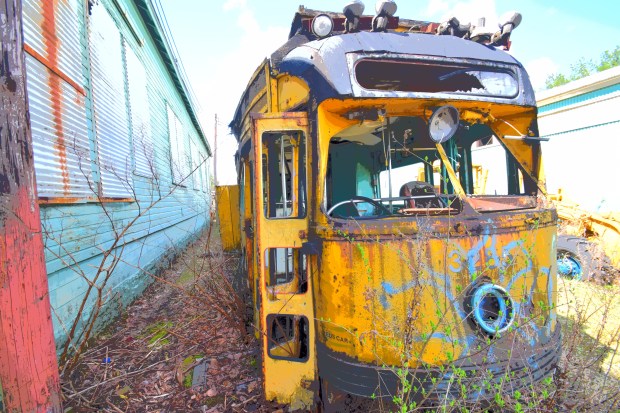
Trolley Graveyard #1, Photo by author.
Critics have pointedly taken aim at some aspects this “urbex” photography, namely the exploitation of people’s natural morbid fascination with the wreckage of off-limits locations, not to mention the implied insensitivity to a region’s economic decline. I have seen a lot of that online, where intrepid shutterbugs return from their trespassing adventures and post pics online to curiously adoring fans who practically gloat over the collapsed remains of defunct shopping malls and shuttered Rust Belt factories.
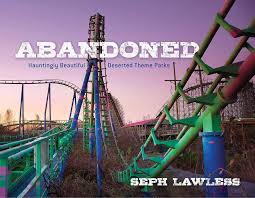
Which brings me to Seph Lawless. Curiously, he released two high-profile photo books in 2017 by two different publishers. “Abandoned: Hauntingly Beautiful Deserted Theme Parks” is exactly as it says, and he put in the big miles to significantly document a big urbex sub-category.
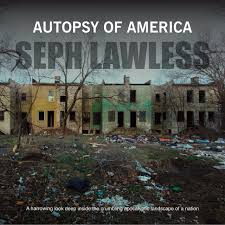
Then somewhere the same year was the boldly presented “Autopsy of America.” In case you don’t get it, you can turn to the back cover where we get in big letters, “Death of a Nation.” Really, the whole nation?? Published by a house called Carpet Bombing Culture (kind of a red flag in itself) the text for this book is so over-the-top that it can only work as self-parody.
“Is this just another recession? Or is this the beginning of the end?”
“America is a giant… mistake.”
“I want Americans to see what is happening to their country from the comfort of their suburban homes and smartphones.”
Oh gawd, spare me the edgelord/drama queen posturing! 😉. As usual, the photography is tremendous, though by this date we’ve all seen enough abandoned houses, darkened shopping centers and the odd isolated ghost town. (Lawless throws in several of his eye-catching theme park images for contrast). Yeah, there is serious income inequality. But it’s preposterous to pretend that cities like Pittsburgh and Cleveland (to name two I have personal evidence of) are hollowed-out landmarks of a country in its immediate death rattle. Many of those cities have growing, transitional economies and don’t need this. But I get it. He’s Seph LAWLESS for heaven’s sake, and the hype (and apocalyptic rhetoric) often goes with this territory.
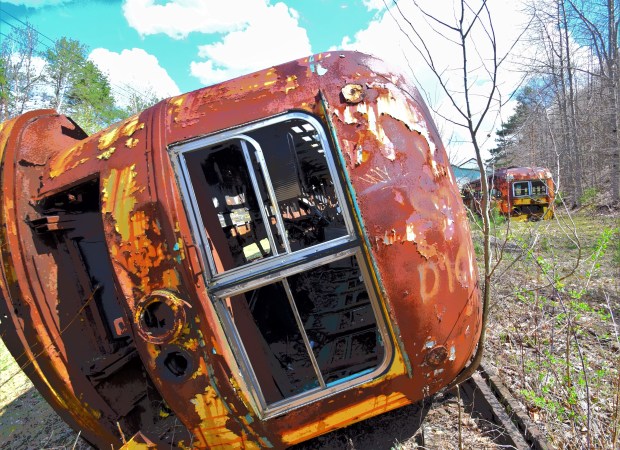
Graveyard Trolley #2, photo by author.
So while I may wince when Seph, like a supervillain in waiting, stands on a half-collapsed roof and gazes at a distant metropolis, you got to hand it to him. The logistics and craft it took to depict these places that so many want to know about. I’m just a part-time amateur at this game and have only been to one of the locations featured in “Autopsy of America.” I took a tour of the (now former) Trolley Graveyard outside of Johnstown, Pennsylvania with the aforementioned Matthew Christopher. He had photographed this huge collection of streetcars, owned by a super-hobbyist, many times before, including the pre-smartphone/GPS days. By the time I got around to committing to a tour, vandals had graffitied almost every car and smashed almost every window on them. It just got too easy in the Internet age to popularize and locate these spots, for good or ill.
But Rust Belt tourism is a thing and these cities often have a long-established culture in arts, cultural attractions and professional sports. As soon as we start realizing the value and vitality of such places, the better it will be for everyone, and we can all avoid the “Autopsy.”
 Reel and Rock