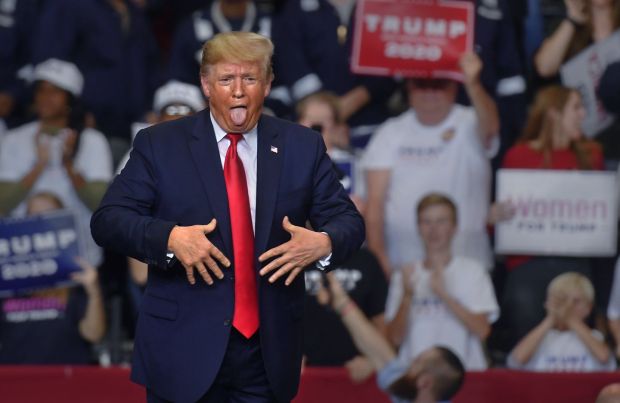
Month: April 2020

What can one do when the Death Merchant is King?

A soon-to-be former Facebook “friend” recently sent a very simple question, using white words on a black background: “Can you name a President that didn’t lie?” He then quickly added the first comment before apparently fleeing the scene, “Go ahead, make my day.”

Brilliant, no? In came a rash of replies, many of them actually indulging the poster by naming their choice of a non-lying or least-lying American head of state. Jimmy Carter, Lincoln, FDR and George Washington were all offered up. More promisingly, some people sniffed out his gambit, answering with the usual Trump-hating retort that he “lies as he breathes.” That would have been my first impulse, but after a recent rash of such social media sleights-of-hand I paused.

The whole question was a grotesque false equivalency. I replied, “That’s like asking ‘Who never stole some office supplies?’ to make it seem like the same offense as someone who blows up the office building with all the workers inside.”

Hey, it got one Like anyway. The comments continued, Washington was named again. I tried to bring poster out of hiding, calling him out with the question, “Care to join us?” Nothing. Unfriend and move on.

Apparently, it’s OK for an American president to sit on his now blood-stained hands and do nothing for a whole month as a pandemic raged across the planet, claiming that there was only one confirmed Covid-19 case and that it was a hoax of the opposition Democratic party. Then when it got to the point where even the intellectually-void narcissist who goes by the name of Donald Trump couldn’t deny the scope of this disaster, he of course knew about it all along even though he was just calling it a hoax while the death toll climbed to over 20,000. That’s OK, because Everyone Lies.

The sniveling dishonesty (or ignorance) of that Facebook poster was esp. troubling to me. In a better world, it would be common knowledge that people in many walks of life (not just politics) sometimes bend the truth to win people over to their way of thinking. That is bit different from the actions of a demented demagogue like Trump whose whole perversion of a life has been one gigantic lie.
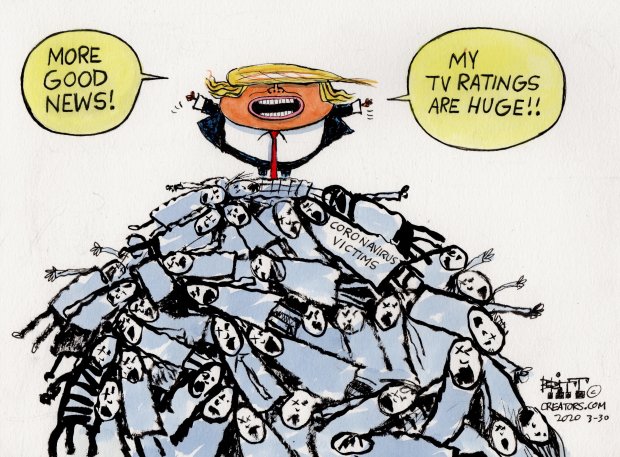
Covid-19 may be a terrible global pandemic, but Trump is a uniquely American form of moral plague. He’s the son of a Nazi-sympathizing landlord father who started Donnie off with a cold shoulder and a small loan (actually, a shady $14 million trust).The story could have ended there. With a few safe investments, this spoiled dimwit could have lived the life of a callous playboy and left the rest of the world alone. But no. Somewhere “The Donald” developed a chip on his shoulder that was as big as that world he would someday try to fuck over. Having no discernible talents yet possessing a malignant compulsion to be the center of attention, Trump achieved that most (ugly) American of goals: being famous for being famous. Everything else has been tasteless buildings, bankruptcies, failed casinos and airlines, legal entanglements, admitted sexual assaults, unpaid contractors, and the insipid “Celebrity Apprentice” TV show where he lorded over pathetic ex-stars like Gary Busey.

But that ability to focus all attention on himself, most often by denigrating “elites,” minorities and the underprivileged, was underestimated by many on his way to an Electoral College victory in 2016 (though he lost the popular vote by a hefty three million votes). Yes, he released a tidal wave of latent racism and made hostility a virtue for millions of (mostly white) Americans whose own sense of powerlessness is often unfocused or greatly exaggerated. Of course, psychiatrists have had a feel day for the last few years. One aspect that I like is Trump supporters’ receptivity to a “primitive morality” of might-makes-right, which is normally grown out of by age five or six. To people who never outgrew this, or have reverted, this cartoonish display of power is more important than real-world abilities. It is also inherently violent (this includes economic violence), even to the point of followers happily becoming his victims. Is it any wonder he “loves the poorly educated”? Trump is so boxed in with legal issues and Russian duplicity, that his only choices now seem to be remain President or go to jail. He has now become the American Death Merchant who also wants to be king.

This is not new. In this exceedingly disturbing photograph, Trump and his null-and-void wife Melania, grinning maniacally like the very Angels of Death, pose in El Paso with the baby whose Hispanic parents had just been murdered in that week’s mass shooting. One columnist suggested that to Trump, this baby is “little more than a hunting trophy in his own brutal race war.” That may explain why Trump is insanely giving a thumbs-up.

Trump wants “total authority” but “takes no responsibility” and because he was afraid for his re-election prospects, we have now seen 32,000 die (as of April 16th) from this “hoax.” Some 22 million Americans have filed for unemployment and you can’t go anywhere anymore without feeling you could be the next to go. But this infantile ghoul has accomplished his one central goal in life: love him or hate him, everyone is thinking or talking about him all the time. But even the Death Merchant can’t escape immortality. And though John Donne, in his “No Man is an Island” poem said that “Any man’s death diminishes me,” I’m not sure that will ever apply to someone who has so divided us into many little islands, first politically then physically into a social distancing archipelago that could last on-and-off for years. So when it’s Trump’s time to go, feel free to ask for whom the bell tolls. Because it will toll not for thee but only for he, and the rest of us will be much better off whether we care to know it or not.

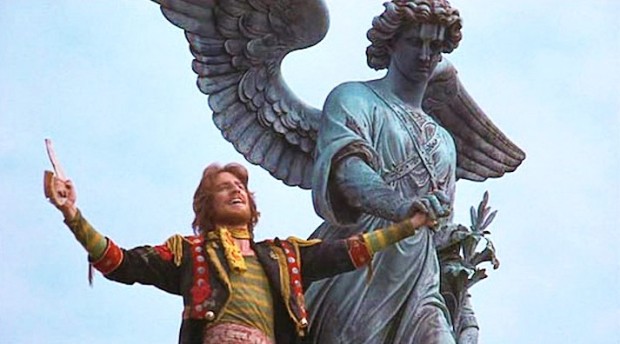
Tinseltown Rock #3: “Godspell” (1973)

The musical Godspell certainly came into the world at the right time, during the height of the early Seventies “Jesus Rock” mini-genre. Although the concept album Jesus Christ Superstar had hit the stores in 1970, this Stephen Schwartz-penned production hit the stage first, debuting Off-Broadway in March of 1971 several months before the Andrew Lloyd Weber-Tim Rice blockbuster raised curtain on the Great White Way. At the same time, the AM stations were sprinkled with hit songs like Norman Greenbaum’s “Spirit in the Sky” and Ocean’s “Put Your Hand in the Hand.” The idea of Jesus as a sandal-footed advocate of selfless human values had firmly caught on with many in the counterculture as the Sixites gave way to the new decade.

Meanwhile, in my own little corner of the world, this musical trend played out during my last two years (7th and 8th grade) of parochial school. There had been a marked change during the eight illustrious years I spent at St. John’s School in downtown Peabody, Mass. The earlier years were marked by a grim catechism and vestiges of corporal punishment—ear-pulling was still a go-to tactic of the older nuns (luckily I was spared). By the time I hit sixth grade, the modernizing Vatican II decrees were in place, and there were hippie-ish nuns and younger priests with acoustic guitars at “folk mass.” By seventh grade, we were listening to Jesus Christ Superstar in class, our homeroom sister tittering at the use of the term “J.C.” to address the Messiah.

Although our tastes were running more to Rod Stewart and the Stones, we dug JCS. It was a straight-up rock opera, musically compelling and contemporarily astute in its retelling of the Passion of Christ, with anti-hero Judas at the center of the action. In the eighth grade (1971-72) it was all about Godspell, with a field trip to Boston’s Wilbur Theater in the offing to see a performance by the touring company. The record, with its familiar illustration of Jesus against a red background, was ubiquitous and the single “Day by Day” hit #13 on the Billboard charts. But this was a different proposition, a more traditional (and largely plotless) musical based on a series of parables adapted from the Gospel of St. Matthew. Godspell also seemed to tap into the so-called “Jesus freak” scene of the time, with its ragamuffin characters exuding relentless good spirits and hamming it up in such a way as to convince the world that vaudeville was not dead after all. Still, we 14 year-olds ate it up, debating our favorite songs and having a ball at the Wilbur Theater. It was my first time at seeing a big-time theater production and though I could sense the corniness of it all, the in-your-face eagerness and enforced audience involvement, it was a spoonful of sugar that helped the last year of my Catholic medicine go down.

By the time this film adaptation hit the screens in 1973, that overweening flower-power jauntiness must have seemed to many to be past its shelf life. It doesn’t take long for the film to give you this feeling. Shot entirely on location in the Big Apple, it begins with John the Baptist (David Haskell) pushing a cart over the Brooklyn Bridge pedestrian boardwalk into Manhattan and into cinematic immortality of a sort. He cases out eight potential disciples in a manner that may nowadays seem a little creepy. He then blows his fanfare trumpet from the top of the Bethesda Fountain and, after a quick Friends-style baptism, it’s showtime!

And so it goes for most of the film, until the betrayal and death of Christ is quickly taken up near the end. Jesus is played by the wispy Victor Garber whose face paint and mime-like outfit, complete with stylized Superman t-shirt, is like an open invitation for skeptics. But hey, I’ve always considered myself a fair-minded critic and I will say that the early parts of the movie are the strongest, before the relentless mugging and prancing becomes too much. “Save the People” exudes a certain poignancy, Garber’s plaintive tenor is just right as he ponders “Shall crime bring crime forever?” and pleads for the exaltation of everyday people, “not thrones and crowns.” The camera’s telephoto shot of massed skyscrapers neatly show the concentration of power and money that have replaced those thrones and crowns, never mind the fact that when it pans down to the street the troupe are playing leapfrog on the empty avenue. The J-man and the Baptist lead the apostles, now all dubiously attired in patched-up glad rags, light out to their new HQ on Randall’s Island. They take on a purposeful, march-like gait under the multitudinous (and cathedral-like) support beams of Hell Gate Bridge, apparently prepared to set the world to rights.

But there’ll be no fishes ‘n’ loaves action here. From here until the end credits you’ll hardly see another soul. The ten-member cast proceeds to sing and tell parables amongst themselves in a strangely de-populated New York City, strange that is until the recent scenes of a ghostly Gotham in the throes of the current Covid-19 pandemic. Of course, this insularity derives from it being a play with humble beginnings (Godspell was conceived and first staged by Jean-Michael Trebelak at Carnegie Mellon Univ. as his masters’ thesis). But the insularity, along with the suffocating positivity, soon gives the group an almost cult-like demeanor, starting with the clip below.

The troupe put a fresh coat of hippie paint to their new scrapyard base of operations, set to the new version of “Day by Day”, here sung by the tomboyish Robin Lamont (all the apostle actors retain their first names in character)

Rather than go out into the world and do good deeds as the historical Jesus probably would have wanted, director David Greene retains the let’s-put-on-a-show impetus and “opens up” the stage musical by using his Columbia Pictures budget, and an oft-used zoom lens, to stage scenic production numbers all over the city: Lincoln Center, Times Square and the top of the nearly-completed World Trade Center are just three of the famous sites used in a single song, “All for the Best.” A nice “get” was the interior of the Andrew Carnegie Mansion, used as the setting for Joanne Jonas’ solo turn a la Mae West in “Turn Back O Man,” petitioning mankind to give up its foolish, materialistic ways.

The late Lynn Thigpen, who some may recall for her role in the Carmen San Diego TV series, does a bang-up job with “Bless the Lord” though the all-fall-down ending points up the film’s reflexive silliness.

Stephen Schwartz’s songs, with their appealing melodies and soaring choruses, can only support this movie so long with all the troubadour triteness going on. A lot of one’s receptivity to Godspell depends on how much one accepts the built-in artificiality at stage musicals. My receptivity became very limited very quickly after seeing the Boston production in 1972, by the mid-70s my idea of a touring company was when Jethro Tull or the Allman Bros. Band hit the Garden across town. Things improve a bit when the mood turns serious at the end, esp. with Katie Hanley singing “By My Side” and the vaulted supports of Hell Gate Bridge make a great setting for the “funeral” of Jesus.

But to what end? Does Godspell have something to say today, even for us secular humanists? There is if you stretch your imagination, and the kindness espoused does stand in stark contrast to the callous evangelists of today, who more closely resemble the money-changers Christ went ballistic on way back when, the ones who now defy state orders and recklessly urge their hapless parishioners to congregate during a pandemic, lest they miss even one week of the collection box. But for that we may need a new kind of righteouness, leaving the Godspell movie as the “patches and face-paint” relic it was even in 1973, never mind today.

You can check out the excerpt of my book “Rock Docs: A fifty-Year Cinematic Jorney” at http://booklocker.com/books/8905.html or by clicking on the book cover image above. If interested in purchasing, you can contact me directly for a special offer and free shipping! Thanks, Rick.
rick.ouellette@verizon.net

When Miles Ran the Voodoo Down: “Bitches Brew” at 50

The sessions that produced this landmark double-album by Miles Davis, released fifty years ago this week, began precisely one day after the Woodstock festival concluded. On August 19, 1969 at 10 AM—exactly 24 hours after Jimi Hendrix concluded the events in upstate New York with his legendary set—the 43 year-old Davis and his talented cast of young sidemen shuffled into Studio B at Columbia Records down in Manhattan to start work on Bitches Brew.

The timing has a nice symbolic ring to it. Bitches Brew has always been seen as a touchstone recording that fused the worlds of modern jazz and heavy rock. Actually, Miles had been leading up to this magnum opus with the four studio albums he released in 1968 and ’69, especially In a Silent Way and Miles in the Sky. Electric instruments and groove-like jams became more predominant and the players he had under his wing (Herbie Hancock, Wayne Shorter, Chick Corea, John McLaughlin, Joe Zawinul and others) would all become key players in the jazz-rock “fusion” genre that took flight in the Seventies.

Bitches Brew even today sounds adventuresome in an almost eccentric way. Many jazz purists were skeptical or downright hostile, rock fans were more welcoming. Weaned on the improv excursions of Cream and Hendrix’ Band of Gypsies, they helped get the album up to #35 on the Billboard pop charts. Over time, of course, it would be generally recognized as a masterwork. But not classic in the sense that Davis’ 1959 Kind of Blue is viewed. The more traditional Blue is the best-selling jazz album in history, while it took Brew thirty-four years to go platinum.


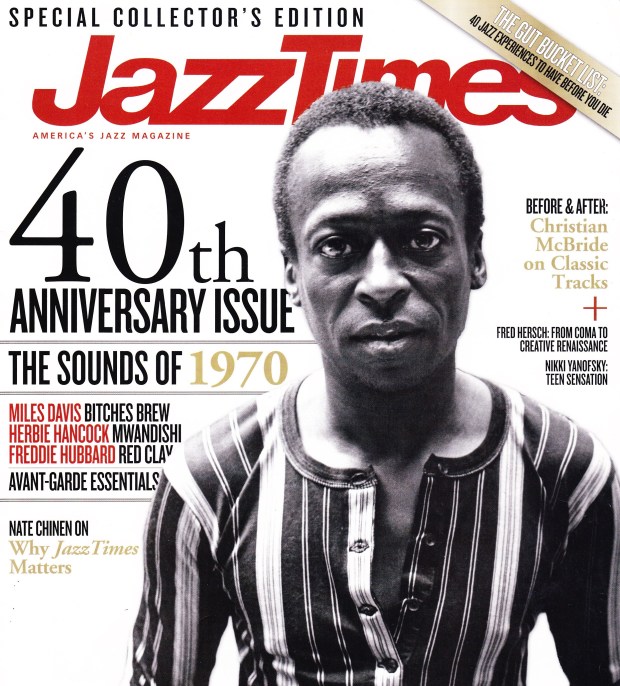
Thanks to this ten year-old issue of Jazz Times for many of the anecdotes in this post.

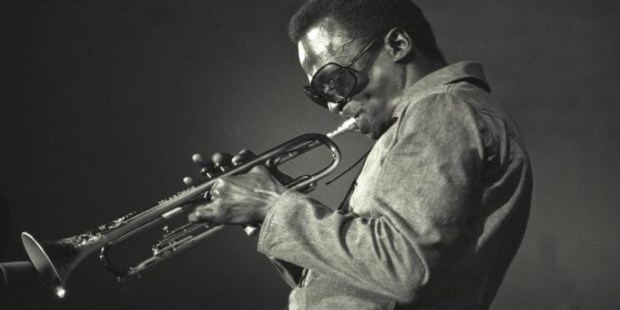
The 20-minute “Pharaoh’s Dance” takes up all of the old side one. It kicks off with a steady cymbal-riding rhythm, plus the brooding bass clarinet of Bernie Maupin and the whirling keyboards of no less than three electric pianos, played by Zawinul, Corea and Larry Young. Davis enters the picture at 2:30 with a trumpet solo that grows in volume and burns with intensity—a far cry from the cool and controlled tone he was once known for. Here he is blowing his horn over two sets of crashing drums (Jack DeJohnette, Lenny White) and the fevered conga slaps of Don Alias. At around seven minutes, John McLaughlin makes his presence known with some nervy electric guitar fills before the piece slips into a trippy section marked by Miles’ echoed trumpet.

That brief passage is an early indication (at least for the layman’s ears) of one of Bitches Brew central features: the use of editing and loops to mold a finished product from the extended sessions where producer Teo Macero let the tapes keep rolling (he an Miles would piece together the finished product later). This use of the recording studio as an “instrument” had been popular in rock music at least since the Beatles’ Sgt. Pepper but was pretty unusual (even controversial) for jazz, where an organic group effort would work in unison for a best take.

As Davis leads “Pharaoh’s Dance” to its dynamic conclusion with some sharp staccato runs, you get the full sense of just how big this post-bop wall of sound is. This track features three horn players, three keyboardists, two drummer, two percussionists and both acoustic and electric bass. The rest of the LP features the same massing of players, a clear departure from be-bop’s quartet and quintet conventions.

Next up is the alpha-dog title, another side-filler, this one at an envelope-pushing 27 minutes. The famous opening theme is a “tempo rubato” set piece with reverb-soaked electric piano and Miles’ stentorian trumpet blasts. It sounds like a clarion call from a distant planet. At the three-minute mark a groove starts up—you can hear the leader snapping his fingers in time—with clarinetist Maupin and bass guitarist Harvey Brooks kicking it in (Dave Holland plays the stand-up bass). It predictably builds up momentum in the tenacious, if occasionally disheveled, manner of this album. Miles lets rip another upper-register solo until overtaken by McLaughlin’s guitar and a return to the rubato. Another jam follows with noticeable edits until the clarion blasts return to end it.

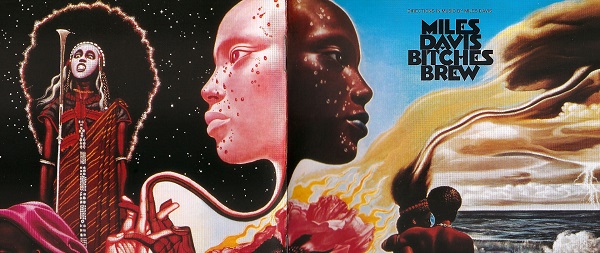
The whole effect is bracing, radical and a little disjointed. But Bitches Brew was the was the whole package, otherworldy right from Abdul Mati Klarwein’s Nubian fantasia gatefold cover art down to the very last groove etched into the vinyl. Still, some listeners likely had jumped off the bus by this point. Donald Fagen, whose Steely Dan was a rock band informed by its love of jazz, has said that the album “was essentially a big trash-out for Miles. It sounded like he was trying for a funk record and just picked the wrong guys.” Davis also took plenty of heat at the time from his colleagues. Holland has told Jazz Times of a backstage scene at the Village Vanguard club in New York. “His older friends (were) telling him he was destroying jazz. But Miles stuck to his guns.”

That, of course, was just like Davis. He was an uncompromising, sometimes menacing, personality, whose life mission seemed to be staying one step ahead of everyone, all else be damned. His influential, forward-thinking sensibility can esp. be heard on side three’s “Spanish Key.” Here is a more straightforward avant-funk jam, the kind that would go on to inspire future R&B and hip-hop artists. It’s also a coming-attractions showcase for future fusion stars, featuring brilliant solos from saxophonist Wayne Shorter (Weather Report), Chick Corea (Return to Forever) and John McLaughlin (Mahavishnu Orchestra). The next track is even named for the guitarist, a piquant guitar workout that, at 4:36, is the only cut that is less than ten minutes.

The aptly-named “Miles Runs the Voodoo Down” is a stunning 14-minute number whose smoky groove makes it initially sound like one of the LP’s more laid-back tracks. Here both Holland and Harvey Brooks take up the electric bass, Don Alias joins Jack DeJohnette on drums and Maupin’s down-low clarinet completes the rock-solid rhythm section. Miles’ skittering runs eventually build-up to an exciting (if chaotic) plateau with Corea and Joe Zawinul soloing simultaneously on electric piano before Davis re-enters with his some of his most sensuous playing on the album.

The title and first few free-floating minutes of “Sanctuary” give the impression that Bitches Brew will go out on a (relatively) reflective note. But nothing on this revelatory record is that simple and when the clattering drums enter the picture you realize that there is no easy sanctuary in this world and the abrupt ending is as enigmatic as the man would have it.

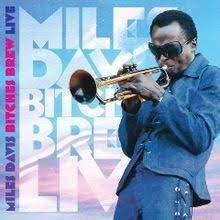
Most of the standard 2-CD editions of Bitches Brew include the excellent add-on track “Feio.” Naturally, there are a few kitchen-sink BB box sets to choose from, centered on the 40th and 50th anniversaries. One related release that I like is the one-CD Bitches Brew Live. It is split between Miles’ July 1969 performance at the Newport Jazz Festival (one month before the BB sessions) and his full August ’70 set in front of 600,000 rock fans at England’s Isle of Wight.

The career of Miles Davis took a typically unusual turn not long after Bitches Brew. Next up was the even more rockist Jack Johnson and a few similar releases. But not long after the poorly received (initially anyway) On the Corner, Miles took a five-year hiatus, saying he “couldn’t hear the music anymore.” (A typically strange but astute but Miles-ism). After his self-imposed exile, Davis retained his popularity if not his cutting-edge status; that period is perhaps most known for his crowd-pleasing versions of such pop hits as Cyndi Lauper’s “Time After Time” and Michael Jackson’s “Human Nature.” In concert, he still could rip it up as I witnessed when I saw him at Newport in 1989, two years before his passing. He had the hipsters in awe and many of the wine-and-cheese blanket-sitters scratching their heads, a true maverick right to the very end.

–Rick Ouellette 4/4/2020
This is #17 in my “Make Mine a Double” series. Next up: Elton John’s “Goodbye Yellow Brick Road”