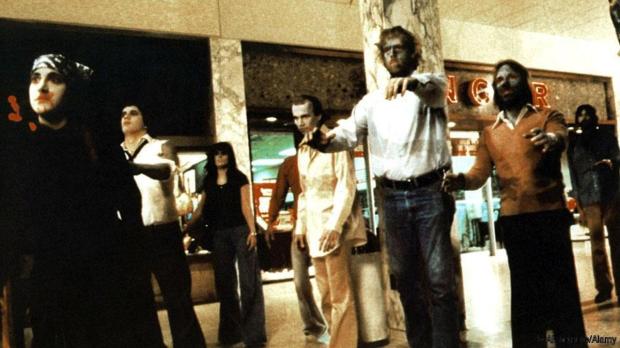
There’s a scene early on in George Romero’s 1978 zombie epic “Dawn of the Dead” where a traffic reporter and his producer/girlfriend (along with two SWAT officers) flee the apocalypse in his helicopter. Seeking refuge, they come across a large shopping mall, and figure it may be a good place to hole up—even though many of the walking dead are already ambling through the empty parking lot towards the entrance.
Baffled, the producer asks, “What are they doing, why do they come here?” Her fly-guy looks down thru aviator shades and deadpans, “A kind of instinct, memory… this was an important place in their lives.” Howls of audience laughter were all but guaranteed.
Hitting the mall, George Romero style.
But comic relief aside, the large indoor mall was a significant place in the lives of many Americans. That is until Amazon came along. The double whammy of online shopping and the Covid pandemic caused many such shopping centers to see their vacancy rates skyrocket—making them more suitable as the setting of a ghost story than of a zombie rampage.
This trend has given birth to the new verb “deadmalling,” whereby urbex photographers and lovers of liminal spaces visit these forlorn victims of a fickle consumer culture. I recently hopped onto this bandwagon, visiting four struggling malls in the Boston area. (Emerald Square Mall, Liberty Tree Mall, Solomon Pond Mall and the Kingston Collection).
Since the middle of the 20th Century, these places were the engine that drove the American idea of identity-through-acquisition. But at least you had to get up and go somewhere, park and then walk to your destination store, then interact with another human being. They were also social gathering places, and many people of coming of age in those decades will fondly look back at the “mall rat” days of teenage bonding.
You won’t likely find roving bands of incorrigible kids roaming the corridors of dead malls. While they live it up on social media, and their parents buy “everything” on Amazon (if only I had a dollar for every time…), a mostly older clientele shuffle around and check out what stores remain or head to the multiplex cinema which always seems to be situated in the property’s deepest recess. Many are there to simply get some exercise—mall walking has long been a thing for seniors. It was a little eerie when I noticed that many don’t just walk straight down the hallways but hew to the perimeter, like they were assigned the outermost lane at a track meet.
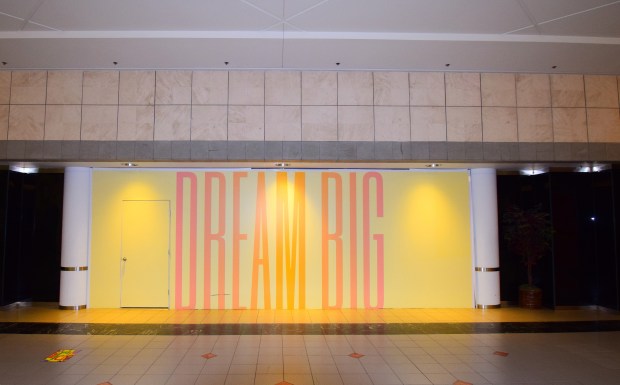
It’s all a bit unsettling, with its blank-faced side entrances, darkened food courts, former anchor-store dead ends and the isolated sitings of photo booths, massage chairs, kiddie rides and gumball machine stations. But there is also a weird, minimalist beauty to a lot of it, though I don’t believe the architects and designers ever imagined they would be appreciated this way.
While online shopping certainly has its place, its existence should not preclude previous ways of doing things, although I’m afraid that thinking through things is not currently a noticeable American trait. Amazon owner Jeff Bezos may be a very successful businessman, but he is far less successful as a human being (as anyone left at the Washington Post could tell you). His retail model has not only helped to close anchor stores but also uncountable small and middle-size businesses. Working at a mall might not be the greatest, but it beats the soul-crushing pressures of working at a cavernous Amazon warehouse, where many employees are only one rung up the ladder from bonded labor.
The malls that are surviving have opened themselves up to some smaller and/or quirkier retailers and added various events and alternate uses to help stem the tide. Some of them won’t make it and many others will likely lurch along in the strange twilight bubble they exist in now. One of them, the Monroeville Mall outside of Pittsburgh (where “Dawn of the Dead” was filmed) has recently added a museum/gift shop dedicated to “Night of the Living Dead” its (literally) ground-breaking predecessor in the original “Dead” trilogy. I’m sure the late Mr. Romero would appreciate that.
In one way, you’ve got to hand it to the ancient astronaut “theorizer” Erich von Daniken. The Swiss author, who passed away on January 10th, built himself a very lucrative career on the preposterous idea that visiting space aliens constructed everything from the Great Pyramids to the Easter Island statues, and just about anything else from the B.C. era. His 1969 book “Chariots of the Gods?” and the subsequent film captured the attentions of millions (including myself) despite not having a shred of evidence to back up its claims.
It did inspire a sense of awe and wonder when it came to the cosmos and the colossal monuments of ancient civilizations. But in a saner world, “Chariots” would have remained a cultural curio of the Seventies. Instead, von Daniken’s stubborn promotion of the ancient astronaut trope—played out over some 25 books and debunked by everyone from Carl Sagan on down—became a gateway drug for the destabilized world we live in today. A world that is filled with conspiracy theories, misinformation, willful ignorance, distrust of expertise and “alternative facts.”
To begin with, Erich von Daniken’s publishing empire was built on fraud, literally. A high-school dropout of no known talents but an interest in UFOs, he swindled his employer (a resort hotel in the Swiss Alps) for $130,000 to finance his travel to far-flung destinations in preparation for his first book. He was convicted and served one year of a 3 and ½ year sentence. “Chariots of the Gods?” was turned down by several different publishers until one agreed on the condition that a professional writer be brought in to fix the manuscript. This was Utz Utermann, previously best known as the editor of a Nazi Party newspaper. Just saying.
One saving grace of the “Chariots” film is the beguiling soundtrack by the Peter Thomas Sound Orchestra. “Book of Ezekiel” is a highlight. Of course, Ezekiel’s Wheel was a UFO according to von Daniken.
If Daniken had any writing chops, he could have turned his ancient astronaut thing into an entertaining science-fiction series. Instead, he plowed ahead with his outlandish theory and exploiting an impressionable public newly inspired by the U.S. moon landings. Most galling is the utter contempt Daniken seemed to have for the human race. To imply out of hand that ancient civilizations were incapable of constructing anything better than a mud hut is profoundly insulting. It also ignores historical and scientific research that traces the ingenuity, technology, and development of ancient human cultures. But of course, ol’ Erich had no use for that and instead endlessly claimed that experts (esp. archaeologists) had something to hide. There’s not much of a leap from that to the present-day Trumpie anti-vax crowd that seemed to think that Dr. Anthony Fauci’s whole life was leading up to his big opportunity to fool them into taking a Covid shot.
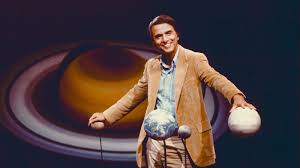
Carl Sagan on von Daniken: “That writing as careless as his, whose principal thesis is that our ancestors were dummies, should be so popular is a sober commentary on the credulousness and despair of our times.” Anybody interested in a point-by-point debunking of the ancient astronaut theory can check out Ronald Story’s “The Space Gods Revealed” and Clifford Wilson’s “Crash Go the Chariots.“
In 2009, von Daniken put it all on the table with a tome called “History is Wrong.” But of course it is. Why believe people who have studied history all their lives, when you can go all in with a convicted embezzler and check-forger who has even admitted to embellishing his claims? Sound familiar? And the man’s twisted legacy lives on in the so-called History Channel and its various “Ancient Aliens” programming. During a single one-hour show, I jotted down all the modifiers:
“There are claims that…”
“There is a theory that…”
“Could it be that…”
“Local legend says…”
Some maintain that…”
“It is rumored that…”
“There’s reason to believe that…”
And my favorite: “You have to wonder…”
Yeah, and I’m wondering right now: how the hell did we get so soft? To have this disregard for the abilities, ideals and aspirations of our own freakin’ species, not just in the ancient world but also in the modern. And left with the hollow phrase of UFO acolytes, “I want to believe.” Believe in what, exactly? Has the world become so daunting that our only hope is that some benevolent alien race is going to come to earth and solve all our problems? Yeah, there was a “Twilight Zone” episode about that once. It ended with that thing about “To Serve Man” being a cookbook.
In an enlightening article published a week before Christmas 2025, New York Magazine writer Lane Brown states that, “Stanley Kubrick’s movies have a habit of aging into new meanings, like monoliths that take time for us apes to figure out.” The enigmatic, maximalist director (2001, Dr. Strangelove, Clockwork Orange, Full Metal Jacket) died in 1999, just four days after completing his final film, Eyes Wide Shut. And it is that psychological fantasy drama, starring then-married Nicole Kidman and Tom Cruise, that is the subject of Brown’s piece. To wit: that “Eyes Wide Shut” could be a coded warning from Kubrick about the horrors of the Jeffrey Epstein sex-ring, which was assumed to have started a few years before. (The “evidence”? There’s a guy who looks like Epstein in the background and Kubrick died right after allegedly having an argument with studio heads, etc.)
Yes, of course, it is bat-shit crazy. The general public should have learned its lesson about pop-culture conspiracy theories way back during the silly “Paul-is-Dead” affair during the latter years of the Beatles. To even assume that reclusive Kubrick, a true artist and not a feckless Reddit rumor-monger, would have had knowledge of this sordid affair and spend years making a 160-minute feature film about it, instead of calling the authorities, is mind-boggling in its inanity.
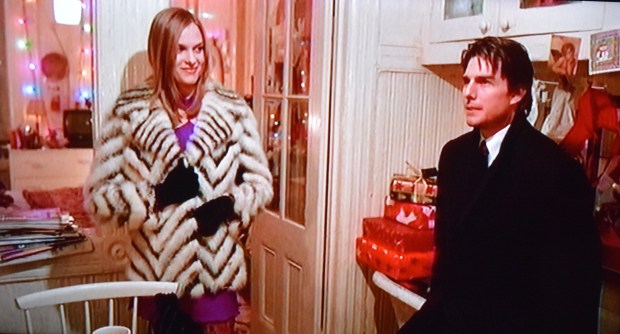
What Kubrick was aware of is the crushing effect of the misused privilege of the upper-upper classes, a theme he also explored in 1975’s “Barry Lyndon.” If the Internet time-wasters focused on this instead of their fictitious figments, it would all be for the better. Eyes Wide Shut is based on the 1926 book “Traumnovelle” (Dream Story) by Austrian author Arthur Schnitzler. It examines the uneasy marriage of upscale Dr. Bill Harford (Cruise) and his wife Alice. Schnitzler was part of European “Decadent” cultural movement, and though the setting is moved from Vienna at Mardi Gras to Christmastime in 1990s New York City, the film doesn’t take long to fit in with this epoch. First there is the ritzy and libertine Christmas party thrown by one of Bill’s super-wealthy patients, Victor Ziegler (Sydney Pollack), where the doctor is called upstairs to administer Victor’s clandestine date, an unclothed hooker who has almost OD’d on a heroin/cocaine binge. After dealing with the situation, Bill is predictably asked to keep it quiet. But a solitary speedballing prostitute is only the tip of this cold-hearted iceberg.
A key scene where the couple talk about their separate flirtations at the party is topped off by Alice revealing her obsession with a handsome naval officer she saw while on vacation, claiming she would leave Bill and their young daughter to be with him. The emotionally upended doctor is then summoned away on a house call. It leads to his all-night series of erotic but unconsummated encounters in a slightly-surreal looking Greenwich Village, and the film’s centerpiece, an elaborate ceremonial orgy scene at a secluded Long Island estate, a place where Bill shouldn’t be and where life is cheap if you’re one of the imported sex workers.
Vinessa Shaw and Tom Cruise discuss Christmas finances.
The tepid response to Kubrick’s last film is partly due to lack of clarity (and subsequent lack of viewer understanding) concerning the work’s origin in dream psychology. (It’s notable that Schnitzler was a contemporary of fellow Austrian Sigmund Freud). “Eyes Wide Shut” is a title indicating “dream awareness,” a kind of window into a deep psychic underworld, where a fantasy like Alice’s would seem to determine a marriage soon to implode. Bill’s Village wanderings, taken at somnambulistic pace, include a vaguely romantic encounter with a streetwalker (see above), interrupted when Alice call him on his cell, being accosted by the betrothed daughter of a freshly dead patient, being shoved aside and gay-baited by a gang of future MAGA assholes, and meeting the sexually promiscuous daughter of a costume-shop owner (played by a 16 year-old Leelee Sobieski).
In one of the film’s most chilling scenes, the costume-shop owner (played by Rade Serbedzija) has suddenly “come to another arrangement” and seems willing to pimp his daughter, hinting at the nefarious workings of secret societies that haunt the movie.
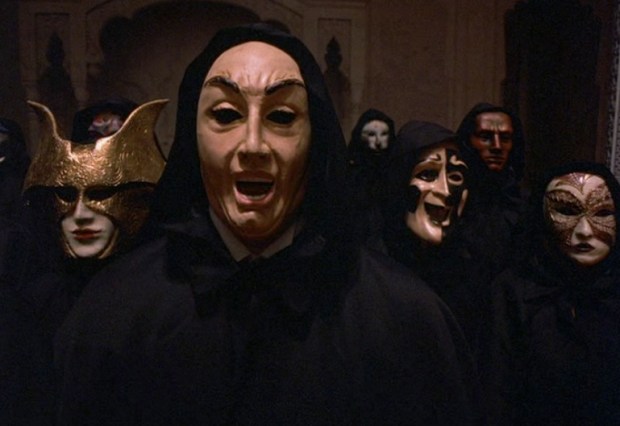
Though it seems like the biggest fever dream of all, Kubrick’s highly stylized orgy scene could be the most plausible aspect of the film. The horrid revelations about the late Jeffrey Epstein, his amoral imprisoned accomplice Ghisane Maxwell, and the numerous powerful men who somehow can’t resist spending time with underage girls, make the orgy seem at first like an elaborate masquerade party, despite the ominous complications caused by Bill’s crashing the scene of the country’s most rich and powerful having it all their way. But the slow-burning but riveting penultimate scene in the billiards room (below) where the untouchable Ziegler uses both tact and veiled threats to make sure to this little Upper West Side doctor will never again spoil the fun. And if someone dies gets themselves killed along the way, so be it. “Someone died, it happens all the time,” Ziegler concludes, sounding like Trump after the latest mass shooting.
At the top of the Epstein list of course, is the Orange Puke From Hell, the current president and convicted sex felon and vile authoritarian-minded degenerate—not to mention a person who built his entire political rise on mendacious conspiracy tropes and toxic social-media exchanges. He has since dragged us so far down into it with him, it feels we can’t stand up for falling down–giving our life over to grievance, rage and fear, both when it’s justified and when it’s not.
Mr. Kubrick, enjoying the holidays his way.
But instead, let’s look into the deeper meanings of what comes across our radar every day, instead of letting everything be a conspiracy or a grievance. And as Stanley Kubrick noted, our dream world is as instructive as the waking one and leads to a reconciliation of this film’s couple (while also acknowledging that “a dream is never just a dream”). The societal reconciliation that would lead all sides to finally come down on the side of stemming the unchecked power of the 1% still seems very far off. So, in the meantime, like in Greg Lake’s famous holiday song, “the Christmas we get we deserve,” meaning the biggest lump of coal that can fit into Santa’s sleigh.
A recent article mentioning that National Geographic has named Pittsburgh one of the Top 25 places to visit in the world (the only U.S. city to make the list), was posted online and made my Facebook feed. Invariably, one of the first comments was “That’s the best laugh I had all day.”
I was tempted to reply, “How so?” But I’m trying to be less judgy nowadays, so I let it slide and left a comment saying how much I enjoyed my own trip to Iron City last year. I mentioned the newly expanded Andy Warhol Museum, a great ballgame experience at the Pirates’ PNC Park with its bridge-and-skyline backdrop, the Nationality Rooms at the Cathedral of Learning and the colorful folk-art complex called Randyland. (See below)
Besides, if I asked that person why she thought it was so funny, the likely answer would be: “Really, I mean, PITTSBURGH?!” If there is one thing I’ve learned over the years, it’s that people love knowing what they already know, even when it’s wrong. This is esp. true when it comes to Rust Belt cities. If you mention Cleveland, a likely response is about the Cuyahoga River being on fire, even though that was 56 years ago. And don’t let’s get started about the state of New Jersey, which many motorists have reduced to the “smelly” stretch of I-95 opposite New York City, filled with refineries and powerlines. We want all the gasoline and electricity we can get—but are somehow offended to see where it comes from.
The AKG Museum in Buffalo. The mirrored surfaced of the institute’s modern walkway reflects both the older building and an outside sculpture.
Perceptions are gradually starting to change, and just not in Pittsburgh. Buffalo’s AKG Art Museum was named by Time magazine as one of The Greatest Places in the World in 2024. A dazzling modern addition has been added to the original 1905 Greek temple-style original, connected by a serpentine elevated walkway.
And the AKG is far from an isolated location: it sits in the middle of Buffalo’s cultural corridor near Frank Lloyd Wright’s jewel-like Martin House, the Buffalo History Museum (housed in the only remaining building from the city’s 1901 world’s fair), an outdoor Shakespeare theater and various gardens and a lake with flamingo pedal boats. All of this in the beauteous confines of the Frederick Law Olmstead-designed Delaware Park.
But my favorite part was staying at the nearby Richardson Hotel (above), which occupies the middle section of the former Buffalo State Asylum. Opened up in 1880 on grounds also designed by Olmsted, this massive architectural gem was an early commission of famed architect H.H. Richardson, fresh off his masterful Trinity Church in Boston. Underneath it’s two colossal towers, the main administration building, as well as its two matching Romanesque wings, make up the footprint of this remarkable boutique hotel. As with many such facilities, this asylum grew overcrowded and it was expanded (in brick, not the expensive Medina sandstone of the original building) to such an extent that it takes about a half-hour to walk around it.
The nighttime photo at top shows both the elegance of Richardson’s design and the great work of the restoration crew. The bottom photo gives one some idea of the scale of the former asylum, some of which is hopefully being set aside for much-needed affordable housing.
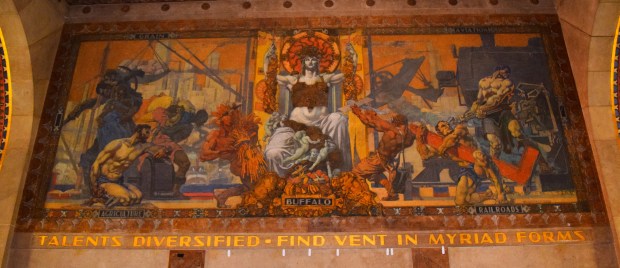
Like many other state hospitals, this one was closed in the late 20th century. But unlike others that were demolished without much opposition, Richardson’s piece de resistance sat there until the city realized what they had. Now this asylum is a point of civic pride, a lynchpin in the city’s ambition to become a design capitol, with a focus on the many significant buildings, including its magnificent City Hall (below) and Central Terminal (currently being restored), two of the region’s premier Art Deco edifices.
The effects of deindustrialization has been devastating for many U.S. cities in the Northeast and Midwest. The poverty, crime, population loss and disinvestment that followed is of historic proportions. But a potential silver lining is the fact that, at their economic peak, places like Buffalo, Pittsburgh, Cleveland and Detroit used some of that manufacturing wealth in the building of first-class (and often majestic) museums, libraries, theaters, railway stations, hotels and monuments—all speaking to a grand sense of collective civic pride all but missing in our age of calcified socio-political divides.
A mural inside Buffalo City Hall from more optimistic times.
I’m not suggesting, or even hoping, that people will give up the default destinations like Las Vegas or Disneyworld. Yet the trend towards sub-genres of domestic travel is encouraging and should help in the nascent Rust Belt revival. These days, there is foodie tourism, historic preservation tourism, music tourism, film festival tourism, sports tourism—Pittsburgh is hosting the NFL Draft next year and it’s a BIG deal. Anything that gets us out and about on a path that leads to greater understanding of our common heritage is a welcome move in the right direction in these wrong times.
Lastly, a word about an even newer trend: abandoned steel mill tourism. In the not-too-distant past, places like the former Bethlehem Steel plant (above top) and the Carrie Furnaces (above bottom) were top-line locations for the urban explorer community. Now I’m no stranger to the wild and woolly world of urbex photography. But I have never been one of its real hardcore practitioners and I was glad when I eventually got the chance to visit such places without fear of arrest.
The gargantuan Bethlehem Steel plant (renamed Steel Stacks) is now the dramatic backdrop to an outdoor concert venue and cultural center. The elevated walkway brings one up close to this amazing structure. Placards inform the visitor of the “Hot, Loud and Dangerous” conditions that the steelworkers put up with to provide the nation with its infrastructure. It’s a “thank-you-for-your-service” moment that some risk-taking explorers would not realize or get the chance to find out.
The same goes for the formerly off-limits Carrie Furnaces, now a state heritage park. Visitors can learn that this was a big part of World War Two’s “Arsenal of Democracy.” Factories on an 8-mile stretch of the Monongahela River, starting in Pittsburgh, produced more iron and steel during the war than all the Axis Powers combined. The scale and complexity of the furnaces are mind-boggling, and the implied message of strength and national unity is haunting in an age where even the word “democracy” seems compromised. So let’s get out there and live and learn: and when someone asks, “Pittsburgh, really?” you can answer, “Yes, really.”
Well, here’s the concluding entry in my survey of recordings in that most star-crossed category, the covers album. Star-crossed in an almost literal way: here are stars performing the songs of other stars.
After listening to so many of these albums I can only conclude that placing one or two well-chosen covers on an album of your own original tunes works a lot better. The reason is a whole collection of tributes usually tends to lack coherence and make even the best artists look like a bar band.
The best way around this is for your covers album to have some sort of concept. The highest-ranking record of Part One of this survey (David Bowie’s Pin-ups) worked so well because of its tight focus. Bowie was paying homage to British bands and key songs from the 1964-67 period, just before he broke thru himself. A similar concept guides the first record reviewed here, the only one other than Pin-ups to gain an A- rating.
Songs From a Haunted Ballroom—The Skids (2021)
While not a household name, most fans of early UK punk will recall this tenacious band who moved down to London from their native Dunfermline in the late 70s. The Skids gained notoriety not just for their tough-guy rep (legend has it that they picked fights in clubs to get their names in the English music press) but also for their aggressive-but-artistic musical approach. That included at least two Brit punk classics: “Into the Valley” and “The Saints are Coming,” both of which are featured here in re-recorded versions.
The rest of Songs From a Haunted Ballroom have an association with the Kinema Ballroom, a vital but volatile music venue in their hometown. The Skids, whose guitarist was future Big Country leader Stuart Adamson, got their start here, playing live sets opening for the likes of the Clash before the place changed over to a discotheque later at night.
Both aspects of the Kinema are celebrated here. Mainstay vocalist Richard Jobson is joined here by ex-Big Country second guitarist Bruce Watson and his guitarist son Jamie Watson. The lads come charging out of the gate with Ultravox’s “Young Savage,” one of many allusions to the club’s stormy history (“Anything goes where no one knows your name”). They tip their hat to the Clash with a nice take on “Complete Control.” In light of the father-son axe duo backing him up, Jobson is obliged to use the song’s proclamation “You’re my guitar hero!” not once but twice.
Elsewhere, there are enthusiastic, high-energy tributes to the Adverts, Sex Pistols, Iggy Pop, Mott the Hoople and Magazine. Just as welcome are some of the less obvious choices like Ace Frehley’s “New York Groove” and Garland Jeffrey’s “35mm Dreams.” The key track is probably their ominous take on David Essex’s glam hit “Rock On.” As an after-hours disco, the Kinema was a magnet for the region’s various violent gangs and apparently “Rock On” was the signal for the trouble to start. Jobson describes the scene in a mid-song monologue as the AV Toi (“the most mental gang in Scotland”) get ready to rumble. Grade: A-
Acid Eaters—The Ramones (1993)
As punk-rock pioneers, the Ramones need no introduction, but once you get past their mid-to-late 70s heyday, they become a lot less examined. By the late Eighties, original bassist and key songwriter Dee Dee Ramone had left, leaving CJ Ramone to man the front line with Joey and Johnny. CJ, who took some lead vocals, was an energizing figure but the band’s run was almost over.
On this, the Ramones’ penultimate studio album, the band matter-of-factly reposition themselves as acid-rock casualties: just look at the disconcerting covert art. Of course, it’s still them so don’t expect Dead-style noodling or Floydish space jams. Opener “Journey to the Center of the Mind” (sung by CJ) may be trippy but it also rocks.
The results here are entertaining if a bit predictable. The Ramones are in a comfort zone when covering their antecedents like the Animals, Seeds and Troggs. And it’s a blast to hear Joey’s long-loved voice singing the Who’s “Substitute” with no less than Pete Townsend guesting on guitar. The same goes when ol’ Bobby Dylan gets the Ramones’ patented faster-and-louder treatment. Their buzzsaw rendition of “My Back Pages” (check out Marky’s triple-time drumming and Joey’s rare lead guitar shredding) gives the Byrds’ celebrated version a run for its money
As usual, though, the results here vary. The Credence vibe (as in “Have You Ever Seen the Rain”) doesn’t seem to suit da brothers and their take on “Somebody to Love” (despite backing vocals by porn star Traci Lords) won’t make any baby boomer forget about Grace Slick. For my money, the Ramones’ best cover came on their next (and last) album Adios Amigos. Their version of “I Don’t Wanna Grow Up,” Tom Waits’ seriocomic take on the old Peter Pan trope, is made all the more affecting by being the final bittersweet salvo of the group’s perpetual teenage rebellion. (The video’s witty animation was done by famed comic artist Daniel “Ghost Story” Clowes). Grade: B (B+ if you add in the Tom Waits tune).
12—Patti Smith (2007)
Rising up from the same Lower East Side scene that birthed the Ramones, New York punk poetess Patti Smith showed a great knack for incorporating others’ work into her own on her revolutionary debut album in 1975. Horses kicked off with her radical recasting of the Van Morrison warhorse “Gloria” with her famous opening line, “Jesus died for somebody’s sins but not mine.” On side two her group seamlessly added “Land of a Thousand Dances” to the outré 9-minute “Land.”
It wouldn’t be until 2007 that the covers-album bug would give Patti a bite. Smith is famously expansive in her fandom, so it’s no surprise that 12 is a grab-bag of songs of different eras and genres. If you want to know how to get from Jimi Hendrix to Tears for Fears to Neil Young in three easy steps, here you are. If you’ve been yearning for a slow-paced version of “Smells Like Teen Spirit” complete with banjo and fiddle, your wait is over.
This will be a pleasurable listen for Patti Smith fans like me. But the fact that her take on “Everybody Wants to Rule the World” is my favorite thing here (despite not being even close to my favorite tune covered) goes to show just how random these records are. Grade: B-
Dylan—Bob Dylan (1973)
This long-derided album can’t be blamed on the artist. A record of traditional songs and covers, they are outtakes from 1970’s lowly-rated 2-LP set Self Portrait It was released against Dylan’s wishes by Columbia Records in “revenge” after Dylan had the audacity to jump ship to Asylum (he came back two albums later).
His largely indifferent takes of various non-originals made up about two-thirds of Self Portrait, and these are the leftovers. There are lackluster tributes to contemporaries (“Big Yellow Taxi” and “Mr. Bojangles”), a few deep oldies (“Spanish is the Loving Tongue” dates to 1907) and a three-hankie Elvis ballad (see below). Bob sings in his appealing “Nashville Skyline” voice but his delivery is lazy, and the record is marred by the overuse of a shrill female chorus too high in the mix. Some have suggested that the ever-cryptic Dylan was engaged in some perverse self-sabotage during this period. I tend to believe it. In his re-issue series, a collection from the same period, called Another Self Portrait, was released in 2013 and it’s freaking great. Grade: C-
Covers—Cat Power (2022)
Chan Marshall, the Atlanta-born singer/songwriter who goes by the stage name Cat Power, has been beguiling fans since she came on the scene in 1992. Her brand of subtle intensity may not be for everyone, but her unique musical stylings make her esp. suitable for doing other people’s material (this is her third, and most recent, covers album). Not everything here sticks the landing, but when it does it’s quietly captivating.
The best to my ears are her artful renditions of two poignant slow numbers. First is the Pogues’ “A Pair of Brown Eyes,” with Marshall accompanying herself on Mellotron (see below). Second is the Replacements’ barroom ballad “Here Comes a Regular.” There are other selections that show the depth of her musical appreciations: Nick Cave’s “I Had a Dream, Joe” and Kitty Wells’ proto-feminist anthem “God Didn’t Make Honky Tonk Angels,” the first C&W #1 hit by a solo woman. On the flip side, she does a song by lesser-chanteuse Lana Del Ray, Bob Seeger’s “Against the Wind” (barely recognizable) and a number from Ryan Gosling’s short-lived group. But with cover albums, variety is the spice of life. Grade: B
Kojak Variety—Elvis Costello (1995)
More “variety.’ First off, I’m glad that this album was named after a store near where it was recorded in Barbados, and not after the charmless TV detective played by Telly Savalas. Secondly, most know that Costello, a generational songwriting talent, has a keen ear for and encyclopedic knowledge of other great tunesmiths—he did a country covers LP (Almost Blue) only a few years into his career. This one also wisely sticks to a plan (the cover touts “Rhythm & Blues, Popular Ballads”) and said tunes are delivered in Elvis’ familiar self-assured style. You get them coming and going: songs by Willie Dixon, Mose Allison, Screamin’ Jay Hawkins, Little Richard, Jesse Winchester etc. Your favorite will depend on your preference for a particular tune. I love his emotive take on Dylan’s “I Threw It All Away” and esp. his elegiac take on Ray Davies’ bittersweet “Days.” This Kinks Klassic Kover was originally from the soundtrack of the Wim Wenders’ film “Until the End of the World,” where it was also a group sing-along during a campfire scene. Grade: B
Through the Looking Glass—Siouxsie and the Banshees (1987)
The distinctive, imperious voice of goth icon Siouxsie Sioux was well known by the time she and the Banshees decided to do this tribute album of early influences a la David Bowie’s Pin-Ups. And like Bowie, she was able to put a unique stamp on many of the well-chosen covers here. Dark and delectable tunes like John Cale’s “Gun,” the Doors’ “You’re Lost Little Girl,” and Kraftwerk’s “Hall of Mirrors” are naturals for her and delivered in excellent style.
Other tracks go next level: Iggy Pop loved Siouxsie’s version of his nocturnal road-tripping “The Passenger” (which added a neat brass section) so much that he asked to do a later duet version with her. Her goth take on the Billie Holiday nightmare classic “Strange Fruit” is not afraid to sit up right up there in the pantheon. And her eerie vocal on Television’s “Little Johnny Jewel” gives that early punk gem a second life, with guitarist John Valentine Carruthers ably reproducing the song’s infamous 8-note guitar motif while wisely avoiding a go at Tom Verlaine’s nervy, virtuoso solo. Grade B+
I didn’t have time to fully review Nick Cave and the Bad Seeds 1986 covers LP Kicking Against the Pricks but was taken by its closing number. It became a signature song (along with “Georgy Girl”) for fellow Australians the Seekers. Written by Tom Springfield, it seems an appropriate place to close. Like a carnival, cover albums have plenty of fleeting pleasure before they move on to another town, while you turn back to your favorite artists doing original material.
The 1975 science-fiction drama “Rollerball” was a bit of an odd duck of a film: come for the bloodsport, stay for the philosophy. Some weren’t buying. Though a success at the time, this movie has always split viewers and critics. While not sensationalistic enough for certain action fans, it was sometimes seen as too plodding in its thematic thrust by the smarties.
But for someone like me, who enjoys thoughtful sci-fi but also grew up watching Roller Derby on late night TV, “Rollerball” hits just right. Its stature has grown over time and is well worth a look now, esp. as the near future it predicted (the film is set in 2018) has come to pass by several years. (Please note that I’m recommending the James Caan-starring original and not the inconsequential 2002 remake, which currently has a 14% rating om Metacritic).
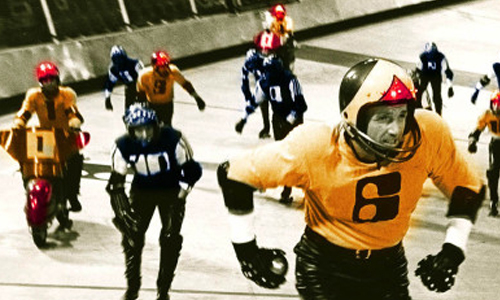
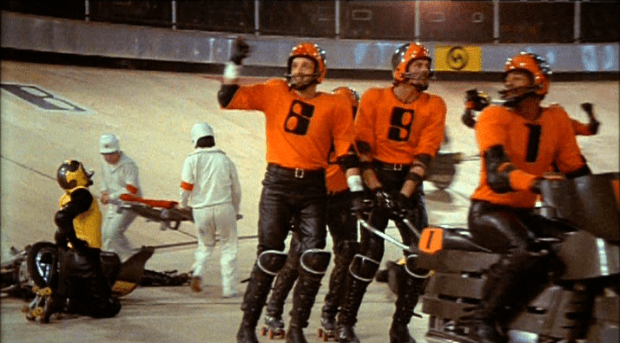
Directed by Norman Jewison, with a script by William Harrison based on his own short story, Caan stars as the foremost superstar of a global sport that combines elements of the old banked-track skating derbies with motorcross and barely-controlled mayhem. Jonathan E. by name, this seemingly indestructible team leader excels like no other at jamming the heavy silver ball into the goal without getting maimed for life (it’s not unusual for there to be fatalities during these “games”).
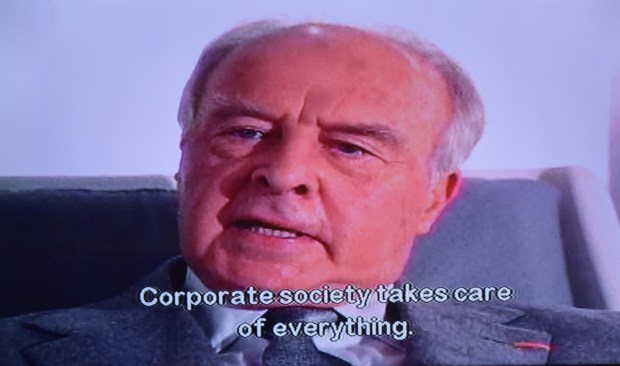
The setting is what I would call a “model dystopia,” where war has been eliminated and all material wants met in a world is run by a cabal of supposedly benevolent corporations. Rollerball is the one unifying element for regular folk to have a visceral outlet for the violence which has supposedly been eliminated otherwise. The game is tightly controlled by the corporations, who are starting to think that Jonathan E. is transcending this concept of social control.
The plot is simple: the corporation wants Jonathan to retire, Jonathan does not want to and attempts to use what leverage he has to resist. No offense to James Caan, who was at the height of his movie-star power and acquits himself well, but the real star of the show is John Houseman as head of Houston’s Energy Corp. and who runs the locally based team.
Houseman, who came up in the theater working with Orson Welles, enjoyed a late-career resurgence as a character actor, winning an Oscar for his imperious Harvard law professor in 1973’s “The Paper Chase.” He is similarly authoritative here, making perfect use of his haughty mid-Atlantic accent which he later employed in memorable TV ads.
His Mr. Bartholemew is a tough nut to crack but Jonathan E. pushes back, wanting to know how their decisions are made, and even to get to the bottom of the mysterious “corporate wars” that brought forth the “material dream world” that he apparently doesn’t appreciate enough, especially in view of the luxury lifestyle he is guaranteed even after retiring.
Aside from the fact that he loves the game and is loyal to his teammates, it is sometimes hard to understand Jonathan’s motivational end game. If he were to beat the global conglomerate, what would he do: bring back war and poverty? I’m kidding, but this does bring up a core problem with the model dystopia brand of futuristic fiction. I recently re-read Adolus Huxley’s classic “Brave New World,” which “Rollerball” resembles in its false-utopia of Pavlovian conditioning helped along by easy access to pleasure drugs and the state-sanctioned rotation of sex partners.
Yes, we have no books: James Caan as Jonathan and (left) John Beck as teammate “Moon Pie”
Bernard Marx, Huxley’s morose protagonist, does rebel against the mindless contentment of his world, chafing against the notion that “Everybody’s Happy Nowadays,” a phrase that inspired the great punk-rock single by the Buzzcocks. Bernard’s attempts to buck the system predictably leads to disaster and although Jonathan’s fate after the film’s climatic and grisly rollerball championship is left ambiguous one is left pondering: when we get the real-world dystopia we have coming to us, it probably won’t be with this government guaranteed sexual fulfillment and free Ecstasy. Just saying.
But although the expository scenes of this film may slow it down at times, Norman Jewison’s artful direction makes it a great watch. Jewison (whose credits include In the Heat of the Night, Fiddler on the Roof, Moonstruck and the original Thomas Crown Affair), was one of those versatile, populist filmmakers of his era—Sydney Pollack and Walter Hill are two others—who did consistently fine work without ever being considered an auteur.
Perhaps to counter audience desensitization, the corporations keep upping the ante, until the final match is played with “No penalties, no substitutions, and no time limits,” essentially setting up a “Hunger Games” type scenario.
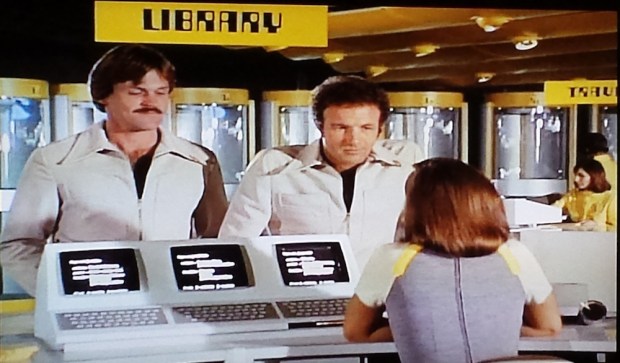
Despite that his work here has a certain Kubrickian vibe. “Rollerball” has shades of “Clockwork Orange” in its ultra-violence and “Eyes Wide Shut” in its upper-class decadence—and even a bit of “2001” in the forbidding hi-tech architecture of the corporate state (provided by the then-new BMW Headquarters in Munich). It’s here that master thespian Ralph Richardson gives a humorous late-career performance as the head “librarian” whose actual job is to tend to the overtaxed super-computer called Zero. In a movie that needed a little comic relief, the befuddled caretaker explains to Jonathan that Zero (who earlier that day “lost the 13th Century”) is so smart that “his borders touch all knowledge.” But the librarian also admits that Zero, who “considers everything,” seems to not know anything at all.
This is perhaps the film’s most prophetic moment, pointing to our own superconnected/disconnected present world. It sends Jonathan E. back to the rollerball arena safe in the knowledge that: Yes, We Have No Utopias.
Someone had to say it. That people would let their democracy slip away on such an embarrassing (and solvable) inflection point as the rise in price of a dozen eggs, is like a national pathology that is nearly impossible to reckon with.
Of course, that was not the only issue that caused the re-election (after a four-year interval) of the convicted felon, admitted sex offender and debased traitor who tried to overturn his 2020 defeat by having a mob kill his own vice president. For the hardcore MAGA crowd it is certainly easier to complain about grocery prices than to admit to being a straight-up (and potentially violent) bigot, with a head stuffed to the gills with false grievances. But what about the rest of us? (I’ll say us to be polite even though I of course voted for Kamala Harris).
Alex had the right idea in “A Clockwork Orange.” He wants to “smash ’em” and so do I.
Fuck eggs. It would be futile for me to argue that the 166 MILLION chickens that died from the recent bird flu may have had something to do with the price hike. Because that would be too normal. Complaining is more fun. I’m not suggesting that there are not real economic troubles affecting some people, but to use that to put back in office a proud psychopath who already said he wanted to be a dictator?
Didn’t anybody ever suggest boycotting those stupid eggs? If most of the country could agree to do this the price would have come down quick, maybe even quick enough to avoid a witless slide into an authoritative nightmare. Joe Biden had about as much to do with egg prices as I have in getting a Pulitzer Prize.
Fuck Eggs. They are the modern equivalent of the old canard that at least Mussolini “made the trains run on time.” No he did not. Reportedly, only the Italian tourist trains ran on schedule. This led some witless British tourists to say that things are better with an autocratic leader running the show from Rome. This then got repeated until it sounded like the truth.
Gang of Four saw thru the ruse. (Lyrics in description)
So in 2024, eggs became some sort of defining issue, much like “soccer moms” were all the demographic rage a few election cycles back. So much so that even a Democratic consultant, was quoted in the paper in January as saying that perhaps it was inevitable that his party lost because, “Just look at the price of eggs.” WTF, dude? With people like that on your side, who needs adversaries?
Also in that day’s New York Daily News there was a poll that showed that about 70% of people thought less of President Biden for pardoning his son Hunter. In the same breath, 70% said they would pardon their own child, Welcome to the USA, kids.
Kamala Harris is certainly no Winston Churchill but I was hoping for at least a little original thinking in her campaign against such an obvious threat to democratic norms. Sure, she may present as America’s “cool aunt,” but recent history has proved that many don’t mind voting for a malignant and demented uncle. If Harris could have convinced a few of them that unkie would be better suited to a padded cell, she may have even squeaked out a victory, God save us.
One little plea. Let’s try to better to learn of “overstanding.” It’s one thing to “understand” that egg prices are high, and a completely different thing to “overstand” the issue and realizing we are being sold a bill of goods much more than $9 a dozen. You don’t even have to man the barricades. On social media, at least treat Trump, Musk et al to a smart-ass putdown, instead of looking up terrified at the sky of worst-case-scenario. We don’t need to be any more anxious than we already are.
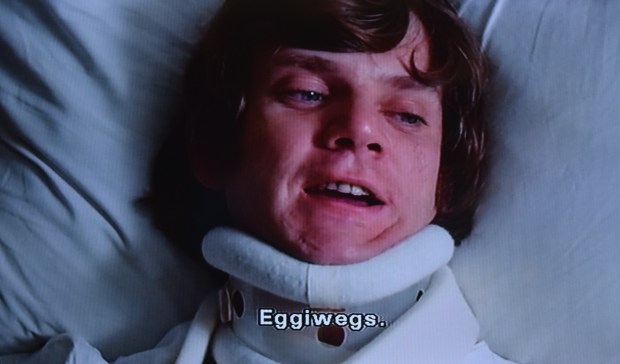
To get back to Alex. In the penultimate scene of “A Clockwork Orange,” he has the upper hand even in a full body cast, being fed the precious eggiwegs (not to mention “steaky-wakes” and “lomsticks of toast”) knowing that he has the unscrupulous Interior Minister right where he wants him (he is obliged to feed Alex his breakfast while being subtly taunted). They both know that the barbaric technique that “cured” him of his criminality also made him defenseless and suicidal. Now Alex has been re-cured and taken to calling the Minister (“my little droogie”) knowing instinctively that thuggery can exist just as easily thrive in the halls of power as it can on the backstreets of London.
In this “horrorshow viddy” clip, Anthony Sharp plays the Interior Minister and, of course, the legendary Malcolm McDowell is Alex DeLarge.
Many readers will know that the Anthony Burgess novel had a “controversial” final chapter that was not included in American editions of the book—and also not included in Stanley Kubrick’s towering film adaptation. Too bad, as it is quite fascinating. It begins almost exactly as the first chapter: Alex is back in the Korova Milkbar with three new droogies. They are making up their “rassoodocks” about what crimes to commit that evening. But later, he runs into his old droogie Pete and is astonished to find him happily married and with a regular job. The softening begins (“Youth must go”) and he imagines himself doing the same. In the end, normalcy will (or should) reign and hopefully Alex will not be the kind of citizen who welcomes a dictatorship because of a temporary spike in the price of eggiwegs. “Alex like groweth up, oh yes,” he thinks to himself. Maybe it’s time to do the same. Righty right.
Graffiti Highway (parabolic), Centralia PA. All photos and text by Rick Ouellette except as noted.
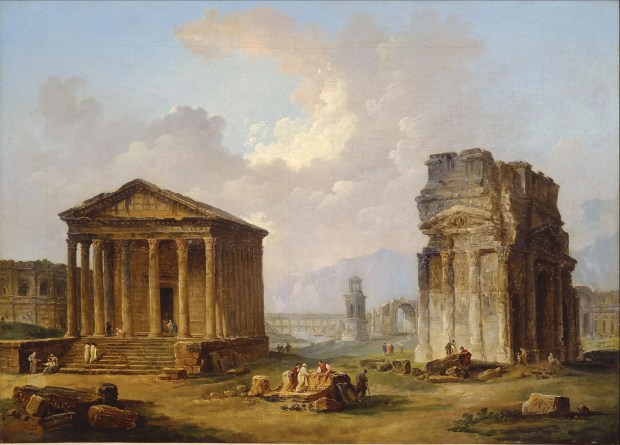
In the late 1700s, towards the tail end of the Age of Enlightenment, the French painter Hubert Robert became well-known for his large-scale canvasses depicting ancient ruins of France and Italy. These romantic (and often semi-fictional) scenes spoke to an age where there was a strong interest in classical antiquity and preserving what remained of it. Hubert and the other artists who followed this trend were surely aware of the evocative power of decay when it came to lost societies.
A typical Hubert Rubert joint.
Flash forward to the 21st century. We may well be deep into the Age of Un-Enlightenment, where hot-takes and online trolling has replaced the philosophical imperative. Yet the “picturesque” art styleembodied by Hubert Robert has been carried on into the burgeoning field of ruins photography, the depiction of urban and industrial decay. Closely tied into the subculture of urban exploring, this field of photography has divided opinion. There are commendable practitioners like Matthew Christopher (in his two “Abandoned America” books) and Christopher Payne (the haunting and humane “Asylum: Inside the Closed World of State Mental Hospitals”) that have looked long and hard into the reasons and consequences of how and why certain American institutions have been left to die on the vine.
Trolley Graveyard #1, Photo by author.
Critics have pointedly taken aim at some aspects this “urbex” photography, namely the exploitation of people’s natural morbid fascination with the wreckage of off-limits locations, not to mention the implied insensitivity to a region’s economic decline. I have seen a lot of that online, where intrepid shutterbugs return from their trespassing adventures and post pics online to curiously adoring fans who practically gloat over the collapsed remains of defunct shopping malls and shuttered Rust Belt factories.
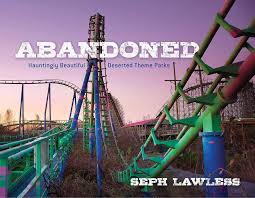
Which brings me to Seph Lawless. Curiously, he released two high-profile photo books in 2017 by two different publishers. “Abandoned: Hauntingly Beautiful Deserted Theme Parks” is exactly as it says, and he put in the big miles to significantly document a big urbex sub-category.
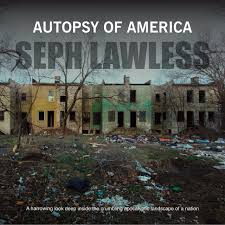
Then somewhere the same year was the boldly presented “Autopsy of America.” In case you don’t get it, you can turn to the back cover where we get in big letters, “Death of a Nation.” Really, the whole nation?? Published by a house called Carpet Bombing Culture (kind of a red flag in itself) the text for this book is so over-the-top that it can only work as self-parody.
“Is this just another recession? Or is this the beginning of the end?”
“America is a giant… mistake.”
“I want Americans to see what is happening to their country from the comfort of their suburban homes and smartphones.”
Oh gawd, spare me the edgelord/drama queen posturing! 😉. As usual, the photography is tremendous, though by this date we’ve all seen enough abandoned houses, darkened shopping centers and the odd isolated ghost town. (Lawless throws in several of his eye-catching theme park images for contrast). Yeah, there is serious income inequality. But it’s preposterous to pretend that cities like Pittsburgh and Cleveland (to name two I have personal evidence of) are hollowed-out landmarks of a country in its immediate death rattle. Many of those cities have growing, transitional economies and don’t need this. But I get it. He’s Seph LAWLESS for heaven’s sake, and the hype (and apocalyptic rhetoric) often goes with this territory.
Graveyard Trolley #2, photo by author.
So while I may wince when Seph, like a supervillain in waiting, stands on a half-collapsed roof and gazes at a distant metropolis, you got to hand it to him. The logistics and craft it took to depict these places that so many want to know about. I’m just a part-time amateur at this game and have only been to one of the locations featured in “Autopsy of America.” I took a tour of the (now former) Trolley Graveyard outside of Johnstown, Pennsylvania with the aforementioned Matthew Christopher. He had photographed this huge collection of streetcars, owned by a super-hobbyist, many times before, including the pre-smartphone/GPS days. By the time I got around to committing to a tour, vandals had graffitied almost every car and smashed almost every window on them. It just got too easy in the Internet age to popularize and locate these spots, for good or ill.
But Rust Belt tourism is a thing and these cities often have a long-established culture in arts, cultural attractions and professional sports. As soon as we start realizing the value and vitality of such places, the better it will be for everyone, and we can all avoid the “Autopsy.”
The prolific producing-directing team of Jules Bass and Arthur Rankin, Jr. have had a huge impact on our holiday viewing traditions. They made no less than 17 animated Christmastime special between 1964 and 1985. The duo created such iconic Yuletide characters as Rudolph, the Little Drummer Boy and Frosty the Snowman—-and memorable side players like Yukon Cornelius, BurgerMeister MeisterBurger and the Snow Miser/Heat Miser brothers.
Rankin and Bass were among the first American producers to employ Japanese animation teams and the resulting “Animagic” stop-motion puppet films (often mistaken for Claymation) are distinctly hand-crafted, often enchanting (even trippy) and sometimes unsettling. So let’s review those Christmas TV memories, both delightful and disturbing:
THE GOOD
“The Year Without a Santa Claus” (1974)
This entry has shot up the charts in many people’s holiday hit list in recent years, due in large part to the increased popularity of the irrepressible Snow Miser and Heat Miser, who do meteorological battle to control the holiday weather via a vaudeville sing-off. But overall, this is an attractive and well-written entry without the dark psychological underpinnings that lurk in other R/B productions.
Here, a very believable Santa (voiced by Mickey Rooney) is fatigued and under the weather. Suspecting that we mortals have stopped believing in him anyway, he decides on a mental health holiday just as December inconveniently rolls in. But the sensible and resourceful Mrs. Claus (Shirley Booth), showing us that it’s not only the Hubbie who knows how fly a reindeer, conspires to save the day. Features the songs “Here Comes Santa Claus” and a children’s version of “Blue Christmas.”
“Rudolph the Red-Nosed Reindeer” (1964)
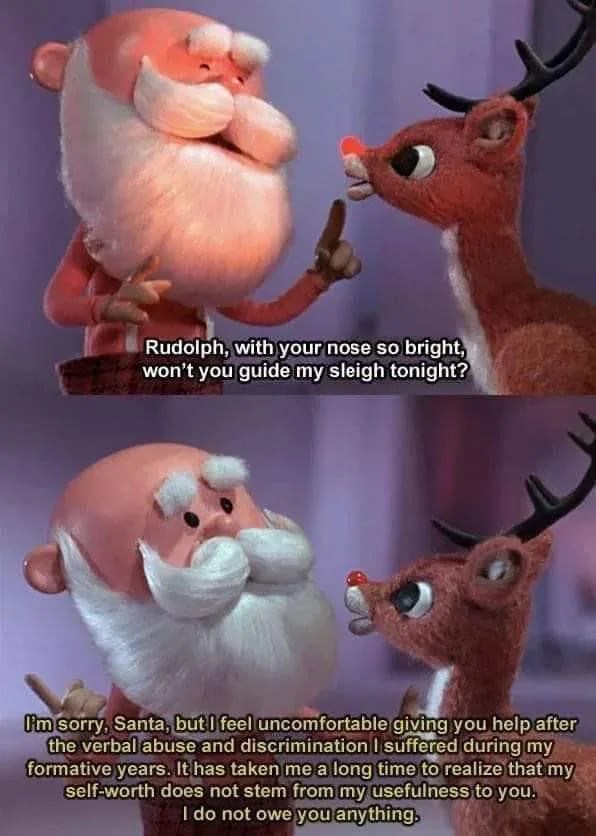
This perennial favorite celebrated its 60th anniversary this month by returning to NBC from whence it first aired. That it came out so long before the “safe space” era makes it great meme fodder for those who want to imagine the magnanimous Rudolph with a different answer to Santa’s famous question. This request for help coming after ol’ Ruddie Red Nose was practically disowned by his dad and bullied and ostracized by nearly everyone at the North Pole, forcing him into a dangerous (but ultimately rewarding) exile.
In these days of everyone-gets-a-trophy, “Rudolph” can stand tall as a great example that the world can be a cruel and callous place, and that a true test of character is not the worst thing. Rudolph “finds his tribe,” first teaming up with would-be dentist elf Hermey who has fled the town’s forced-labor camp, oops, I mean Santa’s workshop. They sing the great non-conformist anthem “We’re a Couple of Misfits” before heading out for their colorfully weird adventures with Yukon, on the Island of Misfit Toys, and against the Abominable Snowman. Note that when Rudolph returns to save the day, only his father straight-up apologizes for his previous cruelty, leaving a lot of unanswered questions about Santa’s alleged kindness.
“The Little Drummer Boy” (1968)
By the late Sixties, Rankin and Bass had hit upon a good dependable working model. This usually involved building a story around a preexisting holiday song (“Drummer Boy” was first recorded in 1951 by the Von Trapp Family), getting celebrity talent to do the voice work (June Foray, Paul Frees and guest narrator Jose Ferrer) and not shying away from subject matter that was a little dark for the kiddies. I confess to traumatizing my own son at a tender age when he witnessed the house of drummer-boy Aaron being torched by bandits while his parents were still inside.
Oopsy! The orphaned and embittered Aaron wanders the Middle Eastern desert, leading on his team of three surviving farm animals, by laying down some beats on the drum he received from his parents before you-know-what. He is exploited by a shady showman, before being led to Bethlehem on the coattails of Three Wise Men. Cue the Vienna Boys’ Choir for the stately rendition of Katherine Kennicott Davis’ revered (and sometimes reviled) carol. Behind that soaring chorus, the scene at the manger with Aaron and his stricken lamb is unabashedly religious and admittedly moving.
“Santa Claus is Coming to Town” (1970)
Fred Astaire gets the “Told and Sung By” honors here, as the R/B team hits on all cylinders. House scriptwriter Romeo Muller pens a succinct origin story for the big guy, and the Animagic cinematography team, led by Kizo Nagashima, do splendid work all the way from the icy-blue Mountain of the Whispering Winds down to the Teutonic grays and browns of Sombertown. The original music by Bass and Maury Laws is Broadway-worthy stuff, especially the two “Toymaker” songs and Claus’ self-improvement tune, “Put One Foot in Front of the Other,” sung to the easily-won-over Winter Warlock.
Voice actor extraordinaire Paul “Boris Badunov” Frees, was the voice of ace villain Burgermeister Meisterburger as well as his assistant Grimley.
This is also the first appearance of Mickey Rooney voicing the part of Santa, a role he would reprise a few times over the next decade. His is a nicer Santa than the ethically dubious one we saw in Rudolph. However, I still have a bit of an issue with the title song, first sung on the radio in 1934 by Eddie Cantor. I mean, here’s a guy who “sees you when you’re sleeping/knows when you’re awake.” Stalker, much?
Jack Frost (1979)
Moving away from the Santa-centric holiday fare, here’s a tale of everyone’s favorite wintertime sprite, one of the team’s most visually appealing entries. But this special’s affecting tale, much of it taking place in a splendorous silvery-blue domain, is hamstrung by a rather odd Groundhog Day framing device, with corny ol’ Buddy Hackett as narrator as Pardon-Me-Pete explaining at length the connection between Jack and his big day on February 2nd.
Otherwise, this is a grown-up story of how lovelorn Jack, crushing hard on the pretty but flighty Elisa, asks Father Winter if he might become human in an attempt to win her hand. She was a fangirl of ol’ Frost in his invisibility mode, but as a real boy it’s more like let’s-be-friends. Nevertheless, Jack proves himself in battle against the fearsome Kubla Khan, the Cossack King, who rules January Junction atop his mechanical horse and has at his disposal a steampunk army and an iron-plated sidekick called Dummy. (Kubla is memorably voiced by Paul Frees in his Boris Badunov voice).
The voice of Elisa is Debra Clinger, of the Clingers. She and her sisters were the first all-girl rock band signed to a major label.
Ultimately though, Jack is obliged to return to his former nipping-at-your-nose occupation, making this maybe the only R/B production with a romantic heartbreak theme.
The Life and Adventures of Santa Claus (1985)
It’s back to the Santa origin story in this adaptation of the 1902 book by “Wizard of Oz” author L. Frank Baum. This is the last, and one of the best, of Rankin/Bass holiday productions, driven by the almost psychedelic visuals inspired by Baum’s ripe imagination. The grand procession of The Immortals that kicks things off in grand style.
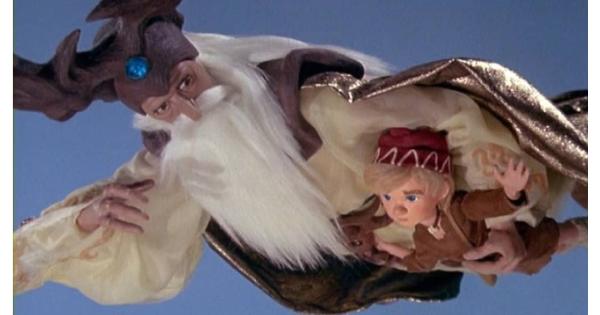
The conclave of these pagan bigwigs is called by the Great Ak (“The Master Woodsman of the World”) to decide whether to confer Immortal status on the human orphan named Claus, who they took in after he was abandoned some 50 years previous. Of course, Ak relates the whole backstory, how he and young Claus had travelled the medieval world and got a close-up look at man’s inhumanity to man. Claus is esp. offended at the plight of neglected children and commits himself to their happiness. (But not before the Immortals have to take out the fantastical kid-hating baddies known as the Awgwas).
After a half-century of service, Santa is feeling his age so will the Immortals step up to the plate and make him an Immortal? No spoilers here. Rankin and Bass and their Animagic collaborators in Japan went out on a high note, so don’t miss out on this special special. After all, not all R/B creations we were great, and below we will look at some of their Greatest Misses.
The Bad and the Bizarre
“Frosty the Snowman” (1969)
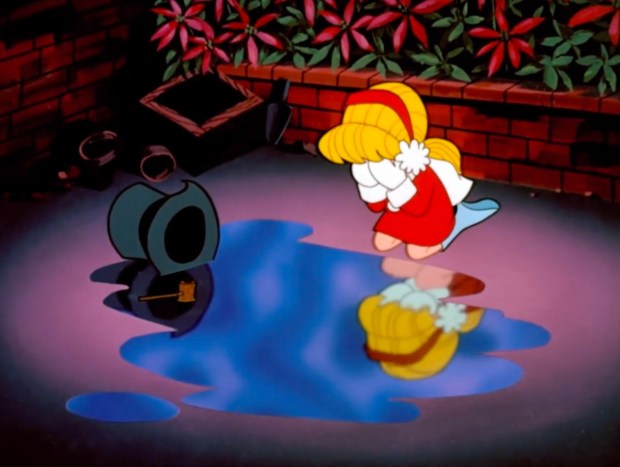
As if the 1950 Gene Autry song wasn’t annoying enough, this cartoon is so appallingly awful that it shouldn’t appeal to anyone over the age of five with at least one working brain cell. Here is the IMDB capsule description: “A living snowman and a little girl struggle to elude a greedy magician who is after the snowman’s magic hat.” Let’s get one thing straight off the bat: the hat belongs to the magician!! He is clearly shown as the owner when he does his rather inept magic show for the school children. That it later accidentally blew unto their snowman is beside the point.
Merry Christmas, kids!
Let’s admit it, Frosty was better off as an inert snowman. As a living being he is a chucklehead always in danger of melting and thus breaking the hearts of the impressionable kids. Jimmy Durante, as the defensive narrator (“That hat DID belong to Frosty and the children, that point must be made very clear”) sees nothing wrong with Frosty taking one of the children along with him to the North Pole, even though the girl almost freezes to death in the process. But, hey, it’s a classic, I guess! Rankin and Bass always had less luck with their cel animation, though this one paid off handsomely.
“Nestor, the Long-Eared Christmas Donkey” (1977)
This well-meaning but derivative program is also based on a Gene Autry ditty, and Roger “King of the Road” Miller does the honors as narrator and singer here. Shades of “Rudolph” abounds as Nestor is discriminated against because his ground-dragging ears make him clumsy. But Mary and Joseph look kindly on him and Nestor is enlisted to help them make it to Bethlehem. Note to parents: this special is rife with savage Roman soldiers, meanie animal merchants and even Bambi-level tragedy. But it all ends well on that fateful night at the manager, so we all good?
“The Stingiest Man in Town” (1978)
In view of their prolific output, it is no surprise that Rankin/Bass would have a crack at Dickens’ timeless tale. But this operetta-style version of “A Christmas Carol” is best left forgotten. The cel animation is uninspired at best and the musical numbers are mediocre, esp. considering the lazy lyrics (Jacob Marley to Ebenezer: “My chain of wrong is very long/But yours is even longer”). And whatever Walter Matthau was paid for voicing Scrooge, it was too much.
The First Christmas: The Story of the First Christmas Snow (1975)
The unwieldy title is not the only awkward thing about this entry. I mean, Christmas at the convent? I had eight years of parochial school, so it’s a hard pass for me. However, I did like Angela Lansbury’s version of “White Christmas.”
‘Twas the Night Before the Christmas (1974)
There are mouses in the houses in this rodent-infested version of the inescapable holiday poem. And they are stirring, unfortunately. Another example of how the R/B team were seemingly indifferent with their cel animation works, this one looks like a Hanna-Barbara reject.
Rudolph and Frosty’s Christmas in July (1979)
The youngsters should love this crossover effort. It has two of Rankin and Bass’ most beloved creations, and the stop-motion work looks great. I continue have doubts about the problematic top-hatted snowman, who still insists on using tobacco products in the company of children. Put away that corncob pipe and I’ll wish even you a Merry Christmas, Frosty!
So what do you think, what’s your most and least favorite Rankin/Bass show? Let me know and have a great holiday season! –Rick Ouellette
He warned the world about global warming in the 1840s. He had the foresight to know that the application of science and technology without the balancing spirit of poetry would yield a “rectangular obscenity.” He decried the myriad media hoaxes of the middle 19th century and concocted a few of his own as a warning to the gullible. Oh yeah, and he wrote some nifty horror stories as well.
Meet the other Edgar Allan Poe. Everyone knows about the haunted, hard-drinking author of such psychological terror tales as “The Tell-Tale Heart” and “The Pit and the Pendulum” that all but invented the modern Goth aesthetic. Most are familiar with the rigorous poet behind the famous verses of “The Raven” and “Anabel Lee.” But far fewer are aware of Poe the inspired cosmologist, the young man who studied engineering and mathematics at West Point, and who, as America’s first de facto science reporter, cast a very skeptical eye on the era’s centralization of power in that growing field.
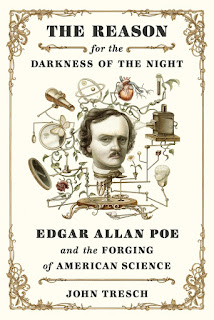
In the extraordinary 2021 book, “The Reason for the Darkness of the Night,” author John Tresch goes a long way into giving this iconic American figure his full due. The fourth and fifth decades of the 19th century saw significant advances in industrialism and science, which had only recently graduated from its previous incarnation as “natural philosophy.”
It was also an age of chicanery, of dubious pseudo-sciences like phrenology, which could be used for racial profiling in an age when the conflict between slavery and abolition were headed to a boiling point. According to Tresch, Poe’s writing (in both fiction and reportage) “dramatized the act of inquiry and the struggles, fears, hopes, and delusions of the human undertaking.”
Foremost in the struggle was Poe’s conflicted feelings regarding the dawning Industrial Revolution. He wrote his “Sonnet to Science” early on (while still in the service), asking this new field “Why prey’st thus upon the poet’s heart/Vulture! Whose wings are dull realities!” and later asking “Hast thou not dragg’d Diana from her car?” In other words, are we now destined to only see the Moon as Earth’s cratered satellite and not perceive the lunar patroness riding her celestial chariot? As both an exceptional book-learner and an amateur astronomer since his youth, Poe could appreciate both.
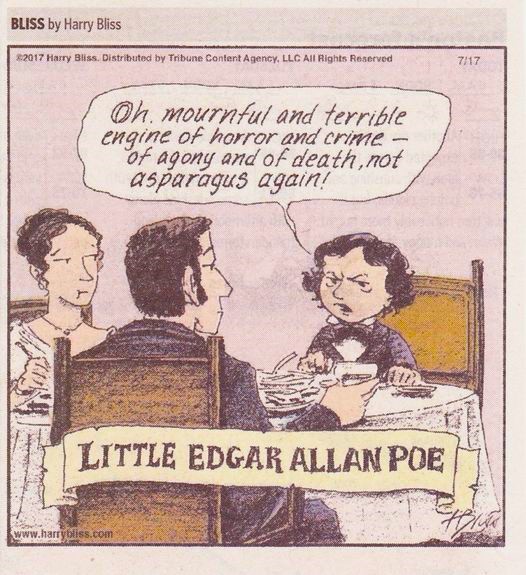
Poe’s enduring popularity even extends to speculation about his childhood, in this personal favorite of cartoonist Harry Bliss.
Around the same time Poe, in a letter, declared “I am a poet… if deep worship of all beauty can make me one.” His deep reverence for—and uneasy awe at the power of—the natural world oozes out of his lesser-known fantasy stories like “The Domain of Arnhiem” and “Tale of the Ragged Mountains.” Oftentimes, Poe depicted a desolate or decayed landscape (read the stark opening of “The Fall of the House of Usher”) a background to what he may have felt in the newly industrializing cities of his East Coast haunts from Boston down to Richmond. A smoke and/or fog blankets many of his tales and while he was no Luddite, the growth of polluting factories free from regulation was indicative to Poe of the at-any-cost mindset when business, science and government were centralized without popular input.
Poe famously had a tough life. His mother, foster mother, brother and wife all died of TB (then called consumption) which he memorably personified in “Masque of the Red Death.” His wealthy rat-fink foster father all but disowned him, undermining his enrollment at the Univ. of Virginia and cutting Poe out of will while providing for several illegitimate children. Poe lived the life of a penurious journeyman writer, struggling to get published and drifting in and out of the employ of various journals and newspapers. Despite fleeting fame for the hugely popular “The Raven,” widespread acclaim avoided Poe in his lifetime.
From 2015, the excellent animated anthology “Extraordinary Tales” is also highly recommended.
But despite (or because) the morbidity of his circumstances and the flavor of his best-known work, Edgar Allan Poe is an enormously popular figure. At his core a man of the people, he’s the guy we need right now. His instinctive opposition to giving great power to those who excel only in a technical sense. One need only look at the barely recognizable human “qualities” of a Mark Zuckerberg or the unstable rantings of an Elon Musk to see where the problem lies into giving such people nearly limitless agency. And that’s not to mention the scourge of the Orange Grotesquerie, whose appeal to grievance and hatred in the pursuit of power is a horror even the master himself would maybe be challenged to depict.
I don’t want to speculate too much on a man that’s been dead for 175 years, but I think Poe today would provide a refreshing antidote to modern society’s pitfalls. Despite his personal tragedies and epic binge drinking, our man Edgar was at heart an idealist. Never afraid to mix it up in the court of public opinion, he would probably be a social media sensation, and a modest Go Fund campaign might alleviate his persistent money problems. A year before his death, he wrote and lectured on his cosmological treatise “Eureka” part of which positioned us all as part of a universal brotherhood united by our common inheritance of a single unitary effect at the beginning of time (Poe was an early proponent of the Big Bang Theory). Tresch begins “The Reason for the Darkness of the Night” with Poe’s last stand, reading “Eureka” before a small but rapt audience in New York City. The author thought that this manifesto would be his defining work, though it was not to be. But still, (in Tresch’s words, “Poe’s work embodies the defining tensions” of both his age and ours: “between popular diffusion and elite control, between empathy and detachment, between inspired enthusiasm and icy materialism.” While we don’t have the Poe we need today, Tresch’s illuminating book and a deep dive into his subject’s lesser-known but still invaluable works, is recommended, if not essential.




























 Reel and Rock