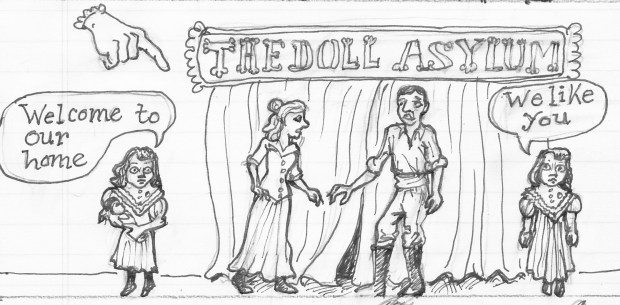
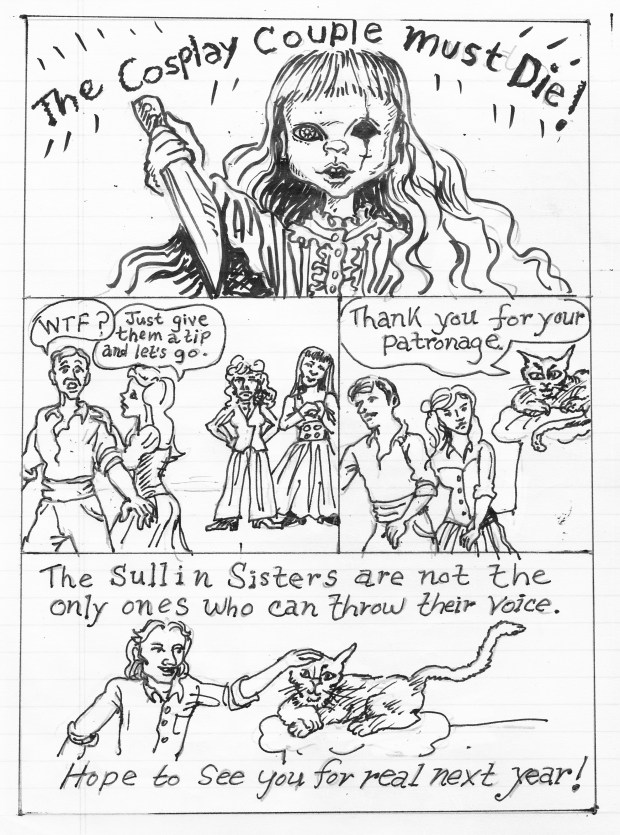
In the realm of urban exploration, the general spirit of the thing is “the morbid the merrier” (as Curly Howard once put it after the Stooges had stumbled into a haunted house). The popular fascination with abandoned sites shows little sign of abating, a phenomenon I explored in my series called “The Pale Beyond” some years back (see links below). My own interest in this subject has now extended beyond my photography and occasional blog post to the realm of comic books. I am working on a graphic novel called “The Ministry of Dark Tourism” with artist Ian Miller. I will be posting the first chapter of this some time this spring.
In the meantime, here are some related photographs of mine, mostly taken the last year during our Covid Year. Hope you like them, let me know if you’d like more info on any of them.
—-Rick Ouellette
Chapel of the Holy Innocents, former Fernald School, Waltham MA
The Fernald School went from notorious exploiters of unwanted youth to caretakers of the state’s most severely disabled adults in the course of its long history. Closed in 2014 and currently off limits, the Fernald campus was the site of a Christmas lights drive-thru attraction in 2020, the former chapel lurking behind the Candy Land section.
Tewksbury Hospital tour, Tewksbury MA
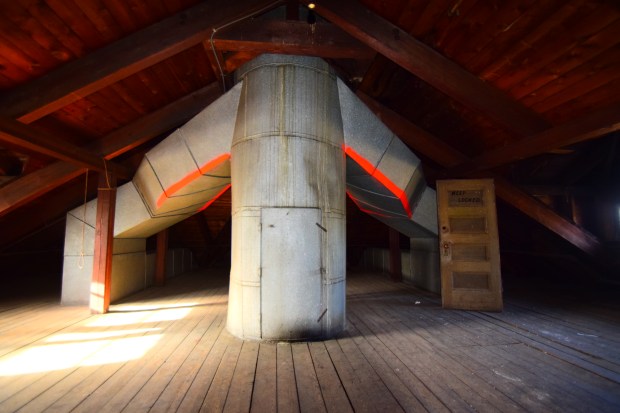
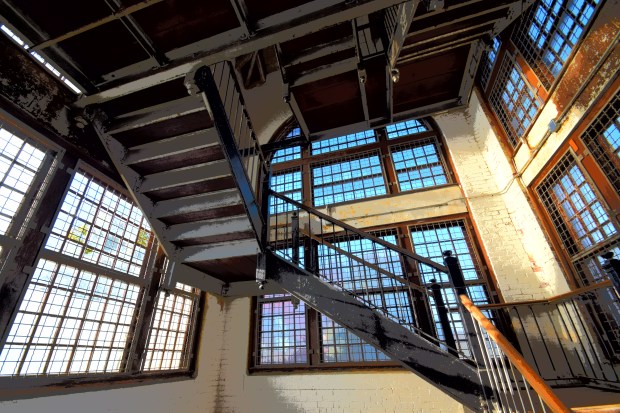
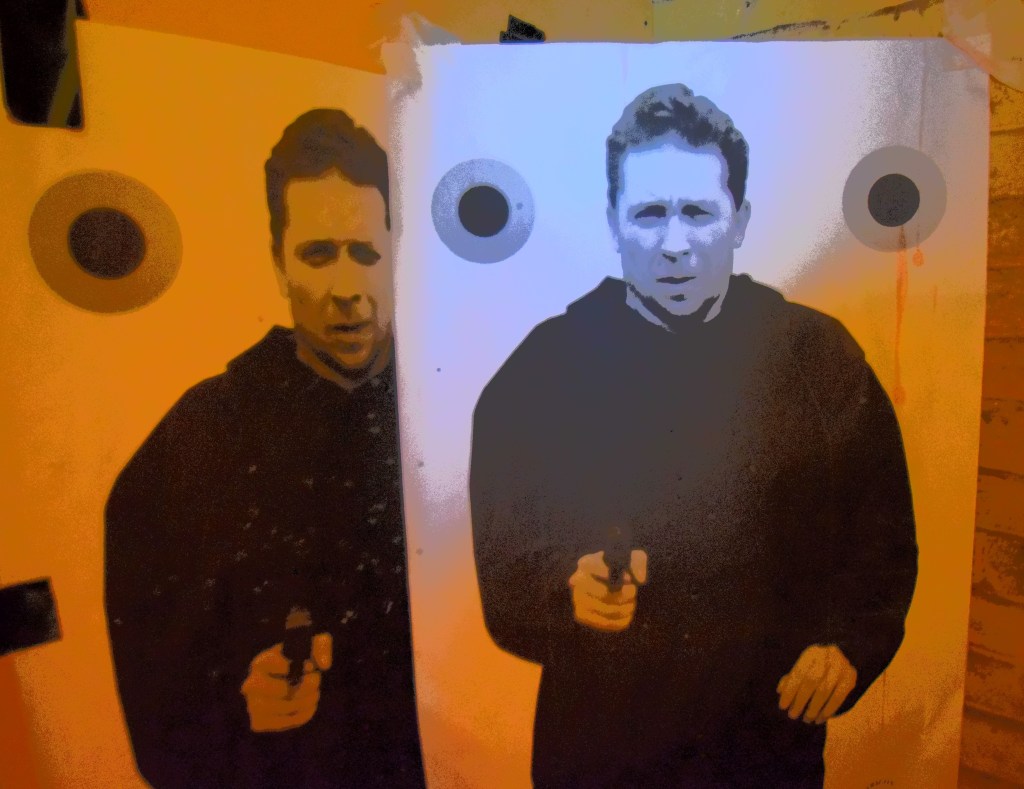
My tour of historic Tewksbury Hospital was canceled in April of 2020 at the start of the pandemic, but the good folks at Silver Crescent Photography rescheduled it for October, and was so glad they did. The hospital, like many such institutions from the 19th century is spread over a large campus. Parts of it are still a working hospital and the main building also houses the Massachusetts Public Health Museum. Although it was an early innovator in special services for indigent and disabled people, Tewksbury did have its darker side as evidenced in the Violent Female Offenders Ward seen at the top of this article. The shuttered MacDonald Building (exterior shot above) was used in the TV adaptation of Stephen King’s “Castle Rock.” The Rice Building (the two shots below that) have also been used for horror film locations.
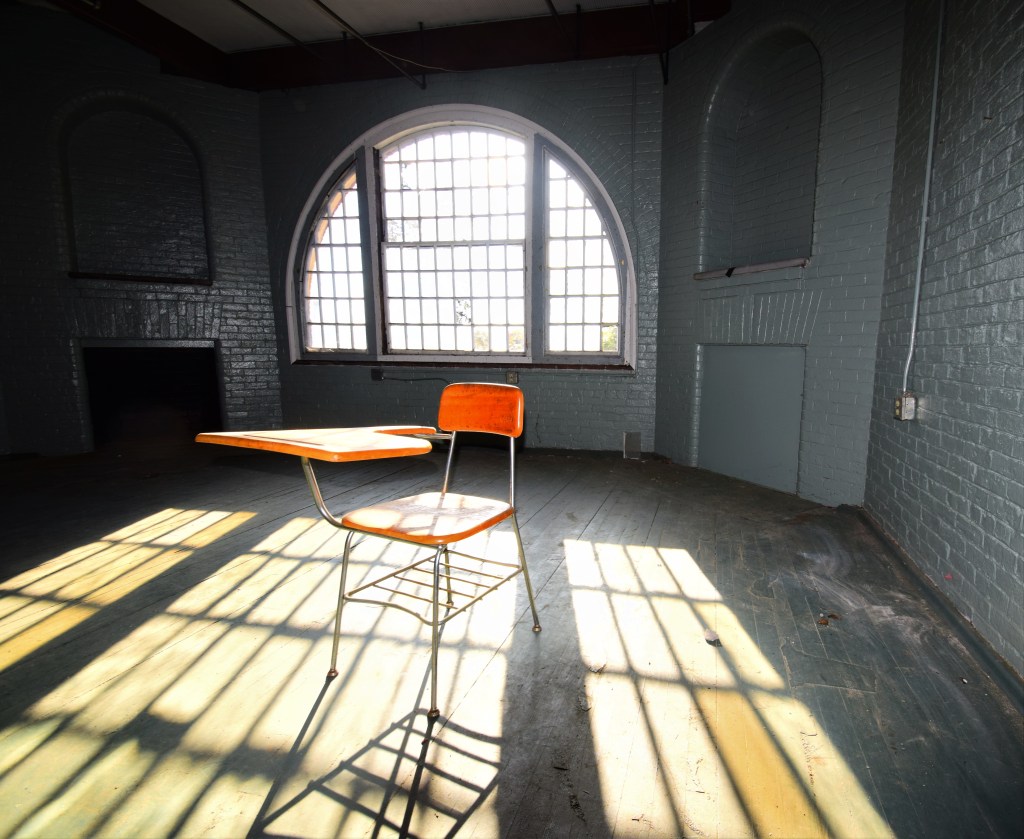
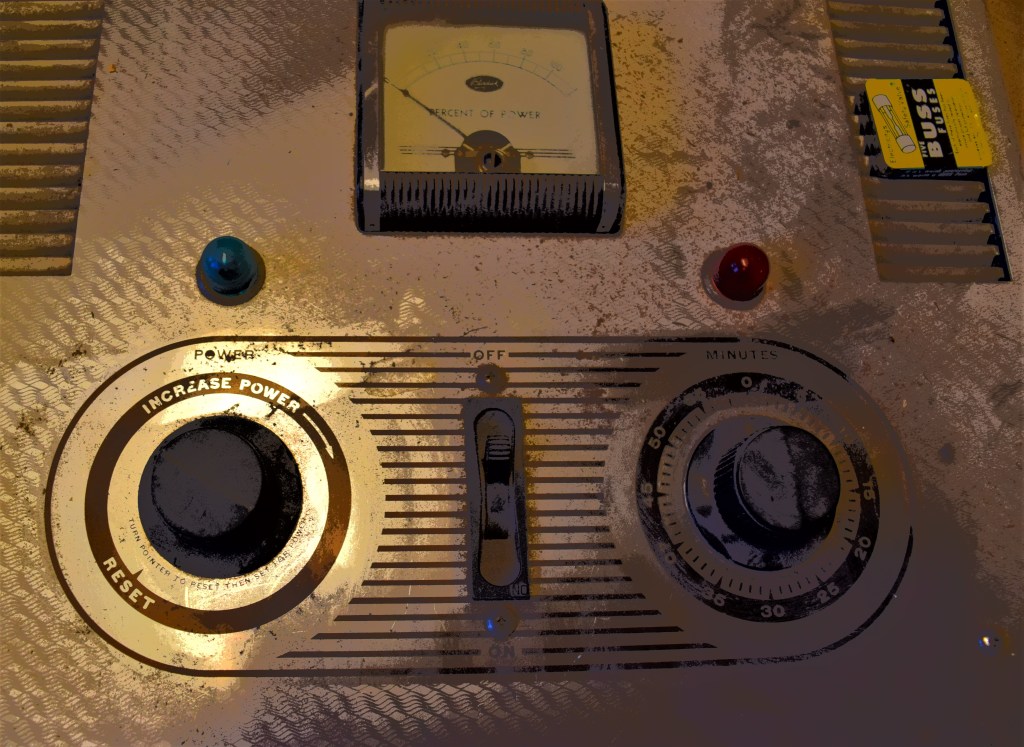
Sometimes you never know what you’ll see on one of these tours. Unexpected beauty (like sunlight illuminating a vintage school desk), unexpected utilizations (the basement of one building had been used as a state trooper training facility) and unexpected chills (the basement storage area of the Public Health Museum sported an old electroshock machine).
Danvers State Hospital Auxiliary Patient Cemetery, Middleton Colony, MA
The fabled Danvers State Hospital, the once-idealistic sanatorium whose fearsome Gothic exterior loomed over Danvers, Mass. for 130 years, was demolished (except for the façade of the main building) in 2007; it has been replaced by (ho-hum) condominiums. It’s two patient cemeteries, where grave markers only bear numbers, still remain and bear witness to the institutional callousness that marked its 20th century incarnation. One cemetery is in a hollow down the hill from the main site. The other, pictured above, is about a mile away and eluded me until a year or two ago. It’s surrounded by fields and farmland and has gained a memorial that lists the names of many of the unfortunate souls laid to rest there.
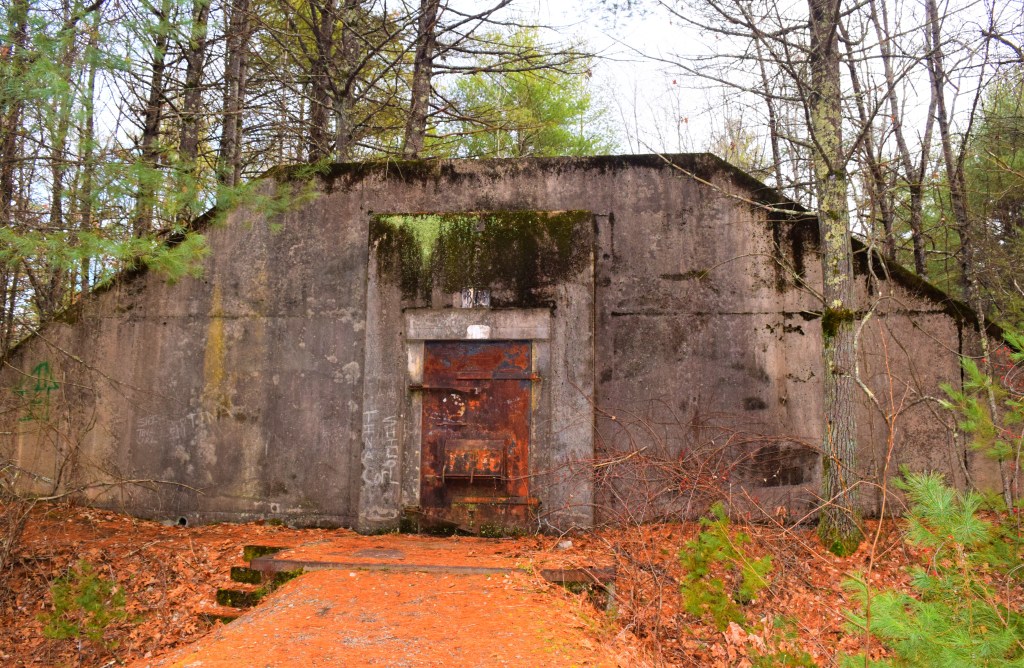
World War II Ammo Bunkers, Assabet River National Wildlife Refuge
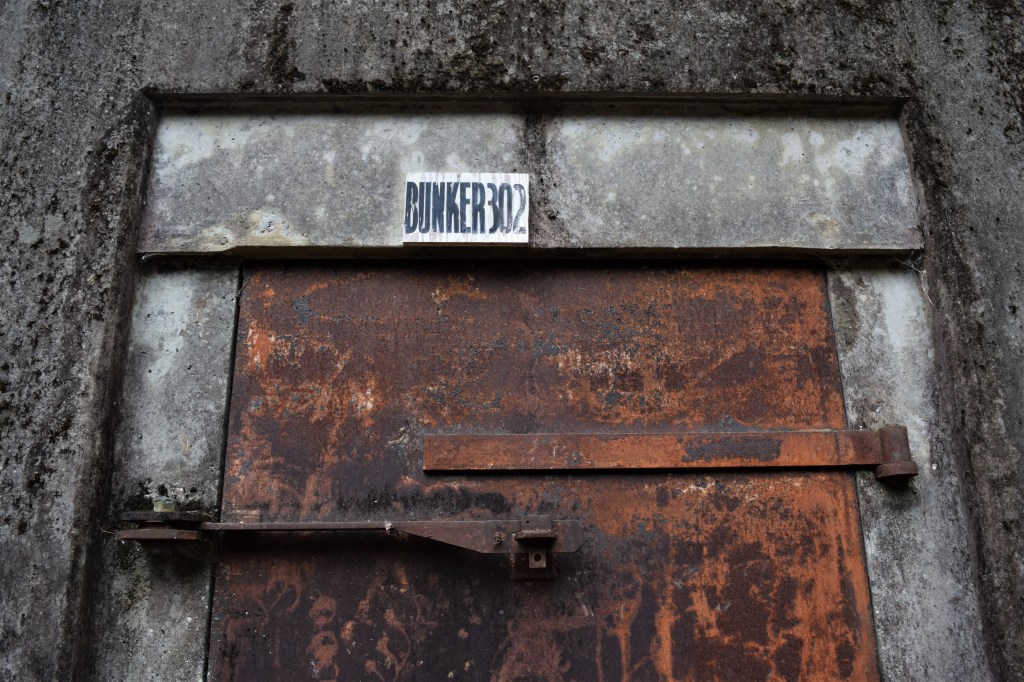
There are more WW2 ruins in the America than you might expect, esp. along the two coasts. There are a couple of dozen giant ammunition storage bunkers in the woods of Massachusetts in what is now a wildlife refuge. The ammo was shipped here some 30+ miles from Charlestown Navy Yard in Boston, to be out of range of German warships. Sadly, this bit of local history has a down side too. The military took this once-populated area by eminent domain, with only ten days notice for residents and ten-cents-on-the-dollar compensation for their property.
Follow and watch this space for more Dark Tourism photos and comix!
The daily posts I put up for my Facebook group Rock Docs (check it out if interested) generally fall into a few different categories: birthday tributes, trailers for upcoming music documentaries and seasonal-themed series (I recently had a weeklong string of posts about Irish bands centered around St. Patrick’s Day). Another frequent category that can’t be avoided: obituary posts. Any rock music fan of a certain age who is on social media knows these well. Whenever one of our beloved stars dies, the online tributes, often very heartfelt, come pouring in and last for days if not weeks. This phenomenon probably peaked in early 2016, when David Bowie and Prince passed away within a few months of each other.
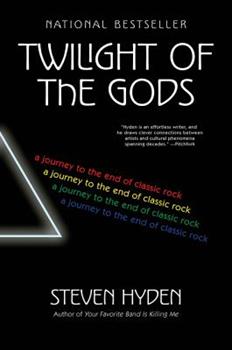
Of course, a lot of this can’t be helped: rock ‘n’ roll is a youth-centric artform that is now about 65 years old. While many of the baby-boomer stars of its Golden Age are in their Golden Years, rock has ceded its primacy in the pop-music pyramid since at least the late Nineties. A book like Twilight of the Gods: A Journey to the End of Classic Rock was inevitable.
Freelance author and podcaster Steven Hyden has acquitted himself well on this subject. Twilight of the Gods is an accessible, witty and committed book. Part of its success may be that Hyden was born in 1977 and grew up in suburban Minnesota, a Gen X/Millennial bitten bad by the Classic Rock bug. He is no portentous, self-serious scribe a la Greil Marcus, but he gets it. By early middle school he was subsumed by rock “as an act of faith: albums as sacred texts, live concerts as quasi-religious rituals, and rock mythology as a means of self-discovery.” An avowed agnostic, Hyden admits that “if there is a God, I was sure I had found Him on side two of Abbey Road.”
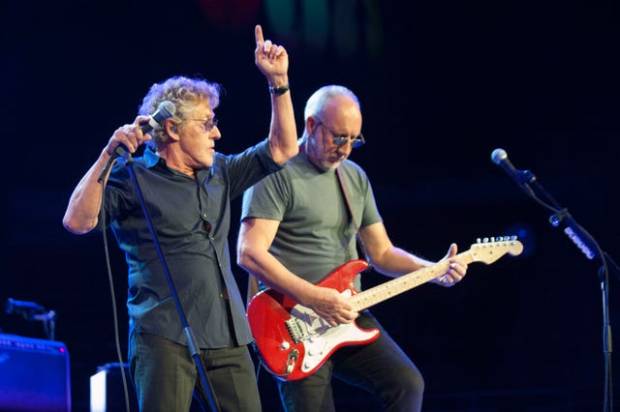
Hope I die before I get old—or not. Roger Daltrey and Pete Townshend on the “Who Hits 50 Tour” in 2016
He first saw his favorite band (the Who) in 2002, so the timeline of his grand obsession was already leaning into advanced middle age. But by the end of the night, Hyden had found his musical Olympus as the Who rose to the occasion of past greatness. Or, more precisely, Pete Townshend and Roger Daltrey did that. Bassist John Entwistle had recently died (after a night of latter-day rock-star debauchery) and Keith Moon, the original wildman drummer, was already a quarter-century in the grave.
But to Hayden and countless other fans, what may matter above all is the (hoped for) immortality of the form itself. Bands like the Beatles, the Stones, Led Zeppelin and Pink Floyd not only have a considerable repertoire of recordings but are also steeped in rich mystique and all sorts of esoterica. Like many before him, Hyden enthusiastically partakes of both the canon of accepted masterwork albums and more obscure discoveries, reads the books and music mags and views all the important rock docs.
By 1988, when American TV viewers were treated to the legendary “Freedom Rock” commercial, the canonization of Sixties and Seventies youth music was in full swing.
The result of this deep-diving is an often quirky book where the author explores all sorts of different tributaries on this long and winding musical river. Hyden tells of his great appreciation of both the rebel spirit of Bruce Springsteen’s wilder early albums and the more reflective tone of his later work (both men had complicated father/son relationships). He talks of how fans can keep the classic-rock experience fresh by embracing once-avoided “good bad albums” like the Stones’ Black and Blue and Neil Young’s Trans. And of course, no book about rock history would be complete without foray’s into the subjects of the occult (there is an excellent dissection of the Ozzy Osbourne song “Mr. Crowley”) and the old stand-by discussion of how awful the Eagles are (“They were cool like the captain of the high-school baseball team is cool… the kind of guys who will tape your ass cheeks together if you dare pass out early at the party”).
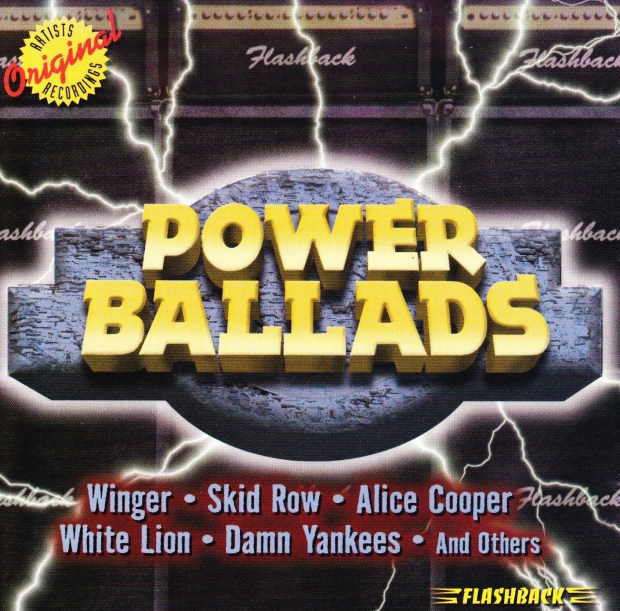
Not every section of The Twilight of the Gods works equally well. The “dad rock” chapter, while entertaining enough, goes on too long with its Wilco vs. Pearl Jam showdown. But Hyden mostly stays on point, often keenly so. Through the real-life example of his own divorced mother, he discerns a generational class of women who by the Eighties had moved on from the randy sex anthems of Aerosmith et al. Instead, they welcomed the embrace of goopy power ballads like “Open Arms” by Journey and “Keep on Loving You” by REO Speedwagon. But for good reason. Here, wised-up sensitive men were also looking for something more lasting. “These power ballads are about damaged people trying to make a go of love despite trying circumstances” and Hyden has the stats to mark this as a growing demographic.
Divorce Rock? Singers of this song type were often (and improbably) culled from glam metal bands.
As the author observes, eventually “you’ll see there is no beginning or end to music, only grooves that you can lock into until you find another groove.” But there is an end to the mortal coil and early on in the book he makes note of the rock notables who passed on while he was working on it: Chuck Berry, Gregg Allman, Leonard Cohen etc. Each of these deaths is mourned personally (online) often in ways that are inter-generational. In the the closing pages he notes, “The exaggerated arc of rock stardom creates a framework for understanding our own lives. Now classic rock is helping us understand, and accept, the inevitability of death.” Not the most pleasant thought, but I’m glad that Steven Hyden has tackled this thorny subject with such insight and panache.
–Rick Ouellette
Irish musicians have had a broad, if rather diffuse, impact on the history of pop music. The relative social and geographical isolation of the Emerald Isle until well into the Sixties may have had a lot do with that. Since then there has been a smattering of superstars (Van Morison, U2, Phil Lynott of Thin Lizzy), notable genre artists (blues-rock master Rory Gallagher, indie-rock darlings the Cranberries) and iconoclastic greats like Sinead O’Connor and the Pogues’ Shane McGowan.
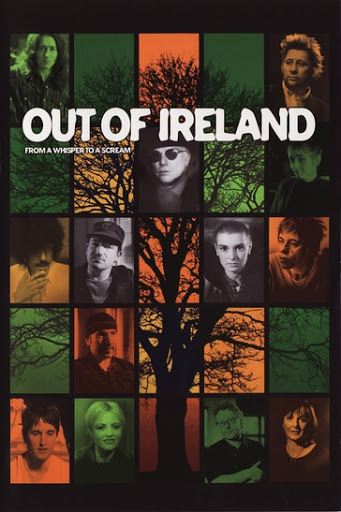
Originally released in 2000, the entertaining and encyclopedic “Out of Ireland” was a three-part program produced for Dublin-based RTE television and its 158 minutes should satisfy even the most ardent fan of Irish popular music. Director David Hefferman starts with an overview of the country’s lively but derivative show bands that dominated the music scene while rock ‘n’ roll came to the fore in the Fifties and early Sixties. But the influence of the Beatles and other British Invasion groups on the other side of the Irish Sea could not be denied, though the response at first came in fits and starts. Tellingly, it was from a wide range of emerging acts, from the gritty garage rock of Van Morrison and Them (whose “Gloria” would be a starter-kit tune for innumerable bands to follow) to the lightweight pop of Gilbert O’Sullivan and Dana, whose candy-coated “All Kinds of Everything” won the 1970 Eurovision song contest.
A ten-minute clip of “Out of Ireland,” covering the punk years.
There is a lot to get to here and Hefferman gets to a lot of it, even if things here feel a little puddle-deep at times. He does counterbalance this tendency by returning to major artists like Van and Rory and U2, at various points and stages of their careers. One interesting point that gets echoed at different junctures is that many Irish rockers reached back past the show bands to find inspiration (even if by osmosis) to the greater example of traditional Irish music, literature, and storytelling. Morrison’s observational/impressionistic lyrics on his landmark Astral Weeks LP echoed James Joyce’s ability to lend grandeur to the everyday. Thin Lizzy’s first hit was a rocked-up version of the traditional “Whiskey in the Jar.” The progressive folk band Horslips dressed up archetypal Celtic themes in glam-rock finery while the Pogues spoke (both wildly and poignantly) to the modern Irish diaspora. There’s a keen sense that Irish rock often finds that bittersweet, happy-sad symmetry so typical of Irish culture.
This video of Phil Lynott’s “Old Town” (featured and discussed in the film) shows both the charismatic and troubled side of the Thin Lizzy frontman, who died at age 36.
The film, aptly sub-titled “From a Whisper to a Scream”, does well to ground this thematic thread from the Erie as a lightly-populated backwater to dynamic player in the global pop scene with regularly placed commentary from creative consultant (and editor of Ireland’s music magazine, Hot Press) Niall Stokes. This is esp. advisable when you’ve got a rhetorical road race of musical personalities like the flinty Van the Man, the sharp but soft-spoken Sinead, and the road-hogging conceits of the notably self-regarding Bono and Bob Geldof, who continues to over-estimate the pre-Live Aid influence of his band the Boomtown Rats.
The Cranberries’ lovely “Ode to My Family,” another video steeped in rich Irish ambience
Speaking of screaming, “Out of Ireland” also provides a good overview of the country’s contributions to the punk revolution, with segments on Belfast bangers like Stiff Little Fingers, the Undertones and the Blades (bands that really had something to yell about in that town during The Troubles) and Dublin’s Radiators from Space, whose guitarist, the late Philip Chevron, later joined the Pogues. There are also sidebars on important Irish-English performers of the era (Johnny Rotten, Elvis Costello, Boy George) and 80s bands that never broke out bigtime but are still plugging away, like the Saw Doctors and Hothouse Flowers.
Of course, U2 are still plugging away as well, and their international popularity does not seem to be waning anytime soon. A section towards the end of “Out of Ireland” makes the odd connection that the group’s gargantuan “Pop” and “Zoo TV” tours may be a more modern version of those old show bands (the stage show “Riverdance” is also edged into that category). I agree with that to an extent, but don’t see it necessarily as a compliment. But that’s put aside for Hefferman’s final point that although the lightly-populated island has put itself on the world music map it is no time for complacency. I think all can agree on that, even if it means overthrowing the “show bands” all over again.
If you like my music documentary posts, feel free to click on the book cover above right to check out a 30-page excerpt of my Rock Docs: A 50-Year Cinemtaic Journey and/or join my Facebook group simply called Rock Docs. Thanks, Rick Ouellette
I am likely to live out the rest of my days forever fascinated and repelled by the idea that millions of young folks once trudged off to over-populated music festivals to hear various rock ‘n’ roll legends in conditions that ranged from beatific sunshine and starry nights to suffocating humidity and apocalyptic rainstorms yielding vast mud fields. Of course, they still do if you count pre-Covid gatherings like Coachella and Glastonbury.
I was a little too young for the original wave of iconic rock festivals and by the time I came of age the business model was superstar bands playing in sports arenas and second-tier groups gigging at theaters. I was never destined to be one of those peeps rising in unison to say, cheer on Richie Havens at Woodstock or to complain to a film crew that the authorities don’t like me because of my long hair or because “I smoke a little shit.” But then again, I never took an unwanted mud bath or had to thumb home two hundred miles because I was short on “bread.”
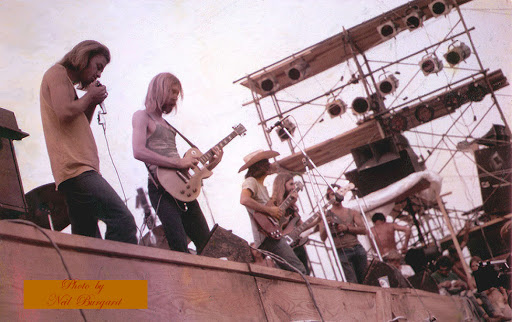
The Allman Bros. Band at Atlanta Pop
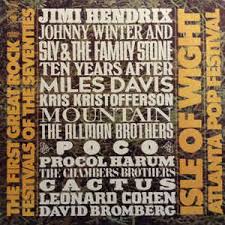
These contemplations took hold recently when I finally secured a copy of The First Great Rock Festivals of the Seventies fifty years after its 1971 release. As a young teen I eyed this whopping three-LP set the way a Little League pitcher may have seen Bob Gibson. It covered the summer-of-1970 Atlanta Pop Festival (sides 1 & 2) and the gargantuan Isle of Wight affair in the UK (sides 3-6). The names of the fourteen artists featured were center-aligned on the cover (Hendrix! Sly Stone! Allman Bros.!) but this was a little rich for my blood and my wallet at the time. Festival burnout was setting in post-Altamont and “First Great Rock Festivals” never came near the stature of the 3-LP Woodstock set (or even the double album follow-up Woodstock 2) and it came to be a curio relegated to the “Various Artists” used-record bins.
The second Atlanta Pop Festival was not in the city. After various official roadblocks (not least of all from Georgia’s then-governor, the infamous reactionary Lester Maddox) it was moved way out to pasture in the little town of Byron, where a couple of hundred thousand kids gathered in a sun-baked soybean field, for the 4th of July event where temps reached just over 100 degrees. The album kicks off with Johnny Winter doing “Mean Mistreater,” the sort of emphatic blooze-rock that was a key genre at the time and which is well represented on TFGRFOTS. But so to is the stylistic hop-scotching of these huge events. We get a couple of nice country-rock numbers by Poco (the romantic “Kind Woman” and the up-tempo instrumental “Grand Junction”) and the groovy soul of the Chambers Brothers. Next up are favorites sons the Allman Brothers. The Macon GA stalwarts do “Statesboro Blues” and the proverbial “Whippen Post” (sic) though neither version matches up to the ones on their landmark At Fillmore East, also released in ’71.
The real acid test (literally and figuratively) of this six-sided foray comes at the end of the Atlanta disc with the 19-minute indulgence that is Mountain’s take on the T-Bone Walker blues standard “Stormy Monday.” I love Leslie West and the gang but this is not their finest moment. Mountain may have preferred the steamroller method when it came to their decibel-cranking concerts, but they could be ingenious as well (just check out the multi-sectional joyride that is the 25-minute live side of their Flowers of Evil album). Here you get a pro-forma jam where the usual Leslie West/Felix Pappalardi guitar-bass interplay is pushed along by Corky Laing’s rat-a-tat drumming, but it never gets to that next level. The crowd seem to enjoy it and these lengthy excursions (both musical and geographical) were part of the scene then. To get a pair of eyes on the ’70 Atlanta Pop Festival, check out the 2015 concert doc Jimi Hendrix: Electric Church. It begins and ends with 10-15 minute segments about the event and in the middle you get an uninterrupted (and most excellent) one hour set of what amounts to a best-of-Hendrix show, complete with 4th of July fireworks.
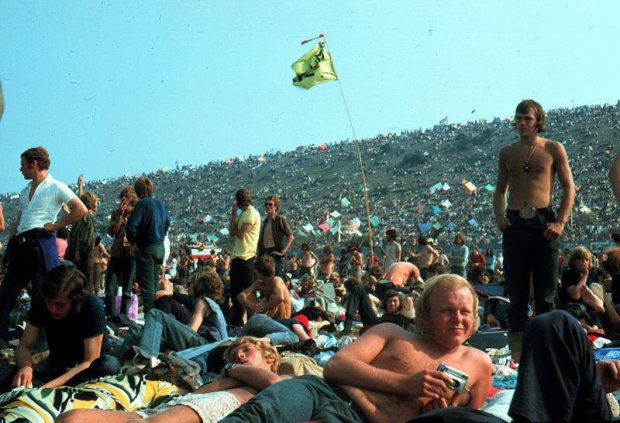
Jimi would also appear at the Isle of Wight festival off the coast of southern England a month later. Despite the logistics (ferry-access only) some 600,000 made it to the island for the tumultuous five-day festival. There is a full documentary of this third annual Wight festival, Murray Lerner’s essential Message to Love, which due to money issues was not released until 1997. In my book Rock Docs: A Fifty-Year Cinematic Journey I wrote about how the film shows how a happening that was supposed to be an English Woodstock descended into “chaos as the Aquarian hippie ideal knocked heads with the emerging notion that rock music was ripe for mass-market exploitation.” French anarchists and freeloading freaks unwilling or unable to pay the three pounds sterling entrance fee tried to knock down the corrugated fencing erected by the youngish promoters who thought they were onto a good thing but took a financial beating (hence the delay in the release of Lerner’s commissioned film).
I miss all the fun! Part of the crowd at the 1970 Isle of Wight.
Peter Goddard, in the Wight liner notes here, compared the festival to a “medieval joust up-dated and passed through a time loop. An interviewed fan in the film used a similar metaphor, describing a “feudal court scene” with the rock stars as royalty, the groupies as courtiers and the audience as serfs. When it boiled down to the music, though, there was a lot less to grouse about. Jimi Hendrix was headlining again and though people who were in the know at that time said it wasn’t his best show, there’s a lot to like in his 15-minute segment here, esp. his razor-edge soloing on “Power to Love” and a wild take on “Foxy Lady.” Ten Years After, not to be outdone by Mountain, offer up there own 19-minute warhorse with far better results. Anyone familiar with the group’s 1973 live album will recognize their version of Al Kooper’s “I Can’t Keep from Crying” with its extended speed-freak guitar workout by Alvin Lee and its little side excursions into “Cat’s Squirrel” and the “Peter Gunn” theme. Despite the pyrotechnics preceding it, Procol Harum’s stately “A Salty Dog” comes off well.
Great excerpt of TYA’s above-mentioned jam from the Murray Lerner film “Message to Love: The Isle of Wight Festival 1970”
Sly and the Family Stone, who like TYA had a big boost from Woodstock film and record, do a morale-boosting medley of “Stand!” and “You Can Make it if You Try.” The restive crowd that is so evident in Lerner’s documentary spills into the record via the poorly-received appearance from Oxford-educated cowpoke Kris Kristofferson. Tensions between fans and promoters were peaking and seemingly taken out on cocky Kris, who tries to win back the crowd with the coy redneck parody “Blame it on the Stones.” In the film, he is seen waving dismissively while exiting before finishing “Me and Bobby McGee.” Faring better in the singer-songwriter department are David Bromberg with a tender “Mr. Bojangles” and Leonard Cohen. The bard of Montreal gives an unusually empathetic vocal on the jaunty “Tonight Will be Fine.”
That leaves Miles Davis to close out Side Six with a 17-minute bracing jazz-fusion outburst titled here as “Call it Anything.” That was probably Miles’ wily wit at work given the free-flowing improvisations of the trumpeting legend who was at a career peak and crossing over to a rock audience at the time. We know that from the 2011 CD release of Bitches Brew Live that this track compromises the last half of his allotted time (the whole 35-minute set is on the CD) and consists of a wired and inspired clutch of compositions centered around “Spanish Key.” His band consisted of both Chick Corea and Keith Jarrett on keyboards, Gary Bartz on sax, Dave Holland on bass, drummer Jack DeJohnette and percussionist Airto Moreira. Whew.
Peter Goddard, towards the end of his liner notes, opines that the age of the great rock festival was “kaput” despite the promise of the more to come in the title. I wouldn’t own The First Great Rock Festivals of the Seventies for many years to come although in 1972 I bought a discounted copy of Mar-y-Sol, a double LP from a Puerto Rican festival from the same year. Its line-up was typical of the eclectic roster of artists so typical of these outside multi-day events, which would continue, great or not. Everyone from Jonathan Edwards to the Mahavishnu Orchestra to Afro-rockers Osibisa were featured. And the age of the various-artist mega-rock album was not over either. By the end of 1971 we had George Harrison & Friends with the 3-LP benefit album Concert for Bangla-Desh. Other triple-deckers included 1972’s Fillmore: The Last Days, where the Bay Area’s finest congregated to mark the closing of Bill Graham’s fabled ballroom the Fillmore West, and the dreaded No Nukes from 1979. (John Hall, anyone?).
Gong’s side-filler from the Glastonbury Fayre triple album. You’re welcome!
There’s even a three-bagger form the 1971 Glastonbury Festival, called Glastonbury Fayre (an accompanying film of the same name is worth seeking out). This six-sider is rare and bound to test the patience of even the hardiest mega-rock aficionado. It boasted songs ranging from 16 to 23 minutes from Mighty Baby (“A Blanket in My Muesli’), The Pink Fairies (“Uncle Harry’s Last Freak-Out”), Edgar Broughton Band (“Out Demons Out” and Daevid Allen & Gong with the immortal “Glad Stoned Buried Fielding Flash and Fresh Fest Footprint in My Memory.” I don’t know if any of those works would have made much sense away from the Glastonbury grounds, where the pot was plentiful and there was plenty of room for twirly freeform dancing in the days before the event exploded in popularity.
But like they say nowadays, “Go big or go home.” Luckily, we can also go virtually exploring into the far-off fields of adventurous rock exploration. Go big and stay home, to save yourself the unwanted mud-caked blue jeans and acid hangover.
–Rick Ouellette
Leave a message in the comments section if you are interested in getting a discounted copy of my book “Rock Docs: A Fifty Year Cinematic Journey”
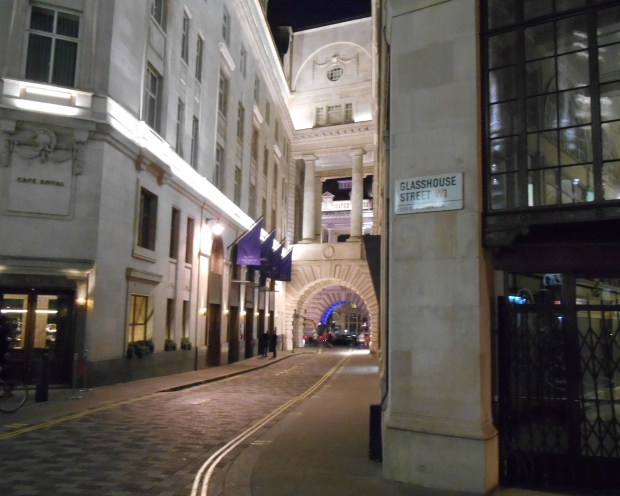
A view from behind a John Nash-designed Regent Street archway, 2016 (All photos by author unless otherwise noted)
I have come here tonight to praise the former Regent Palace Hotel, just off Piccadilly Circus in London. At 1028 rooms, it was the world’s biggest hotel on completion in 1915. I did not know this tidy little fact when I stayed there for a week in May of 1976. This would have surprised me back then. The hotel had a rounded, impressive Edwardian façade but it didn’t seem especially large. That’s maybe because many of the rooms (like mine) were small and communal bathrooms were in the hall, which was the case until the place finally closed in 2006.
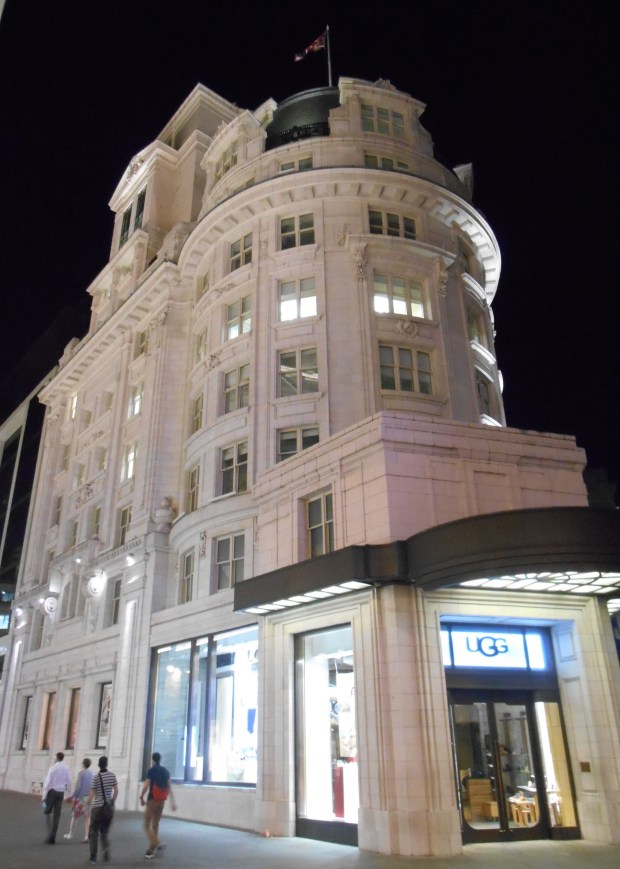
The white-washed ghost of the Regent Palace Hotel in 2016. Seemingly empty save for an Ugg store. Ugh.
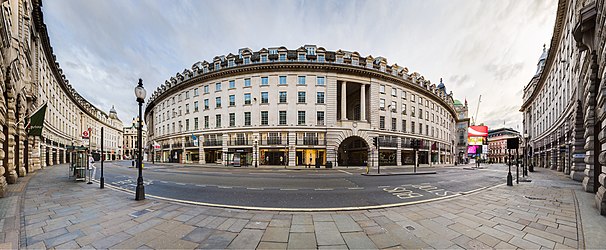
So the Regent Palace was not much of a palace, but it did back up to rear of the Regent Street quadrant. That famously curved shopping street was laid out by John Nash, the master architect of Regency/Georgian England. His work also includes Buckingham Palace, the Brighton Royal Pavilion, and Marble Arch. The elegant sweep of Lower Regent Street led into Piccadilly Circus, anchoring London’s West End entertainment district, before taking a sharp turn and proceeding thru a stately institutional area to the The Mall, which of course leads to the Queen’s pad.
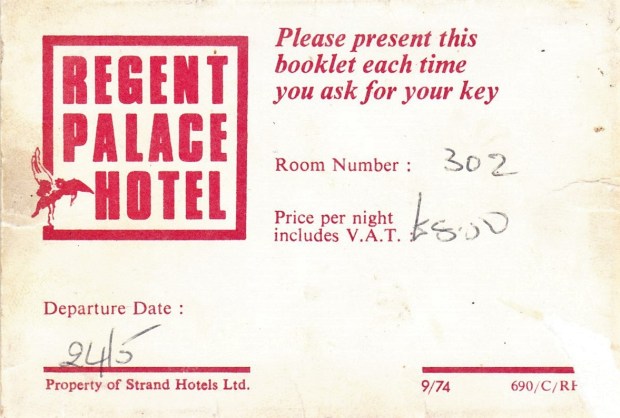
For 8 pounds a night, the Regent Palace Hotel was a place where “You enjoy all the amenities of a modern hotel, including telephone, radio and razor point.” (!!)
I’ve always had a thing about architecture and John Nash (1752-1835) is my favorite practitioner, except maybe for American Samuel McIntire, the Federalist architect/carver who’s greatest works were also done in the early 19th century. Sam’s not only a fellow countryman but lived and worked primarily in my hometown of Salem, Mass. Anyway, I cribbed the title for this post from the Simon & Garfunkel song “So Long, Frank Lloyd Wright.” After all, there just aren’t enough tribute songs to famous architects, I mean how much can you say in that format? Even S&G are pretty much reduced to saying how they and ol’ Frank would “harmonize ‘til dawn.” Sounds funny, but city-building can have its own musical richness and John Nash was a symphony-level composer. He found his fame as a patron of the Prince Regent (later King George IV) and his master plan started with a design for Regent’s Park (ringed by his terraces and great-houses) and proceeded south in a grand avenue procession down to Regent Street and the Circus. So very royal, yes, but it also gave London some of its greatest public spaces. But more on all that in a bit.
Ray Davies makes the rounds of Swinging London in this satirical Kinks Klassic from 1966.
I was 18 at the time of my first visit to the city that had so captured my boyhood imagination, mainly stirred by my steady diet of Kinks albums and Chares Dickens novels. This trip to England I had planned for some time, funded by my high-school job as a busboy and by a nice little fund put aside from my godfather that he gave me when I had turned the big 1-8. I had gone with my mom to a local travel agent (remember them?) and the guy, seeing that I was a bright young lad off on his own for the first time, suggested that the Regent Palace Hotel, a literal stone’s throw away from London’s version of Times Square, would be a good base camp. My mom was already nervous about me going but it was quickly a done deal.
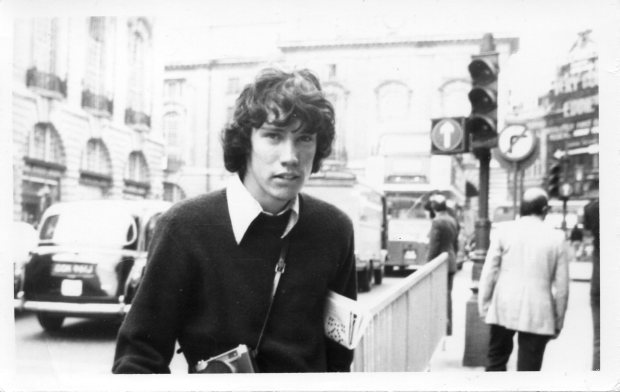
Your humble blogger at age 18, captured by a street photographer near my hotel.
Piccadilly Circus in the post-war years became world-famous for its neon-lit nightlife and its giant advertising signs for films, shows and a bewildering array of consumer goods. But ten paces away from these bright lights and rushing traffic, and thru the corner entrance of the Regent Palace it was a different story. The hotel had a certain frumpy charm, it was like a character in a Graham Greene novel, with a certain faded elegance and a hint of intrigue. (I was certainly intrigued by the occasional hooker loitering at a staircase landing). The Circus came to be one of those great gathering places, both for Londoners and tourists, but ol’ John Nash was way ahead of the curve. Lower Regent Street (completed around 1825) featured a covered arcade that kept window shoppers out of the elements and maybe give a chance for sweethearts to have a tete-a-tete, reportedly a consideration in the planning.
Panorama of Nash’s Regent St. quadrant. (Photo by Benh Lieu Song via Wikipedia)
Rock ‘n’ Roll Circus
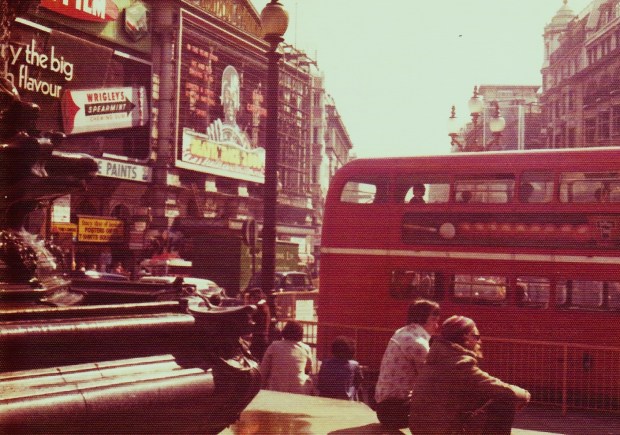
Society took over from their and certainly by the 1960’s it was (like Carnaby Street) a place to see and be seen. Many of the nightclubs of Swinging London, hosting future rock mega-bands like the Who and Pink Floyd, were in adjacent areas like Leicester Square and Soho. It was well past the prime of that golden era by the time I got there in ’76. The place was considered tawdry by many, with its illicit street dealings and dignified old buildings covered in advertising hoardings and movie marquees. But it was transformational for me, the spark that started a lifetime of sporadic European travel. So I went boldly where all men had gone before and sat myself on the steps of the Shaftsbury Memorial (see below) topped by the famous statue of Eros though it is actually his brother Anteros, the god of requited love. Either way, point well taken.
Piccadilly Circus, 1976
Across from the steps was the grand façade of the London Pavilion, where the Beatles’ Hard Day’s Night and Yellow Submarine had had their world premieres. Currently, the theater’s 3-story high sign was boosting it’s first-run showing of Death Race 2000, the pedestrians-as-points cult film; a die-cut image of David Carradine as the black-masked driver loomed over the square. Instead, I opted for a walk down Coventry Street to the now-demolished Odeon West End to see The Man Who Fell to Earth, the futuristic mind-bender starring David Bowie. The bottom of the Odeon marquee, for all of Leicester Square to see, read “Kinky Sex”—The Evening Standard. Well, your average perv may have been disappointed to buy a ticket based on that alone, but I took up my seat in the balcony (smoking allowed) not unlike the girl in Bowie’s song “Life on Mars?” who’s “hooked to the silver screen.” After having my mind suitably blown, I walked past a Piccadilly pub where an hour later, a few of the Rolling Stones stopped by a drink. I read that the next day in the (wait for it) Evening Standard.
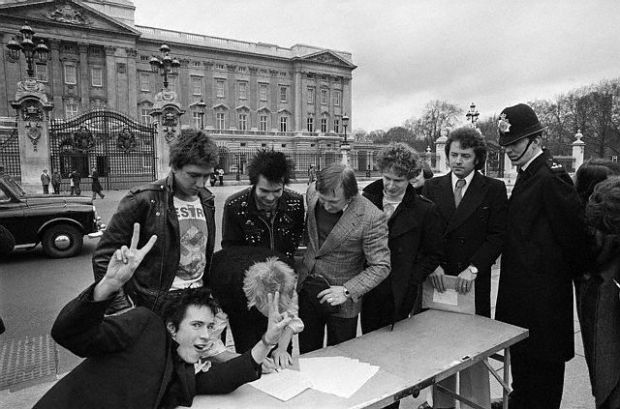
Jumping ahead nearly 45 years, I found out something that I had long suspected, a possible brush with rock and roll history that would have been more significant than catching a glimpse of a few Black and Blue-era Stones. The pre-Sid Vicious Sex Pistols were gigging in Central London the same month in the spring of ‘76 that I was first visited my fabled London. Mainly, they had a Tuesday night residency at the nearby 100 Club. Not that I necessarily would have known what to do with a Johnny Rotten back then (I was more of a Ray Davies and Ian Anderson kind of guy), but I did miss being present at the crossroads of rock history at a time when the band were not yet tabloid fodder. But ten months later the Pistols, now with Sid in tow, the group’s manager arranged a publicity-stunting signing of a contract with A&M Records, in front of the John Nash-designed Buckingham Palace. The competing symbolism was clear, even if the band didn’t release their groundbreaking, vitriolic anthem “God Save the Queen” until several weeks later. After that, they repaired to one of the lobby bars at the Regent Palace Hotel where they were over-served by the staff, according to (I believe) Jon Savage’s definitive book “England’s Dreaming.” Just think, only a gob’s throw away from where I sat in the RPH’s breakfast room, or the Carvery restaurant, whose sliced-roasts station, dessert cart and great big Imperial pints of lager were already legends in my own mind. The group’s drunken hijinks continued over at the A&M office, where their punkified misdemeanors had them booted off the label by week’s end. Twenty years would pass by the time I saw the re-formed Sex Pistols at an outdoor venue I the summer of 1996.
I would visit London alone again in 1994 and in 2016 with family. I was older and a bit wiser and able to take much better photographs, including those of John Nash’s greatest architectural hits (more in Part Two!). In ’94, I took a nostalgic stroll thru the Regent Palace lobby and out the side door. Also by then, the obstructing sign was down at the London Pavilion and it had been turned into a rock-themed wax museum; there were David Bowie and Mick Jagger effigies looking out imperiously from the revealed balconies. In 2016, the RPH was long-closed when I showed my son where I had stayed in another lifetime. The building, like many others in the Piccadilly/Regent Street area, had been scrubbed of their age-old London grime and white-washed to within an inch of their lives. The “people’s palace” hotel had only ghost of the memories of the lone travelers, wandering-eye businessmen and tour-group tag-a-longs that once issued forth the lobby into the whirlwind of London’s famous/infamous crossroads. But I’m still here to tell you my tale where the secret lives of buildings, people and pop culture intersect and will be back for more in Part Two.
—Rick Ouellette
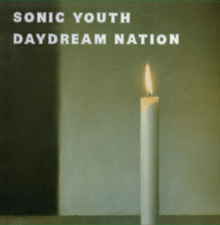
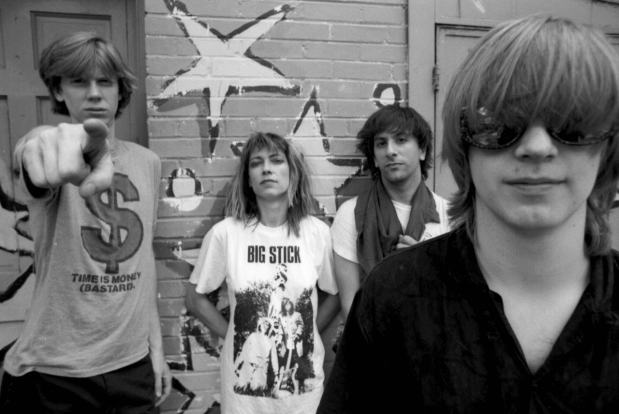
Early on in career that spanned the years 1981-2011, Sonic Youth earned their spot as one of America’s quintessential modern rock bands and are almost the very definition of what became known as postpunk. Their three principal members, guitarists Thurston Moore and Lee Ranaldo and bassist Kim Gordon, migrated to New York City and found their musical footing (and each other) as the mid to late-70s CBGB heyday was ending. They got their start in the noisy No Wave scene that followed and made their first recordings on a small label started by experimental composer Glen Branca, with whom both Moore and Ranaldo had played. Shirttails and a certain ironic detachment replaced the torn apparel and sneering attitudes of the early punk days. All three wrote and sang and the two guitarists were brash but studied sound architects while Gordon gave the group undeniable sex appeal. Sonic Youth remained fiercely independent even after their aggressive sound was tempered with the more conventional pop attributes that theoretically meant a larger fan base. They stuck with smaller indie labels right through to this, their fifth full-length album. Daydream Nation is the magnum opus of both their own career and of the downtown scene that spawned them. It is widely considered the band’s conceptual peak even though there would be many fruitful years to follow.
The impressive breadth of this double disc derives from a combination of a group writing spree and encouragement to commit to vinyl (and to cassette and CD, the late 1980s being the transitional era of formats) the extended noise rock jams and feedback frenzies that were long part of their live show. From its hand-to-mouth beginnings, SY could now book three weeks of studio time in advance, co-producing with noted hip-hop engineer Nick Sansano. Daydream Nation opens with the seven-minute anthem “Teenage Riot,” its most well-known number and a favorite of college radio back in the day. After eighty seconds of free-floating guitar notes and Gordon whispering sweet nothings to the listener, it kicks into gear with a relentless forward motion that carries all the way to the finish line. “Teenage Riot” is a call-to-arms directed at bored young people that in one way harkens back to the totemic songs of rock ‘n’ roll pioneers albeit with an updated snarky attitude (“You come running in on platform shoes/With Marshall stacks to at least just give us a clue”) and the attenuated values of a seen-it-all age (“It’s getting kind of quiet in my city’s head/Takes a teenage riot to get me out of bed”). Typical of the band’s singing, Thurston Moore delivers all this with a voice that rarely exceeds conversational volume—but when it comes to the instrumental work it’s a different kettle of fish. Halfway through the next number, “Silver Rocket,” there is a sudden eruption of overamplified six-string carnage before the determined full trot from drummer Steve Shelley’s snare kit pulls the tune back from the chaos.
Sonic Youth 1988. “You WILL like our ‘overamplified six-string carnage,'” insists Thurston Moore.
The rest of the album pretty much follows the same pattern. Razor’s edge punk riffing holds sway on a collection of mosh-worthy rockers that are often punctuated by atonal outbursts or gentler ambient passages, often as the prelude or postscript to a song. Many of feature the alternative tunings and effects favored by Moore and Ranaldo and beloved by guitar geeks not beholden to the blues-based model. There are several worthy additions to the Kim Gordon catalog of sultry/tough come-ons (in real life she and Moore had been married for four years), most notably on “Kissability” and “’Cross the Breeze”. Suffice to say when she sings, “Let’s go walking on the water/come all the way, please” it will sound as much of a challenge as an invitation.
Lee Ranaldo contributes three tracks including album highlight “Hey Joni”, a cock-eyed tribute to band fave Joni Mitchell. Although Ranaldo’s abstracted lyrics are a bit hard to get the measure of (“The time in the trees, we broke that vice/We took some steps and now we can’t think twice”) the intrigue over its subject’s transformation from Woodstock-era songbird to brittle iconoclast shows the SY’s keen sense of pop history. As if to underline it, there are also a couple of double-album gambits: a brief bit of musique concrete called “Providence” (Moore’s piano recorded on a Walkmen overlaid by a deadpan voice mail left by ex-Minutemen Mike Watt) and the closing 14-minute “Trilogy.” But no prog pretensions here when a three-parter means a patented Thurston Moore night-on-the-tiles raver, more dissonance and a Kim Gordon ditty called “Eliminator Jr.” Then Daydream Nation ends in mid-squall, as if no further concession to its own gravitas was needed.
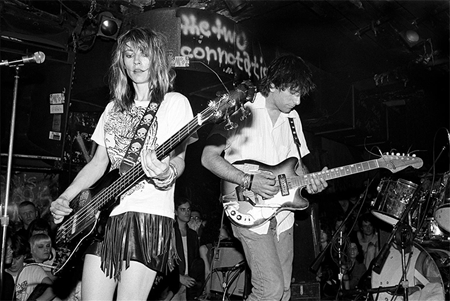
Kim Gordon center stage as SY play CBGB in 1988.
The acclaim greeted DN may not have exactly resulted in sales that would warrant chart placement, but the increased stature of the band eased the move to David Geffen’s DCG label for the 1990 follow-up Goo. That yielded the signature smash “Kool Thing” whose alluring video was an MTV staple. Through the 90s the cult status of Sonic Youth grew from its base of late baby boomers (like themselves) to include many of the kids who hit their twenties just in time for the grunge scene. Daydream Nation started appearing on numerous all-time best-of lists as the group stuck to its guns like true believers of the rock continuum. As middle age approached, Moore and Gordon repaired from lower Manhattan to the calmer (but still hip) hinterlands of Northampton, Mass. By 2002, their daughter appeared on the cover of late-career highlight Murray Street. Although the couple (along with Sonic Youth) split up in 2011, the various members have kept their irons in the fire with other bands, solo records and (in the case of Kim Gordon) a high-profile memoir. Daydream Nation will likely continue to be a noise-rock touchstone as long as there are teenagers who need to riot.
Few rock and roll Christmas stories are as heartwarming as the Sex Pistols’ tale of how they spent December 25th, 1977. You may well ask, huh? But look at the situation facing the England’s most notorious punk band at the end of that epochal year. Queen Elizabeth’s Silver Jubilee was celebrated that summer, with the one notable exception of the band’s blistering protest song, which took its title from the royal anthem. The Pistols’ “God Save the Queen” lambasted a “fascist regime” and an outdated monarchy that lorded over a population that needed a serious wake-up call. They had connected with a significant portion of the nation’s youth and the single is widely believed to have denied the #1 spot in the UK by industry chart-rigging at the very height of the festivities in June. Johnny Rotten and the crew had also spent the better part of a year earning their reputation as cultural enemy #1 in the eyes of Britain’s establishment.
The year wound down with a planned Sex Pistols tour, but local authorities saw to it that 27 gigs were cancelled, leaving the group in a bus that had a destination sign accurately reading “Nowhere.” That’s where we are at the start of Julien Temple’s thoroughly engaging 2013 documentary look-back. The one-hour film actually kicks off with an extended montage of hokey holiday B-roll of British holiday miscellany that shades into the darker side of that particular season: the country’s economic woes and desultory labor strikes.
Huddersfield from the hill.
It was then that the “Christmas miracle” mentioned in that montage’s ironic narration happens. The Pistols, disillusioned and all but destined to spend December 25th tooling around the rainy motorways in their Nowhere coach, got a call from the firemen’s union in the hardscrabble West Yorkshire town of Huddersfield. The firemen, who were stuck on wages of 170 pounds a week, had been on the picket line for nine weeks. They asked the band if they would be interested in doing a charity gig for the worker’s children on Christmas Day. Would they?
Here’s the complete film. Enjoy!
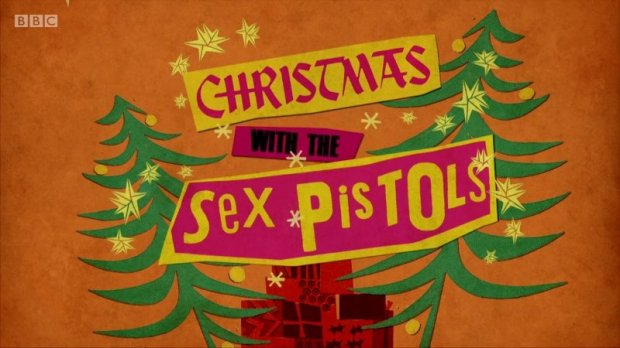
“Christmas With the Sex Pistols” (aka “Never Mind the Baubles”) is an object lesson in the random acts of kindness that can make our world a little better when tolerance and understanding win the day. The band’s anarchic outrageousness may have been necessary to shake up the country’s moribund state of mind, a process that would go on to reenergize Britain’s culture for the better. But it came at a price, esp. at the hands of the country’s tabloid press, led by the likes of Rupert Murdoch and his ilk. “Anything we did was transferred into a lie,” John Lydon (then Johnny Rotten) says in the film’s contemporary band interviews. “They just wanted to smear us,” he continues, “but you can’t beat the truth.” And the truth of that Christmas afternoon was that the Sex Pistols were accepted as (and presented themselves as) nothing more than good-natured benefactors, throwing an unpretentious Yuletide party for the kids (most of them grade-schoolers) with gifts and band memorabilia for all, a luncheon and a huge cake (more of that later).
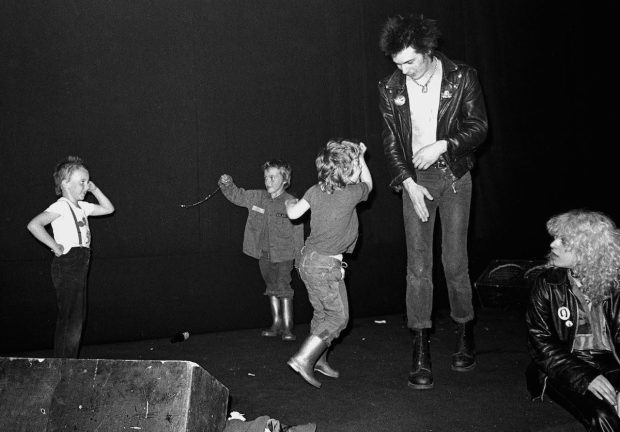
Temple smartly compliments this angle by having the three surviving Pistols from this line-up (Lydon, Steve Jones and Paul Cook) relate their own childhood recollections of the Yuletide. The relatively stable home environments of Lydon and Cook contrast sharply with the backstory of Jones, whose sour holiday memories and it’s “fucking ‘orrible” TV specials are related to his abusive “shit family” (refer to his memoir Lonely Boy for details), only partially relieved by escaping to the house of his childhood friend, Cook. Of course, John Simon Ritchie (aka Sid Vicious) is not here to tell his tale but Lydon recalls that Sid, keen on coming across as a punk tough guy, needed a “serious talking to” before the party. He reminded Sid that that kind of posturing wouldn’t work with children. Jez Scott, who was about 15 and is the only kid there interviewed here as an adult, remembers that “Sid was brilliant.” He had ended up with two Sex Pistols soccer-style scarves and Mr. Vicious politely asked Jez if he could have one as the memorabilia were not meant for band members.
Sid and kids, with girlfriend Nancy Spungen, his partner in doom, looking on.
Jez also remembered that the Pistols delivered their usual furious set, even including their anti-abortion tirade “Bodies.” But the children, being “natural anarchists,” loved them and enthusiastically started a cake fight with the ample leftovers of the featured dessert. Johnny Rotten, as the lead singer, was apt to lean over the front of the bandstand or wander into the audience. So he soon had his head covered in frosting, much to his own delight. “It had all gotten a little too serious” by then, he recalls of the atmosphere surrounding the group. Both band members and a couple of greying guys who walked nine miles to see the night show, talk of the fleeting days of “punk unity” and the good vibes that permeated this gig. Near the end of this piece, Temple treats the true-blue Pistols fan to a chunk of great footage from the evening “adult” show. These performance clips are of particular interest as it was the band’s last UK show in their original run. Their chaotic U.S. tour soon followed and ended with the group’s bitter break-up a mere three weeks later.
That story could (and has) filled many a magazine article and book chapter. What Temple’s shrewdly charming film does is sprinkle a little holiday magic on the band’s inglorious ending. There were many factors that contributed to that; the group’s youthful inexperience, the tabloid nonsense and an older generation’s stark intolerance, not to mention the cynical machinations of the Pistols’ manager Malcolm McLaren. It’s a loving holiday card sent to the town of Huddersfield and a fine record of a notable moment of grace for a beleaguered rock legend in the making. With all the hype scraped away, it’s simply a tale of people doing a good deed where needed, when only a lump of coal was expected.
If you like my music documentary posts, feel free to click on the book cover above right to check out a 30-page excerpt of my Rock Docs: A 50-Year Cinemtaic Journey and/or join my Facebook group simply called Rock Docs. Thanks, Rick Ouellette
The annals of rock music journalism are filled with outsized personalities like Lester Bangs, Nick Tosches, Robert Christgau, Dave Marsh and others. They tended to be opinionated writers with national magazines, keen to rile things up. Less recognized in this field are the countless other music scribes who work for local or regional publications, welcoming bigger acts into town while also promoting the local scene.
Notable among this second group is Washington, DC-based Michael Oberman. He wrote a weekly interview column for the old Washington Evening Star from 1967-73 (his late brother Ron did the column for the three years before that) and interviewed many of the great rock, blues and soul artists during that classic epoch, and many of them before they really took off.
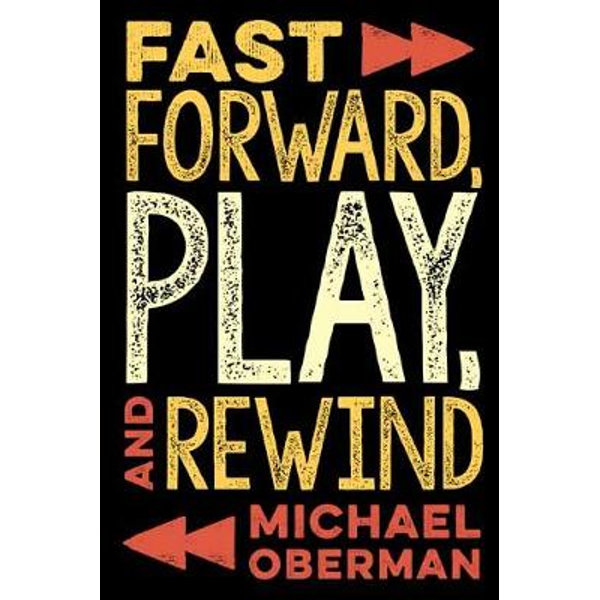
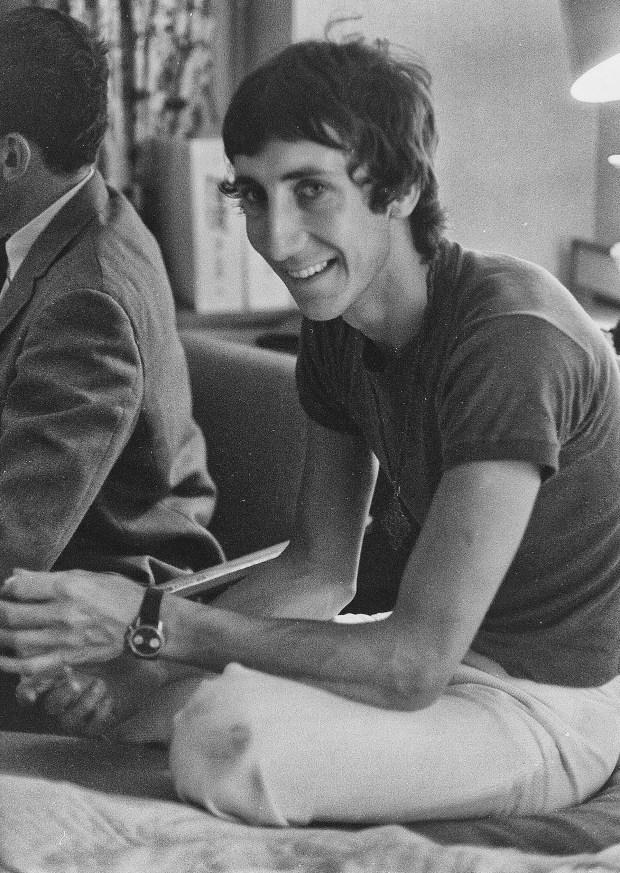
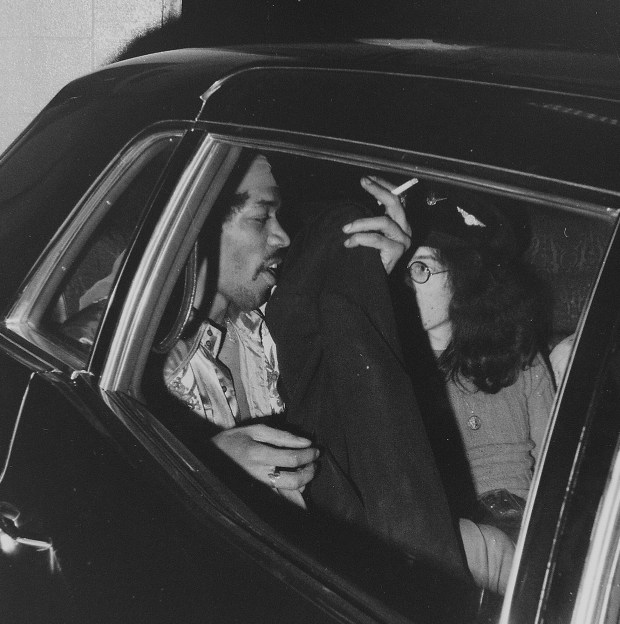
Oberman’s newly released book “Fast Forward, Play, and Rewind” collects many of those music columns with personal reminiscences and background narrative of meeting (and seeing in concert) such an array of pop music luminaries during this heady era. He watches the first moon landing backstage with members of Blind Faith. He has an interview with Peter Townshend cut short so the Who leader can catch Jimi Hendrix at his residency crosstown at the Ambassador Theatre, leaving Oberman there to do his reporter’s duty and check out headliner Herman’s Hermits! (Don’t worry, Michael caught Jimi earlier that week). The columns, though short pieces of 400-700 words, can sometimes reveal some fascinating interview tidbits, like the quirky details of the Cowsill’s ramshackle “Munster-like mansion” in Newport, RI just before hitting it big.
Pete Townshend in a D.C. hotel room, 1967 (Photo by Michael Klavans)
These pieces, though they are the snapshots in time they can’t help but be, are weighted down a bit by the fact they contain a lot of info that has long passed into rock fans’ common knowledge: like being told the personnel of The Doors. Wisely, Oberman intersperses these old columns with his “Musings” feature, newly written memoir-like mini-chapters on his experiences in the biz as well as his boyhood experiences. In the latter category, there are fun tales of youthful hijinx (his brother Ron’s good buddy was Carl Bernstein of “All the President’s Men” fame) and discovering great local music in the DC area. This includes the club scene in the Georgetown district and bands like the British Walkers, which featured a young Roy Buchanan, the blues guitar great. In the former, there are intriguing detours down the side lanes of the rock ‘n roll landscape. Oberman managed the Claude Jones band who not only played a Halloween gig at a mental hospital but also played host in 1970 to the notorious Medicine Ball Caravan travelling freak show at their shared home deep in Virginia redneck country.
Jimi Hendrix outside the Baltimore Civic Center (Photo by Michael Klavans)
My favorite part of the book, and the most pertinent in light of the recently-released movie “Stardust,” is the author’s retelling of the story of David Bowie’s first day in America, which the soon-to-be-superstar spent with Oberman’s family in Sliver Spring, Maryland. Michael’s brother Ron Oberman was by then a publicist for Mercury Recoords, Bowie’s US label. He had already met the singer in England and David had requested that he would like to spend the first night on his stateside publicity tour with a true-blue American family. Oberman’s father was a manager at the National Bohemian Beer Co. and Bowie asked for his business card as a memento. The card is what he’s holding in the picture below, sitting on the family sofa with Michael (on the left) and Ron in the middle.
Many thought that Bowie, in this much-circulated photo taken by Oberman’s mother, was holding a joint and not, innocently enough, her husband’s business card. (Oberman Family Archive)
Ron Oberman, who died in Nov. 2019 after a long struggle with fronto-temporal dementia, had a long and accomplished career in the record business, later moving on to Columbia and MCA where he helped launch Bruce Springsteen, the Bangles and others. His role in helping Bowie introduce himself to America was significant enough to make him the co-protagonist of “Stardust.” Michael Oberman is polite but steadfast in his dismay that the producers cast 56 year-old comedian Marc Maron to depict his brother (who was 27 at the time) as a “small-time publicist” instead of the director of publicity for Bowie’s label, which he was. The film producers didn’t take advantage of an actual participant in this event and finally told the surviving Oberman brother that they were going for more of a “buddy movie” (how original) centered around a cross-country road trip that never happened.
But you know that Hollywood will goes its own way, even if its the wrong way. “Stardust” (which didn’t get the rights to use any of Bowie’s music) is harvesting the bad reviews it probably deserves judging from the previews. If you’re more in tune with the folks who keep it real by the honest appreciation of pop music history that can only come from first-hand reporting, there’s a lot to like about Michael Oberman’s look back at this golden age of rock.
Michael has had a second career in fine-art photography and you can check that out, as well as finding a link for purchasing the book, at michaelobermanphotography.com
This new documentary directed by Rubika Shah could not have been released at a more favorable time. It is a lively and concise look back at the U.K’s Rock Against Racism movement of the late Seventies. The group was a direct counter-protest to the rise of the virulent anti-immigrant political party the National Front. The RAR was a grassroots movement that were supported by many high-profile punk and reggae bands from that musically fertile era. Coming as it does during the hangover period of Britain’s Brexit fiasco, and the restive aftermath of the election that ousted American’s unapologetic bigot of a president, White Riot shows how this struggle against humanity’s inner demons is a perpetual, vital cause.
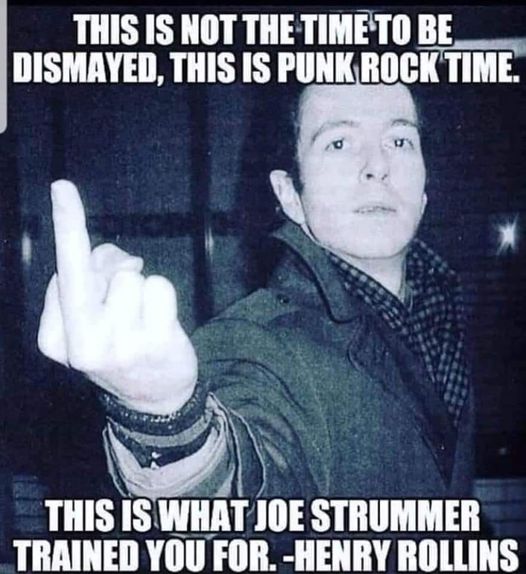
The only real beef I have with White Riot is its title. Also the name of the Clash’s first single, the song was a fervent call for multi-racial unity against a common foe: a government indifferent to the many societal and economic woes facing the working-class at the time. But the song could be misconstrued the other way (and occasionally was in 1977) and may also lead some to think that this is a film about Joe Strummer and Co. Although the Clash do make several appearances, this is squarely a film about a movement where music plays but a supporting role.
Central to this tale is Rock Against Racism founder Red Saunders, now an old grizzly bear of a man sitting in his office surrounded by the memorabilia of the time, esp. many back issues of the group’s handmade newspaper, Temporary Hoardings. Early on, Shah uses some of the available stock footage of National Front rallies and marches, with their drearily obvious signs (“It’s Our Country, Let’s Win It Back”) and speech snippets by those like the odious NF leader Enoch Powell and their paunchy and punchable “activities head” Martin Weber. Saunders came from a background in agit-prop theater and knew how to gain attention for a cause without being a bore about it.
When Saunders, who is also a photographer, was asked to shoot at a punk concert, he was instantly bowled over by the Clash. Here was the musical energy that could match the drive of his upstart social movement. The Rock Against Racism manifesto was re-printed in many of Britain’s biggest music mags and that movement quickly spread. Bands that played at RAR-related shows were X-Ray Spex, 999, Steel Pulse, XTC, Sham 69 and the Tom Robinson Band; several members show up in interview snippets.
But director Shah makes no mistake in pointing out that the National Front had made race prejudice an “acceptable point of view” in Britain at that time. This extended to some prominent old-guard rock stars. Included in this shameful category was David Bowie (who opined that the nation could “benefit from a fascist leader”) and Rod Stewart, who suggested (from the comfort of his new home in Los Angeles) that all of the UK’s immigrants “should be sent home.” Most egregious was Eric Clapton who, during an infamous 1976 concert in Birmingham, launched into a drunken racist tirade (“get the coons out”) while also asking minority fans in the audience to raise their hands and chanting the NF slogan “Keep Britain White.”
Of course, Saunders was all over this, bitterly criticizing Clapton (who built his career on the blues) of musical colonialism and suggesting that the guitar-god may be suffering from a touch of “brain damage.” True, punk did sometimes dabble in Nazi iconography, but you always got the feeling this was for shock value and not the sort of contemptible white privilege on display in the examples above.
An enjoyable aspect of White Riot is the emphasis on the inner workings of Temporary Hoardings and the current interviews with staffers like “Irate” Kate Webb, Syd Shelton and Lucy Whitman. The grassroots organizing, in an age before cell phones and the Internet, is inspiring as are the animated re-creations pf the newspaper’s cut-and-paste punk aesthetic.
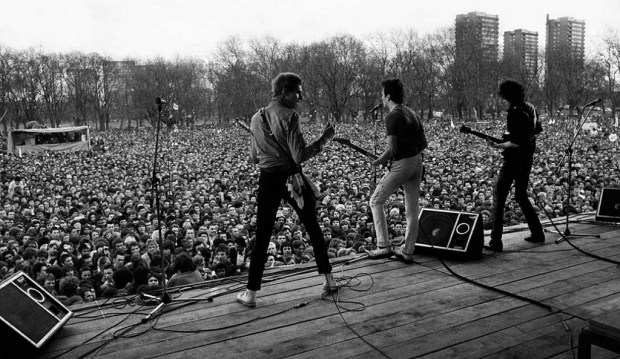
After months of rumbling with NF marchers and right-wing yobs, RAR had its moment in a bravura march from Trafalgar Square (see photo above) to Victoria Park, the ensuing demonstration and concert (headlined by the Clash) drawing close to 100,000 folks. The National Front fizzled at the polls in the ensuing general election (1.3%) but the vote also saw the election of Prime Minister Maggie Thatcher, who employed the dog whistle instead of the boot to exploit the cause of white grievance. Yet the celebration of cultural diversity promoted by Rock Against Racism has taken hold over the decades, even as populations seem intent on going backwards. So the struggle goes on, but Rubik Shah’s compelling work can act as a valued piece to show us again the way forward.
**************************************************
You can check out the excerpt of my book “Rock Docs: A fifty-Year Cinematic Jorney” at http://booklocker.com/books/8905.html or by clicking on the book cover image above. If interested in purchasing, you can also contact me directly for a special offer and free shipping! Thanks, Rick.
rick.ouellette@verizon.net
Here’s a little homemade seasonal comic from myself as writer and Eric Bornstein as the artist. It takes its cue from my work “The Ministry of Dark Tourism” part one of which is under way in graphic novel form with illustrator Ian J. Miller. More on that later and hope you can enjoy your socially-distanced Halloween! –Rick Ouellette






 Pete Townshend in a D.C. hotel room, 1967 (Photo by Michael Klavans)
 Jimi Hendrix outside the Baltimore Civic Center (Photo by Michael Klavans)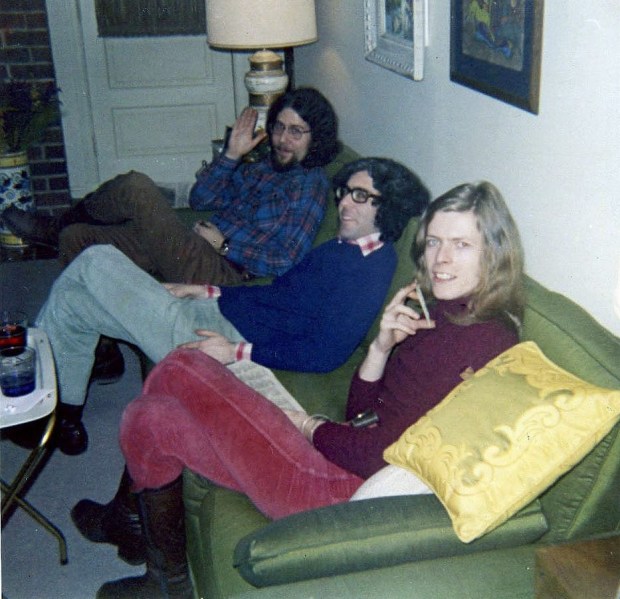
 But director Shah makes no mistake in pointing out that the National Front had made race prejudice an “acceptable point of view” in Britain at that time. This extended to some prominent old-guard rock stars. Included in this shameful category was David Bowie (who opined that the nation could “benefit from a fascist leader”) and Rod Stewart, who suggested (from the comfort of his new home in Los Angeles) that all of the UK’s immigrants “should be sent home.” Most egregious was Eric Clapton who, during an infamous 1976 concert in Birmingham, launched into a drunken racist tirade (“get the coons out”) while also asking minority fans in the audience to raise their hands and chanting the NF slogan “Keep Britain White.”
Of course, Saunders was all over this, bitterly criticizing Clapton (who built his career on the blues) of musical colonialism and suggesting that the guitar-god may be suffering from a touch of “brain damage.” True, punk did sometimes dabble in Nazi iconography, but you always got the feeling this was for shock value and not the sort of contemptible white privilege on display in the examples above.
An enjoyable aspect of White Riot is the emphasis on the inner workings of Temporary Hoardings and the current interviews with staffers like “Irate” Kate Webb, Syd Shelton and Lucy Whitman. The grassroots organizing, in an age before cell phones and the Internet, is inspiring as are the animated re-creations pf the newspaper’s cut-and-paste punk aesthetic.
But director Shah makes no mistake in pointing out that the National Front had made race prejudice an “acceptable point of view” in Britain at that time. This extended to some prominent old-guard rock stars. Included in this shameful category was David Bowie (who opined that the nation could “benefit from a fascist leader”) and Rod Stewart, who suggested (from the comfort of his new home in Los Angeles) that all of the UK’s immigrants “should be sent home.” Most egregious was Eric Clapton who, during an infamous 1976 concert in Birmingham, launched into a drunken racist tirade (“get the coons out”) while also asking minority fans in the audience to raise their hands and chanting the NF slogan “Keep Britain White.”
Of course, Saunders was all over this, bitterly criticizing Clapton (who built his career on the blues) of musical colonialism and suggesting that the guitar-god may be suffering from a touch of “brain damage.” True, punk did sometimes dabble in Nazi iconography, but you always got the feeling this was for shock value and not the sort of contemptible white privilege on display in the examples above.
An enjoyable aspect of White Riot is the emphasis on the inner workings of Temporary Hoardings and the current interviews with staffers like “Irate” Kate Webb, Syd Shelton and Lucy Whitman. The grassroots organizing, in an age before cell phones and the Internet, is inspiring as are the animated re-creations pf the newspaper’s cut-and-paste punk aesthetic.
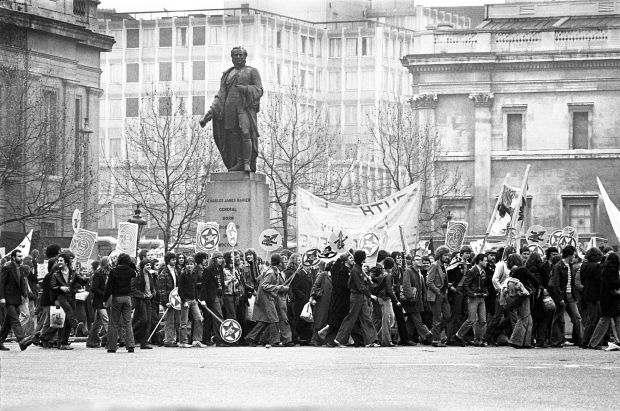 After months of rumbling with NF marchers and right-wing yobs, RAR had its moment in a bravura march from Trafalgar Square (see photo above) to Victoria Park, the ensuing demonstration and concert (headlined by the Clash) drawing close to 100,000 folks. The National Front fizzled at the polls in the ensuing general election (1.3%) but the vote also saw the election of Prime Minister Maggie Thatcher, who employed the dog whistle instead of the boot to exploit the cause of white grievance. Yet the celebration of cultural diversity promoted by Rock Against Racism has taken hold over the decades, even as populations seem intent on going backwards. So the struggle goes on, but Rubik Shah’s compelling work can act as a valued piece to show us again the way forward.
**************************************************
You can check out the excerpt of my book “Rock Docs: A fifty-Year Cinematic Jorney” at
After months of rumbling with NF marchers and right-wing yobs, RAR had its moment in a bravura march from Trafalgar Square (see photo above) to Victoria Park, the ensuing demonstration and concert (headlined by the Clash) drawing close to 100,000 folks. The National Front fizzled at the polls in the ensuing general election (1.3%) but the vote also saw the election of Prime Minister Maggie Thatcher, who employed the dog whistle instead of the boot to exploit the cause of white grievance. Yet the celebration of cultural diversity promoted by Rock Against Racism has taken hold over the decades, even as populations seem intent on going backwards. So the struggle goes on, but Rubik Shah’s compelling work can act as a valued piece to show us again the way forward.
**************************************************
You can check out the excerpt of my book “Rock Docs: A fifty-Year Cinematic Jorney” at