Uncategorized

“Extraordinary Tales” and Dream Geographies: The animated Poe and Beyond

extraordinary1

Extraordinary Tales
Directed by Raul Garcia–2015–73 minutes

The delectable new animation anthology “Extraordinary Tales,” where five of Edgar Allan Poe’s most notable stories each receive a distinctly different visual treatment, came along at just the right time and place. I had been scoping around for a suitable seasonal post but was at a loss until I heard of the film’s release. I would have settled for a straight review. Then I realized just how fitting that this limited-release title landed at the AMC Loews Boston Common. This 3-story, ersatz movie palace may be home of the $6.50 small popcorn but at least the downtown multiplex has returned movie-going to the center of the city after so many cinema closings there in recent decades. It also overlooks Poe’s hated Frog Pond in Boston’s famous public park across the street and is less than two blocks from the recently-installed Poe statue close to his birthplace. But I had a notion that the geographical connections went deeper than that (often to the point of being subterranean) and all-in-all made for an interesting night out at the pictures. But more on that later; I almost forgot about the film.

img520

“Extraordinary Tales” was directed by Spanish filmmaker/animator Raul Garcia and produced under the auspices of Film Fund Luxembourg (don’t laugh: little Luxy is a hotbed of animation team-building, check out “Song of the Sea” or “A Town Called Panic” for starters). Each story is boiled down to its core element of terror and dread and narratively speaking the film is a little thin. I imagine that’s to be expected given 21st century attention spans as well the density of 19th century expository writing. (Exhibit A: the 60-word opening sentence of “The Fall of the House of Usher”).

extraordinary2

And it is “Usher” which kicks things off after we are introduced to the framing device. This has the spirit of Edgar in the form of the famous Raven ruminating over his literary legacy with various female-figure statues in a curiously beautiful pastel graveyard. The sharp-lined antique-y style of “Usher” suits the grim tale of a family’s doomed bloodline as that old self-imploding greathouse is practically the main character. Christopher Lee’s great portentous narration here turned out to be his last film part before his passing last June.

The next narrator also sweeps in form the pale beyond as a scratchy period recording of Bela Lugosi reciting “The Tell-Tale Heart” is matched to stark B&W imagery in homage to Argentine comics artist Alberto Breccia. Ben-Day dots and colored overlays define the look of “The Facts in the Case of M. Valdemar” wherein an exercise in applied hypnotics goes way off the rails. The old warhorse “The Pit and the Pendulum” gets the quasi-realist look of an Xbox game and a Guillermo del Toro narration, the mechanics of the pendulum are especially well represented.

The concluding “Masque of the Red Death” may be the cream of the crop. The vibrant hues of its oil-on-canvas style (with visible brush strokes) are a feast for the eyes. The literal feasting—and dancing, card-playing and sexual byplay—of the royal partygoers, who cannot keep the Black Death at bay is portrayed without narration or (except for a couple of lines voiced by Roger Corman) dialogue. The slightly overexcited (universal) desire to partake of life’s rich pageant before death (Black or otherwise) comes a-calling was understandable enough without words.

masque

DREAM GEOGRAPHIES

When these cinematic pleasantries concluded, I stepped out to a clear late October night and crossed into the Common, with Poe’s repeated motif of falling or being trapped underneath fresh in my mind. There’s the Usher mansion collapsing into an abyss, the prisoner imagining a drop into a bottomless pit before facing the pendulum and the master with the dodgy eyeball getting sectioned off below the floorboards in “Tell-Tale Heart.” As Tom Waits once had it “There’s a world going on underground.” Between the Poe plaque at the corner of Boylston St. and what was once the top of Poe-birthplace Carver St. (now a service alley named Poe Way) and the AMC Loews there are several places that would make great locales for this man’s stories. There’s the trench-like row of crypts in the Central Burying Ground (a one-stop shop for all you “Premature Burial” needs!), Steinert Hall, a recital auditorium four stories below the Steinway store (built by the piano-making clan in 1896 but closed to the public since 1942) and an urban-legend pedestrian tunnel from the tiny Boylston subway station possibly up to the Schubert theater two blocks away.

img521

img522

It was Edgar Allan Poe’s literary successor H.P. Lovecraft that really put this macabre Ley-line notion into sharp relief. He once said that “there are black zones of shadow close to our daily paths.” While in real life this is not very comforting to acknowledge, in the aesthetic world it is super cool. In Lovecraft’s short story “Pickman’s Model,” the titular painter is banished from the upper-crust Boston Arts Club when his subject matter gets a little too hairy for the “Beacon St. tea-table” crowd. To wit: “There was a study called “Subway Accidents” in which a flock of the vile things were clambering up from some unknown catacomb through a crack in the floor of the Boylston subway and attacking a crowd of people on the platform.” (And you thought the T was bad nowadays). Those monsters, who may not be imaginary in the context of the tale, supposedly roam around in an extensive network of tunnels that fan out under central Boston from an opening in Pickman’s decrepit North End building, from where the artist muses, “these ancient places are dreaming gorgeously and overflowing with wonder and terror and escapes from the commonplace.” No kidding, right?

The dreaming part of that statement certainly resonates with me. I can look at that block of Tremont St. and see the AMC Loews and a vestige of the façade of the wax museum that used to be next door and the great hulk of the Masonic Temple on the corner of Boylston (I’d love to get a look at their sub-basement!) but a shade behind it all is a reoccurring dream landscape that I have visited periodically for decades. This REM wonderland is a densely-packed district of curio shops, chop suey stalls, burlesque theaters, pinball parlors and Art Deco shopping arcades–an urban archetype of the collective unconscious. Maybe writing about will bring it back because I haven’t landed there in over a year.

Walking back to my car, I passed by the Poe statue again, the morbid and magnificent author seemingly striding as quick as he can out of town (with his trusty Raven by his side) a cold shoulder turned to the dreaded “Frog-Pondians” of the city of his birth. In the “Extraordinary Tales” postscript he petitions for immortality in view of the six-foot hole. Mission Accomplished. Nowadays, our Subterranean Homesick Edgar is as iconic and indispensable in October as Charles Dickens is in December with “A Christmas Carol.” We can almost walk along beside him, dreaming gorgeously, one step ahead of the black zone at all times.

img518

A Reel and Rock Summer Break

Lord of the Ry's

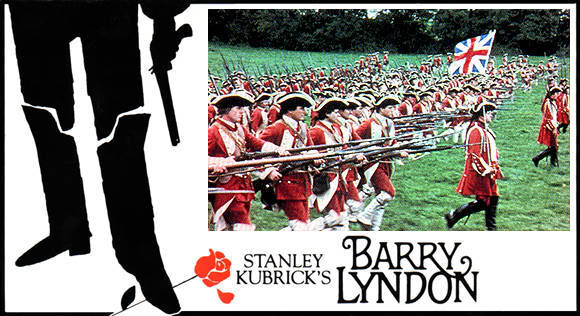
It’s blog break time. When I return, I’ll have Part 2 of my “Books That Rock” article, a re-consideration of Stanley Kubrick’s “Barry Lyndon” on its 40th anniversary and more of my “We’ve All Gone Solo” series, among other items. For those readers interested in music documentaries, a pretty hashed-over subject on this blog, feel free to visit my Facebook group called “Rock Docs” and join up if so inclined. Here is the link:

https://www.facebook.com/groups/rockdocumentary/

Currently, I have posted a clip from Penny Woolcock’s 2012 documentary “From the Sea to the Land Beyond” not a rock doc per se, but with a excellent soundtrack by the band British Sea Power. This compilation of early English documentary footage with that music makes a beautiful tribute to late summer. Until then… happy viewing and listening from Reel and Rock.

Rick Ouellette

Sex and Sensibility: “The Girl-Getters” is the Lost Classic of British Beat Cinema

system4

The Girl-Getters (a.k.a. “The System”)
Directed by Michael Winner—1964—93 minutes
Starring Oliver Reed, David Hemmings, Jane Merrow, Barbara Ferris, Julia Foster & Harry Andrews

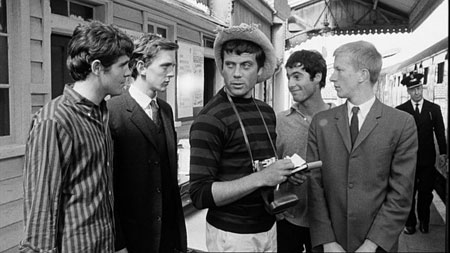
The under-recognized Michael Winner film “The System” represents a great lost missing link in the evolution of British cinema. Re-named “The Girl-Getters” for the American market and released just three months after “A Hard Day’s Night,” it rings out with the ascendant spirit of the youth films just coming into vogue. But it still owed a debt to the so-called “kitchen sink” dramas of the late 50s and early 60s, those gritty films like “A Taste of Honey,” “This Sporting Life” and “Saturday Night and Sunday Morning” that featured characters hemmed in by class boundaries, societal expectations and (more often than not) unexpected pregnancies. A 26 year-old Oliver Reed stars as Tinker, a wily beach photographer and ladies’ man in a seaside holiday town on England’s south coast. He heads up a gaggle of young men who have developed “The System” to maximize their success rate in the time-honored British endeavor known as “pulling the birds.”

6a00d83451cbb069e200e553cd10598834-800wi
The gang take inventory of the “finches.”

Right out of the gate, “The Girl-Getters” is a movie to savor. The shimmering B&W cinematography is by a talented up-and-comer named Nicolas Roeg. To the nifty uptempo strains of the Searcher’s theme song, we watch the guys speeding around in their roofless, backfiring jalopy. They drive to a neighboring train station to drop off a couple of their number so the incoming young ladies can be chatted up on the train before it even arrives in town. (“Get into the System” the Searchers sing, or at the end of the line “you’re alone”). Over the last two weeks of August, the gang and a rotating cast of the fairer sex will play out the summertime rituals on the bright-white promenade, in the shadows under the pleasure pier and inside the dancehalls and snack bars—as well up in Tinker’s attic loft. Although it’s not hard to guess that narrative complications will scratch up the film’s carefree surface, “The Girl-Getters” never gets as low as the often-embittered kitchen sinkers. Realistic rites of passage have replaced tragic pitfalls on the road to adulthood.

A lot of credit to the film’s success goes to Mr. Reed’s finely-tuned performance as the rakish but astute (even philosophical) Tinker. With none of the coarse mannerisms that sometimes dragged down future roles, Reed’s broad, handsome face and piercing bright eyes are at the center of most every scene. He meets his match in level-headed society girl Nicola (Jane Merrow), a stunning brunette fashion model who’s in town to check in with her aristocratic father and have some fun between assignments. Many movies would exxagerate the unlikely pairing: Nicola is all that: she’s got the looks, personality, money and use of her dad’s Buick Riviera. Tinker may be boss of the boardwalk but it’s a short season and the specter of a long, lean winter hangs over the locals whose credo is (according to him) “take what you can from the visitors, gather nuts against the hard winter.” But Winner’s naturalistic direction and Peter Draper’s clear-eyed script won’t allow for easy clichés. The pair’s bubble-blowing interlude and demure way of asking each other’s age hint at their relative innocence even as adult experiences beckon. They see in each other a possible way forward: for Tinker, Nicola may be a catalyst to get out of his provincial rut and better himself professionally in London; in Tinker, Nicola sees a native intelligence perhaps preferable to the entitled snobbery of her male friends back at the palm court.

girl getter A

It was not all marketing hot air when posters for “The Girl-Getters” proclaimed it was “an adult film for teenagers and a teenage film for adults.” Maybe that’s because the cast, brimming with the youthful energy typified by the rise of the Beatles, fell neatly in between those two broad demographics. A fresh-faced David Hemmings, as the newest addition to the boy’s club, is introduced to the ways of the “grockles” (tourists) and the inner workings of The System, but by end is planning on ways of improving it. Barbara Ferris does a sympathetic turn as the local would-be girlfriend of Tinker and the wonderful Julia Foster makes a brief but winning appearance as a party girl all too ready to offer Tinker the dreaded domestic arrangement offer after a brief fling. (I was a little young for this film during its brief American theatrical run, but developed a mad crush on Julia three years later in 1967 when she was the female lead in the Tommy Steele musical “Half a Sixpence.”) Veteran British hard-guy actor Harry Andrews steps up as the “Establishment” figure, playing Tinker’s boss, the no-nonsense proprietor of the Sunny Snaps photo lab.

system3
A grockle’s eye view of Tinker

Michael Winner certainly deserves credit for organizing this excellent cast and script into a time-tested end product that totally avoids the silliness that infected slightly later swinging British Beat Cinema entries like “The Knack” and “Here We Go Round the Mulberry Bush.” But Winner (who died in 2013) was more of a journeyman director probably most remembered for the indefensible “Death Wish” series he would do with Charles Bronson. The real production star is Nicolas Roeg. His photography during Tinker and Nicola’s romantic idyll on a remote cliff-backed beach is one of my favorite things ever by him, comparable to Ingmar Bergman’s 1953 young-love classic “Summer with Monika.” It is on this same scenic beachfront (with its abandoned hamlet) where the film ends. One of Tinker’s men has gotten himself married (as usual in these films, a pregnancy is involved) and the young locals combine an end-of-the-season bonfire with a strange, primal ritual involving bridge-and-groom effigies and scarifying masks. Instead, of the hopeless undertow that pulls down supposedly “carefree” movies like “Georgy Girl,” this group looks like they are smoking out the demons and putting trust in their collective friendship. The morning after, as Tinker gives Nicola a “bye-for-now” wave and joins his pals (both male and female) for one last frolic on the sand, you are given hope in a sensible implied outcome. These young people may have shaken off the shackles of confining post-war British mores, but neither do they look like they are going to be bamboozled by the illusions of a totally-liberated Sixties mindset. You expect that they’ll be working a sensible middle path to a place where things will end up just fine.

My next book, “Rock Docs: A Fifty-Year Cinematic Journey” (1964-2014) will be released later this year.

This post is my contribution to the Classic Movie History Project Blogathon, hosted by Fritzi at Movies Silently, Aurora at Once Upon a Screen, and Ruth at Silver Screenings. See the link below to see a list of the other 90 amazing entries spanning the eras from the beginning of cinema up to 1975…

The Classic Movie History Project presents THE GOLDEN AGE

blogathon

Age Against the Machine: “Alphaville” at 50

Alphaville
Directed and written by Jean-Luc Godard–1965–98 minutes

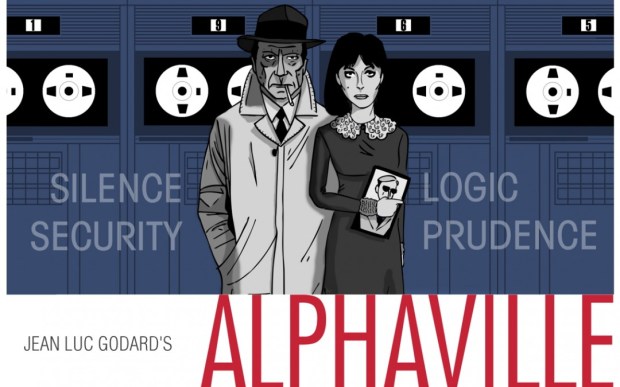
“Tarzan vs. IBM” was the cheeky working title Jean-Luc Godard gave to his dystopian tale of a technocratic dictatorship that was released in 1965 as “Alphaville.” The enfant terrible of French New Wave cinema was still at a phase in his career, five years after his breakout film “Breathless”, where his aesthetics were accessible enough to produce an entertaining movie that also caught you up in an intellectual brainstorm whose message—that mankind is apt to surrender his self-determination in the face of its own technological bedazzlement—was pertinent then and even more vital today. Of course, it may seem silly to anyone born after a certain period (1980?) to think we need rescuing from a vine-swinging hero in view of all the great advances the Information Age has afforded. But in a way, the domination of a digitally-based power structure has been achieved in the half-century since by the deployment of a different battle plan. Instead of banning emotions like the authorities do in Alphaville, it turned out to be easier to indulge people’s vanity instead. The omnipotent supercomputer at the center of Godard’s film (who calculates “so that failure is impossible”) endlessly spouts off the most numbing blandishments this side of Mark Zuckerberg.

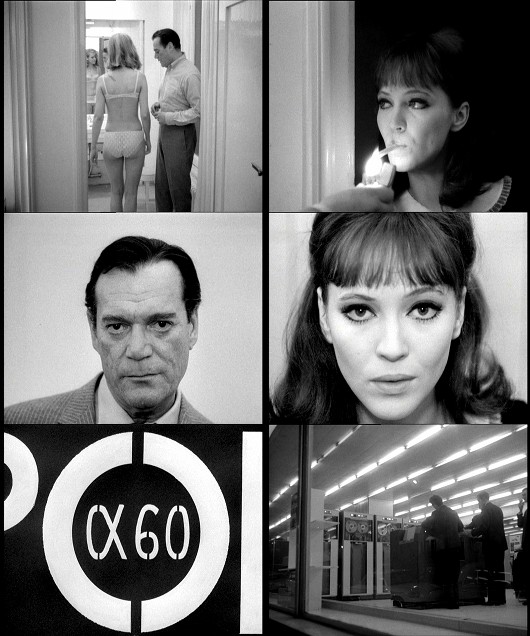
Of course, technology, like a lot of things, is what you make of it. It’s not as if Godard is averse to keeping up with technical advances in his chosen medium. The director is now 84 and recently released a dazzling (if typically uncompromising) 3D film called “Goodbye to Language” shot on various devices including a GoPro and a smartphone. But it was a half-century ago this year, some two decades before personal computers, where Godard first divined the potential grave errors of relying too heavily on one’s own machines. He cast American expat actor Eddie Constantine as a secret agent who infiltrates this nocturnal city-state to capture Professor von Braun, a renegade atomic scientist who has defected from the rival “Outlands”. Constantine retained the delightful character name of Lemmy Caution, a role he had played in a series of French pulp films. But this was a whole other ball of wax. Godard concocted a heady brew of hard-boiled detective plot points and science fiction iconography, with an extra-added sprinkling of philosophy and romantic poetry. Using no special sets, he and his go-to cinematographer Raoul Coutard created a fantastic futuristic city-state by shooting in the modern high-rise districts of Paris, a luminous B&W world of bleak boulevards, stark hotel interiors, sterile government ministries and the labyrinth of giant mainframes that culminate in the inner sanctum of Alpha 60, whose “1.7 billion nerve centers” of remorseless logic has been put to use in creating an acquiescent and nearly robotic population.

Constantine, with his gruff mannerisms and deadpan humor, keeps the film light on its feet even during the passages of weighty intellectualizing. An unpredictable rugged individual going up against mechanized conformity; it’s a tailor-made mission for the trenchcoated Caution, whose surname is quite the misnomer. Posing as a journalist, he blows into town, brushing off the scripted niceities of the hotel staff and resisting the advances of his assigned “seductress third-class” (“I can find my own dames”) and scorning the directive to report his presence with the proper authorities. He does not find it so easy to resist when his official escort around Alphaville turns out to be Natasha von Braun (Anna Karina), a cat-like beauty who is the daughter of the turncoat professor. Like other Alphaville residents, she has a serial number branded on the back of her neck and an impulse to say things like “I’m very well, thanks for asking” when no one is asking. But Lemmy has a hunch that in view of her parentage, Natasha may yet hold memories of pre-brainwashed times in the Outlands. This means she could be turned into a useful ally in infiltrating Alphaville’s central command and will also give him ample time to fall in love with her.

alphaville 33

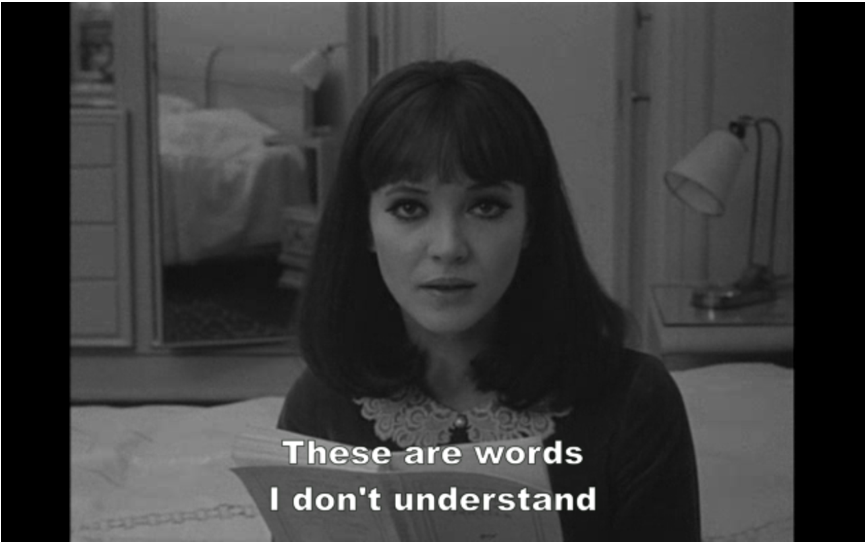
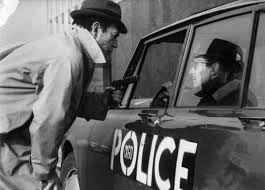
Ah yes, “love.” Just one of many words that the state’s leaders have banished, along with “conscience” and “tenderness” and many others in the expected Orwellian fashion. The film turns on Karina’s nuanced performance, as she slowly awakens to possibilities beyond Alphaville’s remorseless edicts. Her soulful sphinx gaze and delicate body language are of course rigorously recorded by Goddard (they were married at the time but soon to be separated) and makes for a curious contrast with the craggy-faced, trigger-happy Lemmy Caution. It’s all part of the film’s crazy-quilt sensibility, one minutes he’s blasting away at the secret police with his trusty firearm (which, along with his Instamatic camera, never seems to need re-loading) and the next he’s producing a book of romantic poetry to see how Natasha will respond.

alphaville words

But unlike later Godard films, the literary and political points don’t overwhelm. The transgressions of the Alphaville power elite are revealed gradually, even humorously. (Lemmy’s observation that “Everything that’s weird is normal in this whore of a city” is one of my all-time gumshoe one-liners). After a meet-up with one of his fellow operatives (a serio-comic turn by Akim Tamiroff) goes awry, he’s invited by Natasha to a gala at the Institute of General Semantics. This is capped off by a memorable firing squad scene at an indoor pool where emotion-loving dissidents are led out onto diving boards to share some final thoughts before being gunned down. It’s after this grim ceremony that Caution makes his first (unsuccessful) grab at the Professor, after which he is interrogated by Alpha 60, whose croaking basso profundo voice is by now well known to the viewer.

In two absorbing scenes, Lemmy Caution goes mano a machino with Alpha 60 and if any proof was needed that venal authoritarianism does not require some raving Hitler-type, here it is. It’s not just that Alpha’s “face” bears a strange resemblance to a malfunctioning box fan. It calmly declares that the essence of both capitalism and communism “is not an evil volition to subject their peoples… but the natural ambition of any organization to plan all its actions.” Of course, how could anything be less evil? This logic continues to suggest that the proper course in all matters is simply the endless self-perpetuation of all that favors oneself regardless of anything as quaint as the “common good.” So nowadays we have untouchable “too big to fail” financial institutions that run themselves like criminal syndicates, spying agencies that can snoop in on everyone to prevent a tiny number of wrongdoers, political parties that are openly in the bag to corporate interests and glitzy social-media behemoths that distract and flatter us all the way to the end of privacy. I could go on and so could you. Or at least some of you could, as younger generations seem to see little problem with the supremacy of technology over any of its potential pitfalls. We have developed a dislike of complexity just as the world has become insanely complex, making modern-day acquiescence to a permanent status quo seem more of a slow-motion crawl than the result of heavy-handed 1984-type rulers as seen in Godard’s film.

alphaville 999
“I’m too old to argue, so I shoot”—Lemmy Caution

Here, there is more of an immediate concern, as the paranoiac supercomputer and its minions prepare for an atomic attack on the Outlands. “It is logical to condemn you to death” announces Alpha 60 to Monsieur Caution but it may have proved to be not quite powerful enough for our humble secret agent. With a big FU to those who would “play the world when technical power is the only act in their repertoire”, Lemmy grabs Natasha and blasts his way out of town, hopefully one step ahead of the expected counter-attack. It may not be too late for us either, but I think we all need a little of that derring-do—or at least more critical thinking—so our own “journey to the end of night” ends not with more night but as in “Alphaville” with a hint of a new dawn.

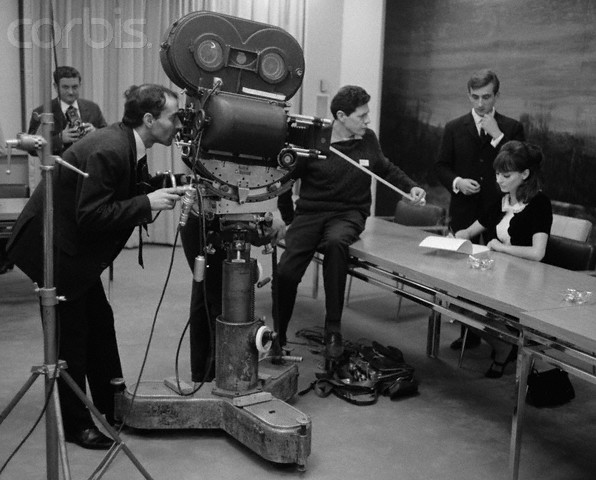
On the set of Alphaville, Une Etrange Aventure de Lemmy Caution
Definitive gaze: Godard and Anna Karina on the set of “Alphaville”

“Good bye to Language” may be nearing its arthouse run in 3D but remains recommended for adventurous filmgoers. You may come out of the film a little cross-eyed (his visual bag of tricks include parallax images, double exposure 3D and extreme color saturation) but you may also feel challenged or even inspired, a far different prerogative than most 3D Hollywood fare, where the CGI tail is often seen wagging the movie dog.

The Two Sides of 1967 by Joe S. Harrington

(After nearly two years in exsistence, Reel and Rock has its first guest-written post! Joe S. Harrington is the author of “Sonic Cool: The Life and Death of Rock ‘n’ Roll” [previously recommended in my “Books That Rock Pt. One” post] and was editor of the former Kapital Ink magazine. When I wrote a column on rock documentaries for KI, I was in the habit of sending edit-defying articles of a few thousand words each and now Joe has returned the favor. Visuals and captions by “Ed.” Enjoy!–Rick Ouellette)

beatles & VU

What more could possibly be said about the Beatles? And for that matter, the Velvet Underground? The Beatles are like the “learner’s manual” of rock n’ roll—they covered every discernible style, and did it all first. The Velvets, on the other hand, represent the dark underbelly of rock, from whence emerged a Cause and a Way of Life. It’s just proof of something that’s been said a million times about the VU: their influence didn’t really take hold until years later. So even though they were contemporaries of the Beatles, what they were doing was so far ahead of its time that the influence of it wouldn’t be felt or years, or even decades. So while the Beatles were totally of the ‘60s, the Velvets transcended it, making them the “better” group, right? But maybe that’s because the influence of the Beatles is so profound and well-engrained that it doesn’t even need to be clarified—which is what I’ve been forced to reconsider, having read Ian McDonald’s epic Revolution in the Head, and hence actually listened to the Beatles, album-by-album, for the first time in decades.

This aural re-evaluation ultimately led me to “lend my ears” to that most sacred of sacred cows, Sgt. Pepper’s Lonely Hearts Club Band, which has suffered so much overkill that genuine proponents like Rolling Stone, in their ultimate anti-hip measure, only rated it FOUR stars in the first edition of The Rolling Stone Record Guide, published in 1978. The point being, what was once considered “the greatest rock n’ roll album” of all time, in just a decade had come to be seen as sadly dated, a curio of a bygone era, and somehow quaint in its timeliness. At the same time, to demonstrate how much the critical consensus had changed since the ‘60s, in the same volume, The Velvet Underground & Nico pulled five stars. With the rise of punk—viewed by critics as the Velvets’ progeny—esteem for the VU had only risen and they were seen as innovators, whereas the Beatles, as adventurous as their mid-sixties music had been, now had their lot lumped with the bastions of “classic rock,” beloved by FM rock listeners, but considered passe by hipsters.

lennon_mccartney

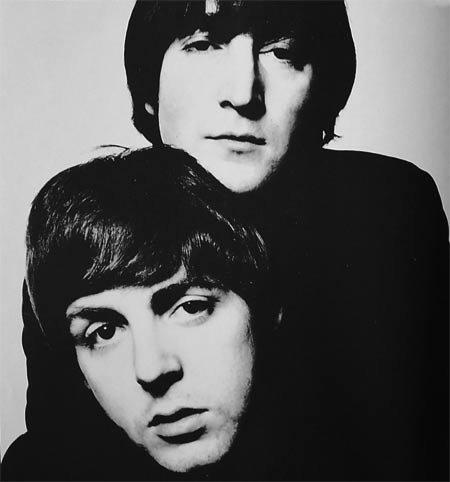
J & P, moments after learning the results of a Hipster Popularity Contest, where they went up against Alex Chilton and Chris Bell

In the ‘80s, as the post-modern mentality crept in, the Beatles, given their universal mainstream appeal, were short-changed in favor of not only the Beach Boys but far lesser groups like Big Star. But these things are cyclical—first Yoko Ono was acknowledged as kind of a godmother figure to both new wave and Riot Grrl, and then it was the Scorsese documentary about George Harrison, but eventually the Beatles came back into favor…but they’ve been “going in and out of style,” as they themselves said on Sgt. Pepper, for so long that, at this point, all such arguments are moot, because as the years go by the whole ERA gets more compressed—hence the Beatles have much more in common, in the long run, with, say, the Ramones or even Metallica than any of them have with Taylor Swift. At a certain point there came a time, especially as a barometer of the Zeitgeist, when music just didn’t matter anymore. But it can be argued that the Beatles—along with Dylan, the Stones and all the rest—ultimately represent the moment when music did begin to matter, and that’s why, ultimately, the Beatles and Velvet Underground have a lot more in common than critics and fans may have surmised back in rock’s golden age.

Make no mistake, the Beatles were not a boy-band, or a pop artifice—they had some of that in their music, but by the time they recorded, in 1962 (not counting a few odd recordings a year or so before as a backing band), they were a seasoned performing unit in a way that few groups who followed them could match, simply because the Beatles opened the floodgates for those groups. The Beatles not only had to prove themselves, they had to prove the worth and merits of the whole style of music—rock n’ roll—because their embrace of such was simply unprecedented. Therefore, by the time the other great groups of the ‘60s emerged—the Kinks, the Rolling Stones, the Grateful Dead, the Velvets, the Byrds, the Doors, the Airplane, the Who, Zappa, etc.—they didn’t need to toil away playing the dingy bars of Hamburg (or its equivalents) for more than six months whereas the Beatles had been doing it for six years. Sure, there are arguments that those bands, given their relative youth and inexperience, caught up—and even surpassed—the Beatles in record time.

velvet-underground open enrollment

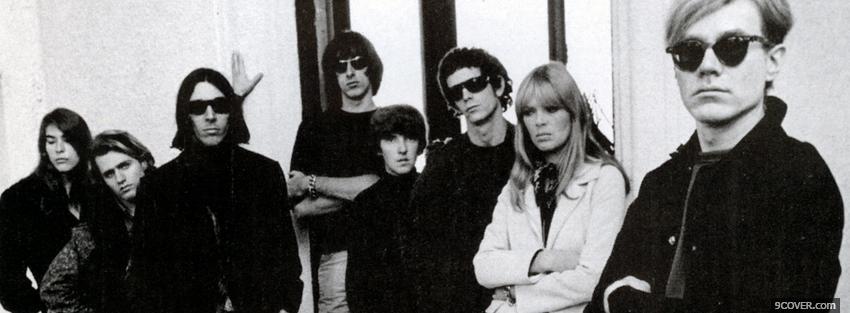
The Velvet Underground during their open enrollment period

That included the Velvets—but don’t think they weren’t hip to the Beatles: Lou Reed played a hollow-bodied Gretsch guitar like George Harrison and on the flexi disc that came with Index magazine in 1967, which featured a conversation recorded at Andy Warhol’s Factory just after the Velvets’ first album came out—and, consequently, Sgt. Pepper as well—one hears Nico mimicking “Good Morning, Good Morning”…not sarcastically either, but just because that’s what everybody was doing in the Summer of ’67, because the album was ever-present. In other words, even though the Velvets, who could loosely be considered “rivals” with the Beatles, had just put out their own LP, they couldn’t get out from under the shadows of Sgt. Pepper. After all, it was Number One for fifteen weeks—virtually the entire summer of ’67—and, other than Michael Jackson’s Thriller, how many other albums can you say that about?

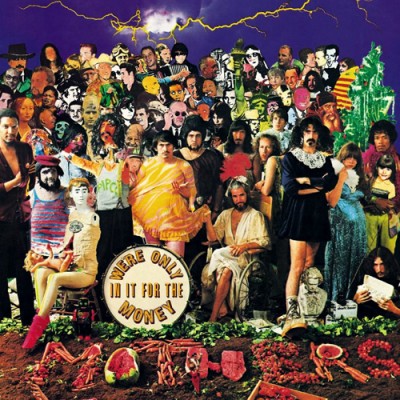
Even as late as 1970, the Velvets’ Sterling Morrison gave an interview to Fusion magazine where he actually venerated Sgt. Pepper in favor of Frank Zappa’s parody of it, We’re Only In It for the Money: “Let me see him come out with something as good as Sgt. Pepper. What Zappa saw in Sgt. Pepper was something good which showed real perception and talent, and lacking these attributes himself, he decided to do something else, and make fun of it. Is there anything on We’re Only in It for the Money that even remotely compares to the original?” Given this evidence, it’s clear that it wasn’t the Beatles whom the Velvets considered rivals, but the California groups like the Mothers and Grateful Dead.

Zappamoney2

I’m more of a “Weasels Ripped My Flesh” guy, anyway.

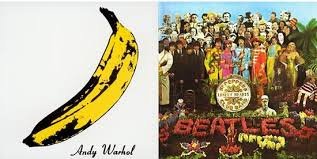
In fact, as rock rolls on, it becomes clearer that perhaps the two most enduring bands of the entire rock n’ roll era are the Beatles and the Velvets. Don’t believe me? Just ask Robert Christgau, who proclaimed the VU “the number three band of the sixties” after, of course, the Beatles and James Brown & His Famous Flames. Now JB is sacrosanct, irrefutable…where would Gospel, Soul, Funk, Disco, Hip Hop and Rap be without the Godfather of Soul? But it’s not rock, it’s R&B, and therefore in a separate category. The Velvets, on the other hand, format-wise, are the same as the Beatles—guitar/bass/drums—but both groups dabbled with non-rock motifs: the Beatles with symphony orchestras and the Velvets with electric viola. And both had high-art aspirations, not the least of which was they employed actual artists to design their album covers, instead of leaving it to the record company. Therefore you could have the infamous Andy Warhol banana on the cover of The Velvet Underground & Nico, and Klaus Voorman’s black-and-white collage adorning the Beatles’ Revolver, the album that predated Sgt. Pepper. By the time of Pepper, standards were being raised even higher by Michael Cooper’s elaborate cover design, and the fact the Beatles actually printed the lyrics on the back to assert that Lennon and McCartney warranted serious consideration as “composers.” And although almost no-one knew it at the time, and the Velvets didn’t print the lyrics on their album, a future generation of critics would assert much the same thing about Lou Reed.

Add to that the fact that both Sgt. Pepper and the Velvets’ first album were among the first rock LPs to be issued with a gatefold, extremely rare for rock albums at the time—the thought being the Powers That Be at the record companies didn’t want to waste the cardboard on mindless fodder. But the Beatles being the Beatles, and the Velvets with the Warhol connection, obviously warranted a higher standard from their respective labels (only Frank Zappa, who recorded for the same label as the Velvets—Verve, who’d previously specialized in jazz—was accorded the same dignity).

velvet inner gatefold

There were precedents for this kind of maturation in rock—not only Zappa but the Beach Boys of Pet Sounds (both cited by the Beatles as influences on Sgt. Pepper). But compared to the breakthroughs established by both the Beatles and Velvet Underground in 1967—even though they were worlds apart—such early innovators can be seen as merely stepping stones. And the Stones, although their early R&B-based work and even proto-psychedelic stuff can be seen as superb, didn’t really surpass the Beatles until the great string of albums beginning with Beggar’s Banquet and culminating with Exile on Main Street—by which time both the Beatles and Velvet Underground were no more.

Released within three months of one another in 1967, Sgt. Pepper’s and the Banana album represented the two social and sonic spheres of the sixties—the Beatles were light, optimistic, effervescent; the Velvets were dark, foreboding, luminescent. It’s hard to say which one had the most influence, but it’s obvious the Beatles’ influence was more immediate and the Velvets’ was more latent. What’s obvious, though, is that, taken together, they are the two most influential groups of their time—and hence any time, because, despite punk, it’s doubtful, at this point, in terms of rock music, the ‘60s is ever going to be surpassed.

1967 was the apex of that renaissance. Surely there will never be another year in which the possibilities of rock music seemed so limitless, before it became clouded by irony and pretention. Both the Velvets and the Beatles epitomized rock’s giant breakthrough as an art-form, and Sgt. Pepper and The Velvet Underground & Nico were both high water marks of the revolution—but whereas the Beatles used a more ornate style to reflect rock’s increasing maturity, the Velvets, in stark contrast, produced an almost primitive sound. Despite the stylistic differences, however, both groups shared similar concerns (which admittedly were in the air at the time). Themes of alienation, for instance, are reflected in both Pepper’s “She’s Leaving Home” and the Banana Album’s “All Tomorrow Parties.” Both albums are heavily drug-influenced, and while something like John Lennon’s “Lucy in the Sky with Diamonds” is nowhere near as blatant as Lou Reed’s “Heroin” and “I’m Waiting for the Man,” it probably turned more people onto acid than any similar song of the era (and John would have his own junk-song a couple years later in the form of “Cold Turkey’). That’s one of the things McDonald makes clear in his book—the Beatles greatest importance was as the Uber-messengers of not just rock, and psychedelia, but the avant-garde. And the Velvets of course benefited from this, being an “art band” and all.

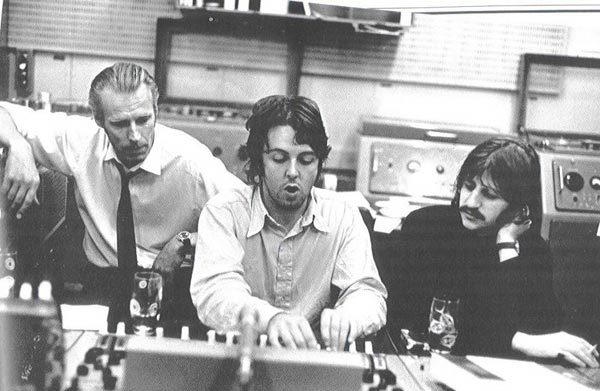
Paul McCartney in studio with George Martin

Thanks, George, we’ll take it from here.

Noise was another integral element of the new, freer music, in both jazz and rock, and perhaps the first aspect of the Velvets to be fully grasped by future generations was this atonal quality. The Velvets were the first band, save perhaps the Who, to embrace the concept, even calling an early track “Noise.” And while the Beatles are more universally remembered for their melodic qualities, by 1968, when the whole world seemed to be in a state of chaotic dissonance, even the Beatles were pushing the sonic envelope with what could loosely be called “noise experiments”—including of course the infamous “Revolution 9” on the White Album, 8 minutes of audio mélange that, as McDonald acknowledged, became the most widely-disseminated “avant garde” document, in any art form, ever. As so often happened with the Beatles, they may not have come up with the idea, but their enormous popularity guaranteed that such concepts—ones first promulgated by the actual bastions of the avant-garde like Warhol and John Cage (and, for that matter, Yoko Ono)—would reach a much wider audience.
Speaking of noise, certainly John Lennon’s embrace of atonality in the later stages of the Beatles—from audio pastiches like “Revolution 9” and Two Virgins to the raunchy and dissonant guitar playing on tracks like “Cambridge 1969” on Life with the Lions and the live version of “Don’t Worry Kyoko” on Live Peace in Toronto—owe a lot more to the Velvets’ type of pure-noise exorcisms than the more sculpted textures of the Who and Jimi Hendrix.

While everyone was aware of the Beatles, there’s a good chance the Beatles were aware of the Velvet Underground as well. Mick and Keith already copped to the influence of the VU on “Stray Cat Blues,” and it’s a known fact that, in those days, Paul McCartney was an avid champion of the underground (sometimes even in the philanthropic sense, such as his support for the International Times or the Monterey Pop Festival). In the spring of ’67, when Andy Warhol was trying to bring Chelsea Girls to Europe, he and his entourage actually visited Paul McCartney at his home in London right around the time of Sgt. Pepper. There’s a video on YouTube, dating from ’67 or so, where Paul Morrissey, Warhol’s director, talks about how, at the time, Paul McCartney, like just about everyone else in those days, was experimenting with underground movies (which Morrissey refers to as “psychedelic”). There’s even the possibility that, right before he died, Brian Epstein, the Beatles’ manager, was thinking about managing the Velvets!


Says “factory interview” but took place in England–Ed.

According to Danny Fields in the book Uptight (pg 84): “I had given Brian the banana album and one night I was with Lou at Max’s and Brian came in briefly. He said he was on his way uptown. I went outside to his limousine with him and then I said, ‘wait a minute I have an idea.’ And ran back in and said to Lou, ‘This is your big chance to talk to Brian Epstein.’ He got in the car but there was like total silence because they were both too proud to say anything to each other. Finally Brian leaned over and said ‘Danny recommended this album to me and I took it to Mexico with my lover. It was the only album we had there. We rented a phonograph, but we couldn’t get any more albums, so we listened to it day and night on the beach in Acapulco. Consequently my memory of the whole week in paradise was your album.’”

Of course if Brian Epstein was listening to the Velvets’ first album there’s a pretty good chance the Beatles themselves had caught wind of it. Ironically, it was Brian’s death in 1967, just a couple months after Sgt. Pepper was released, that finally liberated the Beatles from their former teen-pop image…which is just another way of saying, with rock’s increasing maturity, the Beatles were no longer necessarily “leading” the movement, but increasingly were just one more hue in its ever-expanding palette. And it can be argued that, once that happened, it was inevitable that the Beatles—and hence the whole movement—would fragment. Which is why, in the ensuing years, the Velvets, who’d symbolized this individualistic, non-unifying quality from the beginning—cynicism, if you will—would be increasingly looked upon as being as important, if not more so, than the Beatles (a premise that would’ve seemed unthinkable in 1967). It should be noted also that Richard Hamilton, the artist who designed the blank cover for the White Album—undoubtedly the Beatles’ most experimental and musically-varied opus—actually appeared in Warhol’s film, Kiss, in 1964. In the ‘60s, the worlds of art, music, media and graphic design were all converging. The Beatles were at the forefront of it, but the point is, so was the Velvet Underground

And not everybody at the time favored the Beatles either—critic Richard Goldstein, who’s somewhat praise-worthy article in the Village Voice about the Velvets actually made the press blurbs reprinted on the sleeve of the banana album, famously panned Sgt. Pepper when it was released (making him, admittedly, the lone dissenter at the time). It’s clear that, in 1967, both Pepper and the VU & Nico were pointing the way towards the future; but there was no shortage of groundbreaking albums released that year, from the first albums by Cream, Pink Floyd, the Bee Gees, the Jimi Hendrix Experience, Traffic and the Doors to the Mothers’ Absolutely Free, Love’s Forever Changes, the Beach Boys’ Smiley Smile, After Bathing at Baxter’s by the Jefferson Airplane, the debuts of Moby Grape and the Grateful Dead, the 13th Floor Elevators’ Easter Everywhere, the Incredible String Band’s Hangman’s Beautiful Daughter, the Who Sell Out, There Are But Four Small Faces, Younger than Yesterday by the Byrds, Captain Beefheart’s Safe as Milk and Nico’s own Chelsea Girls to name but a few. Changes were in the air—yes, of the “forever” variety—and while it’s tough to say whether ’67 was the “best” year that rock will ever know, it’s clear that it was the turning point. And if this is true, two albums clearly stand out as definitive: Sgt. Pepper and the Velvets’ first.

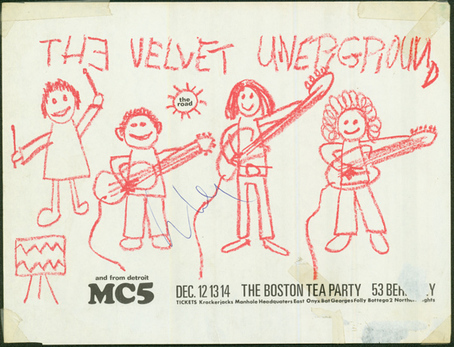
velvet crayon
Those were the days

Despite other similarities between the two groups—such as the fact they were both managed by prominent older gay men and they both sacked their original drummers—the worlds of the Velvet Underground and the Beatles were still universes apart in 1967. And although, in post-modern terms, there’s a tendency to view the Velvets’ album as having even greater impact than Sgt. Pepper, in critics’ polls conducted over the years, both albums are almost always in the Top 20. For example, in the VH1 poll conducted in 2001, Pepper comes in at Number Nine, and the VU & Nico at Number Nineteen. In 2003, Rolling Stone placed Pepper at Number One of all time, with the Banana Album at Number Thirteen. The NME, on the other hand, in a more recent Top 500—in which the Smiths’ The Queen is Dead pulled number one—the Velvets’ debut was at Number Five and Sgt. Pepper’s was relegated to the 87th spot (although Revolver was Number Two). But that’s just another example of post-modern revisionism (which the Brits are champs at). For another more Anglo-centric view there was Paul Gambacinni’s groundbreaking 1977 Top 200 Albums, where Sgt. Pepper copped the Numero Uno spot, and the Velvets’ first album placed at Number 14. Ten years later, in the book’s revised edition, although Pepper still sat firmly at the top spot, the Velvets had risen to Number Seven.

More telling is a more recent poll by Rolling Stone supposedly entailing the 100 Best Debut Albums of All Time where they proclaim the first Velvets album “the most prophetic album ever made.” Which is somewhat closer to the truth—and goes back to Ian McDonald’s original premise that the Beatles were so much a product of their time—while at the same time DEFINING it–that it became almost impossible for them to transcend it (and not be judged totally within the context of it). Sgt. Pepper was such a cataclysmic event when it was released in the Summer of Love that it honestly had nowhere to go but down in terms of esteem in the ensuing decades. The Velvets, on the other hand, were so underground in their time that it took 25 years for their full impact to be assimilated. If the Beatles were the most influential band of the ‘60s, the VU were clearly the most influential band of the ‘80s—and that influence continued to grow up until a few years ago, with the Strokes being yet another band who took their cue from the Velvets, following in the tradition of the Modern Lovers, Feelies, Dream Syndicate, Sonic Youth, Gang of Four, Jesus & Mary Chain, you name it.

It really doesn’t have to be decided which one is “better” because ultimately it can’t be. But one thing remains clear—in the minds of music fans, 1967 will live forever, and Sgt. Pepper’s Lonely Hearts Club Band and The Velvet Underground & Nico are two big reasons why.


This 4-minute clip is from the Beatles official YouTube channel, so the over/under as to when it will be taken down is 36 hours based on past Reel and Rock history.

The Annotated Charlie Brown Christmas

charlie xmas ad

Gentle snowflakes fall on an idyllic silver-blue landscape. A group of kids weave around each other on a skating pond, all in time to an angelic children’s chorus. “Christmas Time is here,” they sing, a season that speaks to “olden times and ancient rhymes/of love and dreams to share.” Heading down that way is the comic pages’ most famous underdog, already complaining to his forbearing best friend that despite the many pleasant trappings of the holiday season he can only feel depressed, unable to rise to the way he’s “supposed to feel.” Soon after Charlie Brown and Linus make it to the pond and strap on their skates, the former’s dog has them both has both tangled up in the latter’s security blanket, sending Charlie spinning off the ice and into a tree, where the snow that shakes off the branches reveals the name of one the earliest—and still one of the most popular—TV Christmas specials.

charlie-brown-skate
The short-lived skate pond Arcadia

Sure, there are many reasons that “A Charlie Brown Christmas” ranks so high in the now impossibly crowded parade of annual Yuletide specials. The already popular characters of the daily funnies were first brought to life for this project—by a spot-on cast of child voice actors—and were never as vibrant as here. The memorable smooth-jazz score of Bay Area piano great Vince Guaraldi is a legend in its own right. And the fact that the amenable inclusion of a Nativity reading from the Gospel of St. Luke (and the concluding “Hark the Herald Angels Sing” chorus) has kept it in the hearts of the more religious-minded. This is all to the good.

But let’s face it—it’s the script’s dogged search for the nature of “what Christmas is all about” inside the maelstrom of an uncaring, chaotic and profiteering universe that will always be the big takeaway here. Sure, the show’s repeated gripe that the season is getting “too commercial” sounds a bit quaint now—fifty years later the problem is so pervasive it would be like protesting that the ocean is too wet. When we’ve reached a point where it seems the entire American economy is underpinned by the retail activity of the last two months on the calendar, with people being known to do grave violence to each other at 4 AM on Black Friday just in order to get a “bargain”, no wonder the show’s free-floating anxiety resonates. We are all Peanuts.

Of Phobias and Five Cent Co-Pays

In this strangely de-populated town of mottled skies—not even one honking adult voice in its 25 minutes—the kids fend for themselves even when it comes to mental health services. Of course, this takes the form of the outdoor psychiatric stand run by the gang’s alpha female. Lucy may only charge five cents but seems well-versed in the jargon of her chosen field, picking up bits and pieces from TV and re-purposing them for a small fee. Charlie Brown miserably takes a seat but his plaintive admission (“I’m in sad shape”) is not met with a hug but with a request to pay in advance, and then waiting while the doctor savors the sound of the nickel rattling around in the can.

Just as modern-feeling as the casual indignities of the health care system, is the rush to label Charlie’s neuroses. Lucy famously runs through a bewildering series of possible phobias: hypengyophobia, “ailurophasia” (actually ailurophobia, the fear of cats), thalassophobia and others, before ending with the one she should have started with—pantophobia (aka panphobia), the fear of everything. Welcome to the 20th century. Lucy, who can transition from bully to confidant without batting an eyelash (OK, maybe with batting an eyelash for effect), admits she gets depressed as well, having to settle for getting “stupid toys” under the tree every year when all she wants is the gift of real estate.

Lucy shrink
Ailurophasia, screamed in vain.

Let’s Just Dance

Lucy’s suggestion that Charlie Brown direct the school Christmas play as a sort of involvement therapy can only go wrong (naturally). A production never to be sullied by adult interference, Charlie’s half-decent attempts to whip the group into shape are constantly interrupted by the Harpo Marx-like antics of Snoopy, casting disputes and general disorder. In a better world, his efforts may even have been appreciated. He deftly attempts to defuse Frieda’s objection that the cloud of dust emanating from her innkeeper-husband Pigpen “is taking the curl out of my naturally-curly hair” by suggesting that that it may have originated in ancient Babylon, thereby enhancing the play’s authenticity. But it’s all for naught. Lucy has merely drawn Charlie out the manageable discontents he finds outside (his “commercial dog” decorating its doghouse in hopes of a cash prize, taking down a letter-to-Santa dictated by his sister, Sally “Tens and Twenties” Brown) and into a group setting where his status as a social outcast can be magnified. (His installation as director is met with cries of “We’re doomed!”). Every time Charlie calls for “Action!” the gang break out into the spontaneous free-form dancing that is a hallmark of this special, where the kids can be kids and forget their status as part-time adult stand-ins.

charlie brown dance

“Isn’t it a great play?” (Research by your diligent blogger has revealed that the three children in the middle (the purple-dress twins and the yellow-shirted boy doing the head-bobbing shuffle) are all siblings from the obscure “95472” family, the girls’ first names being 333 and 444 and their brother’s 555. Their parents apparently were preparing them for the impersonal, data-driven world ahead of them.)

I Suggest We Try Those Searchlights

Nagging dissatisfaction with the play leads Lucy to admit that the whole season is little better than a Mob racket (“It’s run by a big Eastern syndicate, you know,” she whispers conspiratorially) and although Charlie suggests getting a Christmas tree as a countermeasure, that idea instantly evolves to mean an aluminum tree, preferably “painted pink.” Uh-oh. With Lucy’s mean-girl lieutenants (Violet, Patti, Frieda) already primed for the kill, Charlie walks off and, despite Linus’ mild objections, picks the comically scrawny natural tree in a forest of exaggerated metal replicas.

charlie-brown-wooden xmas tree
“Fan-tastic!” Inside the aluminum forest

Interestingly, the faddish popularity of aluminum trees—esp. those silver ones that came with a rotating color wheel—had already peaked by 1965 and this show proved to be the nail in the coffin. They went out of general production two years later, relegated to novelties.

“This little one seems to need a home,” Charlie suggests, and marches it back to the auditorium where his charitable instinct is lost on everyone in a hailstorm of derision (“Can’t you even tell a good tree from a poor tree?”) save for Linus who seizes the day with his impromptu Gospel reading. He quietly reprimands the kids without once speaking to them and in doing so forever shields the show from the “War on Christmas” numbskulls at Fox News. Well played, my thumb sucking friend.

As in life, however, our protagonist’s redemption is still tempered by life’s tiny indignities. Even after Linus suggests the application of a little TLC, which turns this plus-sized twig into a regal fir, Lucy is still hedging her bets. “Charlie Brown may be a blockhead, but he did get a nice tree.”

It is strange to think now that so many folks behind the scenes thought that “A Charlie Brown Christmas” was going to go down in flames faster than Snoopy’s doghouse after a fight with the Red Baron. CBS execs, and some people who were working on the project (which had a mere six-month production window), thought the combination of the adultish kids, jazz music, modest animation style and the religious element that Charles Schultz insisted on keeping, was a mish-mash that would never work. Instead, it played to half the TV sets in America on its first airing and was heaped with praise by critics the next day. It seemed like only animation team member Ed Levitt could see his way clear before the broadcast, insisting to producer Bill Melendez that “This show is going to run for a hundred years.” It’s halfway there now.

(If you liked this post, please check out last year’s Christmas entry, “The Education of Ebenezer.” To find, click on the Uncategorized section to the right. Also, please feel free to friend me on Facebook. I’m the Rick Ouellette from Bedford, Mass. Thanks for reading!)

The Newburyport Documentary Film Fest is this weekend

Newb doc

Those of you from Massachusetts (or the lower reaches of New Hampshire and Maine) who share my love of non-fiction film should definitely try and make it to the annual Newburyport Documentary Film Festival being held in downtown Newburyport, Mass. from Sept. 19-21. See below for the link to their official website and schedule:

http://newburyportfilmfestival.org/

This is a modest (two-venue) happening but intimacy is a big part of the festival’s appeal. There are free panel discussions and coffee times with many of the filmmakers and it’s a great place for those producing documentary shorts: this year there are three different one-hour blocks of short subjects.

Moreover, Newburyport, if you’ve never been, is a great place to spend a day, a city that blends hipness and old New England charm. Check it out if you get a chance.

And if you can’t make because of time or geography, please have a look at their schedule to maybe find out about some great docs to see later at your convenience.

Reel and Rock takes a holiday

img911

When we return from the idyllic retreat overlooking Ipswich Bay, I’ll be continuing my “Dubious Documentaries” series, the first two entries which have already appeared on my Facebook page. Speaking of FB, please feel free to friend me there. I’m the Rick Ouellette with the glasses and the location of Bedford, Mass. Hope your summer’s been great so far.

Why Burn Books When You Just Can Just Ignore Them? Fahrenheit 451 Revisited

f451

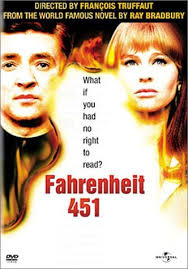
While puttering around in the library a couple of weeks ago, I looked down at the cart where they put the recently-returned DVDs and caught the soulful gaze of Julie Christie on the cover of the recently re-issued 1966 film version of “Fahrenheit 451” directed by Francois Truffaut. So of course I had to check it out. The French auteur’s first English-language movie has always had a mixed reputation at best: the acting and dialogue was deemed too starchy and the themes of Ray Bradbury’s classic speculative novel too flattened out.

But it had been so long since I last watched it (probably on a 13-inch TV) that I figured a new viewing would be like a re-discovery. And how. In this age of restored content and hi-def screens, Truffaut’s “451” looks fantastic with its autocratic iconography, bold primary colors and the retro futurism of its deftly chosen locations. Also, in view of broad societal shifts since it was made 48 years ago, the film seems more prophetic than ever.

img758
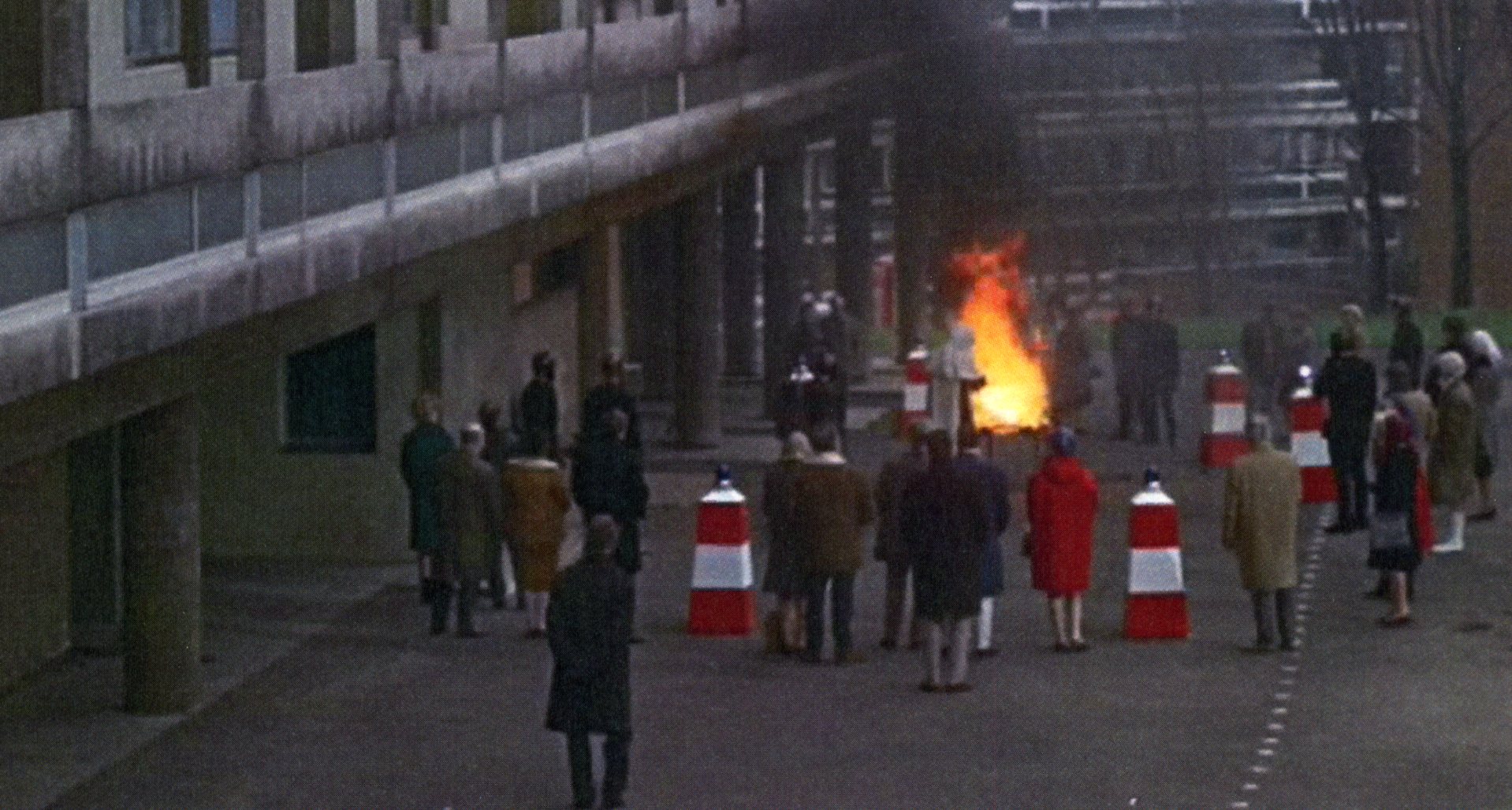
The flamethrowing fanatics of “Fahrenheit 451”
Coming soon to a Barnes & Noble near you!

Of course, the central premise of Bradbury’s cautionary tale may seem silly in retrospect. In a world where all literature is banned, the protagonist, Guy Montag (Oskar Werner), is part of a team “firemen” who rely on informants (usually neighbors) to swoop down on the homes of violators and publicly burn their hidden stashes of books. The plot centers on Montag’s crisis of conscience as he starts to read books that he has slipped into his kit bag during raids. Matters are complicated by his budding friendship with the non-conformist Clarisse. Both Clarisse (a student in the novel but a young teacher here) and Linda (Montag’s media-overloaded, pill-popping wife) are played by Christie.

The institutionalized conflagrations of this story can appear far-fetched. Yet when Bradbury wrote this in 1953 the Nazi book burnings were in recent memory and the dirty dealings of the House Un-American Committee were in full swing. The state-sanctioned pyromaniacs of “Fahrenheit 451” were more broadly symbolic of the casting off of all independent knowledge and self-determination.

Behind the visual hyperbole of the black-shirted firemen with their brass kerosene squirters and fascist salutes, Truffaut tweaks some of the book’s subtler messages to great effect. Although this is supposed to be a totalitarian society, there is no overarching Big Brother; the local fire department zipping around in their pyromobile is about the only representation we really see. Instead, the tiresome tirades of some blowhard dictator has been effectively supplanted by ingratiating TV hosts making every one of their “cousins” feel as if they are Special just by tuning in.

This personal neediness, so well evoked by Christie’s nuanced performance as the wife, is all too indicative of an attention-starved 21st century Western population. Instead of Orwell’s 1984-style eternal-boot-in-the-face, the people are kept in place by being incessantly flattered. Instead of widespread state censorship, we get instead access to everything in a completely commodified environment. (The child-less Linda remarks that “when you have a second wall screen put in, it’s like having your family grow around you.”)

But access is a long way from enlightenment. In our own age, ads endlessly hawk Internet speeds “ten times faster” than speeds that are already all but instantaneous, an age of aggressive techno-snobbery where people wait in overnight lines to trade in their “old” I-phones that were state of the art six months before. Relatively recent analog technologies are dismissed and even disdained while we barely bother to shrug at the widespread loss of personal privacy and make no distinction between reasonable progress and a runaway train. Meanwhile, deep-seated problems like income inequality and a ticking environmental time bomb, while not exactly ignored, fight for attention in a 24/7 overflow of content where melting Arctic pack ice and the latest celebrity baby bump are two equal drops of information and bookstores close left and right.

img763
The brutalist architecture of Alton Estate in the London suburbs frames the firemen’s handiwork

Truffaut’s film is an uncanny time-indefinite fable, where such technology, as far as it could be imagined back then, has rendered a population inured to any causes but their hedonism. In the world of “Fahrenheit 451” there are few options left, which make’s Christie’s housewife Linda more sympathetic than her counterpart in the book, who was named the less-appealing Mildred. But Bradbury made clear in the book that the totalitarian state came about in part because the over-abundance of pleasure-delivering technologies sapped the populace of their willpower to challenge authority, and the jackbooted thugs just stepped in to finish the job with flamethrowers. We still have something of a choice left, but it doesn’t appear to stretch out indefinitely. If our own era is the start of an invisible dystopia, then give me the film’s version, where at least you can ride home from work in an awesome monorail (that lets you off in a meadow!) and walk back to your house chatting with a mini-skirted bookworm subversive.

img757

Oskar Werner (who was best known for his role in Truffaut’s “Jules and Jim”) is quietly impressive as the conflicted Montag. The Austrian actor (who was a pacifist) had fled the Nazis in the latter stages of World War II and with his young child and half-Jewish wife, waited out a battle by hiding in the Vienna Woods. This scenario is echoed in the film’s final scenes when Montag, who is found out and forced to take part in a raid on his own house, takes drastic action before fleeing. (Even the clunky process shot of jetpacking policemen in pursuit–the film’s one big visual miscue—-seems endearing in retrospect). He follows an old railroad line to a forest populated by the Book People, each committing one volume to memory so as to carry forth the world’s knowledge while staying within the law. Of course, too-hip critics gagged at the achingly sincere tableau of societal holdouts introducing themselves to Montag as their title. Ray Bradbury may have liked many things about the adaptation, including the decision to not kill off Clarisse and to have one of the Book People introduce himself as “The Martian Chronicles” (a surprise tribute from the director). But the official consensus was that the film was a Disappointment and the monolingual Truffaut would not make another English-language film nor would he attempt another genre movie—although an admirer of the novel he was not a big science fiction fan. Too bad, “Fahrenheit 451” is a great embodiment of the old saying that “if you don’t stand for something, you’ll fall for anything” and this worthy cinematic complement to the book drives home that ever-salient point even further. Check it out and see if you agree, cousins.

img760

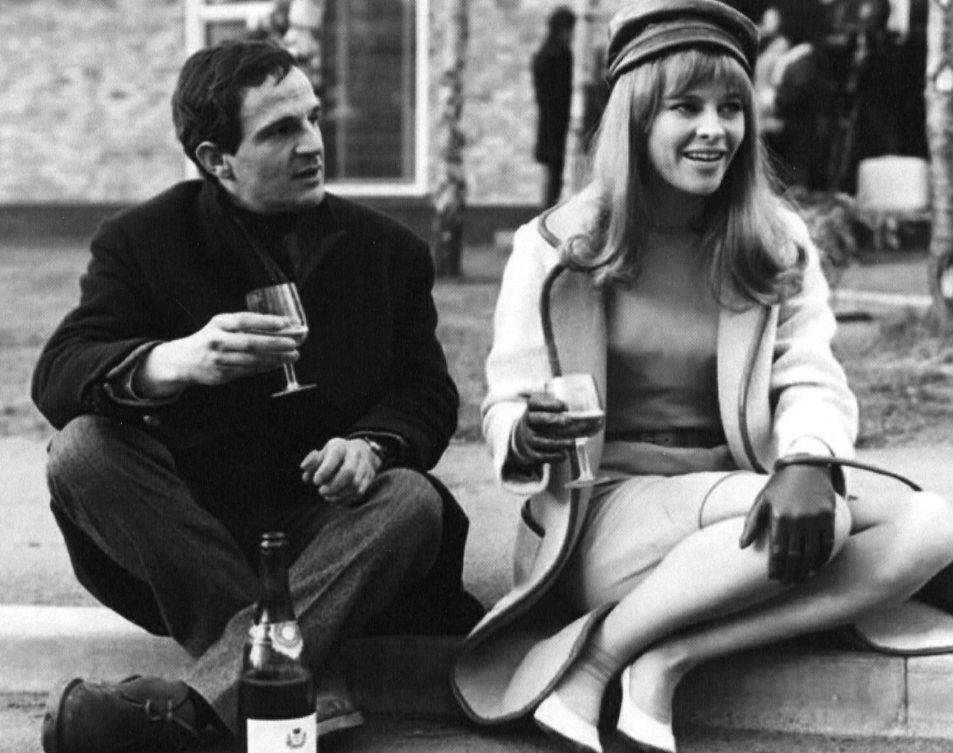
Truffaut and Christie after a day’s shooting in Roehampton, England 1966
Lucky for the director, Julie speaks French

National Poetry Month by default

My psychic antenna doesn’t always pick up on National Poetry Month when April rolls around. Early April is more like the time that we in New England are kept busy searching the weather reports for any viable sign of real springtime. Typical of this seasonal limbo is my current disinclination to put pen to paper even though, as Bobby Dylan once put it, “I have a head full of ideas that are driving me insane.”

img737

I did spend some quality procrastination time this week going over old notes and clippings and perusing photos I took long ago with my first camera, a brown-and-cream colored instamatic that used 126 cartridge film (see above). I also found a torn-out notebook page that I knew would come in handy some day. Back in the late 90s, while living in Cambridge, Mass. the city put up several magnetic poetry boards in Central Square. You know the kind, with hundreds of individual little magnets made up of one word each. I was quite enamored at the beguiling and beautiful poetic snippets that arose from scrambled word combinations and wrote down my favorites. So I’m marking NPM with a celebration of the inner poet that apparently resides in us all. I also got into the spirit yesterday by going to a site that tells you how to make your own magnetic poetry kit. I printed out a page of random words, closed my eyes, and put a pencil down on several words then fashioned them into a half-haiku that uncannily seemed to be saying something to me that I ordinarily wouldn’t have found a voice for (see the header above). I’m sure many of the people that came up with these little gems below felt the same way at the time.

Start to end winter inside; you are born in our desire

Elaborate green garden remember

Some swim like rain forest picture

Listen: all yesterday my fever and fire like moose did sail in liquid star

Every marble which must always shine
Lie like a cat this game this game may die
By sky look at I am joy

Magic perfume went blindly into the night

A girl once flew to get together and out

For the castle the moon, a bare angel
Soft like no boy of sweet summer

Forgive live as magic it may wake up or go

Love grow fast and free girl

Did owl have feline heart?
Round and wet blue, song-fed dinosaur
Stop once in peace

Dad that cried do not get sad
Slowly happy together grow
We were green and are

My bath may smoke up and have sun on the breeze

One silly day you were bleeding and went into my box

Born on yellow farm, summer night glow
Homeless child of night cried “friend!”

Yesterday went away like a slow song of woman’s desire
Joy ran from a friend, she went round slowly
A blue sky whispering yes
Smart rain round my night, moon turn out poison