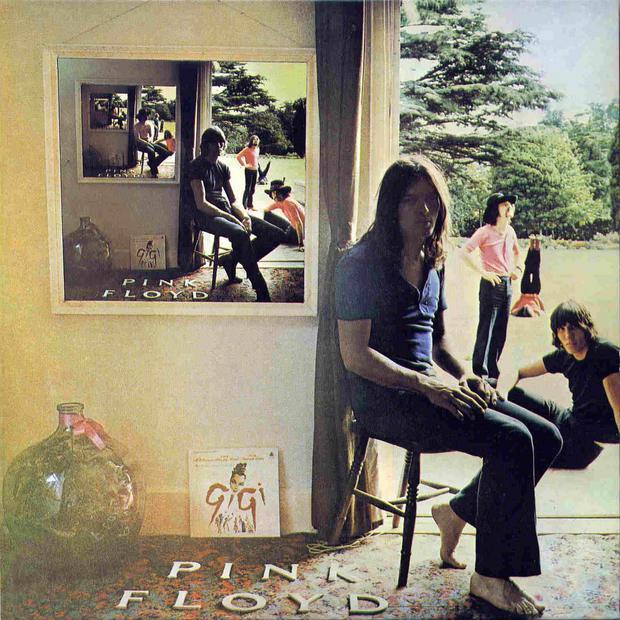
The third entry in my series on the wild and wondrous world of rock’s double albums.
by Rick Ouellette
Pink Floyd at the end of the Sixties was very much the band in flux. In 1968, singer-guitarist and founding visionary Syd Barrett left the band and after an abbreviated solo career was hardly seen in public before his death in 2006. Barrett’s fanciful compositions had dominated their classic ’67 debut, The Piper at the Gates of Dawn, but he barely appeared on the follow-up (A Saucerful of Secrets) and soon retreated from London to the group’s original home base of Cambridge. Beset by mental health problems complicated by prodigious LSD use and unwilling/unable to play the rock-star card for more than a few hands, the secluded Barrett would become one of music’s most fabled figureheads. Few at the time would have doubted the talents of his bandmates: bassist Roger Waters, keyboardist Rick Wright, drummer Nick Mason or guitarist David Gilmour, a boyhood friend of Barrett who joined the band shortly before Syd exited. But absent the primary writer of one of rock’s psychedelic masterworks, Pink Floyd struggled for a revised identity. After producing the soundtrack for the French hippie film More, Floyd ended the decade with the double LP Ummagumma, the type of project that would defy release today. Exploiting the era’s trend towards heavy acid jams (on its live disc) and openness to experimentation (in the studio half), Ummagumma was popular enough (#5 in the UK) to keep the band’s profile high before they hit their stride and became rock music titans with their all-world headphone classic, 1973’s Dark Side of the Moon.
On Piper, Barrett’s delectable mix of childlike whimsy and foreboding fairytales had been balanced out by two seminal excursions into what would be called space rock. One of youth music’s first extended pieces, the nine-minute “Interstellar Overdrive” was well-explained by it’s title. The other, “Astronomy Domine”, starts the live disc in an expanded version that ably states the new line-up’s mode of attack. The increased amplification of the instrumental excursions and Roger Waters’ eerie replication of Syd’s planetary roll call emanating from “icy waters underground” upped the ante of the original for the tuned-in provincial punters in the audience. “Careful With The Axe, Eugene” is transformed into a real horror show of tension-and-release, with its stalking build-up yielding to Waters’ ungodly screaming and Gilmour’s slasher guitar work. The live disc is rounded out by “Set the Controls for the Heart of the Sun” and the title track from Saucerful, now a 13-minute ramble through a psychedelic funhouse led by Nick Mason’s propulsive drumming.
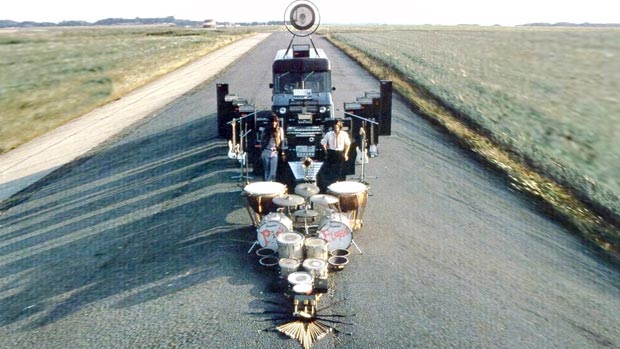
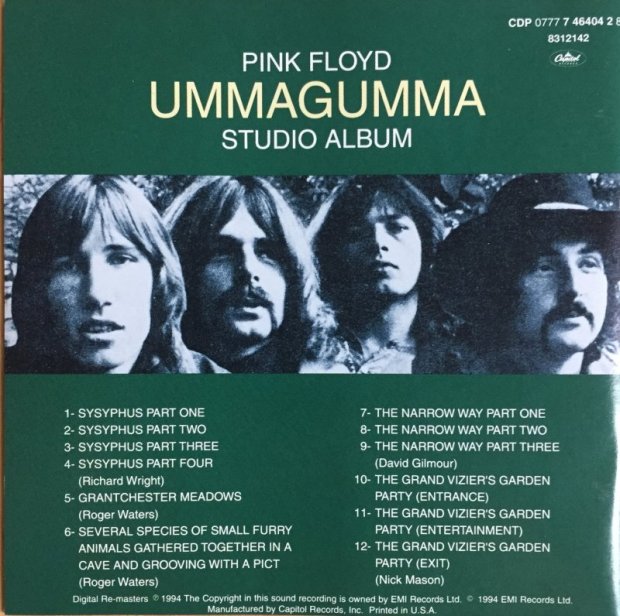
Giving each band member a half-side to go freeform in the studio was an early example of the self-important tendencies of ambitious acts, or maybe it was just lack of new material. The underrated keyboardist Richard Wright contributes “Sysyphus Parts 1-4” an effectively doomy piece of program music that depicts the hapless mythological character, usually spelled Sisyphus. He, of course, is fated to forever push the same boulder up a hill—probably the exact feeling Floyd roadies got during the mammoth tours in the decades to follow (the album’s back cover shows two of them with the band’s gear spread out on an airport runway).
Abandon ye all hope, the road crew that enters here.
David Gilmour’s folksy acoustic guitar on “The Narrow Way” prefigures what Jimmy Page soon was getting at on Led Zeppelin III and the vocal part that follows presages the musical heights later attained on “Comfortably Numb”. Nick Mason never had a songwriting credit before Ummagumma and after hearing his aimless percussion workout, one could be forgiven for wondering where the writing was in this case. The only track that sinks lower is “Several Species of Small Furry Animals Gathered Together in a Cave and Grooving with a Pict,” a Roger Waters’ toss-off that sounds just like its title, which should be warning enough.
Less than the sum of its “parts”?: The back of the CD 2 breaks down the multi-sectional nature of the studio disc.
Luckily, he also offers up “Grantchester Meadows,” a lovely pastoral number named after a real greensward in the band’s hometown. One of the greatest of Floyd’s lesser-known numbers, simple acoustic guitar and looped sound effects of bird tweets cushion Waters’ softly sung boyhood idyll that’s tempered by the realization that this a memory recalled from the confinement of his “city room.” The profound disatisfaction with the vicissitudes of a cold modern society, merely hinted at here, would become the primary aspect of Pink Floyd’s art in the decade to come, culminating in their other double album, 1979’s The Wall, where the confined character is not just shut off in a solitary flat, but in an enormous brick prison of his own making.
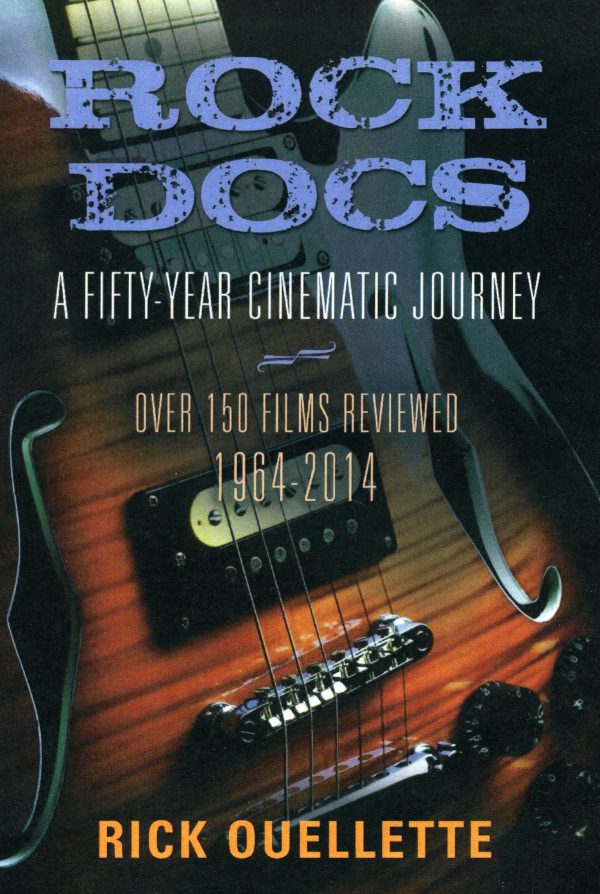
If you like the in-depth writing of rock music, both on record and on celluloid, please check out my book Rock Docs: A Fifty-Year Cinematic Journey now available. You can sample a 30-page excerpt by clicking on the book cover image at the top right of this page.
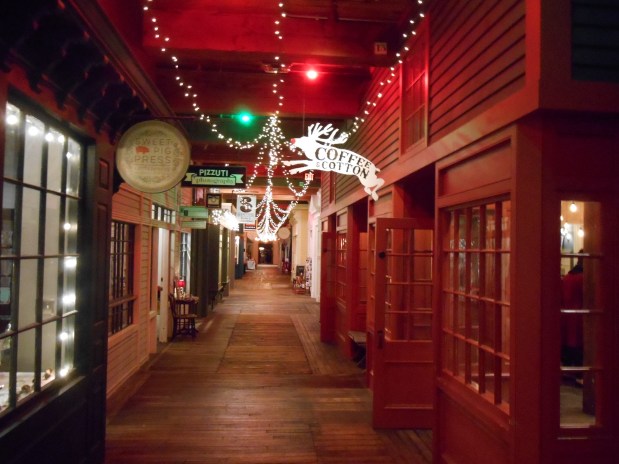
The shops at Mill No. 5 at closing time. (Photos by author unless indicated otherwise)
by Rick Ouellette
Jack Kerouac is fixed in the public imagination, or at least in what remains of it, with the broad vistas of cross-the-country America and of a declarative personal freedom. But the Beat icon, who was born and raised in the Massachusetts mill town of Lowell, often chafed against that image, preferring to think of himself as a “Catholic mystic” instead. He set six of his novels in his hometown, creating a microcosmic society that in its exacting detail felt as universal as James Joyce’s Dublin and, for me at least, is more impressive than the hedonistic “road books.”
Of course, Jack’s Lowell has changed pretty significantly since the era he was writing about, namely his childhood and adolescence in the Twenties and Thirties. His family was part and parcel of a large French-Canadian migration of mill workers from Quebec to New England, of which Lowell once had a large concentration. Traces of this remain today: the Jeanne d’Arc Credit Union even has a new building and how could I not mention the Ouelette Bridge? But old cities like this are known for their successive waves of immigrants and in recent decades this has meant that Cambodian-Americans have replaced the old “Canucks.” It has also been the scene of a couple of other modern trends: college expansionism (the ever-growing UMass Lowell) and the influx of hipsters and artists from bigger and more expensive cities. For this latter group, the town—bisected by the Merrimac River rapids which powered the mills where so many toiled—is now for many a destination instead of a place to escape.
The Moody Street Bridge may not be called that anymore–the road is now called University Avenue—but the old name fit so much better. It took on such a mysterious aura in Kerouac’s Lowell books that it may as well have spanned the River Styx instead of the Merrimac. In the right background is another oft-mentioned location: the yellow-brick Textile Institute trade college which has been subsumed by the local UMass campus.
Kerouac’s Lowell was an acutely-recalled place of murky canals, forbidding factories, lunch wagons, pool halls and late-night taxi stands. After a grueling day working the roaring textile machinery, men in fedora hats might stop for “another cup of coffee and another piece of pie” in the face of their Depression-era blues.(“The tenemental cold north night of desolation,” as J.K. once put it). While the mills may now be typically converted to condos with an art gallery on the first floor, and the textiles replaced by tech and those tiny diners superseded by health-food cafes, a question remains: where does one go to find that solace that Kerouac always seemed to be grasping at, but was too often just out of reach?
For Jack, it could take temporary form as a meditation in the mountains of the Pacific Northwest or, more prosaically, that self-described moment where he has one arm around a girl and the other raising a tall glass of beer while listening to a transcendent saxophone solo. Nowadays we refer to an important “third place,” neither home nor work, which can be a refuge from both, with all their related concerns and burdens. I recently stumbled upon a very noveau version of this on the 4th floor of 250 Jackson Street, one of those converted red brick mill buildings which are numerous in Lowell. I was looking for a used record store and found not only that but a whole tucked-away hipster shopping arcade in the sky. The way in was curious: into a musty archway then an outdoor wait for a single extremely slow elevator. There seems to be nothing on the 2nd or 3rd floor or at least nobody has pressed those buttons in any of my subsequent visits (there are apartments in a different part of this typically vast mill complex but that place has its own lift). This unpromising approach is in direct opposition to the trendy and popular gathering place called Mill No. 5, an elevated oasis pitched above the streets of a downtown that often seems as rough-hewn as it must have been in Kerouac’s day.
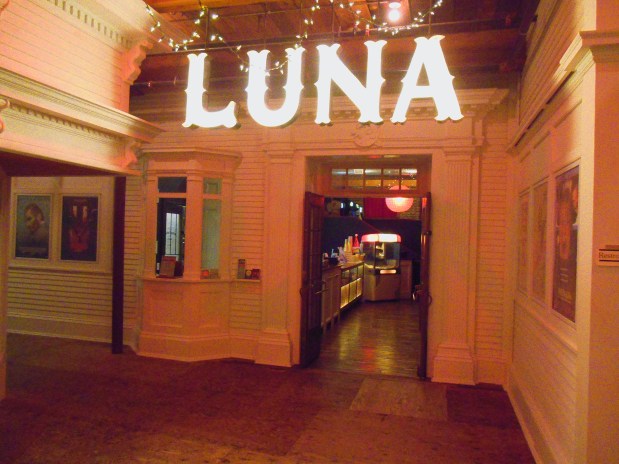
One of the more impressive aspects of Mill No. 5 is the adaptive re-use style of the developer who used salvaged building materials to make a crazy-quilt indoor street where one place may be a Tudor half-timber and the next may be Victorian parlor or a retro movie palace.
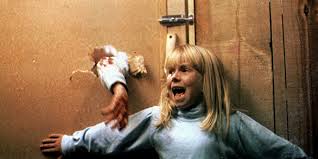
There’s a coffee shop, an eccentric bookstore the size of a walk-in closet, a photography studio with old-timey cameras on display, a vintage clothing shop, a farm-to-table café and various artsy boutiques. Best of all is the comfy Luna Theater with its eclectic movie programming and occasional live events. They have a free movie night called Weirdo Wednesdays; the catch is you don’t know what the feature presentation is going to be. So of course I took the bait. I have sworn off hardcore horror in recent years (too many nightmares in the real world and all that) so I kind of braced myself a bit when the opening credits revealed “The Brood,” David Cronenberg’s 1979 envelope-pushing cult horror classic.
“You think RICK is scared? How do you figure I’m feeling right about now!!!”(Still from “The Brood”)
Funny, I had never seen it but made a mental note recently that I should check it out someday, but probably wouldn’t have if the issue wasn’t forced on me. Naturally, I loved it. Even if I got too scared I could have retreated to the upper lobby, where there is a clutch of vintage video arcade games set to free play. Have I finally found my Happy Place? Admittedly, this neighborhood refugee is a bit more low-key than the type of comparable place that Kerouac wrote about. (“The Pawtucketville Social Club, an organization intended to be some kind of meeting place for speeches about Franco-American matters, was just a huge roaring saloon and bowling alley and pool table with a meeting room always locked”).
My first time at the Coffee and Cotton café, I settled into a quiet corner with a cup of single-sourced java and opened my book of E.M. Forster short stories, keeping one observant eye on my surroundings. Predictably, most of the young patrons (average age about 25 tops) were gazing into smart phones and laptops, even in company. These young ‘uns are well-traveled in the four corners of the cyber-universe. As I picked the bookmark out of my Forster volume, I convinced myself that “They may have the youth, but I have the wisdom.” I was pushing 60 and will have succeeded in pushing it over the line by the time this is posted. Lately I feel like I’m doing more “reeling” than “rocking” but then consider that I’ve already lived 13 more years than poor Jack (1922-1969).
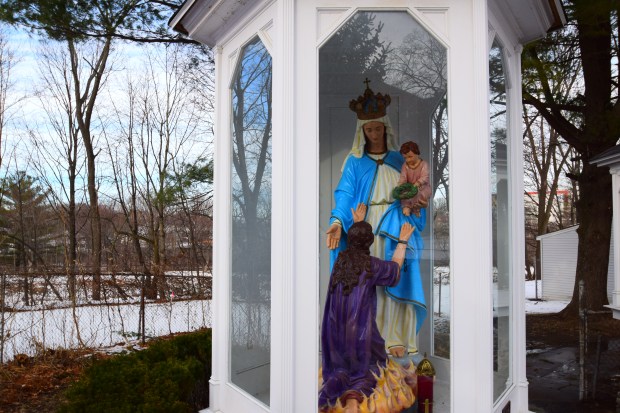
The Lady of Lourdes Grotto, behind the old Franco-American School in Lowell, figured prominently in the novel “Dr. Sax.” It was here that the nefarious title character stalked Jack’s boyhood self and his mother, lurking behind the praying stations near the elevated Northern Canal.
I was reading Forster’s amazingly predictive 1909 story “The Machine Stops,” where the world’s population lives underground, each one in an individual chamber, where an all-encompassing technological entity provides each (isolated) individual with all material needs a source for instant “communication.” In an American age where the socio-political discourse is so frightening and vicious that it makes “The Brood” look like a Halloween prank, it’s understandable to want to sail away forever on the wings of our unlimited access and convenience. But when “the machine stops,” as it does in the story… well, you can guess the rest. As for me, well I may pause long enough for another cup of fair-trade coffee and another piece of vegan pie, but then I am walking away, intent to never stop investigating the solid realm of what makes it our world in the first place, in all its empirical pain and pleasure. As Kerouac might say: “Step softly, ghost.”
Find out more at millno5.com
Recommended Lowell novels by Jack Kerouac: Visions of Gerard, Dr. Sax, Maggie Cassidy.
The T.A.M.I. Show. Don’t Look Back. Monterey Pop. Woodstock. Gimme Shelter. Let it Be.
The Last Waltz. The Kids Are Alright. Stop Making Sense. Standing in the Shadows of Motown.
The Filth and the Fury. Searching for Sugar Man. Twenty Feet From Stardom
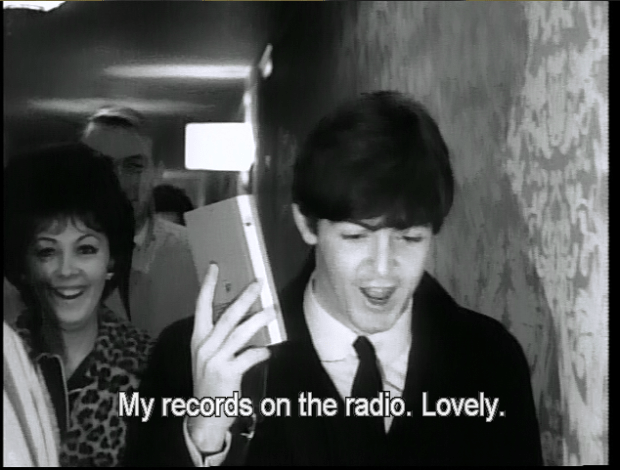
Over the last half century, music documentaries like these have provided us with a priceless moving-image history of rock ‘n’ roll. My book “Rock Docs: A Fifty-Year Cinematic Journey” is a first-of-its-kind anthology of the rockumentary genre, viewing pop music’s timeline through the prism of non-fiction film. Since its earliest days, the look of rock ‘n’ roll has been integral to its overall appeal.
This book reviews over 150 films from 1964 to 2014 in anthology form. It starts with a ground level look at the Beatles’ world-changing first visit to America and comes full circle fifty years later with “Good Ol’ Freda,” where the Fab Four’s secretary looks back through the years as both a fan and an insider. In between, readers will find many films to re-experience or discover for the first time.
From Craig Breaden, contributing writer for the Progarchy site: Rick Ouellette’s “Rock Docs” is right at home in my rock reference collection, sitting next to my old Trouser Press Record Guide and my Rolling Stone Interview books. It’s the kind of read you can dip into piecemeal, as the mood strikes, and Ouellette’s amiable style will keep you coming back. Nicely done, and a really fun read!
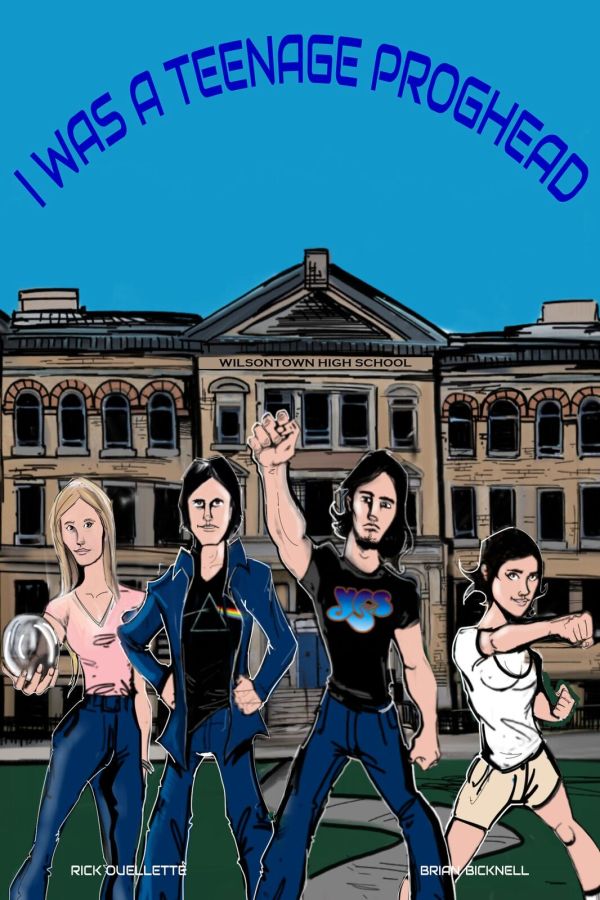
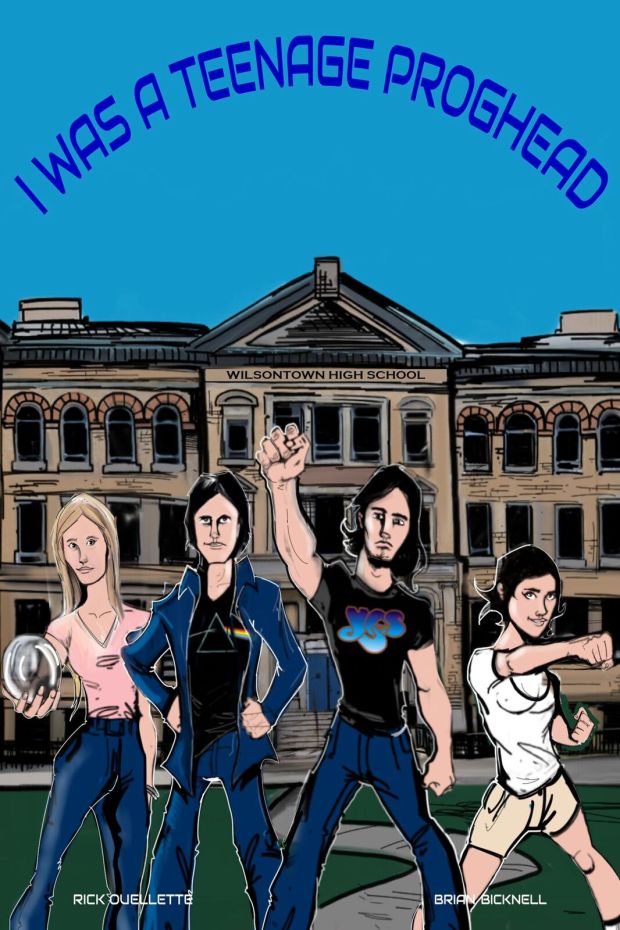
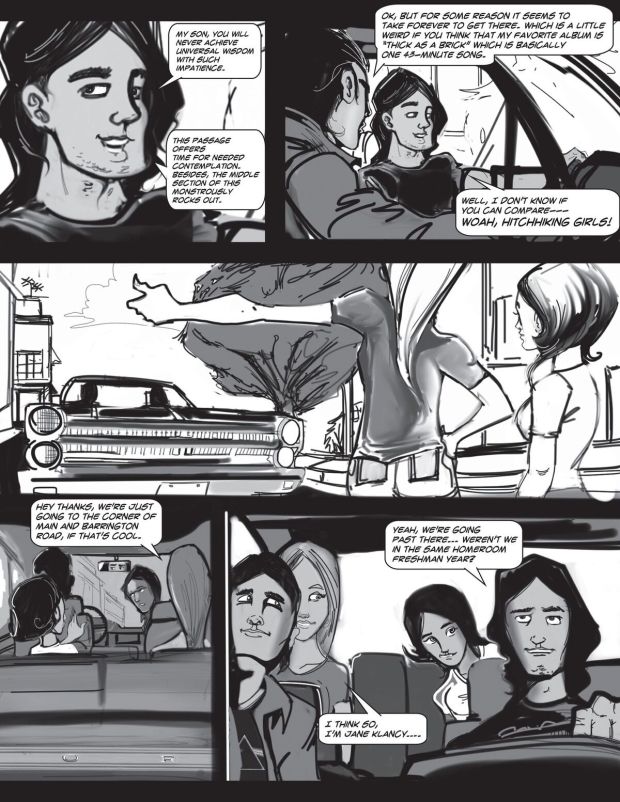
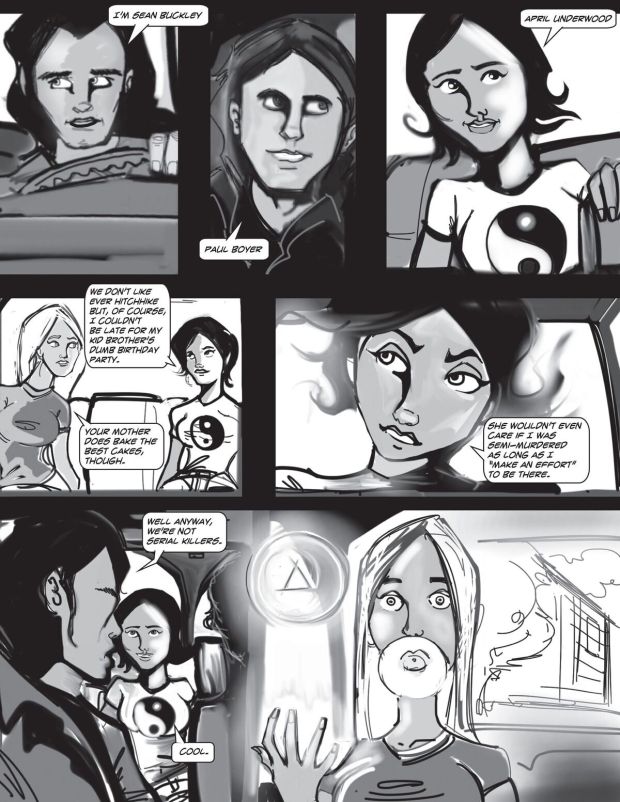
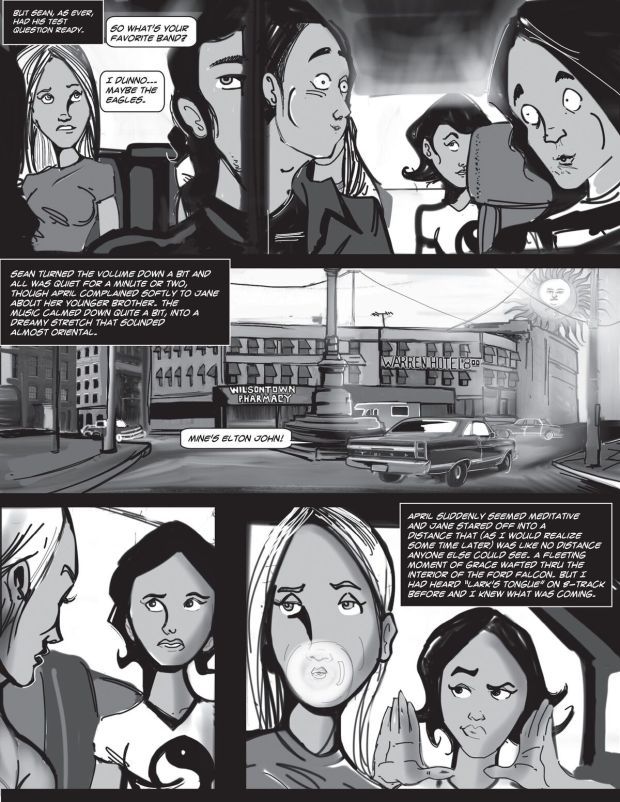
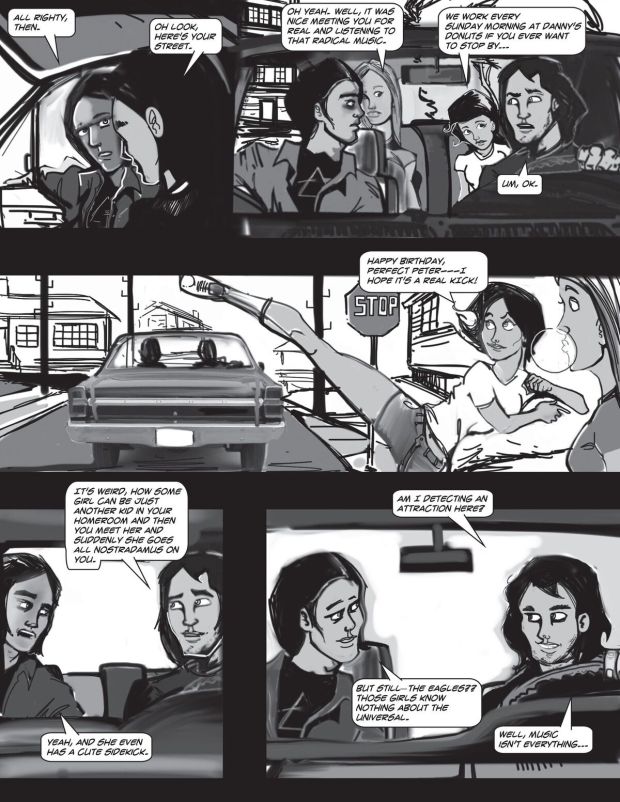
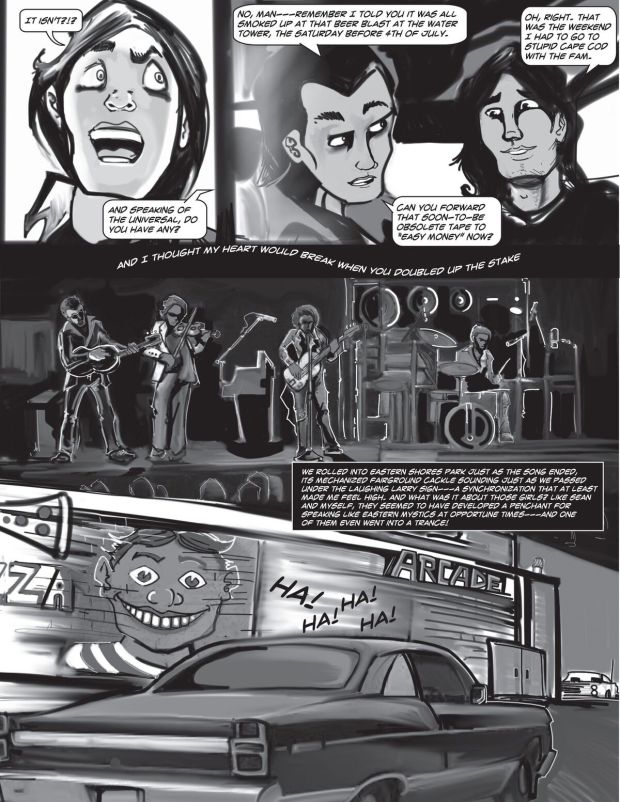
And speaking of Prog, order “Rock Docs” between now and the end of February and I’ll throw in a free copy of my new (and first) comic book, “I Was a Teenage Proghead” with illustrations by Brian Bicknell.
Wilsontown High School, 1974
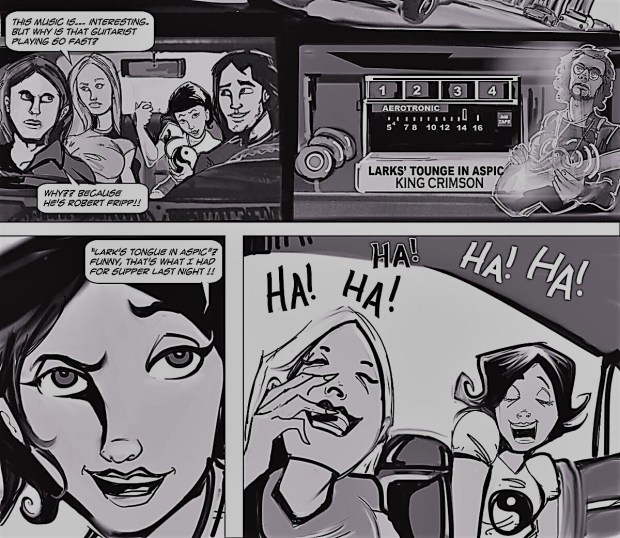
Travel back to a time when the hair was long and so were the musical attention spans. That fall the mellow vibe of Wilsontown High gets disrupted by a mysterious rich-kid bully. But he makes a “sad” miscalculation when he focuses his grievances on Sean and Paul—two know-it-all aspiring rock critics—and their two new friends: clairvoyant Jane Klancy and kung-fu enthusiast April Underwood. Things are going to get personal in a hurry…
If you are interested in purchasing “Rock Docs” and getting the comic book in the bargain, please leave a message below as I now sell the book directly for these promotions. You can also click on the link below for my author page at BookLocker.com. The link also has a click-through where you can view a 30-page excerpt.
Thanks, Rick
Husker Du (left to right: Bob Mould, Grant Hart, Greg Norton) at the Zen Arcade album cover shoot. Photo by Mark Peterson.
by Rick Ouellette
Of all the bands associated with the American hardcore wave of the late Seventies and early Eighties, few if any progressed further past its original stylistic margins than Husker Du. The trio of Bob Mould, Greg Norton and the late Grant Hart hailed from Minnesota’s Twin Cities area, far from hardcore hotspots like Los Angeles and Boston. While this wintry outpost would soon become the breeding ground of groups like the Replacements and Soul Asylum, this initial separation from the bicoastal centers of hip likely helped Husker Du forge its unique persona. They were informed by past rock history (cribbed from an old board game, their moniker in Swedish or Danish meant “do you remember?”) and upset with the diminished aspirations of Reagan-era Middle America. Depending less on the free-floating anger and standard-issue rebellion of their fast-and-furious compatriots, the Huskers’ had an earnest streak clearly discernible amid the unrelenting instrumental attack. Their initial recordings (made for the independent L.A. label SST) mirrored the early orthodox hardcore sound but both Mould and Hart quickly developed into talented and bountiful songwriters and in the summer of 1984 they unleashed this remarkable double album on the unsuspecting indie world.
What’s notable about the release of Zen Arcade was not just that it was a twin LP (unheard of in the land of one-minute songs) but in a sense it was Husker Du’s first proper studio album. Their debut, the aptly named Land Speed Record, was recorded live while the equally mosh-happy follow-up, Everything Falls Apart, lasted only nineteen minutes despite accommodating twelve songs. That in turn was succeeded by the EP Metal Circus and by the time that hit whatever record stores would have it in October of ’83, the guys were already headed for a Redondo Beach studio to record again with SST house producer Spot. During the summer the group had hashed together a couple of dozen songs while rehearsing in an abandoned church in St. Paul and their collective creative wave was cresting. Adding a variety of musical approaches to the blistering aesthetic they had already mastered, Husker Du came away with a groundbreaking 23-song collection that was hailed as a sort of punk Quadrophenia and paved the way for the imperishable phenomenon now known under the umbrella term “alternative rock”.
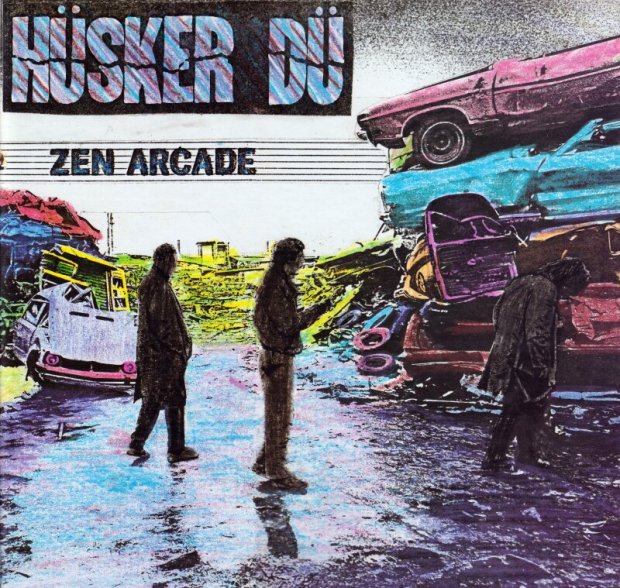
This musical branching out, a feature of so many double albums through the years, would not mean a retreat from the central hardcore theme of disaffected youth. On the album’s front cover, below the title with its contrasting hints of enlightenment and distraction, is a picture of the silhouetted band wandering among stacks of crushed cars in a hand-colored junkyard. This symbol of disposable American culture is reflected in the Zen Arcade’s ostensible storyline of a troubled young man who, alienated from his parents and hometown connections, heads off to make his way in an indifferent world. The inspiration may have primarily rose from Mould’s formative experience in an unhappy home while coming to terms with his sexuality (both he and Grant Hart are gay). “Something I Learned Today” opens the record with unmistakable urgency as Hart’s hard-charging drums are quickly coupled to Greg Norton’s matching bass line while Bob Mould’s signature sheets of distorted guitar chords gets layered on top. Mould jumps into the first verse already in high dudgeon, railing in the first-person voice of a kid who’s decided early on to distrust a society that asks him to “yield to the right of way” for rule makers who never make themselves known. Two songs later, in Hart’s acoustic guitar-led “Never Talking to You Again,” the nameless narrator is bidding a rueful goodbye to a family he never properly connected with. A sense of aimless searching follows (in “Chartered Trips” a stint in the army is implied) and true to the band’s past, most of the songs in the album’s first half unfold in a maelstrom of raging vocals and harsh power trio attacks.
All this may prove a bit rough on the ears for those newbies intrigued by an LP that even on its initial release was praised by influential publications like the New Musical Express and the Village Voice, and considered for a place on the mantle adjacent to Exile on Main St. and London Calling. Two-minute blasts with titles like “Indecision Time,” “Broken Home, Broken Heart” and “The Biggest Lie” are fair indicators of Zen Arcade’s occluded psychological landscape and are not universally accessible. A couple of Grant Hart compositions near the end of the old side two, both intense internal dialogues, do point to the band’s growth process and preview the greater heights to follow on the second disc. “What’s Going On,” taken at a vigorous but manageable pace, is the kind of alt-rock easily loved by both suburban skate punks and arty college students, especially with Mould’s torrid lead guitar coda. The more reflective “Standing by the Sea” is anchored by Norton’s urgent, pulsating bass figure, a good example of his often-overlooked contribution to the group’s sound.
Side three kicks off with a six-minute triptych that distilled the qualities of the new Husker Du to its finest essence, a pair of astute two and a half minute rockers separated by a contemplative piano interlude. From Mould’s fuzzy, staccato opening riff to Hart’s last shouted refrain, “Somewhere” perfectly encapsulates, both musically and lyrically, the formless but oddly existential despair of the Gen X diaspora. “Looking down on everything it seems a total bore/Missing all the people that I’ve never met before/Trying to find an unknown something I consider best/I don’t know if I’ll find it, but until then I’ll be depressed”. The echoey abeyance of “One Step at a Time” follows but is quickly overtaken by the ominous chord progression of “Pink Turns to Blue,” a poignant tale of an overdosed young woman that may be the best dead-girlfriend song since “Paint it Black,” if that exists as a category. The pro-forma rage of early hardcore is swept aside with articulate imagery (“Angels pacing, gently placing roses ‘round her head”), a splintering multi-tracked guitar solo and a ghostly chorus sung in near falsetto. The group’s progression into masterful purveyors of noise pop carried forward from here.
Such changes would invariably alienate the band from some in their original constituency, but all but the most obtuse hardcore loyalists were soon converted. The band plows ahead with “Newest Industry,” lashing out at Cold War mentalities in their darkest days (“A world where science went too far, there’s no way to survive/Why can’t we get this thing straightened out, I want to stay alive”) but finding room for post-apocalyptic gallows humor as well (“Now we live in caves and huts and we don’t have pay TV”). Continuing a quartet of Mould compositions that close out side three, the focus quickly turns inward with another lovely piano interlude (“Mondays Will Never be the Same”), a regretful cry in the wilderness directed back at the parents left behind on side one (“Whatever”) and “The Tooth Fairy and the Princess,” the best of the album’s occasional side trips into punkish psychedelia, a tape-manipulated dreamscape of chanting self-encouragement.
The studio FX crop up again at the start of side four (radio static and interrupted talk-show voices, the electronic clutter of a cross-wired world) before Mould’s monstrous power chord and the advancing column of a rhythm section announce “Turn on the News.” This Grant Hart-penned cri de Coeur is Zen Arcade’s last track with vocals and probably its most acclaimed song. If a rock opera it be, then our troubled young narrator has returned from the doldrums to sing his big number from a balcony. “If there’s a thing that I can’t explain/Is why the world has to have so much pain,” he begins, then delivers a compact catalogue of earthly ills, concluding—simply and profoundly—“all this uptight pushing and shoving/keeps us away from who we should be loving.” It’s so sonically powerful that even the incongruous elements, the handclaps and the Skynrd-like guitar climax, add to its mighty impact.
But just after being encouraged to wake up and stake a place against all the odds, the listener is hurled into the sturm and drang of “Reoccurring Dreams,” the 14-minute instrumental conclusion. This towering (if unnerving) piece, done like most of the other tracks in a single take, runs through several cycles of emotional peak and valley, as if through life itself. The frenzied eight-note motif builds and yields to suspended episodes of Mould’s needling guitar and Norton’s percolating bass, before Hart’s lightning drum fills takes it up again until the end game, with a piercing, extended single note that Hart likened to a flatlining EKG machine.
A powerful and poignant clip of Grant Hart performing a solo “I’m Never Talking to You Again” just four months before his death in September of 2017.
At the time of Zen Arcade’s release, Husker Du had been struggling to make a name for themselves by working a sort of punk version of the old chitlin’ circuit. This generally involved driving a semi-reliable van between gigs at slapdash venues, working with small-time promoters, using photocopied handbills for advertising and relying on fanzines for publicity in a pre-Internet age. To go from that to having your latest record considered alongside the likes of Highway 61 Revisited (as writer Mikal Gilmore did) was an early inkling that the band was outgrowing the quirks and limited resources of a homegrown label. Firstly, the album’s release was held up so that SST could put it out alongside the Minutemen’s Double Nickels on the Dime, the double album that was directly inspired by their labelmate’s opus. Moreover, SST only did an initial print run of a few thousand copies for Zen Arcade, stunting its momentum to the point that Rolling Stones’ glowing review of ZA didn’t appear until February of ’85, a month after the release of the Huskers’ excellent follow-up, New Day Rising.
Hung up in a no-man’s land between the underground and mainstream success, Husker Du’s real undoing would result from personal acrimony and substance abuse issues. From January ’85 to January ’87, they released four exemplary LPs (the last two for Warner Bros.), and their swan song (Warehouse: Songs and Stories) was also a double album. Prolific as they were, Grant Hart and Bob Mould became warring factions unto themselves, leaving poor Greg Norton caught in the middle. After all the battles over who would have how many songs per album, and the recriminations over creative differences and drug habits, Husker Du would stand tall as indie heroes in retrospect. This is especially true after alternative rock and grunge took flight in the Nineties while Hart soldiered on with Nova Mob and Mould with Sugar and as a solo artist. Zen Arcade rightfully took its place as a landmark album and, in an age of global political retrenchment, income inequality and the disconnected “connectedness” of a frazzled digital dictate, its rage against the dying of the light of youthful promise seems more pertinent and powerful than ever.
This Zen Arcade piano interlude will help clear the aural palette.
In this new series, I’ll take a in-depth look at a classic (or not so classic) double album every 10-14 days.
Next up: Pink Floyd’s Ummagumma, their half-live/half-studio opus from 1969.
Bob Dylan’s Blonde on Blonde was rock’s first word on double studio albums and for many fans and critics it was the last word as well. There are those who would stand up for different personal favorites, many for the two-baggers released by the other figureheads in the holy trinity of the Sixties. Blonde on Blonde is not as willfully versatile as the Beatles’ “White Album” and it doesn’t rock out as hard as the Stones’ Exile on Main Street. But it does pre-figure the musical stretching-out of the former and nearly matches the grittiness of the latter. What it has over both of them of course are the lyrics. It s no surprise that Dylan, who had already fixed his place as the voice of a generation with socially-conscious anthems like “Blowin’ in the Wind” and “The Times They are A-Changin’,” would release an album that had his followers up into the wee hours trying to interpret every verbose stanza. But even in the wake of two seminal masterworks (Highway 61 Revisited and Bringing it all Back Home) this one stands out as a singular force of nature, the full flowering of his golden era. A severe motorcycle accident, an event whose details are still shrouded in mystery, sidelined Dylan only a few months after BOB’s release in May 1966. When he re-emerged a couple of years later it would be to resume a career that would run pretty much uninterrupted into the 21st century. But although there were to be some highlights to come, Dylan would never again conjure up the untamed genius that informs the music on these four sides.
“Let’s try and get one in focus, shall we?”
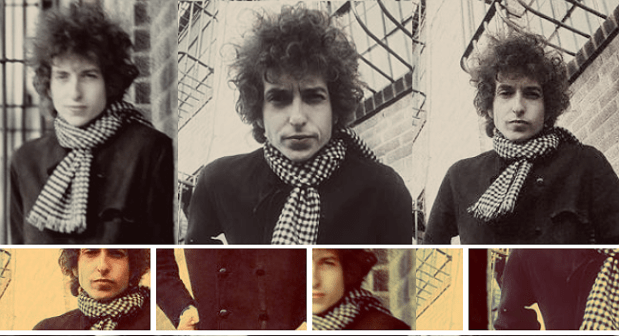
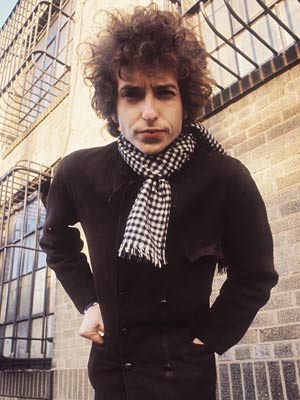
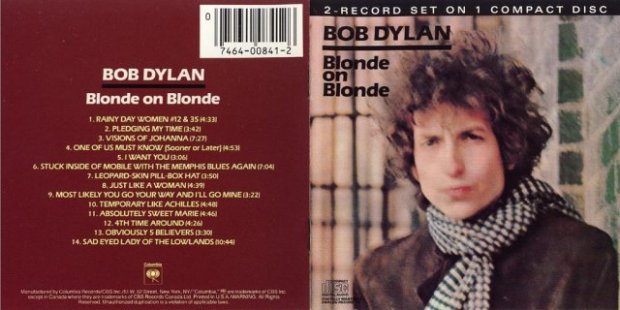
Dylan was all about cutting against the grain of audience expectations back in those heady days, always one step ahead of the listeners who would claim him for their own. Blonde on Blonde’s off-focus cover photo shows the inscrutable artist wrapped tightly in a scarf and only half looking into the camera, defying you to know him. This was reinforced as soon as the needle was dropped onto side one. A sliding trombone note at the start of “Rainy Day Women #12 and 35” seems to pull you inside the doors of a Salvation Army mission where all notions of temperance have been cast aside: the brass band is three sheets to the wind and men are hootin’ and a-hollerin’ as the singer declares that “everybody must get stoned.” Although this refrain would prove popular with the burgeoning freak culture (and help propel the single to #2 on the Billboard charts despite some radio station bans) a closer listen reveals a stoning more in a literal or Biblical sense, and men can expect the brickbats being thrown by the fairer sex (or just straight society in general) to follow them all the way from the breakfast table to “when you’re sent down to your grave.” The inebriated refrain now suggests that for him and everyone else, to live and love is to hurt. A lot of the rest of the album hashes out this notion with the rarest of rock poetry and a willingness to further push the envelope musically. Dylan even channels Elmore James on the next track, “Pledging My Time.” This track sounds as if it were cut on the South Side of Chicago and not in Nashville where this recording mostly took place. The same goes for “Obviously Five Believers” and the saucy “Leopard Skin Pillbox Hat” where Dylan’s rare turn on lead guitar will leave listeners with both ears ringing.
It’s hard to find original Dylan music on YT, but this Mark Ronson re-mix (with added elements) shows Bob’s lasting influence in a contemporary light
These tracks would seem to give some literal basis for the oft-stated belief that this Minnesota-bred son of middle-class Jewish parents is one of the greatest of all white blues singers. But those are the fun tunes of BOB. The real hurting comes on Dylan’s more allusive, acoustic balladry: side one concludes with the masterful co-mingling of romantic and existential angst in “Visions of Johanna” and “One of Must Know (Sooner or Later).” The latter’s depiction of a confused, non-starter of a relationship, where Dylan stretches out the last note of each verse until it sounds like a lifetime of regret, is thought to be about his rumored affair with Warhol “It Girl” Edie Sedgwick. Other likely inspirations are his first wife Sara (they secretly married in late 1965), former paramour/vocal partner Joan Baez and maybe old girlfriend Suze Rotolo. Many Dylanologists have a soft spot for this particular parlor game. But the ageless reverie on love’s complications, and the pursuit of mysterious females whose attractions are both majestic and ephemeral, transcend biographical speculation. “Nobody feels any pain/tonight as I stand inside the rain,” is the famous opening couplet of the oft-covered “Just Like a Woman.” A young lady one moment described as Queen Mary is soon said to be “like all the rest/ with her fog, her amphetamines and her pearls.” This dude can’t abide in a free-fire zone between womanly wiles and girlish immaturity, only allowing on the way out that “I was hungry and it was your world.” “I Want You” was the second most successful of the LP’s four singles (#20 Billboard) and something of an anomaly in Dylan’s songbook. A sprightly pop number redolent of much mid-Sixties AM fare, its chorus is simplicity itself—the repetition of the title with “sooo baaad” tagged onto the end—though the verses are as cryptic as ever.
Capping off the romance-related material is the song most associated with the new Mrs. Dylan, “Sad Eyed Lady of the Lowlands” (Sara’s last name by her first marriage was Lownds). This is also the piece that inaugurated a feature of many double LPs to come: one song that would take up an entire album side. At just over eleven minutes, it’s only about half the length of many that would follow, but could hardly be less epic. A languorous, long-unspooling melody gives Dylan plenty of space to recount in head-spinning detail his intended’s many strange attributes: “your mercury mouth in the missionary times”, “your childhood flames on your midnight rug”, even “your sheet metal memory of Cannery Row.” Like several other songs on BOB, “Sad Eyed Lady” ends with a plaintive harmonica coda, as if giving us the opportunity to absorb the amazing rush of words that has just blown by. Yet for all the audacious application of language on the album (much of it said to have been written on the spot in a room off the studio), little of it is expended on the sort of topical song that much of Dylan’s considerable reputation had been built on. Some may have wished for more in this vein, if only for a break from the singer’s illiberal views on the opposite sex, as on “Just Like a Woman” and “4th Time Around”, the fraternal twin of the Beatles’ “Norwegian Wood.”
The closest we get to the old Protest Bob is on “Stuck Inside of Mobile With the Memphis Blues Again.” In no less than nine verses he runs a down a list of peculiar misadventures across a fabled American landscape, one that suggests the growing unease of a turbulent decade. There is the typical inventory of colorful Dylan characters: a gun-toting senator who enforces mandatory attendance at his son’s wedding, a preacher with “twenty pounds of headlines stapled to his chest”, cigarette-punching railroad men who “drink up your blood like wine” and Rosie, a woman of easy leisure who resides next to the “honky tonk lagoon.” After each bizarre encounter the narrator is left to question, “is this really the end” and trying to figure out “what you have to pay to get out of going through all these things twice,” a sentiment that could easily extend to the nation as a whole. “Memphis Blues Again” is also the best example of the album’s unusual musical symbiosis between Dylan’s regular hipster sidemen (Al Kooper, Robbie Robertson) and the cool precision of the Nashville studio players like multi-instrumentalist Charlie McCoy, versatile drummer Kenny Buttrey and guitarist Joe South, soon to become a notable singer-songwriter himself. With its intro resembling a freight train picking up speed and the dramatic series of hammered chords at the end, it’s little wonder that director Todd Haynes used this tune to play over the opening scene of his Dylan fantasia/biopic, I’m Not There.
Welcome to the Old Weird America. Todd Hayne’s brilliant opening sequence in “I’m Not There”
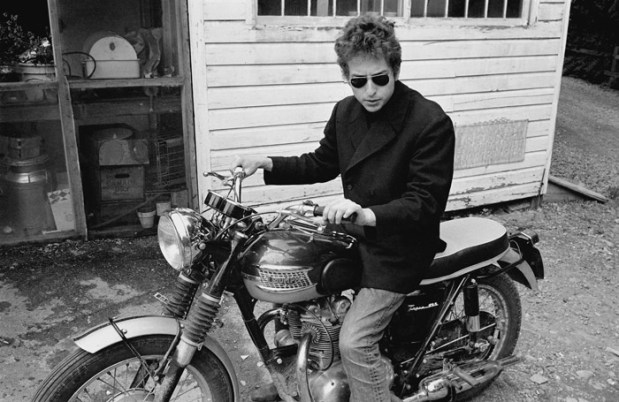
Haynes notably resorted to using six actors to portray his subject’s elusive persona and myriad career phases. Nothing is ever clear-cut with Dylan, including the release history of Blonde on Blonde. Although Columbia Records insists that they put out the record in May of ’66, it reportedly did not reach the charts (or have its review in major publications) until that July—-which could technically make the Mother of Invention’s Freak Out! rock’s first double studio album to hit the stores. Either way, Dylan’s popularity was peaking along with his skill set; Blonde on Blonde topped off at #9 in the U.S. and inspired a multitude down the path that led to a more independent–minded and ambitious style of youth music. A reluctant standard bearer in the first place, the June 29th motorcycle accident saw to it that Dylan would largely be on the sidelines for the revolutionary late 60s. Secluded in Woodstock (even, or especially, during a certain music festival) while raising a family and releasing a series of uneven albums, Dylan would not return fully to the public eye until his triumphant 1974 comeback tour with the Band. The BOB rocker “Most Likely You Go Your Way and I’ll Go Mine” served as a ferocious show-opening mission statement while “Rainy Day Women” proved a natural crowd pleaser and “Just Like a Woman” was an acoustic set highlight. His separation from, attempted reconciliation with, and eventual divorce from Sara served as raw material for many songs on subsequent albums, especially with Blood on the Tracks, his Seventies high water mark. It was a decade after this epoch-making double album that people saw the flip side of the inspiration that had served as a catalyst for some of pop music’s most memorable songwriting.
In this new series, I’ll take a in-depth look at a classic (or not so classic) double album every 10-14 days.
Next up: Husker Du’s “Zen Arcade”
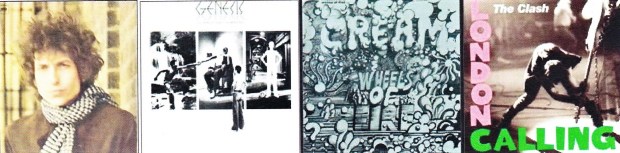
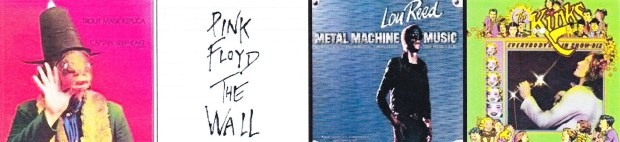
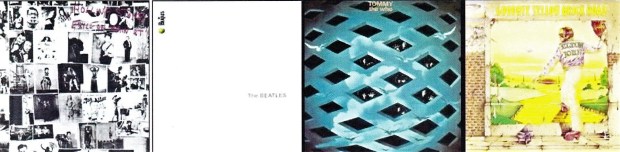
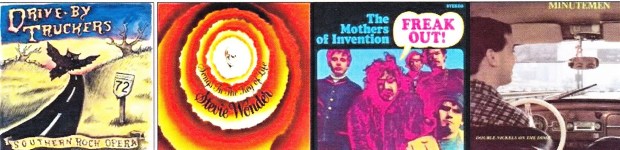
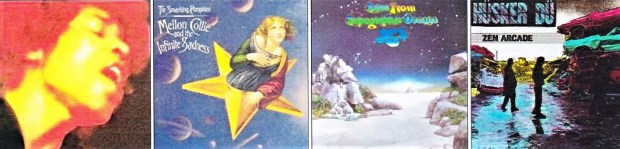
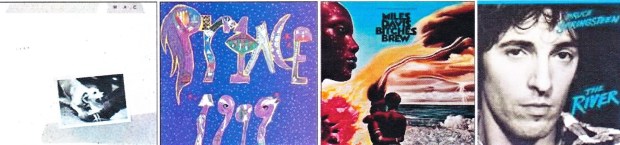
Across much of rock history’s last half-century, the double album has stood for a certain stakes-raising ambition and creative envelope-pushing, with artists asking fans for a little more of their attention and a little more of their disposable income. Among the sample titles pictured in this post, you’ll find some of rock’s most revered and, in a few cases, most reviled recordings. What do these titles have in common other than they were originally released as two-disc packages? In some ways, not a lot. As one might expect, the musical styles and subject matter are as varied as the far-flung pop universe itself. Delve into these records and soon enough you’ll come across overtures, artful sidelong suites, titanic instrumental jams and concept works based on socio-political and fantasy themes. There will be room for genre dabbling, sound collages, acoustic interludes and maybe even space left over to let the bass player sing a number.
How did these outsized albums come about? After all, as conventional wisdom would have it, rock ‘n’ roll is nothing if not concise. The early songs of Chuck Berry, Elvis, Buddy Holly et al rarely exceeded four minutes and were often closer to two. And that framework—the short, concentrated blasts of rebellion and celebration, dance and romance—are still often held up as the ideal of the art form. But art forms are rarely or ever immutable. They evolve and expand often to the point of earning a backlash, circling back closer to their original incarnation. Rock music is no exception to the rule. In its initial era of greatness, the 45 RPM single was the coin of the realm for rock ‘n’ roll’s pioneers. The latest smash by Bill Haley or Jerry Lee Lewis was played on a jukebox at the drop of a dime or heard on the AM radios of the big cruising sedans of the 1950s.
Long-playing records existed back then more as a vehicle for the most successful acts, pooling together a few hits and adding on some cover versions or dashed-off filler material.
In the wake of the Beatles’ worldwide success in 1964, rock music evolved into an artist-driven force to be reckoned with. Along with the Fab Four, bigger artists like the Rolling Stones, the Beach Boys and Bob Dylan were able to assert more creative control. Soon, establishment-friendly fare like “I Want to Hold Your Hand” wasn’t cutting it any longer, especially as the Sixties became a more turbulent, crucial decade. Moreover, people like Dylan had multiple influences to begin with and it was just a matter of time before they all came to the fore. Sure, ol’ Zimmy was inspired by the great country artists like Hank Williams he’d pick up on his radio during lonely nights in northern Minnesota. But alongside them—and rock ‘n’ rollers like Little Richard that he would soon emulate in his high school band—there was a Beatnik strain as well.
Many of early baby boomers who came of age in the Sixties looked back in admiration at the literary rebels of the previous generation (Alan Ginsberg, Jack Kerouac) as a touchstone to a new subversive epoch. For the Beats, the chosen music was jazz, an exploratory long-form medium that connected with a crowd searching for something more cosmic than what the Eisenhower years generally had to offer. The combined effect of a seized artistic freedom and a tempestuous era eventually led to ambitious rock music and it was Bob Dylan on the leading edge. His seminal Blonde on Blonde is widely regarded as rock’s first double album, ranging from ruminative balladry to fierce and free-associating blues rock; it set a very high bar for all four-sided efforts to follow. The officially-given release date of Blonde on Blonde was May 16, 1966 although there are claims that it didn’t show up (at least on the charts) until that July. In the month in between, Frank Zappa and the Mothers of Invention debuted with a two-record set aptly called Freak Out! This anarchic blend of protest rock, Dadaist vocalizing, revisionist doo-wop and avant-garde aural collage was an early indicator as to how far off the margins counterculture music could go in the decade to follow.
By the end of the Sixties, the hippie masses had been treated to the Beatles’ White Album, the Who’s Tommy and Electric Ladyland by the Jimi Hendrix Experience, among others. We were off to the races. In a few days, I’ll start with a review of Blonde on Blonde that will, like other posts in this series, look at the album in view of how it pushed out at the boundaries of rock music (or at least tried to).
Throughout 2018, I’ll post a new one every 10-14 days, jumping around in time and genre. This is for a once a maybe future book project and I have about a third of it written. If you have any suggestions, let me know in the comments section (you can use the album cover images here as a jumping off point). Note that I have made double live albums and best-of compilations ineligible for this series, though half-studio/half-live records will be included.
–Rick Ouellette
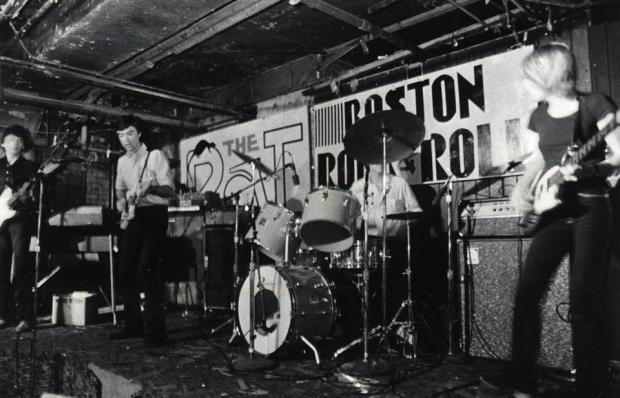
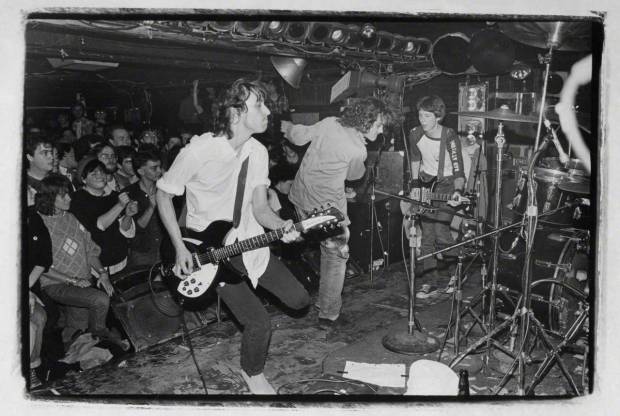
In its heyday, the Rathskeller club’s unassuming façade was tucked into a homely jumble of mis-matched stores, restaurants and nightspots in Boston’s Kenmore Square, where the tony Back Bay neighborhood met the Fenway district and Boston University. Once you crossed its perpetually darkened doorway you could head straight to the street level bar (and later, James Ryan’s popular Hoodoo Barbeque) or turn left and head down the stairs to the subterranean music room. Along with cigarette smoke and the vestigial smell of sweat and spilled beer, the dim interior featured black walls, overhanging water pipes, dodgy rest rooms, tilty tables and a low bandstand that was cheek-by-jowl with the narrow dance floor. From 1974 until it closed in 1997, the Rat (as it was universally known) featured untold hundreds of bands, from rock’s living legends to the lowliest also-ran punk combo. That means about 8000 nights of edgy good times where the music was more often than not delivered at fever pitch.
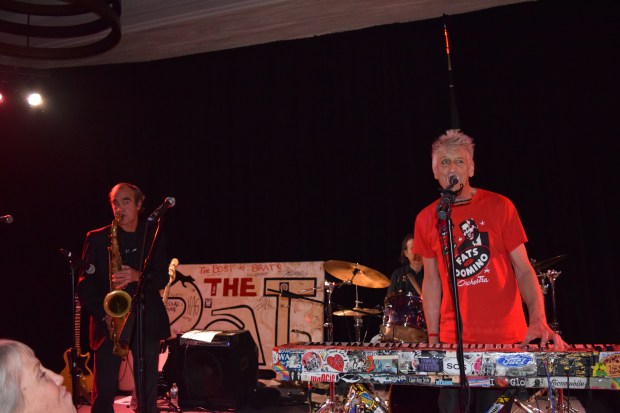
Twenty years to the month after it closed, a Rat reunion show and benefit auction event was held at Kenmore’s Hotel Commonwealth. The supportive vibe that owner Jim Harold provided over the years for so many local groups starting out was a common theme, as it is in the commemorative “Live at the Rat Suite” DVD (more on that in a bit). The event took place in the second floor function area of the hotel whose giant footprint looms over the space where the Rat once stood. On an evening where exclamations of “Long Live the Rat!” were heard more than a few times, this irony was noted by many of folks in attendance.
Willie Alexander and band in front of the Rat’s original backdrop sign. (Photo by author)
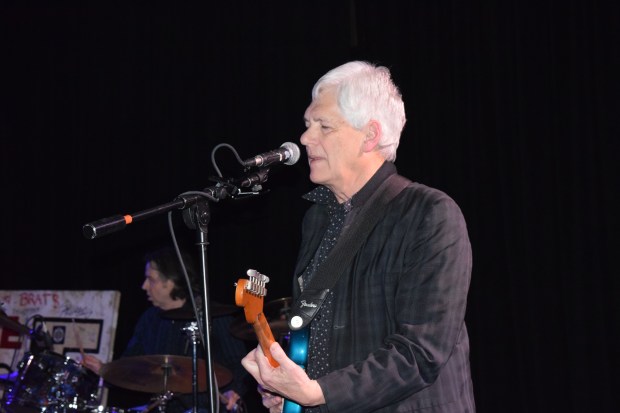
Performing that night were a handful of local rock mainstays. Willie “Loco” Alexander, a godfather of Boston punk since the days of his raucous Boom-Boom Band, kicked things off with a mini-set that included the anthemic “At the Rat.” This tune was the lead track of the 1976 compilation double live album of the same name, organized by Harold to promote the local scene (now re-mastered and available on CD). It proved as popular as ever, two decades after the joint was shuttered. “Thanks for being alive,” Willie said in parting. The Nervous Eaters, led by singer-guitarist-writer Steve Cataldo, are another local legend that came up in the Rat’s earlier days; their buzzsaw riffing and unbridled lyrics set the course for many groups that followed. Having long lived down the compromised album they made in 1980 for Elektra, the Eaters reverted to the tough-as-nails sound in subsequent recordings and gigs. Songs like “Last Chance” and “Loretta” are for many people as much of a Boston tradition as the Swan Boats and were welcomed accordingly.
Steve Cataldo (Photo by author)
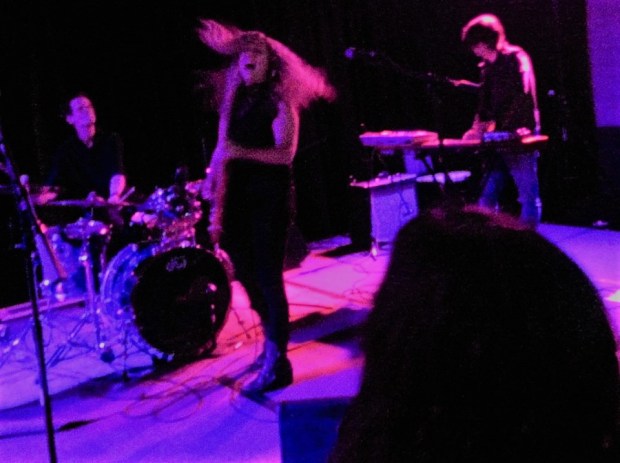
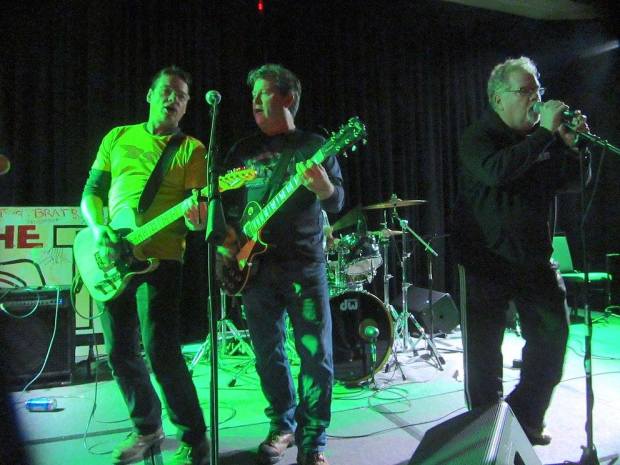
Emily Grogan and her band were of a later vintage than the two acts that preceded her and her impassioned songwriting and vocals were just as well received. Emily also told a touching anecdote about her early days when she was a bandmate of the late Mr. Butch, the beloved dreadlocked street person who was dubbed the “mayor of Kenmore Square.” Closing out the musical festivities were the Dogmatics. They were a prime example of groups that came into local renown in the mid-80s with a sound now twice re-generated since the 60s when garage-rock royalty Barry and the Remains played the Rathskeller when it was differently configured. Led by Jerry Lehane, the Dogmatics were a popular act not just for the Rat and the similarly downscale Chet’s Last Call, but also for the gig parties they’d have at their Thayer Street loft. At the Rat party they faithfully lived up to their legacy with the punked-up garage riffing and raffish townie humor of such nuggets as “Pussy Whipped” and the Catholic-school testimonial “Sister Serena.” They were joined by another Dorchester-bred favorite, Richie Parsons ex of Unnatural Axe, for a few numbers including the always reliable “Three Chord Rock.”
Emily Grogan (above) and the Dogmatics’ Peter O’Halloran and Jerry Lehane w/ Richie Parsons. Photos by Sara Billingsley.
The night ended sentimentally with a few words from Jim Harold as well as from former Del Fuegos drummer Woody Geissman whose Right Turn addiction treatment center was the charitable recipient of that evening’s fundraising. (I chatted with another Del Fuegos drummer, Joe Donnelly, but if either of the Zanes brothers were there I didn’t see them).
I moved to Boston shortly after the Blizzard of ’78, somehow getting my meager possessions from my hometown of Salem, Mass. to the Jamaica Plain neighborhood. I began checking out the notorious Rat as soon as the snow banks started to recede. In the last few months of the apartment me and my older sister shared with rotating cast of third bedroomers (we had moved back there, unimpressed with Ft. Lauderdale where our family had re-located) a few albums had circulated that changed my musical life. I had purchased “Talking Heads ‘77” and Television’s “Marquee Moon” pretty much on the strength of reviews (both were revelations) while a roommate owned the equally eye-opening “Rocket to Russia,” the Ramones third album. Elvis Costello’s debut record was also making the rounds. But the first time I ventured down into the occluded interior of the Rat it was a misfire: it seemed to be an open-amp night for suburban bands whose mountaintop was the first Pat Travers album—-it was like they wanted to send me back from whence I came.
The Talking Heads at the Rat in ’77. By the time I first saw them they had graduated to the Paradise club, which had a higher capacity but less exposed plumbing.
Determined to right this wrong, I went back a few nights later when the Romantics were headlining. These guys, in their pre-red shiny suits day, had a buzz about them esp. after getting a positive notice in Creem magazine’s recent review of the Detroit scene. After a couple of pumped-up power pop numbers (where most everyone stayed seated) the singer presumptuously suggested that this was the place “where all the dancing girls are at.” As soon as they launched into the next song, two sets of young ladies emerged from either end of the bandstand and met in the middle of the dance floor. It was like some vision from a half-remembered rock ‘n’ roll dream. The jig was on: soon after I was going to the Rat every weekend.
I say “half-remembered” because in its original form that what it was all about: the small venues, the dancing, the aspirational groups, the chance encounters. By the time I was old enough to go out to shows, rock music’s economy had changed. My early experiences ranged from the precipitous old Boston Garden down to the 2800-seat Orpheum Theater. But at the Rat (capacity about 300+), the close quarters meant the physical and physic space between performers and audience was reduced or overlapped. I saw dozens of great local groups in this hothouse atmosphere and many of them have remained highly-regarded here even though only a few acts “made it big.” This is evidence of the staying power of a community of outsiders, sort of like why you see Harley-riding guys of Social Security age still riding around in packs.
Do Go Back to Rockville: R.E.M. were one of the last of the really big names to play the Rat. Others who came before them included the Ramones, the Runaways, Talking Heads, the Replacements, the Jam, the Police, the Stranglers and the Boston-based Cars. And few who were there will ever forget the Plasmatics’ three-night stand in March of 1979. I deny all rumors that have my hand brushing Wendy O. William’s derriere moments after she put down her chainsaw at the end of their set.
“The Sound of Our Town,” to borrow the title of Brett Milano’s excellent history of Boston-bred pop music, is ably laid out in the “Live at the Rat” album. It was a dynamic scene that was second only to CBGB on the east coast. Willie Alexander is out front with three tracks, leading a line-up that includes frenetic rave-ups by mid-70s staples like the Infliktors and Thundertrain as well as a fistful of bands known for their distinctive front men: Jeff “Monoman” Conolly (of DMZ), John Felice (the Real Kids) and Richard Nolan (Third Rail). These outfits were definitely the type of the times—with razor-edge riffing that would often build to cathartic peaks that sent the kids on the dance floor into a pogoing frenzy. But the three of them were also savvy songwriters, as were people like Frank Rowe of the Classic Ruins, who Milano suggested was the Randy Newman of punk.
This was a direct result of Harold’s policy of giving a chance to most any band that played their own material—or at least it served to unlock a lot of latent talent. Many bands that came along a little later in the late 70s or early 80s (the Neighborhoods, La Peste, Human Sexual Response, Pastiche, etc.) turned out to have quite a knack at evoking the urban milieu of the times. And what was that like for those who weren’t there or whose memory is getting a little hazy at this point? The “Live at the Rat Suite” DVD, produced and directed by David Lefkowitz, does a good job at hashing out that side of the story in the interviews interspersed with the stripped-down performances in the Hotel Commonwealth suite festooned with the club’s memorabilia. Doing songs are the same performers from the Rat party plus John Felice, Robin Lane and the Chartbusters, Billie Connors and the good ol’ Dropkick Murphys (worthy youngsters 21CF cover La Peste’s “Spymaster”).
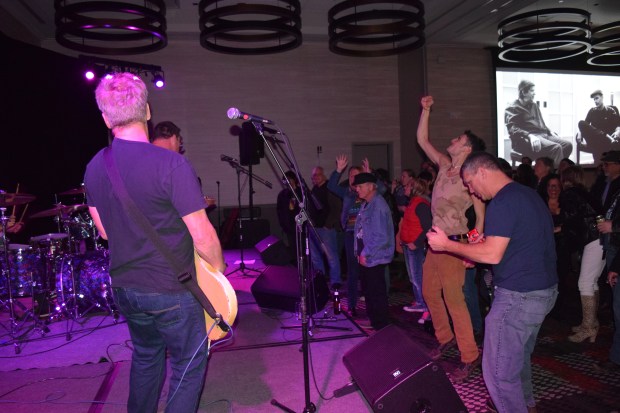
At the Rat reunion party, it was like old times in front of the stage. In the background, “Live at the Rat Suite” is projected on the wall (Brett Milano is interviewing Al Barr of the Dropkick Murphys). Photo by author
It’s great to hear your old faves in this cozy setting but also illuminating are the relaxed conversational segments, conducted by a trio of former Boston Globe music writers (Milano, Jim Sullivan and Steve Morse) along with local radio luminaries Oedipus, Carter Alan and John Laurenti. To Alexander, the supportive management and undemanding surroundings (“We were lucky if there was a door on the bathroom,” notes Willie) left a space that was a focal point where a scene could grow on its own. He says the kids, you know the artsy and non-conformist types you see in most every town, found a place of their own and a symbiotic relationship with the new bands that continues to this day. But while it may have been our clubhouse it was not the excluding type: also in the mix were adventurous suburbanites, post-game Red Sox fans and B.U. students.
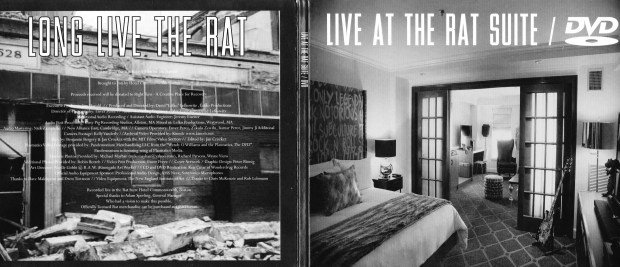
The back cover of the DVD shows the partially-demolished Rat, while the front shows the well-meaning Rat-themed suite where you can have an “authentic experience” for several hundred dollars a night.
Ah, yes: Boston University. That’s where our story starts to fall apart. The school was always a convenient whipping boy for hometown rockers, ever since Jonathan Richman, in the early proto-punk days of the Modern Lovers, told his girlfriend to “Put down your cigarette and drop out of B.U.” But the ever-growing institution, under the presidency of the irascible John Silber, bought up large chunks of the Kenmore district. The eventual eviction of unwanted elements, whether it be leather-jacketed rock ‘n’ rollers or the hodgepodge collection of mid-century business, was almost an afterthought to the manifest destiny of outsized colleges, block-long hotels and chain stores (a similar fate has befallen Harvard Square).
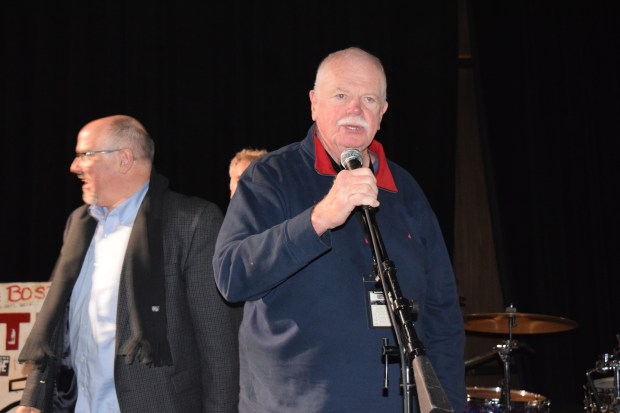
Rat owner Jim Harold with some parting words and (on the left) Woody Geissman, whose Right Turn treatment center (“A Creative Place for Recovery”) specializes in the substance abuse issues of performing artists. Photo by author
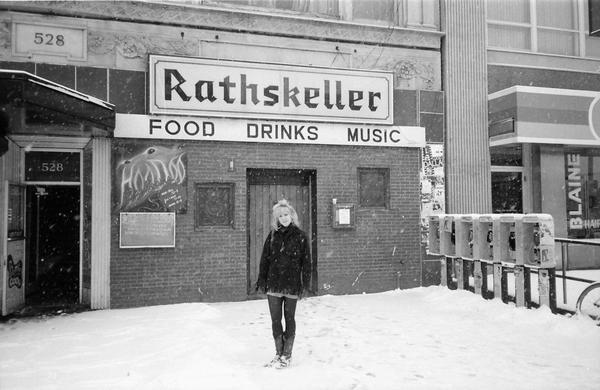
In the photo at the top of this article, local musician Linda Viens stands in front of the Rathskeller, a quiet moment on a snowy day. A tip of the cap to Wikipedia for making this simple but remarkable shot by Wayne Valdez the featured image for their article on the club. All the loud music and edginess have fallen away, and the Rat’s tiny frontage is squished between a vintage clothing shop, a hairdressing school and the pre-Internet bank of pay phones. Viens’ casual pose suggests a kinship (even protectiveness) with her town’s most famous rock club. But not ownership. There’s less of a place nowadays for a “bon vivant” right-place-right-time proprietor like Jim Harold, who had the knack to know when to let something just happen. And boy did it ever. In the 21st century, the Boston rock scene has moved to nearby cities like Cambridge and Somerville where a vibrant blend of veteran bands and newer acts light up venues like the ONCE Ballroom. (I recently wrote about Linda’s new band Kingdom of Love and that abiding sense of musical community here). It’s the idea of the Rat that lives once the wrecking ball has cleared the way for the monolithic streetscapes of today’s gentrified cities. We plant the flag elsewhere and rock on.
Video by John Doherty
My new book Rock Docs: A Fifty-Year Cinematic Journey is the first anthology of non-fiction rock films, covering the years 1964-2014. To see a 30-page excerpt click on the link here or contact me thru the comments section below. http://booklocker.com/books/8905.html
Over the last half century, music documentaries have provided us with a priceless moving-image history of rock ‘n’ roll. “Rock Docs: A Fifty-Year Cinematic Journey” is a first-of-its-kind anthology of the rockumentary genre, viewing pop music’s timeline from 1964-2014 through the prism of non-fiction film. Since its earliest days, the look of rock ‘n’ roll has been integral to its overall appeal. My book reviews over 150 films, starting with a ground level look at the Beatles’ world-changing first visit to America and coming full circle fifty years later with “Good Ol’ Freda”, where the Fab Four’s secretary looks back through the years as both a fan and an insider. In between, readers will find many films to re-experience or discover for the first time. For book excerpts, check my “Rock Docs book sampler” category.
For a limited time, I am offering “Rock Docs” for only $12 per copy (w/ free shipping within the US) when ordered directly through me. Please order soon if you would like to receive in time for the holidays! Thanks, Rick Ouellette
In Part Two: When September rolls around, our four heroes become quick friends. But the hazy tranquility of post-hippie high school life in Wilsontown is shattered when they have to deal with an early-onset case of Trumpism. April decides she has to take matters into her own hands. This time it’s personal….
Part Two will appear in the full 24-page printed comic. Please note that anyone out there who has purchased my book “Rock Docs: A Fifty-Year Cinematic Journey” and would be willing to write a short Amazon review of it, will get sent a free copy. (Just let me know when it’s up). If you would like to purchase “Rock Docs” directly through me, I will throw in a copy of the comic as well. Just $18 for both and that includes shipping within the U.S. If interested, leave a comment or email me.
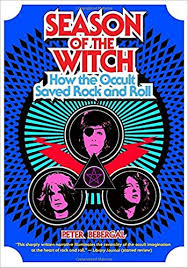
Season of the Witch: How the Occult Saved Rock and Roll
By Peter Bebergal—2014—229 pages—J. Tarcher/Penguin Books
What would you think of first if someone asked you to give a quick example of the union between pop music and the occult? Maybe you’d mention a choice Black Sabbath track like “Children of the Grave,” or recollect an Alice Cooper stage show from high school days or perhaps a death metal show for those of younger vintage. Some of you would quickly counter that naming one example is merely scratching the surface. In his new book Season of the Witch, author Peter Bebergal makes the case that the ”occult imagination” is in fact central to the appeal and success of rock music, and may be its very lifeblood.
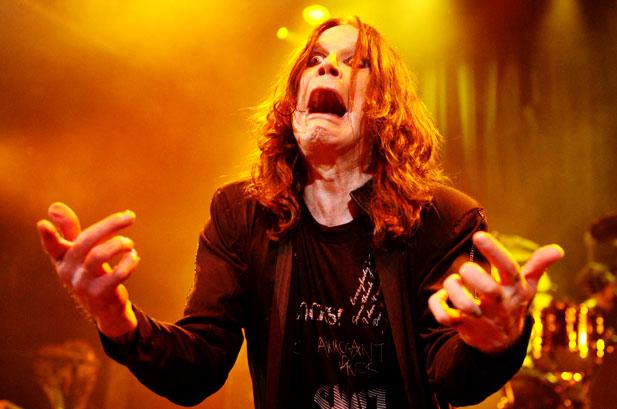
Ozzy says: “I got your occult imagination, right here!”
Early chapters of this intriguing and informative (if occasionally meandering) book traces this influence back to European and American artistic/spiritual movements while also telescoping back to the pre-slave-trade African traditions that would give birth to gospel music and the blues. Bebergal very ably dissects the surprisingly close connections between the sacred and profane that passed into the culture of the American South. “Rock’s origins are in the blues and folk,” he writes, “forms of music deeply ingrained with Christian traditions and values, but whose own roots grew in the soil where other gods were worshipped.” Although he notes that modern Christianity tried to “seal off” these more ancient impulses, they always remained to some extent (speaking in tongues, ring shouts) and this ambivalence shows in the life and careers of early rock ‘n’ roll pioneers like Little Richard and Jerry Lee Lewis. But the influence of the occult (defined broadly as supernatural beliefs and the pursuit of esoteric knowledge) with its rebellious and unorthodox nature was a natural when this new music came along with the ascendance of youth culture in the Fifties.
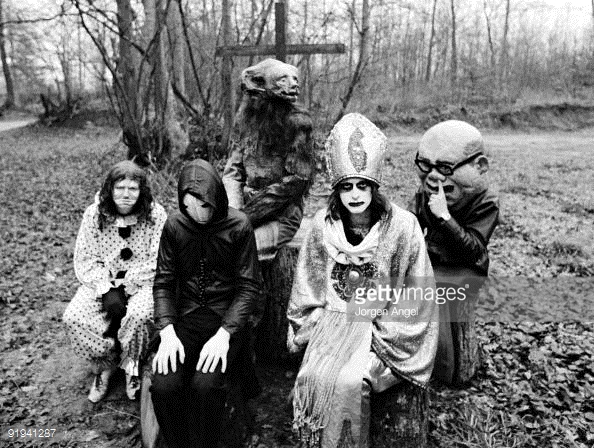
Arthur Brown, after his god-of-hellfire days, formed Kingdom Come, seen here waiting on some hobgoblin action.
In fact, as Bebergal points out, early efforts by parents and ministers to stymie this new music likely backfired in the worst way. “Intentions to stop the music in its tracks instead started a conflagration that has never gone out,” he writes and indeed the relative innocence of those early years was superseded by the influence of the Beat writers, Aleister Crowley, Eastern spiritualism, and of course LSD. Through the likes of Pink Floyd, the Stones, the Beatles (in the post-“Revolver”/Maharishi era), Arthur Brown, Hawkwind, David Bowie, Sabbath, Sun Ra, Yes, Led Zeppelin and many others, “rock created a mythos around itself suggesting it was somehow heir to secret wisdom.” All of these case histories are given a good airing out without (usually) getting lurid. The author is clear-eyed about his subject, noting the negative side effects (drug abuse, cults) but also endorsing its role in affecting personal empowerment and acting as a counterweight to lockstep establishment thinking.
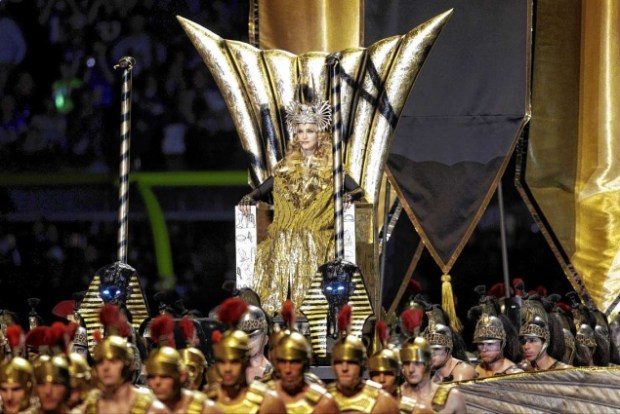
Madonna at the 2012 Super Bowl halftime show, with her carefully-coded performance announcing the imminent takeover of the world by the Illuminati. And here’s me thinking it was just egomania.
Season of the Witch is a fine addition to the ever-growing canon of rock literature. Granted it’s not perfect: with so many artists to cover, some of Bebergals’ insights may sound a bit second-hand to devotees of a particular group. A few things are just wrong (Alice Cooper was not the name of an accused witch burned in 17th century Salem; besides they were hanged). But he does wrap it up nicely, moving the timeline up into this century, noting Jay-Z’s free-associating use of Freemason imagery in his videos and Madonna’s over-the-top halftime show at the 2012 Super Bowl, replete with pompous pageantry based on the kind Egyptian and Kabbalistic iconography that sent New World Order conspiracy theorists into a tizzy. But let’s put aside those vain one-per centers and remember that the magic in music can inspire people to a higher spiritual plain that will benefit us all in the end.
(If you like Books That Rock, please check out my tome Rock Docs: A Fifty-Year Cinematic Journey by clicking on the link below. A 30-page is available there, so try you can try-before-you-buy. Thanks, Rick Ouellette) http://booklocker.com/books/8905.html